
One Rep Max Calculator
Calculate your maximum strength potential using proven formulas. Train smarter, lift heavier, get stronger.
One Rep Max Calculator: Estimate Your 1RM for Bench, Squat, Deadlift (and more)
Quick start: get a 1RM estimate in 30 seconds
You don’t need to test a true max to train like you know it. This one rep max calculator lets you estimate your 1RM (one rep max) from a submax set using your weight, reps, and a chosen formula (like Epley or Brzycki). It’s a simple way to get accurate results for strength training, then turn that number into usable percentages for your next workout.
What you’ll need (weight, reps, and your lift choice)
- Pick an exercise: bench press, squat, deadlift, overhead press, dips, pull-ups, and more
- Enter the load (kg or lb) and how many repetitions you hit with clean form
- Choose a formula, or compare multiple formulas if you want a wider view
Tip from real gym practice: a tough set in the 2–10 rep range usually gives the most useful estimates.
What you’ll see (estimated one rep max, percentages, and options)
- Your estimated maximum for that lift (1RM)
- A percentage table you can use for training weights and programming
- Options to switch formulas, reset, and rerun the numbers fast
Safety note: if your form breaks down, you feel sharp pain, or your reps turn into a grindy mess, stop the set and estimate from a cleaner effort.
What a 1RM is (and why lifters still use it)
A one-repetition maximum (1RM) is the heaviest weight you can lift for one clean, complete repetition with solid proper form. It’s a snapshot of maximal strength for a specific exercise like the bench press, squat, or deadlift. You can get those number two ways: direct measurement (testing a true single) or estimation methods (using a submax set and a rep max calculator). Most people estimate because it’s faster, safer, and still accurate enough for planning.
1RM vs rep max
A 1RM is one single rep at your max. A rep max is the most you can do for a chosen rep count (like a tough set of 5). A rep max calculator uses that rep max to predict your one-rep max. The goal is the same: a useful number you can train from, without guessing.
Why 1RM matters for programming
A good 1RM estimate turns into clear percentages for your workouts and programs. Example: if your bench 1RM estimate is 100 kg, training at 80% gives you 80 kg. Coaches and lifters use that for strength blocks, hypertrophy work, or peaking—because it keeps loads consistent as you progress.
Safety basics for testing vs estimating
True max attempts demand sharp technique, smart warm-ups, and real rest between heavy singles. Estimating is simpler, but it still needs proper technique. Use a set that’s challenging without turning into a form breakdown, rest enough to perform well, and treat the calculator’s prediction as a tool—not a dare.
Are one-rep max calculators accurate?
A one rep max calculator can be very useful, but it’s still an estimate. The closer your set looks like a strong, repeatable lift in normal training, the closer the prediction tends to land. When the set is messy—sloppy depth on squats, bouncing a bench press, hitching a deadlift—the number becomes more of a “ceiling guess” than a reliable training anchor.
Best rep ranges for reliable estimates (2–10 reps; why “many reps” gets noisy)
Most lifters get the most consistent accuracy when they use 2–10repetitions. In that zone, the set is still strength-dominant, and your technique usually stays stable. Once you push into many reps (think 12–20), endurance and pacing take over. Your breathing, grip, and burn tolerance start to limit the set, and the calculator is forced to predict maximal strength from a workout that wasn’t really about maximal strength. That’s where estimates drift.
What changes accuracy: technique, tempo, rest, and fatigue
Four big variables shift results:
- Technique: small form leaks change leverage and bar path
- Tempo: fast reps vs slow grinders aren’t the same “rep.”
- Rest: Short rest can cap reps before strength is the limiter
- Fatigue: hard sets after a long session often underpredict your true max
Experience level matters too. Beginners usually see more noise because their form is still changing week to week.
Why different formulas disagree (and how to interpret spread)
Different formulas “expect” different strength-endurance patterns, so they won’t always match—especially at higher reps. A smart way to read results is to compare multiple formulas and watch the spread. If they cluster closely, your estimate is likely stable. If they’re far apart, treat it as a range, then train off the middle and refine over time.
The formulas inside this one rep max calculator
A 1RM calculator is only as good as the estimation methods behind it. That’s why this tool supports multiple formulas instead of forcing one “magic” answer. Different lifters have different strength-endurance patterns, and different lifts (bench, squat, deadlift) can behave differently once reps climb.
Here’s what’s included, with the equations written out so you can see exactly what the calculator is doing.
Epley formula (overview)
Equation: 1RM = w × (1 + r/30)
Example: w=100, r=5 → 1RM = 100 × (1 + 5/30) = 116.7
Brzycki formula (overview)
Equation: 1RM = w × 36 / (37 − r)
Example: w=100, r=5 → 1RM = 100 × 36 / 32 = 112.5
Lombardi, O’Conner, Wathen, Mayhew, Landers (overview block)
- Lombardi: 1RM = w × r^0.10
- O’Conner: 1RM = w × (1 + 0.025 × r)
- Wathen: 1RM = (100 × w) / (48.8 + 53.8 × e^(−0.075 × r))
- Mayhew: 1RM = (100 × w) / (52.2 + 41.9 × e^(−0.055 × r))
- Landers: 1RM = (100 × w) / (101.3 − 2.67123 × r)
Comparison table
| Formula | Best rep range | Tends to over/under | Notes |
|---|---|---|---|
| Epley | 1–10 | Can run high at higher reps | Simple, popular default |
| Brzycki | 1–10 | Can run high as reps climb | Strong for lower-rep prediction |
| Lombardi | 1–12 | Often conservative at low reps | Smooth curve, easy to compare |
| O’Conner | 1–10 | Slightly conservative vs Epley | Quick estimate option |
| Wathen | 1–10 | Can be optimistic at higher reps | Curve-fit style estimator |
| Mayhew | 1–10 | Often moderate; bench-friendly | Commonly used in bench contexts |
| Landers | 1–10 | Usually mid-pack | Built from a %1RM style model |
Which formula should you choose?
If you want a single number fast, pick Epley or Brzycki and stay in a clean rep range. If you want more confidence, use Show all formulas and treat the spread as useful feedback. For most training decisions, the consensus estimate (median) is a solid middle-ground you can base percentages, workouts, and programs on without chasing a perfect number.
How to use the calculator step by step
This one rep max calculator is built so a beginner can get a clean estimate fast, while a coach can dig into the numbers without jumping between tools.
Step 1: pick your lift (bench press, squat, deadlift, overhead press, dips, etc.)
Start by selecting the exercise you actually performed. The lift choice matters because it controls the input style.
Input types you’ll see:
- Barbell lifts (bench press, squat, deadlift, overhead press): enter the total bar weight you used
- Machines (leg press, leg extension): enter the loaded weight shown on the stack/sled
- Dumbbells (dumbbell bench/press/curls): choose “per dumbbell” or “total load” so your numbers don’t get doubled by mistake
- Bodyweight + added load (weighted dips, weighted pull-ups): enter your body weight and the extra weight, and the calculator totals it for the estimate
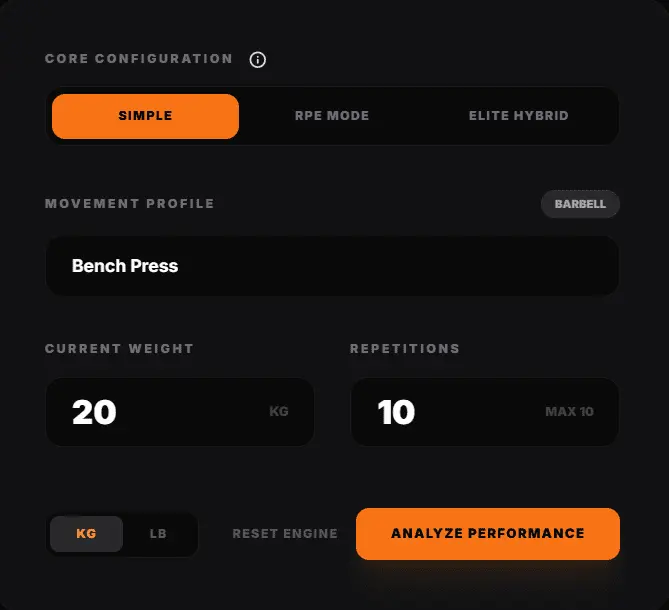
Step 2: Enter weight and reps
Type in the weight and the number of repetitions you completed with consistent form. For the most stable prediction, use a set that’s challenging but controlled.
A “clean” estimating set usually looks like this:
- you could do maybe 1 more rep if you had to
- your range of motion stays the same from first rep to last rep
- your bar path and tempo don’t fall apart at the end
If the set turns into a slow, ugly grind, it can inflate or distort the estimate—especially on compound lifts like the squat and deadlift.
Step 3: Choose your formula (or run all formulas)
Pick a single formula if you want one fast number. Use “all formulas” if you want a comparison spread and a more coach-style view.
Step 4: Calculate, review, reset
Hit Calculate to see your estimated 1RM plus training percentages. Change reps, weight, or formula to compare results. Use Reset to clear everything and run a fresh estimate for a different lift.
Advanced features for lifters and coaches
Most 1RM calculators stop after they spit out a number. This tool treats your estimate as the starting point for real training decisions—work weights, warm-ups, and better repeatability.
Feature snapshot
- Rep-based 1RM estimates using multiple formulas
- Optional RPE/RIR estimate for days when reps don’t tell the full story
- Warm-up set generator based on your estimated max
- Training percentage table (70–90% and beyond) with plate-friendly rounding
- Fast kg ↔ lb conversion (no extra steps)
- Lightweight PDF export (under 10KB) + print-friendly layout
Who this helps
- Beginner: turns “I’m guessing” into a simple plan you can repeat each week
- Intermediate: keeps progress honest across bench, squat, deadlift, and accessory lifts
- Coach / advanced lifter: compare formulas, track spread, and use RPE when needed
RPE-based 1RM estimation (RPE/RIR option)
Sometimes your reps don’t reflect your true strength on that day. Maybe you slept badly, your grip is fried, or the set was taken with a strict tempo. RPE (rate of perceived exertion) and RIR (reps in reserve) give you another way to estimate 1RM using how close the set was to failure.
When RPE helps
- when your rep count is low but the effort is high
- when you’re managing fatigue across hard training blocks
- when you want a quick “today’s strength” check without maxing
When it doesn’t
- if you’re new and can’t rate effort consistently yet
- if form breaks early (then the rating is mostly “how ugly it felt”)
Warm-up sets based on your estimated 1RM
The warm-up calculator builds warm-up lifts from your estimated max so you arrive at working weight ready, not rushed.
- General warm-up style: gradual jumps, more reps early, fewer reps late
- Powerlifting-style: fewer total reps, more specific heavier singles before work sets
Training percentage table (70–90% and beyond)
Once you have a 1RM estimate, the tool shows working weights at common percentages for strength training, hypertrophy blocks, or peaking.
Rounding rules
Choose plate-friendly rounding so the numbers match real loading: nearest 0.5/1/2.5 kg or 1/2.5/5 lb.
kg ↔ lb conversion (fast, no friction)
Switch units anytime without retyping. Your inputs, results, and percentage table update together.
Lightweight PDF export (under 10KB)
Export a clean, text-only PDF that includes your exercise, units, inputs (weight/reps and bodyweight if used), selected formula (or “all formulas”), and your 1RM results plus key percentages. If you prefer, the print view is also formatted to save cleanly as a browser “Print to PDF.”
One Rep Max Calculator Bench: Bench press 1RM estimates that actually match the lift
Bench press numbers get weird fast when the reps aren’t consistent. If you want a bench 1RM estimate that lines up with what you can actually press, the set you choose matters as much as the formula.
Bench press technique checkpoints (setup, bar path, pause/tempo)
Start with a repeatable setup: feet planted, upper back tight, shoulder blades pulled down and back, and a stable touch point on your chest. Keep the barbell moving in a controlled path—down to the same spot, then up without drifting forward. Tempo matters too. A smooth rep with a brief pause reads very differently than a fast bounce-and-go set.
Common variations
- Touch-and-go: higher rep potential, can inflate estimates if bounce creeps in
- Paused bench: usually lower reps at a given weight, often gives cleaner accuracy
- Incline bench: different leverage; treat it like its own lift
- Dumbbell bench: make sure you know if the input is per dumbbell or total load
Mistakes that inflate your estimate
- Bouncing the bar off your chest
- Cutting range of motion (half ROM)
- Losing tightness (hips shifting, shoulders rolling forward)
- Counting a shaky rep that would never pass your own standards
Example: weight × reps → estimated 1RM → working sets
Let’s say you bench 80 kg for 6 reps with clean form. Your calculator estimate might land around 94–96 kg depending on the formula. If you’re training strength, 80% of that estimate puts your work sets around 75–77.5 kg. For hypertrophy, you might live closer to 70–75%, keep reps higher, and manage rest so the last reps stay crisp. Use the estimate as a guide, then update it as your reps or weight climb—progressive overload works best when your numbers stay honest.
One Rep Max Calculator Squat: Back Squat and Front Squat Estimates (without guessing)
Squat estimates fall apart when depth changes from rep to rep. If you want your squat 1RM to mean something in training, keep the movement standard the same every time you test or estimate it.
Back squat form checklist (brace, depth, bar position)
Use this quick checklist before you trust any squat number:
- Brace: big breath into your torso, ribs stacked, and tension through the midsection before you descend
- Bar position: keep it consistent (high bar vs low bar changes leverage, so treat them as different lifts)
- Depth/ROM: hit the same depth every rep, not “deep early, shallow late”
- Foot pressure: balanced over midfoot, no collapsing into toes
- Tempo: controlled down, stable turnaround, strong drive up
Front squat notes (what changes in the estimate)
Front squats often feel “harder” at lower weights because the upright torso and rack position demand more upper-back and core stability. That doesn’t mean your legs are weaker; it means the limiting factor can shift. For estimation, standard rep max formulas still apply, but your best “clean set” might be fewer reps than back squats because form breaks sooner when the rack starts to slip.
Common errors that skew squat estimates
- Taking high reps to failure and letting depth drift
- Turning the last reps into a good-morning pattern (hips shoot up, chest drops)
- Using a set after heavy deadlifts or long workouts when fatigue carryover is high
- Rushing rest so the rep count becomes a conditioning test, not a strength test
Example + how to program from it
If you back squat 120 kg for 5 reps with consistent depth, your estimated one rep max will usually land in a tight range. From there, a strength block might use 80–85% for lower reps and longer rest. For hypertrophy, you can live closer to 65–75%, keep reps higher, and manage fatigue so each set still looks like a real barbell squat. Track your estimate over time. A steady climb is a strong signal your strength level is moving in the right direction.
Deadlift one rep max calculator: Conventional, sumo, trap bar, and RDL
Deadlift estimates can feel “off” if you treat the lift like a high-rep bench press. A heavy hinge taxes more than your back and legs. Grip, bracing, and total-body fatigue climb fast, so rep performance doesn’t scale as smoothly as it does in presses.
Why reps behave differently in deadlifts vs presses
On a bench press, you can often keep the same bar path and pace for several reps. In deadlifts, the first rep is usually the cleanest. Reps two through eight can turn into small changes in position—hips drifting, bar moving away from the body, or your breath pattern collapsing. That’s one reason deadlift predictions can swing more when you use many repetitions. A crisp set of 2–6 reps is usually easier to interpret than a set of 12 that turns into a conditioning grind.
Conventional vs sumo (what changes, what doesn’t)
Both are deadlifts, but they’re different patterns. Conventional tends to demand more from the posterior chain and back position. Sumo shortens the range of motion for many lifters and shifts emphasis toward hips and adductors. The calculator formulas still work, but treat them as separate lifts for tracking. Your sumo 1RM estimate doesn’t automatically “convert” to your conventional 1RM, and the reverse is true too.
Trap bar / hex bar and why it can skew comparisons
Trap bar deadlifts often let you stay more upright and move more load for reps because the center of mass is different. That’s great for training, but it can make comparisons misleading. A trap bar 1RM estimate isn’t a clean stand-in for a straight-bar deadlift max.
Romanian deadlift (RDL) as a related but different “max”
An RDL is a hinge with a controlled eccentric and a deliberate stop point (hamstring stretch). The limiting factor is often positioning and hamstring tolerance, not a floor pull. Use the calculator to estimate an RDL “rep max,” but don’t treat it like your deadlift 1RM.
Mistakes and risk points
- Bounce reps off the floor or touch-and-go pulls that change start position
- Lockout standards drifting (soft knees, no full hip extension)
- Rounding that increases reps but raises injury risk
- Using a fatigued set after heavy squats and expecting accuracy
Programming off a deadlift 1RM
Deadlifts respond well to clear percentages and plenty of rest. Strength work often sits around 75–90% with lower reps and longer breaks. For volume, reduce the percentage and keep reps clean—deadlifts reward quality more than grind.
Other Lifts This Calculator Supports (and how inputs work)
Bench, squat, and deadlift are the big three, but a good 1RM calculator should handle the lifts you actually train week to week. The key is using the right input rules so your estimate matches the real load your body moved.
Input rules by lift category
- Barbell lifts (total load): overhead press / military press, barbell curl, hip thrust
Enter the full weight on the bar. Reps should be clean and consistent. - Dumbbells (per-hand or total): dumbbell bench/press/curls
Choose whether you’re entering weight per dumbbell or total load. That prevents the common mistake of accidentally doubling the weight. - Machines (listed load): leg press, leg extension
Use the weight shown on the stack or sled. Machines vary, so keep range of motion consistent if you want repeatable estimates. - Bodyweight + added load: weighted dips, weighted pull-ups
Enter your bodyweight plus the weight you add (belt, vest, dumbbell). The calculator combines them into one number for the rep max estimate.
Overhead press / military press
The press punishes loose technique. Small form changes—leaning back, cutting lockout, bouncing off the shoulders—can boost reps and inflate the 1RM prediction. Use a strict set with a steady bar path and full lockout for accuracy.
Weighted dips and weighted pull-ups
These are bodyweight lifts with external load, so the total matters. If you weigh 80 kg and add 20 kg, the “lifted” load is 100 kg for the estimate. Keep reps controlled and consistent to avoid turning it into a swing or bounce.
Leg press and leg extension
Machines aren’t standardized. A 300 lb leg press on one machine can feel like 240 lb on another because of sled angle and friction. That’s fine—just treat it as a machine-specific strength level and keep your depth and tempo the same every time.
Curls (isolation exercises vs compound movements)
Curls are isolation exercises. Reps can get sloppy fast with body swing. If you want a useful estimate, lock in your body position and count only strict repetitions.
Hip thrust
Hip thrust max work is often limited by positioning and pause control at the top. Use a consistent lockout and a brief hold so your rep max doesn’t turn into partial reps.
Power clean
For olympic lifts like the power clean, rep caps should be lower. Once fatigue hits, speed and timing drop, and technique can break down. A clean set of 1–3 reps usually gives the best estimate and keeps risk down—especially for CrossFit-style workouts.
How to use your estimated 1RM in training (without turning it into ego math)
A 1RM estimate is useful because it turns “today’s best guess” into clear percentages you can program. The trap is treating it like a trophy number. Your body doesn’t care about the calculator result. It responds to consistent training, smart fatigue management, and steady progressive overload.
Here’s a simple way to use your estimated one rep max for different goals: