
One Rep Max Basics
Percentage-based strength programs reference your one rep max from the first page — 80% of 1RM, 90% of training max, work up to a heavy single. But most programs don’t explain what 1RM actually means, how to find yours without risking injury, or why two calculators can give you different numbers from the same set. This guide covers all of it: what a one rep max is, how to calculate and test it, which formula to use, and how the number connects to everything you do in the gym.
What’s in This Guide
- What Is a One Rep Max?
- How to Calculate Your 1RM
- How to Test Your One Rep Max Safely
- Epley vs Brzycki: Which Formula Should You Use?
- Why Your 1RM Matters in Strength Training
- Is 1RM Testing Safe for Beginners?
- Rep Max Equivalency: What Your 1RM Tells You About Other Rep Ranges
- How Accurate Are 1RM Calculators?
- How to Use the 1RM Calculator
Articles in This Series
- What Is 1RM?
- How to Calculate Your 1RM
- How to Test Your One Rep Max Safely
- Epley vs Brzycki Formulas
- Why Your 1RM Matters
- 1RM for Beginners
- Rep Max Equivalency
- How Accurate Are 1RM Calculators?
What Is a One Rep Max?
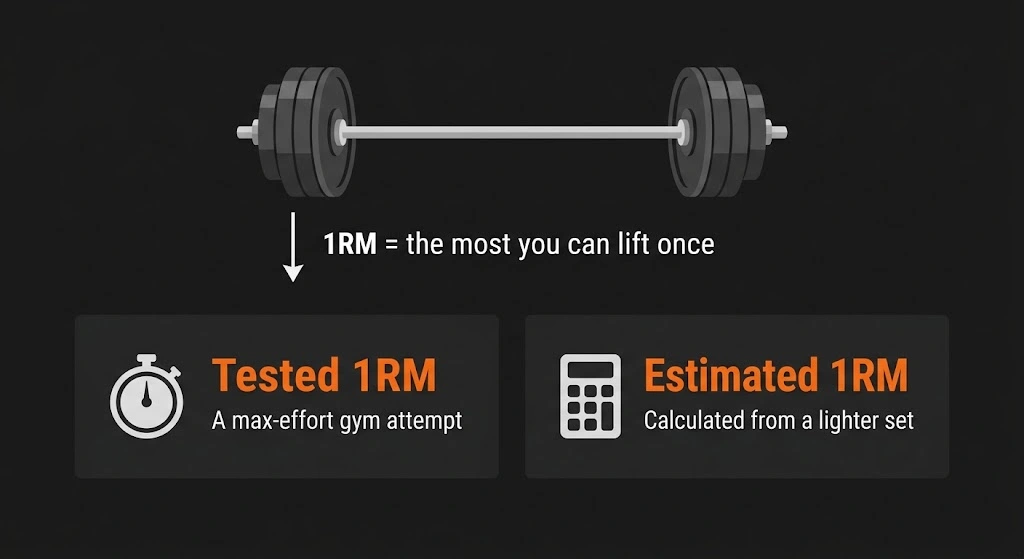
A one rep max (1RM) is the maximum weight you can lift once with correct form and full range of motion on a given exercise. That’s the definition — but the number shows up in two different ways in real training.
A tested 1RM is found through a direct max attempt: you add weight until you reach the heaviest single rep you can complete under control. An estimated 1RM is what a calculator produces when you enter a submaximal set — a weight you lifted for multiple reps — and apply a formula to project where your maximum is likely to be.
Both are valid. Neither is perfect. The tested version is more accurate when the attempt is well-executed and properly set up; the estimated version is safer, faster to repeat, and doesn’t require lifting to an absolute limit. Most lifters use an estimated 1RM for day-to-day programming and test their true maximum only occasionally — typically at the end of a training block or before a competition.
One rep max figures apply primarily to barbell compound movements: squat, bench press, deadlift, overhead press, barbell row, and similar exercises where a maximum single-rep effort can be measured and repeated under consistent conditions.
→ For the full explanation of what 1RM means, where the number comes from, and how it applies across training styles: What Is One Rep Max (1RM)?
How to Calculate Your 1RM
You don’t need to attempt a true max to get a working 1RM number. Estimation formulas let you project your maximum from a submaximal set — a weight you can lift for multiple reps at high effort without going to absolute failure.
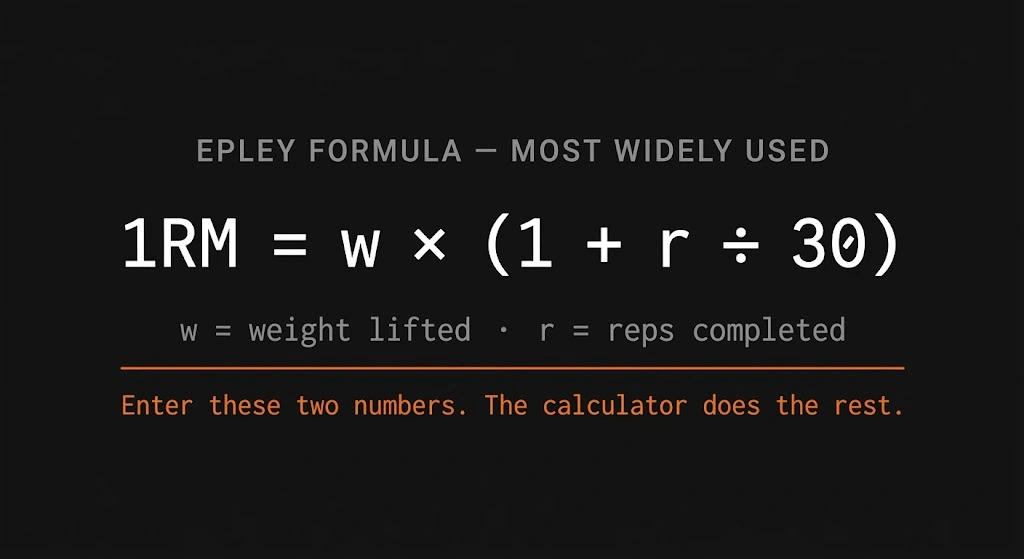
The most widely used formula is the Epley formula: 1RM = weight × (1 + reps ÷ 30). In plain English: multiply the weight you lifted by one plus your rep count divided by thirty. If you squatted 100 kg for 5 clean reps, Epley estimates your 1RM at 100 × (1 + 5/30) = 116.7 kg.
The result is an estimate, not a certified maximum. All formulas assume clean reps performed at genuine maximal effort for that rep count. If your set had form breakdown, or the reps felt controlled rather than genuinely hard, the estimate will be skewed in either direction.
This site’s calculator runs all seven formulas simultaneously — Epley, Brzycki, Lander, Lombardi, Mayhew, O’Conner, and Wathan — and returns every result at once so you can see where they agree and where they diverge. Agreement across multiple formulas is a stronger signal than any single result.
→ For a complete breakdown of every formula, how they compare across rep ranges, and which tends to be most accurate for each lift: How to Calculate Your One Rep Max
How to Test Your One Rep Max Safely
Choosing to test a true 1RM rather than estimate one is a deliberate decision that carries real risk when approached carelessly. Before a max attempt, three things need to be in place: a minimum training base of at least 3–6 months of consistent lifting on the specific exercise, a structured warm-up and ramp-up protocol that builds to a heavy single without pre-fatiguing the muscles, and physical safeguards — a spotter for bench press and squat, safety pins set at the correct bail height, and collars on the bar.
The test itself follows a structured escalation. You start with light sets to prime the movement pattern, then work through progressively heavier sets that approach your target without draining capacity for the actual attempt. Each ramp-up set should feel like it leaves significantly more in reserve than the previous one. If a set feels like a grind, you’ve gone too heavy too early.
Know your stop signals: sharp joint pain, visible technique breakdown past your normal threshold, or lightheadedness from a heavy Valsalva brace all warrant stopping the session. A missed attempt due to technical failure carries a higher injury risk than a successful attempt, and the recovery cost of a failed max single is not zero.
→ For the full step-by-step protocol with exact ramp-up sets, attempt selection, rest intervals, and what to do after a missed lift: How to Test Your One Rep Max Safely
Epley vs Brzycki: Which Formula Should You Use?
The Epley and Brzycki formulas are the two most common 1RM estimation methods. For most input sets they produce similar results — but the gap between them grows as rep count increases, and that divergence matters when you’re programming off the number.
At low rep counts (1–5), the two formulas track closely. At 10+ reps, Brzycki tends to produce a lower estimate than Epley because it applies a more conservative rep-to-max ratio at higher fatigue levels. Neither is universally more accurate — they were developed from different research populations, and individual fatigue responses vary enough that no single formula fits every lifter on every lift.
| Input Set | Epley 1RM | Brzycki 1RM |
|---|---|---|
| 100 kg × 5 reps | 116.7 kg | 116.3 kg |
| 100 kg × 10 reps | 133.3 kg | 130.6 kg |
| 100 kg × 12 reps | 140.0 kg | 136.4 kg |
The practical rule: treat any two formula outputs as a range, not a single answer. If Epley and Brzycki agree closely, the estimate is reliable. If they diverge significantly, test with a heavier, lower-rep set before building a training block off the number.
→ For the complete comparison of all seven calculator formulas, accuracy by lift type, and when each tends to over- or underestimate: Epley vs Brzycki Formula Comparison
Why Your 1RM Matters in Strength Training
Every percentage-based strength program uses 1RM as its reference point. When a program prescribes “4 sets of 5 at 80%” or “work up to 85% for a heavy single,” those percentages are anchored to your estimated or tested 1RM. Without a current, reasonably accurate number on record, those percentages are guesswork dressed up as precision.
Load prescription. Your 1RM tells you what the weights on the bar should actually be on each training day. Programs specify intensity zones — heavy, moderate, lighter — through percentages, and the 1RM is what makes those zones meaningful and repeatable week to week.
Progress tracking. An improving 1RM — or improving submaximal performance from the same input set — is objective evidence that training is working. Without a reference point, “I feel stronger” is difficult to verify, act on, or compare across training blocks.
Strength benchmarking. Your 1RM lets you compare your performance against published strength standards by body weight and training age — a practical reference for setting realistic goals and identifying which lifts are lagging relative to your overall development.
A training max — typically 90% of your 1RM — is often used as the programming anchor rather than the true max, building in a recovery buffer that keeps weekly training loads sustainable across longer blocks without requiring a true max effort every few weeks.
Is 1RM Testing Safe for Beginners?
Most beginners should not attempt a true 1RM test until they have at least 3–6 months of consistent barbell training on the specific lift. The reason is mechanical, not just cautionary: under maximal load, the nervous system cannot express its full force-production capacity until it has learned to recruit and coordinate motor units efficiently in that movement pattern. A beginner’s neurological maximum and technical maximum are not the same number yet — and a heavy single tests both simultaneously.
That doesn’t mean beginners can’t get a working 1RM number. The calculator is the right tool: enter a challenging but technically clean 8–10 rep set, and the estimate gives a useful programming reference without requiring an all-out max attempt. The result won’t be as accurate as an estimate from a 3–5 rep set, but it’s accurate enough to set initial training loads and track direction of progress.
What beginners should specifically avoid is using a calculator estimate from a high-rep set run to muscular failure. A shaky 12-rep grind produces an inflated estimate. A controlled, technically clean 6-rep set at genuine high effort produces a more reliable number — and the discipline of stopping before form breaks is itself a training skill worth developing early.
Rep Max Equivalency: What Your 1RM Tells You About Other Rep Ranges
A 1RM is not just a number for one rep — it’s a reference point for your entire rep-range spectrum. Because the relationship between a 1RM and other rep maxima follows a predictable curve, knowing your 1RM lets you estimate how much you should be able to lift for 3, 5, 8, or 10 reps with reasonable accuracy.
Two benchmarks are widely used in programming: your 5RM is approximately 85% of your 1RM, and your 10RM is approximately 75%. These aren’t exact — individual fatigue curves and fiber-type ratios vary meaningfully between lifters — but they’re close enough to set training loads across rep ranges without separate testing for each one.
| Reps | Approximate % of 1RM |
|---|---|
| 1 | 100% |
| 3 | 93% |
| 5 | 85% |
| 8 | 80% |
| 10 | 75% |
| 12 | 70% |
The practical application: if a program calls for “5×5 at 80%,” enter your estimated 1RM into the calculator and scroll to the Percentage & Rep-Max Table. It reads out your target weight at any percentage in 5% increments alongside predicted rep maxima for 1–12 reps, updated automatically for your specific inputs.
How Accurate Are 1RM Calculators?
1RM calculators are typically accurate within ±5% of a true tested maximum when the input set uses 1–10 reps at genuine maximal effort with clean technique. That level of accuracy is sufficient for programming: the difference between a calculated 120 kg and a true 126 kg is one small plate increment, which most percentage-based programs can absorb within their structure.
Four factors determine how close your estimate will be to your actual maximum:
Rep range. Formulas are most reliable at 1–5 reps. Accuracy degrades meaningfully beyond 10 reps because fatigue and muscular endurance start to contribute more to the result than raw maximum strength. A 12-rep estimate is a rough guide; a 4-rep estimate is a solid data point.
Lift type. The bench press tends to produce more consistent submaximal estimates than the deadlift because rep-to-rep technique and bar speed are easier to maintain. The squat sits between the two. Deadlift estimates should be treated as slightly less reliable than upper-body estimates from the same rep range.
Proximity to true failure. A set stopped at actual technical failure provides the strongest estimation signal. A set stopped conservatively inflates the estimate; a set pushed past clean form deflates it.
Individual variance. Some lifters are fast-twitch dominant and lose capacity quickly across a rep set; others maintain output more evenly into higher rep ranges. No formula accounts for this — which is why running all seven formulas and treating the output as a range is better practice than relying on any single number.
How to Use the 1RM Calculator
The calculator takes three inputs: lift type, weight used in your set, and reps completed. Select the lift from the dropdown — Squat, Bench Press, Deadlift, Overhead Press, Barbell Row, or Front Squat — then enter the weight and rep count from a recent challenging set with solid form. The result section returns your estimated 1RM across all seven formulas simultaneously.
The most useful next step is the Percentage & Rep-Max Table. Scroll down in the calculator — it generates your full training percentage table automatically from the estimated 1RM, showing target weights at every 5% increment from 50% to 100%, alongside predicted rep maxima for 1 through 12 reps. Toggle the Training Max option to anchor the table to 90% of your 1RM, which is how most percentage-based programs are actually structured.
→ Open the one rep max calculator and enter your last solid working set. Then scroll to the Percentage & Rep-Max Table for your full training loads.
Frequently Asked Questions
Key Takeaways
A one rep max is the anchor for percentage-based strength training — whether you test it directly in the gym or estimate it from a submaximal set, having a current, reasonably accurate number makes load selection, progress tracking, and programming measurably more precise. The calculator handles the formula math across all seven models simultaneously; the quality of your input set determines how much to trust the output. Start with a 3–5 rep set at genuine high effort for the most reliable result.
Next, explore the published articles in this series: