
Epley vs. Brzycki Formulas: Which 1RM Estimator Fits You?
Introduction: The Battle of the 1RM Estimators
Your one-rep max (1RM) is the “North Star” for strength training. It anchors load intensity, helps you pick training percentages, and gives you a clean way to track progress even when life (sleep, stress, travel) makes workouts messy.
But a true 1RM test is not always the smartest move on a random Tuesday. Heavy singles can pile on CNS fatigue, and the risk-to-reward changes fast if your technique is not locked in or your shoulders and hips feel “off” that day. That’s where strength estimation comes in: you use a submaximal set and predictive modeling to approximate your max without needing an all-out attempt.
Two names dominate this space: Boyd Epley and Matt Brzycki. Epley founded the NSCA in 1978, and his approach became a staple in strength and conditioning culture. (NSCA) Brzycki’s work is closely tied to Princeton University materials and has stayed popular because it’s simple, consistent, and easy to apply with real gym data.
If you use a 1RM calculator, chances are it’s built on these two heavyweights.
Deep Dive: The Epley Formula
The Epley formula is one of the most widely used 1RM estimators in gyms and strength programs because it’s fast and intuitive: it treats strength loss per rep as a straight-line relationship across a practical rep range.
The Epley equation:
This is basically linear extrapolation: each rep adds about 1/30 of the load back into the estimated max. That’s why many coaches feel Epley “behaves” nicely when you’re working in typical strength-building zones (think 3–8 reps). The math is also friendly for quick mental checks: if you hit 200 lb for 5 reps, Epley estimates (200 \times (1 + 5/30) = 233) lb.
Where Epley gets a reputation for being a little aggressive is at lower rep ranges, especially if you’re naturally explosive (fast-twitch dominant, high strength-to-weight ratio) and you grind well under heavy load. In those cases, the formula can spit out a number that feels optimistic compared to what you can hit as a true single on that day.
One practical tip: if your set turned into sloppy reps with long pauses, bouncing, or technique shortcuts, the equation is not “wrong,” but the input is noisy. Epley assumes the reps reflect stable, repeatable strength under an isotonic contraction pattern, not a survival set with form breaking down.
Deep Dive: The Brzycki Formula
The Brzycki formula takes a different route. Instead of scaling up linearly, it uses a denominator that changes with reps, which creates a different curve across the repetition range.
The Brzycki equation:
This is basically linear extrapolation: each rep adds about 1/30 of the load back into the estimated max. That’s why many coaches feel Epley “behaves” nicely when you’re working in typical strength-building zones (think 3–8 reps). The math is also friendly for quick mental checks: if you hit 200 lb for 5 reps, Epley estimates (200 \times (1 + 5/30) = 233) lb.
Where Epley gets a reputation for being a little aggressive is at lower rep ranges, especially if you’re naturally explosive (fast-twitch dominant, high strength-to-weight ratio) and you grind well under heavy load. In those cases, the formula can spit out a number that feels optimistic compared to what you can hit as a true single on that day.
One practical tip: if your set turned into sloppy reps with long pauses, bouncing, or technique shortcuts, the equation is not “wrong,” but the input is noisy. Epley assumes the reps reflect stable, repeatable strength under an isotonic contraction pattern, not a survival set with form breaking down.
Deep Dive: The Brzycki Formula
The Brzycki formula takes a different route. Instead of scaling up linearly, it uses a denominator that changes with reps, which creates a different curve across the repetition range.
The Brzycki equation:
You’ll also see Brzycki written in an equivalent fraction form, but the practical use stays the same: plug in weight and reps, and get an estimated max.
Brzycki’s popularity is partly cultural (it shows up everywhere in training logs and calculators) and partly practical: it tends to give slightly lower numbers than Epley for many lifters when reps are below 10, which can feel safer for load prescriptions. Wikipedia’s summary captures that common pattern: for fewer than 10 reps, Epley often comes out a bit higher.
Brzycki is also often discussed alongside rep-to-intensity relationships used for programming. The NSCA training load chart, for example, maps 10RM to about 75% of 1RM as a broad planning reference. That doesn’t “prove” Brzycki is always right, but it explains why coaches like having a formula that stays grounded in the idea that reps and percentages follow a predictable pattern on average.
One key detail: once reps climb higher, Brzycki’s denominator keeps shrinking, which can make estimates jump quickly. That matters in the head-to-head section.
Head-to-Head: The “Magic Number” 10
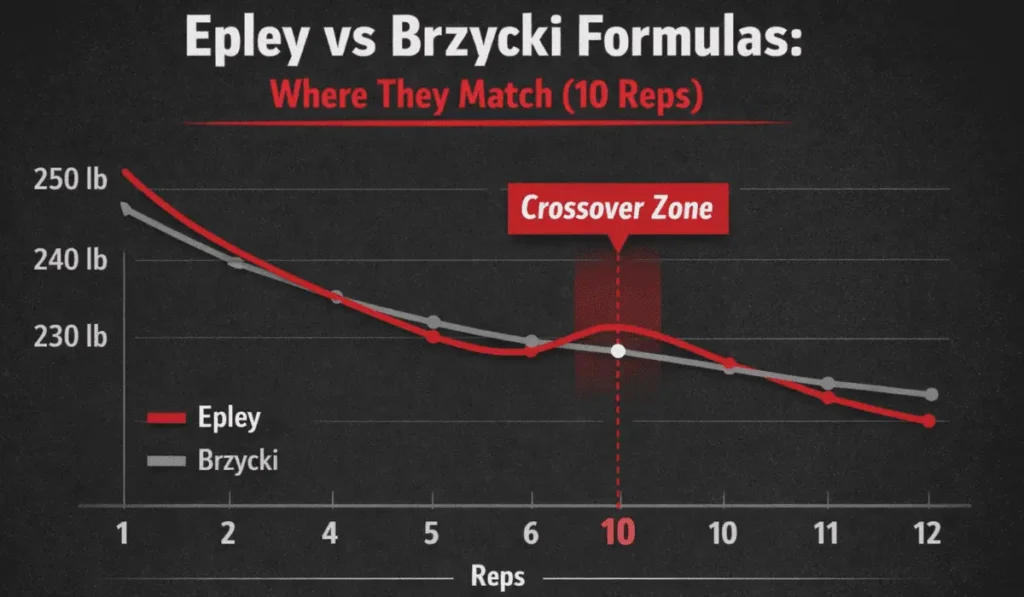
If you only remember one thing from an Epley vs. Brzycki formulas comparison, make it this: they meet at 10 reps.
Multiple references note the same behavior: at 10 repetitions, the two formulas return nearly identical estimates, and below 10 reps, Epley commonly estimates a slightly higher max.
So why does “10” keep showing up? Because 10 reps sits in a sweet spot where:
- loads are heavy enough to reflect real strength,
- technique tends to stay more consistent than it does at 15–20 reps,
- and common programming charts place 10RM around 75% of 1RM for many lifters.
Quick comparison table (225-lb bench example)
Here’s a simple 1RM formula comparison using a 225 lb bench press set at different rep counts.
| Set Performed | Epley Estimate | Brzycki Estimate |
|---|---|---|
| 225 × 3 | 247.5 lb | 238.2 lb |
| 225 × 5 | 262.5 lb | 253.2 lb |
| 225 × 8 | 285.0 lb | 279.4 lb |
| 225 × 12 | 315.0 lb | 324.1 lb |
What the table really shows
- Below 10 reps: Brzycki is usually lower. That’s where the “Brzycki is conservative” reputation comes from.
- At 10 reps: they converge.
- Above 10 reps: things get weird fast. Brzycki can jump higher than Epley because of the denominator effect, and both are more sensitive to endurance, pacing, and technique drift.
So the “magic number” isn’t mystical. It’s a practical intersection where the math and common coaching load charts line up cleanly.
Scientific Accuracy & Limitations
Let’s talk about one rep max formula accuracy like a coach who’s seen hundreds of training logs: the equations are tools, not laws.
Why estimates miss (even with perfect math)
Muscle fiber composition and athlete type
Fast-twitch dominant athletes (more Type II traits) often shine in low-rep, high-force work. They may hit heavier singles than a rep-based formula predicts, or they may fatigue quickly in longer sets and “underperform” at 8–12 reps compared to a more endurance-leaning lifter. That’s one reason two people can do the same 10 reps at 75% on paper but look totally different in real life. Research reviews on repetitions-at-percentages show big individual variability, especially when you compare strength-power athletes vs endurance-trained athletes.
Lift selection matters
A smooth, stable movement like a leg press can let you squeeze out reps. A technical lift like a squat can be limited by bracing, mobility, or a sticking point. Bench press estimates can swing with pause rules, grip width, and shoulder comfort. Deadlifts get influenced by setup consistency and how well you maintain position off the floor. Same muscles, different constraints.
Technical breakdown changes the “reps” input
These equations assume your reps represent repeatable strength, not survival reps. If rep 9 turns into a half-rom grind with shifting hips, the formula is working with compromised data. You did complete the reps, but you did it with a different movement pattern.
CNS fatigue and readiness
A hard set close to reps-to-failure is a good input for prediction, but fatigue can blur the result. If you slept 4 hours, your estimated 1RM might drop even though your “real” strength base is unchanged. That’s not the formulas failing. That’s training reality.
The practical accuracy rule I use
For most lifters, these formulas are most useful when you’re using submaximal loads in a controlled rep range (often the 3–10 rep window) with clean technique. Past that, endurance and pain tolerance start driving the set as much as strength does, and prediction error grows.
If your goal is “most accurate 1RM formula,” the honest answer is: the most accurate one is the one that matches your lifting style and stays consistent in your log.
Practical Application: Which One Should You Use? (200–250 words)
You don’t need to pick a “winner.” You need a rule that helps you train.
Use the Epley formula if…
- You live in lower rep ranges (1–6) in strength blocks.
- Your training leans toward powerlifting style work, heavy compounds, and crisp singles.
- You want an estimate that tends to reflect aggressive strength potential when reps stay low.
Use the Brzycki formula if…
- You want a slightly more cautious number for load selection in many sub-10 sets.
- You’re building consistency and would rather undershoot a little than overshoot and miss reps.
- You’re using estimates to guide hypertrophy blocks (8–12 reps) and you care more about repeatable training than max-day heroics.
My simplest decision framework
- If your set was 3–8 clean reps and you train heavy often, start with Epley.
- If your set was 6–10 reps and you want conservative programming targets, start with Brzycki.
- If your set was 12+ reps, treat both as rough guesses, then sanity-check with a second set on another day.
Whichever you choose, run it through the One Rep Max Calculator and keep your method consistent from block to block. That’s how you get useful trendlines, not random numbers.
Conclusion: Beyond the Calculator
Epley vs. Brzycki formulas is not a debate about “right” and “wrong.” It’s about bias. Epley often runs a little higher under 10 reps, Brzycki often runs a little lower there, and both can drift when reps get high.
Use the equations as a steering wheel, not a verdict. Pick one formula, apply it the same way, and track progress across training blocks. If your estimated 1RM climbs while reps stay clean and recovery stays reasonable, you’re getting stronger in the way that actually carries over to performance.