
How Many Days a Week Should I Work Out? The Definitive Guide to Optimal Workout Frequency
You’ve probably heard every version of the advice: “Lift 3x a week,” “train six days,” “bro-split forever,” “full body only.” The problem is that most of those take confuse gym-days with muscle days.
Workout frequency isn’t just how many times you walk into the gym. It’s how often you give a specific muscle group (and the skill of a lift) a quality training stimulus. Once you see it that way, the big question gets clearer: how many days a week should I workout so I grow, get stronger, and still have a life?
Here’s the punchline you’ll see repeated in the research and in real gyms: the “best” workout frequency is the one that lets you hit enough hard sets per week, recover, and show up consistently. The science matters, but so does whether you can stick to it in February, not just January.
If you want your training loads to match your plan, run your numbers through the One Rep Max Calculator (so your “heavy day” is actually heavy, and your “volume day” doesn’t turn into accidental maxing out).
The Frequency Paradox
People chase the perfect schedule and miss the bigger levers: weekly volume, effort, and recovery.
A lifter who trains 3 days a week for a year usually beats the lifter who trains 6 days a week for three weeks… then disappears. Frequency is a tool, not a badge.
So instead of asking, “How many days should I go?” Ask two sharper questions:
- How many times per week should each muscle (and lift) get trained well?
- How many training days can I realistically repeat every week with decent sleep, food, and stress?
That bridge between biology and adherence is where most “workout frequency” articles fall apart.
The Science Of Growth: Why Frequency Matters
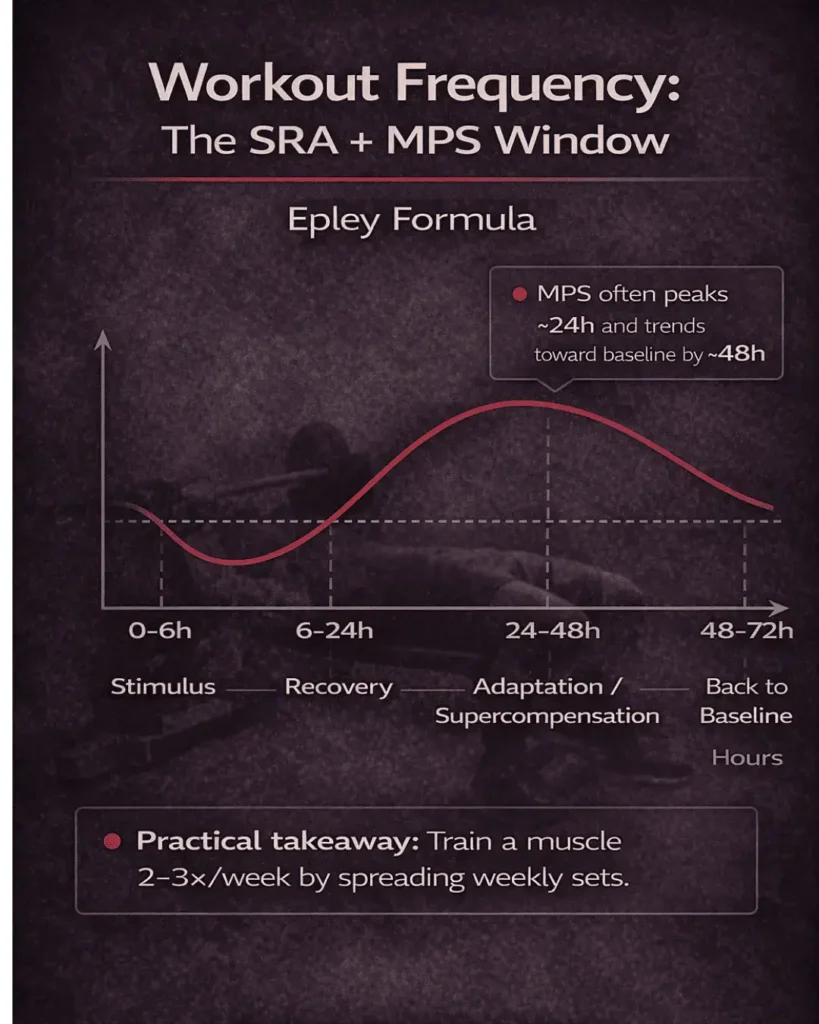
Training works because you create a stimulus, recover from it, and adapt. Coaches call this the SRA curve (Stimulus–Recovery–Adaptation). You train, you’re tired, you recover, you come back a little better… if you time the next stimulus well.
One reason frequency matters is muscle protein synthesis (MPS). After resistance training, MPS rises and then returns toward baseline. In classic studies, MPS was elevated strongly around 24 hours post-lift and was close to baseline by ~36 hours in trained lifters. Other work has shown elevated net protein balance persisting up to ~48 hours after a bout. (PubMed)
That’s the practical takeaway:
- If you only hit a muscle once per week, you’re leaving a big gap where the muscle is basically “waiting” for its next signal.
- Training a muscle twice per week often lines up better with that 24–48 hour window, especially for beginners and intermediates.
Now, a key nuance that higher-level lifters learn the hard way: MPS is not the only limiter. Your nervous system, connective tissue, joints, and overall fatigue also matter. You can “hit” legs again, but can you hit legs well again?
This is why frequency is best viewed as a way to distribute weekly volume. The more weekly sets you need, the more helpful it becomes to spread them across more sessions so you don’t cram everything into one brutal day.
Strength Training Frequency Vs Hypertrophy
Let’s split the goal for a second, because “results” can mean different things.
If your goal is strength (powerlifting vibes)
Strength is heavily skill-based. The more often you practice the squat, bench, and deadlift (with good technique), the faster you tend to improve coordination, bracing, bar path, and motor unit recruitment.
That doesn’t mean you max every day. It means you touch the lift more often, usually with a mix of intensities:
- a heavier exposure (lower reps, higher % 1RM)
- a volume exposure (more reps, moderate % 1RM)
- sometimes a speed/technique exposure (lighter, crisp reps)
This is one reason many powerlifting plans land around 3–5 lifting days per week, depending on training age and recovery.
The ACSM’s well-known resistance training position stand on progression models gives practical frequency ranges by experience level: 2–3 days/week (novice), 3–4 (intermediate), 4–5 (advanced). (PubMed) That’s not a rule, but it’s a solid “starting lanes” framework.
If your goal is hypertrophy (muscle size)
Hypertrophy is driven largely by weekly hard sets plus proximity to failure (for many exercises), with enough recovery to repeat that stimulus.
Research on training frequency shows an important pattern:
- In a 2016 meta-analysis, training a muscle twice per week tended to produce better hypertrophy outcomes than once per week (when comparing typical study designs).
- In a later 2019 analysis, when weekly volume is equated (same total sets), the advantage of higher frequency becomes smaller or even negligible, suggesting frequency’s main job is helping you manage volume and fatigue.
So the practical “coach translation” is:
- Once/week can work, but it’s rarely optimal unless volume is very high on that day (and recovery is perfect).
- Twice a week is a sweet spot for most people.
- 3x/week per muscle can work well if sessions are managed and you’re not burying yourself every time.
Also, the “official” minimum is lower than people think. ACSM general guidance supports training major muscle groups at least twice per week for strength benefits. (ACSM) That’s a floor, not a ceiling.
Choosing Your Structure: Full Body Vs Split Routines
The best split is the one that lets you hit the weekly work you need without turning every workout into a 2-hour grind or a recovery disaster.
Full-body training
Full-body plans are underrated because they’re simple, repeatable, and align well with frequency.
Pros
- Great practice frequency for the main lifts
- Easy to hit muscles 2–3x/week
- Sessions stay balanced (you don’t “skip leg day” because legs are built in)
Cons
- If you try to do “everything” every day, sessions get long
- Heavy squats + heavy deadlifts + heavy pressing in one day can be too much if programming is sloppy
Best for: beginners, busy intermediates, people who want consistency without overthinking.
The 3-day workout split (the classic)
If you’re asking, “how many days a week should I work out,” a 3 day workout split is often the best answer because it’s realistic and effective.
Two common ways to do it:
Option A: Full body (Mon/Wed/Fri)
- Day 1: Squat + Press + Row
- Day 2: Deadlift + Bench + Pull-up
- Day 3: Squat variation + Overhead press + Row variation
You hit most muscles 3x/week, but the intensity rotates, so you’re not redlining every session.
Option B: Upper/Lower/Full
- Day 1: Upper
- Day 2: Lower
- Day 3: Full body
Good if full-body-only feels repetitive.
If you use the One Rep Max Calculator, you can set guardrails like:
- heavy day: ~80–88% (lower reps)
- medium day: ~70–80%
- lighter/volume day: ~60–75%
That way your “three days” don’t turn into three max-effort days.
Upper/lower (4 days/week)
This is the workhorse split for intermediates because it naturally gives most muscles 2x/week frequency while keeping sessions focused.
Example:
- Mon: Upper (heavier)
- Tue: Lower (heavier)
- Thu: Upper (volume)
- Fri: Lower (volume)
It’s easier to push weekly sets up without wrecking a single session.
Push/Pull/Legs (PPL) (usually 5–6 days/week)
PPL can be great, but it’s also where people accidentally do junk volume because they’re in the gym all the time.
PPL 6x/week typically gives each muscle 2x/week. PPL 3x/week gives 1x/week.
Best for: lifters who recover well and enjoy frequent training.
The 5-day workout split (and when it makes sense)
A 5-day workout split is useful when your weekly volume needs are high or when you want more specialization (powerlifting variations, CrossFit accessory work, bodybuilding isolation).
Two common 5-day structures:
Option A: Upper/Lower + 3 focused days
- Day 1: Upper heavy
- Day 2: Lower heavy
- Day 3: Back + arms (volume)
- Day 4: Legs (pump/accessory)
- Day 5: Chest/shoulders (volume)
Option B: 5-day “hybrid” for athletes
- 3 lifting days (strength emphasis)
- 2 conditioning/skill days (CrossFit-style metcons, sprint work, sport practice)
The trap: if your sleep and food aren’t locked in, 5 days becomes “perma-tired.” That’s not optimal training frequency. That’s just more training.
Practical Implementation: How Many Days a Week Should I Work out?
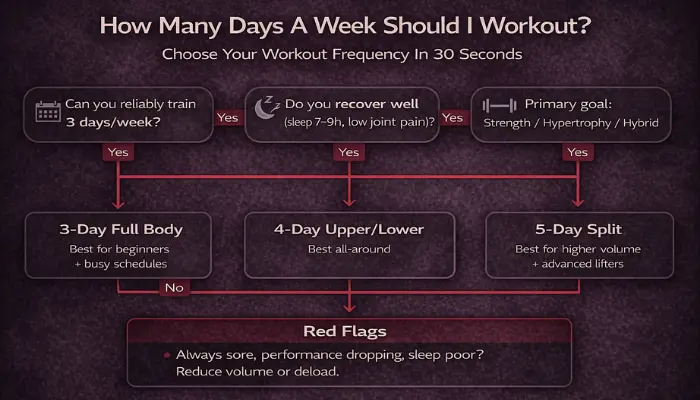
Here’s a simple decision tree that works in the real world.
Step 1: Pick the frequency you can repeat
If your schedule is chaotic, choose the plan that survives chaos.
- If you can reliably train 3 days/week, start there.
- If you can reliably train 4 days/week, upper/lower is hard to beat.
If you can reliably train 5–6 days/week, you’re ready for PPL or specialization, but only if recovery is solid.
Step 2: Match frequency to training age
ACSM’s progression model suggests frequency generally increases with training experience. The NSCA also commonly recommends 2–3 days/week for beginners when training the whole body, often on nonconsecutive days.
A practical version:
Beginner (0–6 months)
- Best: 3 days/week full body
- Goal: learn technique, build consistency, progress weekly
Intermediate (6–24 months)
- Best: 4 days/week upper/lower or 3–4 days/week full body
- Goal: more weekly sets, better load management
Advanced (2+ years, or competitive)
- Best: 4–6 days/week, tailored
- Goal: manage fatigue, specialize, periodize blocks
Step 3: Keep volume honest
If you add days, you should usually redistribute volume, not just pile on.
A quick self-check: if your performance is sliding for 2–3 straight weeks (weights feel heavier, reps drop, motivation tanks), the answer is rarely “add another day.” It’s often reduce fatigue, adjust sleep, or deload.
Quality Over Quantity
The “optimal training frequency” on paper doesn’t matter if it doesn’t fit your life. MPS can guide the why, but adherence decides the result. Studies show that higher frequency can help, especially when it lets you spread weekly volume more effectively, but volume-equated research also reminds us frequency isn’t magic by itself.
Start with the smallest schedule you can nail consistently, then build from there.
And if you want your plan to actually match your intensities, use the One Rep Max Calculator to set training loads, track your estimated 1RM over time, and avoid the classic mistake of turning every workout into a test.