
Training Volume vs. Intensity: The Ultimate Guide to Balancing Workload for Max Gains
Introduction: The Seesaw of Strength
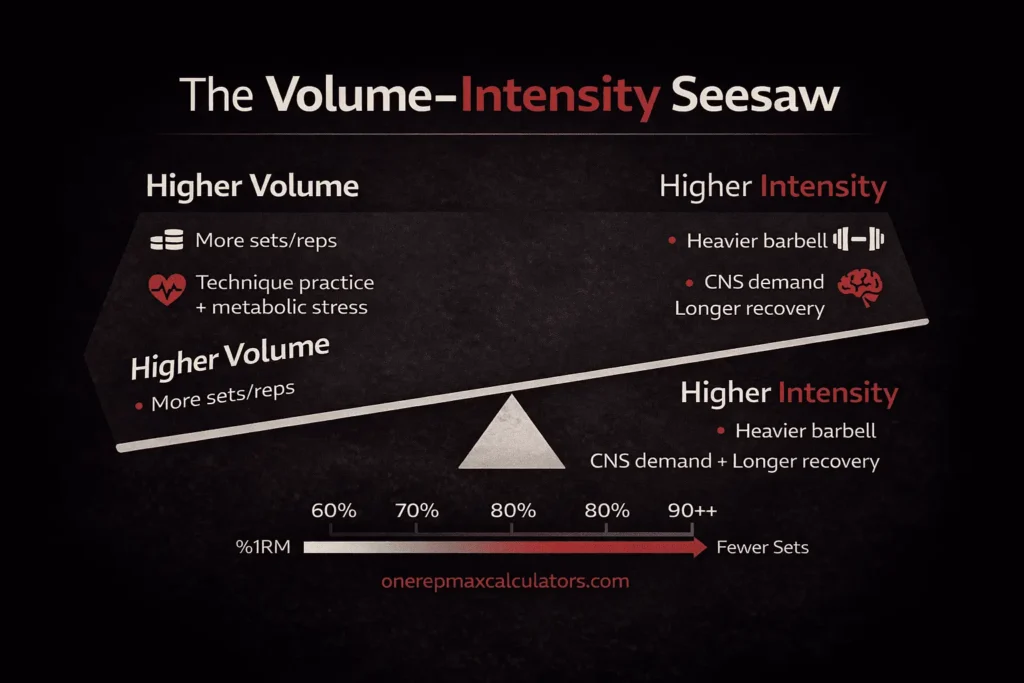
Most training arguments about training volume vs intensity sound like “do more work” versus “lift heavier.” That’s not wrong, but it’s shallow. Volume and intensity are levers that push against each other, and your results depend on how you balance them across time.
Your body adapts to stress the same way it adapts to everything else: you disrupt homeostasis, you recover, and you come back (ideally) a bit more capable. That’s the basic idea behind Hans Selye’s General Adaptation Syndrome, and it shows up in lifting as the stimulus-recovery-adaptation (SRA) cycle. Lift hard enough to send an adaptive signal. Recover well enough to actually respond. Repeat long enough to stack progress.
Here’s the catch: if you crank one lever too high, the other one usually has to come down. That’s why the best lifters don’t “pick a side.” They manage workload like adults. They manipulate training volume vs. intensity based on the outcome they’re chasing: strength, muscle, work capacity, peaking for a meet, or just staying healthy while getting stronger.
Defining the Variables
To program well, you need clear definitions. Not vibes.
Training Volume Meaning
Training volume meaning can change depending on who you ask. In coaching, “volume” usually means the amount of work you complete for a lift, a muscle group, or a week.
Common ways to express volume:
- Sets × reps (simple and useful)
- Total reps at a given intensity zone (like all reps between 70–80% 1RM)
- Volume load / tonnage (how much weight you moved)
The cleanest way to quantify workload is volume load calculation:
Volume Load = Sets × Reps × Load
Example: you squat 4 sets of 6 reps with 225 lb.
- Volume Load = 4 × 6 × 225
- Volume Load = 5,400 lb moved
This matters because your body “feels” repeated tension and metabolic stress, not just your top set. Volume builds work capacity, drives skill practice, and creates a big chunk of hypertrophy stimulus through repeated high-quality reps.
A practical note for programming: the number that tends to move the needle for most lifters is weekly training volume per muscle group or movement pattern. Day-to-day workouts are details. Weekly totals are the real dial.
Training Intensity Definition
Now the other lever.
A strong training intensity definition starts with this: intensity describes how heavy the load is relative to your maximum ability.
There are two ways lifters talk about intensity:
- Absolute intensity
The actual weight on the bar. Example: 225 lb. - Relative intensity vs absolute intensity
Relative intensity is the weight relative to you, usually as a percentage of 1RM (or expressed via effort tools like RPE).
- 225 lb might be 70% for one lifter and 90% for another. Same absolute intensity, completely different relative intensity.
So when people ask what is training intensity, the useful answer is:
Intensity is how heavy the work is for you, most often expressed as %1RM, plus how close you are to failure.
That second part matters because intensity isn’t only load. Lifters also talk about intensity of effort strength training, which is how hard the set is, regardless of the weight.
Two common tools:
- RPE (Rate of Perceived Exertion): RPE 10 = max effort, no reps left.
- RIR (Reps in Reserve): “2 RIR” means you stopped with about two reps left.
A set of 10 at 60% taken to failure can be brutally high effort, even though the load is “light.” That’s why smart programming separates “how heavy” from “how hard.”
The Relationship: Why You Can’t Have Both
This is the part most people miss: training volume vs intensity is an inverse relationship when you’re talking about hard, effective training.
As intensity (load and effort) climbs toward your max, the amount of quality work you can tolerate drops. You can’t do 10 hard sets at 90–95% of 1RM and expect to keep form, bar speed, and recovery intact. Your nervous system, connective tissue, and whole-body fatigue bill comes due.
This isn’t just “your legs are sore.” High intensity creates:
- CNS fatigue (heavy singles, doubles, grinders)
- Higher neurological demand and coordination cost
- Higher allostatic load (the total stress burden from training + life)
- More systemic recovery needs (sleep, food, stress management)
On the other side, high volume at moderate loads creates a different fatigue profile:
- More local muscular fatigue
- More metabolic stress
- More total time under tension
- A big “practice effect” for technique
You still can’t do unlimited volume. Past a point, quality drops, recovery gets compromised, and progress stalls. That’s your dose-response curve showing up in real life: more stimulus helps… until it doesn’t.
So if you’re trying to “go heavy and also do a ton,” your program often becomes a sneaky third thing: mediocre work that’s hard enough to beat you up, but not focused enough to build what you want.
High Volume vs High Intensity Workouts
Let’s compare two extremes. Not because extremes are always best, but because they make the differences obvious.
The high-volume philosophy (example: German Volume Training style)
A classic “high volume” approach might be 10 sets of 10 on a lift, usually at a moderate load, with short rest. It’s brutal in a different way:
- Lots of reps
- Lots of total time under tension (TUT)
- Huge metabolic stress
- Technique practice under fatigue
What it tends to build:
- Hypertrophy, especially the “pump” side often described as sarcoplasmic hypertrophy
- Work capacity
- Tolerance for repeated sets
What it tends to cost:
- Recovery bandwidth
- Joint irritation if exercise selection is sloppy
- Performance on heavy work if you don’t manage fatigue
The high-intensity philosophy (example: Mike Mentzer’s Heavy Duty influence)
A classic “high intensity” approach leans into fewer sets, higher effort, often close to failure, sometimes with forced reps or rest-pause.
What it tends to build:
- High-threshold motor unit recruitment
- Strength expression and neural skill, especially for advanced lifters
- Often more myofibrillar hypertrophy emphasis (the “dense” strength-side growth)
What it tends to cost:
- More CNS/systemic fatigue per hard set
- Longer recovery needs between similar sessions
- Higher risk when technique breaks near failure
Where most lifters actually win: a blended approach
For most people reading this, your best results won’t come from living at either extreme. You’ll do better with a program that uses both levers, on purpose.
Here’s a practical anchor that works for a lot of lifters:
- Sets per muscle group per week often land in the 10–20 range for a strong dose response resistance training effect, assuming the sets are hard enough and your recovery supports it.
That doesn’t mean 20 sets is automatically better than 10. It means most people grow and get stronger within that zone when intensity and effort are appropriate.
If you’re doing 20 junk sets with sloppy form, the number doesn’t save you. If you’re doing 10 sharp sets with good proximity to failure and progressive overload, you might grow just fine.
Programming for Hypertrophy vs Strength
This is where the theory turns into something you can actually run on Monday.
Volume vs intensity for hypertrophy
For muscle growth, volume vs intensity for hypertrophy usually favors more total quality work at moderate to moderately heavy loads. The sweet spot for many lifters sits around 60–85% of 1RM, mostly because it lets you accumulate challenging reps without your form turning into a survival exercise.
What drives hypertrophy:
- Mechanical tension (heavy enough to demand force)
- Metabolic stress (especially in moderate rep work)
- Adequate weekly volume (hard sets that count)
- Repeated exposure that supports muscle protein synthesis (MPS) over time
A simple hypertrophy template (per lift or movement pattern):
- Main lift: 3–5 sets of 6–10 reps @ ~65–80% 1RM (RPE 7–9, 1–3 RIR)
- Secondary lift: 2–4 sets of 8–12 reps (RPE 8–9)
- Accessories: 2–4 sets of 10–20 reps, pushed close to failure with good form
Weekly structure idea:
- 2–3 exposures per muscle group
- Target 10–16 hard sets/week to start
- Add volume slowly if you’re recovering well and progress stalls
How to use your 1RM calculator here:
Take your best recent set (even a solid set of 5–10), estimate 1RM, then map loads to rep ranges. You’ll stop guessing, which means you’ll stop accidentally turning “hypertrophy day” into a max-effort day.
Intensity of effort for strength
Strength-focused training shifts the center of gravity. You still need volume, but intensity becomes the headline.
For pure strength, intensity of effort strength training and heavy relative loads matter because you’re training the skill of producing force under high demand. That usually means:
- More work in the 85%+ 1RM zone
- More low-rep sets (singles, doubles, triples)
- Longer rest
- Higher emphasis on bar speed and technique consistency
A simple strength template (for a main lift):
- Heavy work: 4–8 sets of 1–3 reps @ 85–92% 1RM (RPE 7–9, leave a rep in the tank most of the time)
- Back-off work: 2–4 sets of 4–6 reps @ 75–82% for technique and volume
- Accessories: targeted hypertrophy for weak links (hamstrings, upper back, triceps, etc.)
You’ll notice something: even in strength blocks, you’re still doing volume. It’s just structured around heavier work.
How to periodize the two levers
If you try to run high volume and high intensity hard, year-round, you’ll eventually hit the wall. Periodization is how lifters avoid that wall.
A simple way to think about it:
- Accumulation phase (volume emphasis): more sets, moderate intensity
- Intensification phase (intensity emphasis): fewer reps, heavier loads
- Realization/peak (if you compete): very heavy, very low volume, lots of recovery
You don’t need to be a competitive powerlifter to use this. CrossFitters and general gym lifters can run the same idea in 4–8 week waves.
Quick example wave for a squat-focused lifter:
- Weeks 1–3: Volume emphasis (5×5 at 75%, plus accessories)
- Week 4: Deload (reduce sets and keep loads moderate)
- Weeks 5–7: Intensity emphasis (6×2 at 85–90%, plus back-offs)
- Week 8: Test or re-estimate 1RM, then restart the wave
That “re-estimate” piece is where your calculator becomes your guardrail. You keep the plan realistic instead of ego-driven.
Finding Your Optimal Ratio
Your best training volume vs intensity balance is the one you can recover from while still adding weight, reps, or quality over time. If you’re always sore, always tired, and your numbers are flat, your ratio is off. If you feel fresh but nothing is changing, your ratio is off in the other direction.
Start with a clear goal (strength peak, hypertrophy block, general performance), pick a reasonable weekly volume target, then set intensity zones using a current estimated 1RM. Run it long enough to see a trend, not just a single good workout. Adjust one lever at a time.
If you want the fastest “no guesswork” upgrade: estimate your 1RM from a recent set and build your next 4 weeks around percentages. Use the One Rep Max Calculator, plug in your lift, and let the numbers keep you honest.