
Strength Training Programming
Your 1RM is the anchor: the number every percentage-based program is built from. But knowing that number and knowing what to do with it are two different problems. Strength training programming is how you turn an estimated 1RM into a structured training plan: the right load, the right volume, the right variation over time, and a fatigue management strategy that lets you keep progressing past the first few months. This guide covers all of it, from the principles that underlie every effective program through to the specific models and named programs that apply them.
What Is Strength Training Programming?
The deliberate organization of training variables over time to produce consistent, measurable strength gains: that is what strength training programming means. It distinguishes going to the gym and lifting heavy things from actually training for strength. Both involve barbells. Only one produces predictable results.
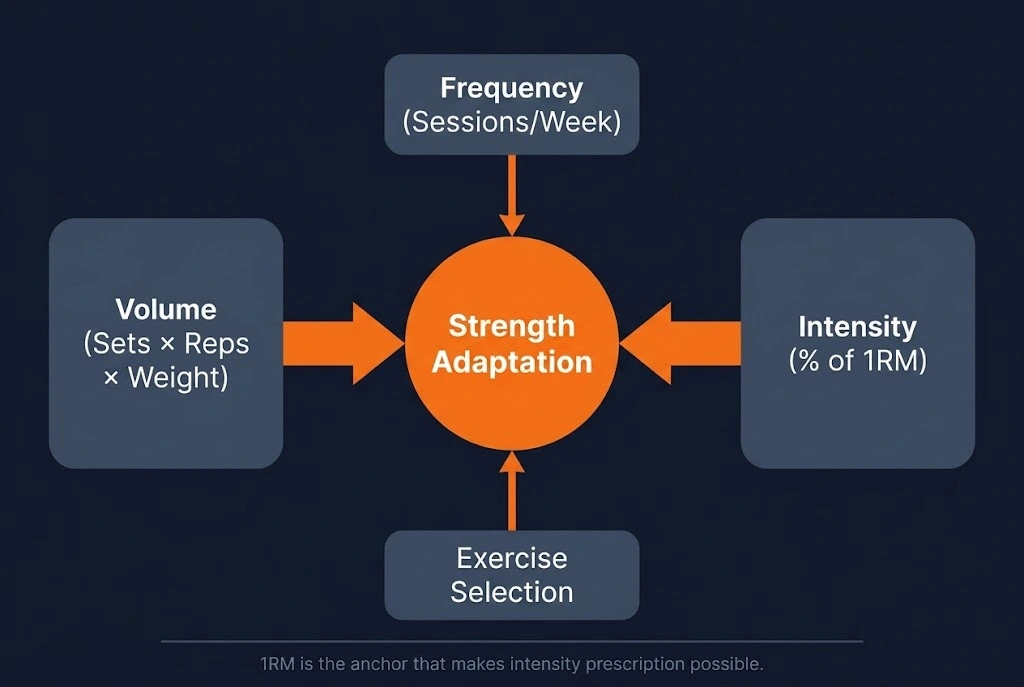
The core variables interact constantly. Volume (sets × reps × weight across a session or week) drives the muscular adaptation that supports strength. Intensity, expressed as a percentage of 1RM, drives the neural adaptation that expresses it. Frequency determines how often each adaptation signal hits the same muscle group. Programming is the structured management of all three at once, across training sessions and weeks and months.
Your 1RM is what makes percentage-based programming concrete. Without it, “lift heavy” and “lift light” are vague. With it, “5 sets at 80%” means something specific: you can calculate the exact load, compare it week to week, and know whether you’re progressing. The one rep max calculator produces the estimated 1RM that anchors every number in this guide.
This pillar covers two things: the principles behind effective programming and the specific models and programs that apply those principles. The foundational concepts come first. Named programs and periodization models follow.
The Foundational Principles of Strength Programming
Three principles appear in every effective strength program, regardless of the specific model or named program. Understanding them makes every other programming decision easier.
Progressive overload is the mechanism that drives all strength adaptation. The training stimulus must increase over time or the body has no reason to become stronger. Add weight, add reps, add sets, or reduce rest: any of these produces a new stimulus. Without progression, training maintains fitness but doesn’t build it. This is the most foundational concept in all of strength training.
For the complete guide: Progressive Overload
Training volume vs intensity is the central trade-off in program design. Volume (the total workload in sets and reps) drives muscle development, the tissue that supports strength expression. Intensity (load as a percentage of 1RM) drives the neurological adaptation that converts that muscle into a displayed maximum. Programming is largely the art of balancing these two levers across a training cycle. High-volume phases build capacity; high-intensity phases express it.
For the full breakdown: Training Volume vs Intensity
Optimal workout frequency determines how often each lift receives a training stimulus per week. For most intermediate lifters, 2–3 sessions per week on the major compound lifts produces better results than once-weekly training, because the adaptation signal fades faster than most people assume. Frequency also affects how volume is distributed: more sessions allows more total volume without crushing any single session.
For the full evidence: Guide to Optimal Workout Frequency
Building Your Programming Foundation
Before choosing a periodization model or named program, three practical decisions shape the structure of any strength plan: which rep ranges to use, which number to program from, and whether your training history matches the program’s demands.
Sets and reps for maximum strength. The evidence is consistent. Sets of 1–5 reps at 80–95% of 1RM build maximal strength expression. Higher rep ranges (6–12 at 65–80%) build the muscle that supports that expression. Most successful strength programs use both in different proportions. The calculator’s Percentage & Rep-Max Table generates your predicted rep max at each percentage automatically, so set selection is data-driven rather than guesswork.
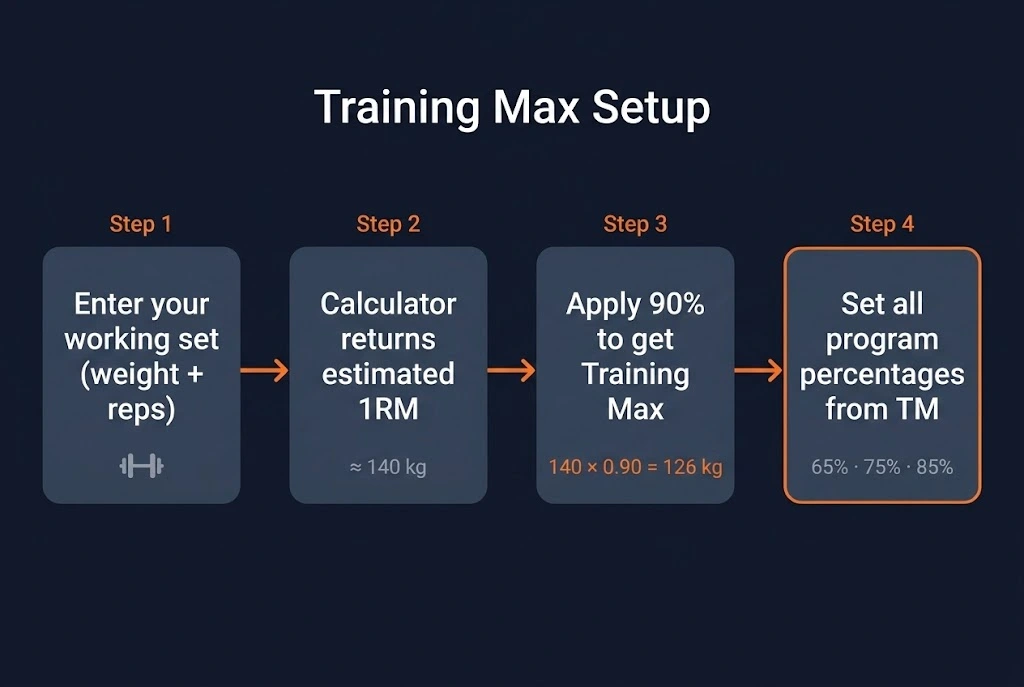
How to set your training max. Most percentage-based programs anchor to a training max rather than your true 1RM: typically 90% of your estimated ceiling. This buffer prevents the program from becoming unsustainable in the early cycles and gives built-in room for the program to progress. Set it too high and you’ll miss reps; too low and the adaptation stimulus is insufficient. The calculator’s Training Max toggle generates percentages from your TM in one step.
Training age and 1RM progress. How long you’ve trained consistently determines which programming model is appropriate. A lifter with six months of barbell training adapts differently to the same stimulus as someone five years in. Training age also predicts how long linear progression will sustain before a more complex model is needed.
Periodization: Structuring Strength Over Time
Periodization is the deliberate organization of training variation across weeks and months to prevent stagnation and peak strength at a chosen time. Without planned variation, the same stimulus produces diminishing returns as the body adapts. Periodization is the solution: structured changes to volume and intensity that keep adaptation happening.
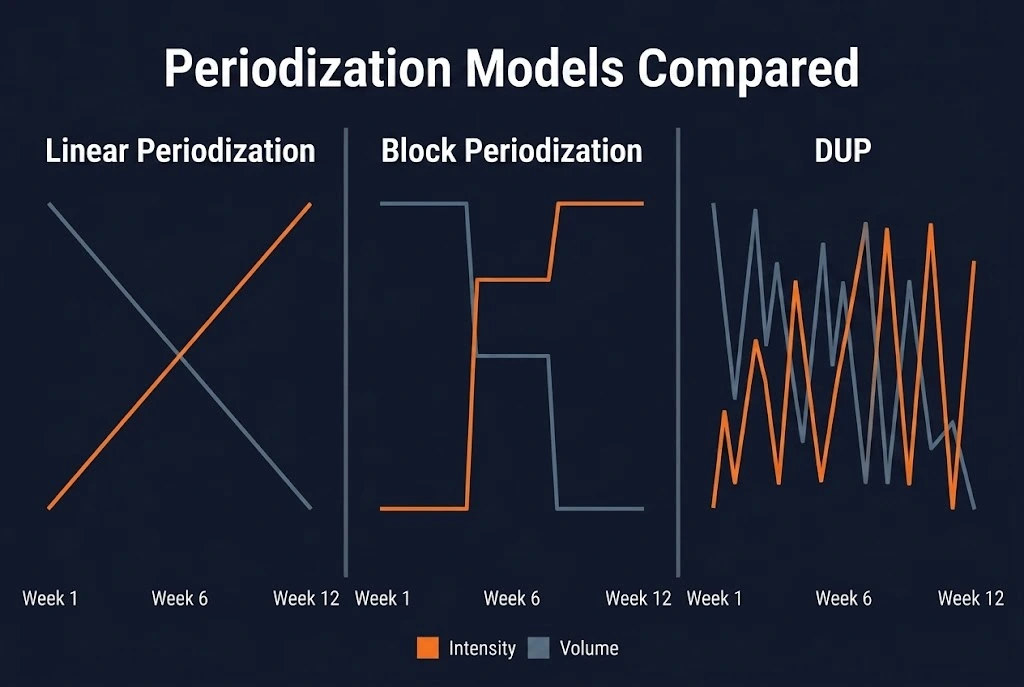
Linear periodization is the simplest model: weight increases each session or each week while reps decrease, cycling from higher-rep moderate-load phases toward lower-rep high-load phases. It works well for beginners and early intermediates because strength gains come quickly and the structure requires no complex planning. The ceiling is that linear progress eventually stalls. When it does, a model with built-in variation becomes necessary.
Block periodization divides training into distinct multi-week phases: accumulation (high volume, moderate intensity), intensification (lower volume, higher intensity), and realization (low volume, peak intensity). Each block has a different goal. Volume is deliberately high early; intensity peaks late. The model suits intermediate-to-advanced lifters who have exhausted linear progress and need month-to-month variation to keep moving forward.
Daily Undulating Periodization (DUP) varies volume and intensity within the same week rather than across multi-week blocks. A Monday session might target 8–10 rep hypertrophy work; a Thursday session might target 3–5 rep strength work. DUP suits lifters who train a lift multiple times per week and want frequent variation without committing to month-long phases.
Proven Strength Programs
Named programs take the principles above and package them into a structure a lifter can follow without building everything from scratch. The key differentiator between the programs below is training age. Program selection should match where you are in your development.
5/3/1 (Jim Wendler) is the most widely used percentage-based intermediate strength program. It anchors to a training max set at 90% of the lifter’s estimated 1RM and cycles weekly loads across four weeks at 65%, 75%, and 85% of TM, progressing upward over each cycle. The structure connects directly to the calculator’s Training Max toggle.
Starting Strength (Mark Rippetoe) is the standard beginner barbell program: three full-body sessions per week, linear progression adding weight to the bar each session. Designed for lifters with fewer than six months of barbell training. The calculator tracks the 1RM implied by each session’s working set, so progress is visible across the whole training period.
The Texas Method is a three-day weekly structure with a high-volume Monday, a recovery Wednesday, and a max-effort Friday. It bridges the gap between beginner linear progression and fully periodized intermediate programming, useful when simple linear progress has stalled but a full periodization model feels premature.
The beginner program comparison (Starting Strength vs StrongLifts vs GZCLP) covers the three most commonly recommended beginner programs side by side, with a decision framework based on schedule and equipment access.
Autoregulation and RPE: Programming by Feel
Fixed percentage prescriptions assume your strength stays constant. It doesn’t. Sleep quality, accumulated fatigue, nutrition, and stress all affect daily performance by 3–5% in either direction. On a bad day, 80% of your estimated 1RM might feel like 87%. On a good day, the opposite.
RPE (Rate of Perceived Exertion) solves this problem by prescribing effort rather than absolute load. The scale runs from 6 to 10 for strength work: RPE 10 means no reps remained; RPE 8 means approximately 2 reps were in reserve. A program that calls for “4 sets of 4 at RPE 8” is telling you to stop each set with two reps remaining, at whatever load that requires today. The bar weight adjusts itself.
The trade-off is concrete. Percentages give reproducibility and an audit trail. You can see exactly what you lifted and compare it week to week. RPE gives accuracy on days when actual readiness doesn’t match the baseline. Most advanced programs combine both: percentage-based volume work and RPE-based top sets.
The calculator’s RPE accordion applies this directly: enter the RPE of your last set and the reps completed, and it returns an adjusted 1RM estimate that reflects actual readiness rather than a number calculated weeks ago.
Managing Fatigue: Deload and Peaking
Fatigue accumulates faster than most lifters expect. A well-designed program builds training load deliberately and plans its reduction with the same deliberateness.
Deload week is a planned reduction in training load to allow accumulated fatigue to dissipate and super-compensation to occur. Most effective programs schedule deloads every 4–8 weeks rather than waiting until the lifter feels run down. By the time fatigue feels obvious, it has already been suppressing performance for weeks. A proactive deload takes 5–10 days to produce its full recovery effect; a reactive one takes longer.
The deload guide covers when to schedule them, how much to reduce, and how to tell the difference between productive training soreness and the kind that signals a required break.
Peaking for a 1RM attempt is the mirror image of the deload: the peaking phase drops volume sharply while intensity rises toward maximal over 2–3 weeks. The goal is to arrive at the test day with accumulated fatigue suppressed and strength expression at its highest. The calculator’s warm-up ramp is the primary planning tool here. Enter your target opener, and it generates the full warm-up sequence up to your working max.
How to Use the Calculator in Your Programming
Three practical flows connect the one rep max calculator to the programming decisions covered in this guide.
Set your training max. Enter your best recent working set into the calculator, get your estimated 1RM, then open the Percentage & Rep-Max Table and toggle to Training Max at 90%. The table generates all your working loads from that TM automatically. Use those percentages in 5/3/1, the Texas Method, or any TM-anchored program.
Set your weekly working weights. From the same table, read off target loads at 65%, 70%, 75%, 80%, and 85% for each planned session. No manual percentage math required.
Adjust for daily readiness. When your working set feels heavier than the percentage suggests, open the RPE accordion, enter the RPE of your last set, and get an adjusted 1RM estimate. Use it to recalibrate the day’s loads rather than grinding through a percentage that doesn’t reflect how you’re actually performing.
Frequently Asked Questions
Key Takeaways
Strength training programming is the structured management of volume and intensity over time, anchored to 1RM percentages that make every prescription concrete. The right model depends on training age: linear progression for beginners, periodized structures for intermediates, autoregulation tools for advanced athletes managing day-to-day variation. The calculator connects the theory to the numbers on the bar.
Next, explore : Foundational Principles:
Also in this series: