
Wilks Score Calculator
Compare your powerlifting total across weight classes — three formulas side by side.
Wilks scores are estimates. For official competition results, use certified meet software.
Coefficients: R. Wilks (1998) · Wilks Coefficient 2.0 (2020) · DOTS (IPF-derived).
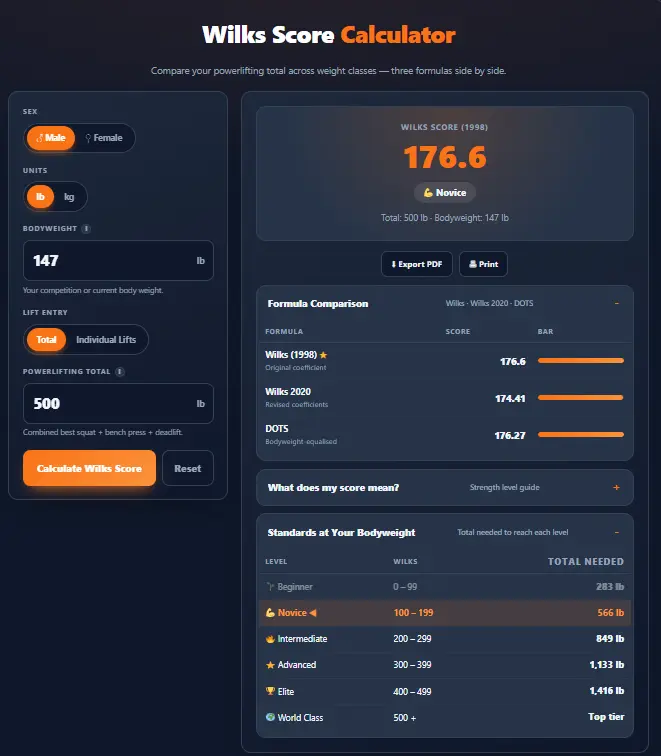
This calculator computes your Wilks score using all three bodyweight-adjusted formulas at once, Wilks 1998, Wilks 2020, and DOTS, then maps the result to a strength level and shows the total you need to reach the next one. No need to pick a single formula or run the math by hand.
Features at a Glance
| Feature | What it does |
| Three Formulas Side-by-Side | Computes Wilks (1998), Wilks 2020, and DOTS simultaneously, not choosing just one |
| Reps → 1RM Estimation | Enter a training set (weight × reps) per lift; 1RM estimated via the Epley formula |
| Personalized Strength Standards | Shows the exact total needed at your bodyweight to reach each level |
| Individual Lifts Mode | Enter squat, bench press, and deadlift separately; total is calculated automatically |
| lb / kg Switching | All inputs and results update instantly when you change units |
| Strength Level Badge | Wilks score mapped to a labelled level, Beginner through World Class |
| PDF Export | Generates a PDF report entirely in your browser, no upload, no server |
| Print View | Clean, ink-friendly print layout strips the calculator UI |
| Mobile-Friendly | Fully responsive across phones, tablets, and desktops |
| Accessible | Keyboard navigable, ARIA-labelled, visible focus indicators |
Enter your sex and bodyweight, add your total, and get all three scores immediately. Everything else, individual lift entry, rep-based estimation, personalised targets, builds on that single input.
How to Use the Wilks Score Calculator?
Four steps take you from a blank form to a complete result. Here's how to calculate your Wilks score from start to finish.
Step 1: Set Your Sex and Units
Select Male or Female. The Wilks formula uses separate polynomial coefficients for each sex, so this choice determines which coefficient set gets applied to your total. Then choose lb or kg. Every input and output switches instantly when you change units, no recalculation needed.
Step 2: Enter Your Bodyweight
Enter your current or competition bodyweight in the unit you selected. For meeting use, enter the actual weighed-in number. The calculator validates this input: Male bodyweight must fall between 40 and 210 kg, and female between 26.51 and 150.95 kg. Values outside this range are rejected because the polynomial coefficients were fitted to data within these boundaries and don't hold reliably outside them.
Step 3: Enter Your Powerlifting Total
Two entry modes are available depending on what data you have.
Total Mode
Switch the toggle to Total and enter your combined squat, bench press, and deadlift as a single number. Use this when you know your competition total or training PR total exactly.
Individual Lifts Mode
Switch to individual lifts and enter each lift separately. The calculator sums them automatically. You can optionally enter a rep count alongside each weight to estimate 1RM from a training set, covered in the next section. Use this mode when you want to see how individual PRs combine into a total.
Step 4: Press Calculate and Read Your Results
After pressing Calculate Wilks Score, three things appear: your Wilks (1998) score with a labelled strength level badge, all three formula scores (Wilks 1998, Wilks 2020, and DOTS) side by side, and the Personalized Standards accordion showing the total needed to reach each level at your exact bodyweight. Pressing Enter in any input field also triggers the calculation, so you don't need to click the button every time you adjust a number.
Estimating Your 1RM from a Training Set
Not every lifter has a tested 1RM for each lift. This feature lets you calculate a Wilks score from a training set instead, using the Epley formula to bridge the gap.
How the Epley Formula Works Here
In Individual Lifts mode, each lift shows a weight × reps input pair. When you enter a rep count greater than 1, the calculator runs the Epley formula: Estimated 1RM = weight × (1 + reps ÷ 30). The estimated 1RM appears below the field in real time as you type, and the live Est. 1RM Total pills at the bottom of the input section updates simultaneously, so you can see your projected total before hitting Calculate.
Worked example: you squat 140 kg for 5 reps. Estimated 1RM = 140 × (1 + 5/30) = 140 × 1.167 = 163.3 kg.
A few things worth keeping in mind:
- Most accurate for 1-5 rep sets
- Accuracy decreases above 10 reps; don't use it for 12+ rep sets
- Leave reps at 1 (or blank) to use the weight directly as your 1RM
- For competition planning, verify with a direct 1RM attempt
For the full picture on formula accuracy and its limits, see How Accurate Are 1RM Calculators?
When Rep-Based Estimation Is the Right Approach
Use rep-based estimation when no recent 1RM test exists, when you want to track projected progress from training sets, or when you're a lifter who never tests true maxes. Don't use it for setting competition openers, official records, or any scenario requiring a certified 1RM. The live total pill is specifically useful for tracking how a set of working weights projects onto a Wilks score across a training cycle, giving you a running estimate without waiting for a max-effort test.
What is a Wilks score?
The Problem with Raw Powerlifting Totals
A 600 kg total means something very different for a 60 kg lifter than for a 120 kg lifter. Raw totals can't be compared across bodyweights, because heavier athletes carry a structural advantage in absolute load capacity. That makes head-to-head comparisons within a weight class fair, but any cross-class or cross-sex comparison needs a bodyweight-adjusted score instead. This matters in three practical scenarios: comparing yourself to lifters in other weight classes, tracking your score across a period when your bodyweight changes, and evaluating year-on-year progress independently of bodyweight fluctuations.
How the Wilks Formula Equalizes Strength
A Wilks score is calculated by multiplying your total (in kg) by a coefficient derived from a 5th-degree polynomial fitted to competition data. The coefficient decreases as bodyweight increases, so heavier lifters need a larger total to reach the same score as lighter lifters. The formula was designed so that the same Wilks score is theoretically equally difficult to achieve at any bodyweight within the fitted range. That goal is imperfectly achieved, particularly at extreme bodyweights, which is partly why Wilks 2020 and DOTS came along later.
A Brief History: Robert Wilks and Powerlifting Australia
The Wilks formula was developed by Robert Wilks of Powerlifting Australia in 1998. It became the IPF's official scoring method for decades and remains the most widely cited bodyweight-adjusted strength score in powerlifting. In 2020, the IPF updated the coefficients using a larger dataset, producing Wilks 2020. DOTS was developed separately, using a 4th-degree polynomial, to address concerns about fairness at extreme bodyweights. This calculator computes all three simultaneously.
The Three Formulas: Wilks, Wilks 2020, and DOTS
Wilks (1998): The Universal Reference
The original formula uses a 5th-degree polynomial with Robert Wilks' 1998 coefficients. In plain English: Score = 500 ÷ poly5(bodyweight in kg) × total in kg. The 500 multiplier scales the score to the familiar 0-500+ range you'll see in results. It remains the universal reference because decades of historical records use it, which makes it the best choice for comparing performance across different eras.
Wilks 2020: The Current IPF Standard
The 2020 update uses the same 5th-degree polynomial structure but with coefficients recalculated from a larger, more recent competition dataset from the International Powerlifting Federation. The key practical difference: Wilks 2020 tends to score lighter athletes slightly higher and heavier athletes slightly lower than the 1998 version. For any lifter competing in an IPF-affiliated federation, Wilks 2020 is the current official score, so use it when comparing against active competitors or setting goals for IPF competition.
DOTS: A Modern Alternative
The DOTS scoring system uses a 4th-degree polynomial with coefficients derived from IPF data, credited to Brechue & Mayhew. The name stands for Dynamic Old-Timers Score. It was developed specifically to address perceived fairness gaps at extreme bodyweights, particularly at the lightest and heaviest ends of the spectrum, where the 5th-degree Wilks polynomial can reward extreme bodyweights disproportionately. DOTS is used by some federations as their primary scoring method and is preferred by coaches who find it gives a more equitable comparison across the full bodyweight spectrum.
Which Formula Should You Use?
- For historical comparison or general reference: use Wilks (1998), the most widely understood score with the longest data record.
- For IPF competition or current federation standards: use Wilks 2020, the active official scoring method.
- For cross-class comparison at extreme bodyweights: use DOTS, the most equitable across the full spectrum.
- If unsure: use all three and compare. A wide gap between them for the same input signals a bodyweight where the formulas diverge meaningfully.
A Worked Comparison: The Same Lifter, All Three Formulas
| Lifter | Bodyweight | Total | Wilks 1998 | Wilks 2020 | DOTS |
| Male | 90 kg | 600 kg | ≈ 358 | ≈ 362 | ≈ 364 |
| Female | 60 kg | 380 kg | ≈ 432 | ≈ 438 | ≈ 441 |
| Male | 120 kg | 720 kg | ≈ 357 | ≈ 349 | ≈ 347 |
Note how the 120 kg male with a 720 kg total, a much higher absolute load, scores roughly the same Wilks (1998) as the 90 kg male with 600 kg, but scores lower on Wilks 2020 and DOTS, which penalize heavier bodyweights slightly more.
Wilks Strength Levels: Where Do You Stand?
The Strength Level Badge in your results maps directly to the six ranges below.
The Six Levels Explained
| Level | Wilks Range | What it represents |
| 🌱 Beginner | 0-99 | Building movement patterns and base strength, just starting the barbell journey |
| 💪 Novice | 100-199 | Consistent training paying off; linear progression producing results |
| 🔥 Intermediate | 200-299 | Structured programming; stronger than the vast majority of gym-goers |
| ⭐ Advanced | 300-399 | Club-level competitive strength; regularly placing in local meets |
| 🏆 Elite | 400-499 | National-level competitor; among the top powerlifters in any country |
| 🌍 World Class | 500+ | International podium contender; world-record territory |
These ranges are guidelines, not federation-official standards. Actual competitive levels vary by sex, weight class, federation, and equipment type.
🌱 Beginner (0-99)
Most people who have never trained for strength fall here. The priority at this stage is consistent practice, movement quality, and linear load increases, not chasing a Wilks score specifically.
💪 Novice (100-199)
Roughly equivalent to a dedicated gym-goer with 6-18 months of consistent barbell training. Linear progression, adding weight every session or week, is still accessible. A Novice Wilks score for a 90 kg male requires approximately a 170 kg total.
🔥 Intermediate (200-299)
Requires structured periodisation; simple linear progression no longer works at this stage. Intermediate Wilks represents a level significantly above average gym strength, and most recreational powerlifters compete at this level.
⭐ Advanced (300-399)
Club and local meet level. Reaching Advanced Wilks takes serious programming commitment, typically 2-4 years of structured strength training. For a 90 kg male, Advanced represents approximately a 500-665 kg total.
🏆 Elite (400-499)
National-level competition territory. Elite Wilks lifters are typically ranked in national competitions and have competed for several years. Training at this level is highly specialised and usually coach-guided.
🌍 World Class (500+)
World records and top international performances. A handful of lifters per weight class worldwide operate at this level. The score has no upper bound; world record performances can exceed 600 Wilks.
Using Your Wilks Level for Goal Setting
The strength level badge is a current snapshot. Use it alongside the Personalized Standards section to set a concrete numerical target: your level tells you where you are, and the standards table tells you what you need to get to the next level at your specific bodyweight. For population-level context on where your individual lifts stand, see Strength Standards & Benchmarks.
Personalized Strength Standards: What Do You Need to Level Up?
How the Calculator Finds Your Target Total?
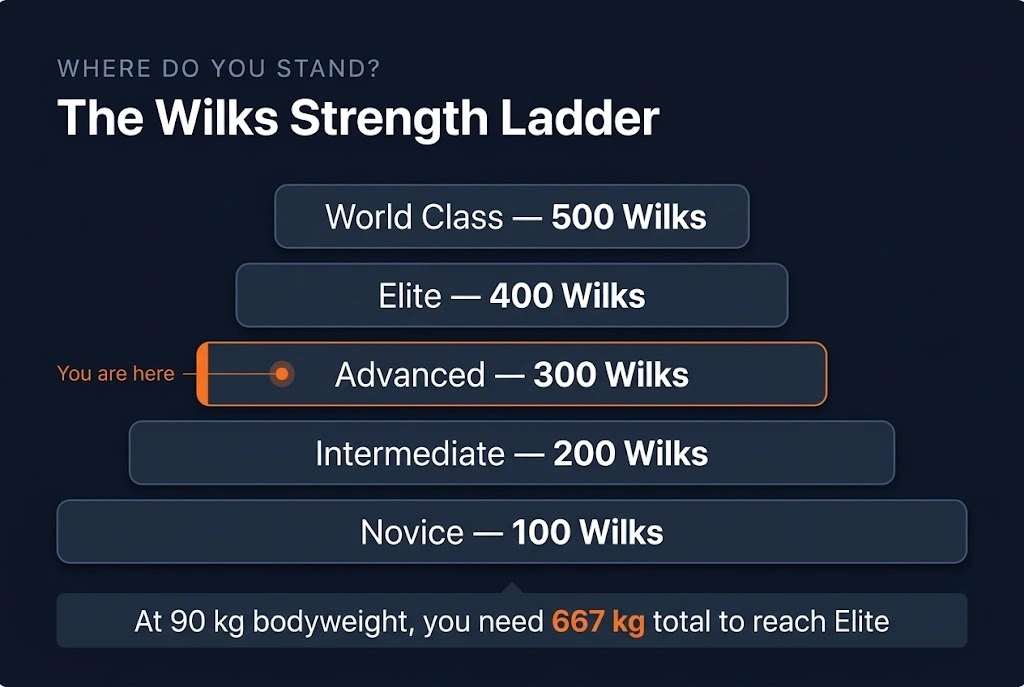
This section explains the "Standards at Your Bodyweight" accordion, the reverse Wilks calculation that answers the most practical question: how much do you need to total to reach the next level? The formula: Target Total = Target Wilks Score ÷ wilksCoeff(bodyweight, sex). For each level threshold (100, 200, 300, 400, 500 Wilks), the calculator solves this using your current bodyweight and sex, giving you a minimum total in your chosen unit. This calculation is bodyweight-specific, so if your bodyweight changes, the target total changes with it.
Reading the Standards Table
Your current level is marked with a ◀ arrow. Levels already passed are dimmed. Total Needed shows the minimum total to enter that band. World Class shows "Top tier" because there's no upper bound.
Example: a 90 kg male with a Wilks score of 350 (Advanced) would see the table show approximately 667 kg total needed for Elite (400 Wilks). That gap, roughly 17 kg, becomes a concrete programming target.
Planning Your Next Training Block From Your Standards
Take the Total Needed for your next level and divide it across the three lifts based on your current lift ratios. If your current total is 600 kg (240 squat, 160 bench, 200 deadlift) and you need 667 kg for Elite, that's 67 kg distributed across the three lifts, giving you specific lift-level targets rather than an abstract Wilks number. For per-lift benchmarks to plan against, see Average Bench Press Standards.
Wilks Score in Competitive Powerlifting
How Federations Use Wilks Scores
Federations use the Wilks score in three ways: Best Lifter awards, comparing performances across weight classes at the same meet; federation rankings, ordering all lifters nationally or internationally on a single scale; and historical comparisons, measuring current lifters against records set in other eras or weight classes. Wilks 2020 is the current IPF official standard, while some other federations still use the 1998 version or DOTS. When registering for a meet, check which formula the federation uses.
Comparing Across Sex and Weight Classes
A key use of the Wilks score is head-to-head comparison of male and female lifters, something raw totals can't do. Because the polynomial coefficients are sex-specific, a Wilks score of 400 represents an equally difficult achievement for a male 90 kg lifter and a female 63 kg lifter, relative to their respective population distributions. The limitation worth knowing: the score reflects population averages and isn't a perfect equaliser. Some lifters are more or less "efficient" for their bodyweight than the polynomial assumes. For the fuller competitive context, see the Powerlifting & Competition guide.
Export, Print, and Share Your Results
Export to PDF
Clicking Export PDF generates a PDF entirely in the browser—no server, no upload, no data leaving your device. The file (saved as wilks-score.pdf) includes your inputs (sex, bodyweight, total, and entry method), your Wilks 1998 score and strength level, a comparison table with all three formula scores, and a disclaimer noting the results are estimates. Useful for sharing results with a coach, keeping a training log, or benchmarking before a competition.
Print Your Results
Clicking Print opens the browser's print dialog with a dedicated print stylesheet, a clean, ink-friendly, black and white summary. Works with "Save as PDF" in any browser as an alternative to the Export PDF button. Use the print view for posting results on a physical training board or handing them to a coach.
Technical Notes and Input Validation
Calculation Engine
All computation runs client-side in JavaScript; no data is sent to any server. The engine is deterministic: identical inputs always return identical scores. Scores are rounded to two decimal places (Math. Round(n × 100) / 100). Pressing Enter in any input field triggers the calculation; pressing Escape closes any open tooltip.
Input Validation Rules
The calculator rejects inputs outside the polynomial's validated range, since extrapolating beyond these bounds produces unrealistic scores.
| Input | Valid Range | Notes |
| Bodyweight—Male | 40-210 kg (88.2-463 lb) | Reflects the range over which Wilks coefficients were fitted |
| Bodyweight—Female | 26.51-150.95 kg (58.4-332.6 lb) | Same reason, coefficients aren't reliable outside this range. |
| Total | > 0 kg; max 2,000 kg (4,409 lb) | Sanity cap; any total above this flags an input error. |
| Near-edge warning | Within 5% of the boundary | Results may be less accurate near formula extremes. |
Coefficient Sources
| Formula | Polynomial degree | Source |
| Wilks 1998 | 5th-degree | R. Wilks, Powerlifting Australia (1998) |
| Wilks 2020 | 5th-degree | Revised IPF dataset (2020) |
| DOTS | 4th-degree | IPF-derived, Brechue & Mayhew |