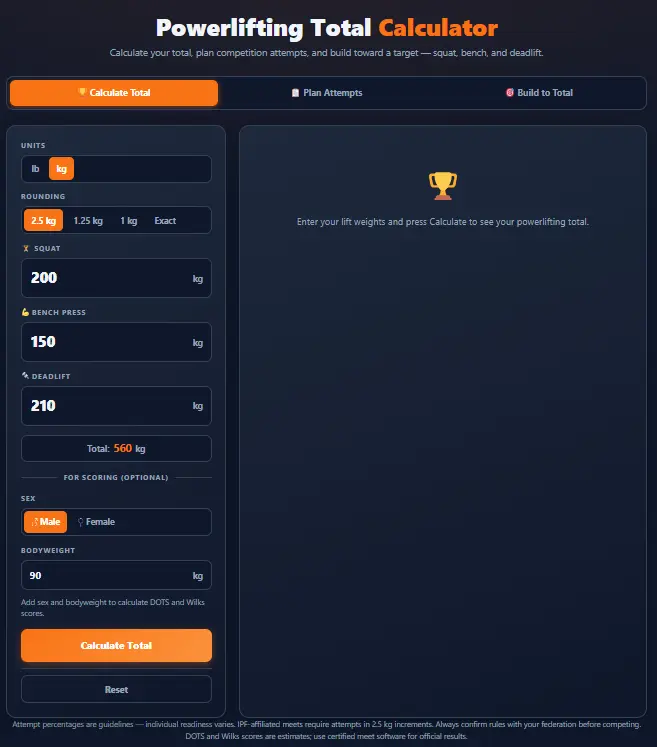
Powerlifting Total Calculator
Calculate your total, plan competition attempts, and build toward a target — squat, bench, and deadlift.
Add sex and bodyweight to calculate DOTS and Wilks scores.
Enter your lift weights and press Calculate to see your powerlifting total.
Attempt percentages are guidelines — individual readiness varies. IPF-affiliated meets require attempts in 2.5 kg increments. Always confirm rules with your federation before competing. DOTS and Wilks scores are estimates; use certified meet software for official results.
Every competitive powerlifter needs three numbers answered at once: what is my total, what should my attempts be, and how far am I from my next goal? This powerlifting total calculator handles all three in separate modes built for exactly those workflows. Calculate Total gives you your current squat, bench press, and deadlift sum with lift balance analysis and bodyweight-adjusted scoring. Plan Attempts generates a three-attempt competition plan with safety-calibrated strategies. Build to Total works backward from a goal to show you the per-lift requirements and the gap to close. For the 1RM foundation underlying all three modes, see One Rep Max Basics.
What the Powerlifting Total Calculator Does
| Mode | Key Features |
| Calculate Total | Sum squat/bench/deadlift: total, lift distribution bar, balance analysis, limiting lift identification, DOTS score, Wilks score, IPF weight class, competitive level table |
| Plan Attempts | Expected maxes: three-attempt competition plan (opener/working/max), three strategy options (Conservative/Moderate/Aggressive), three projected total scenarios, and meet-day tips |
| Build to Total | Target total: per-lift requirements (standard or custom ratio), gap analysis against current lifts, scoring at target total |
| All Modes | lb/kg units, rounding options (5/2.5/1/Exact), PDF export, print view, Enter-key calculation |
Three modes covers every competitive use case: scoring where you are now, planning how you'll perform on the platform, and mapping the gap between current and goal.
The Three Modes: Choosing Your Workflow
Pick the mode that matches the question you're trying to answer:
- Calculate Total: "I want to know my current total and how my lifts compare." Use this to track training progress, compute DOTS or Wilks for competitive comparison, see your IPF weight class, or identify which lift is holding your total back.
- Plan Attempts: "I have a meet coming up and need to pick my three attempts for each lift." Use this to generate a safety-calibrated attempt plan based on your realistic meet-day Maxes: Conservative for first meets, moderate for standard competition, aggressive when chasing a record.
- Build to Total: "I want to hit a specific total. Tell me what I need on each lift." Use this to set a goal total, see the squat/bench/deadlift split required, and find exactly how much each lift needs to improve from your current numbers.
Calculate Total Mode: Your Lifts, Your Total, Your Score
Entering Your Lifts and Getting Your Total
Enter your best squat, bench press, and deadlift. The calculator accepts weights up to 2,000 in any unit. The live total pill updates in real time as you type, showing the running sum before you press Calculate. Bodyweight and sex are optional: leave them blank if you only need the total and lift balance analysis. Add them to activate the DOTS score, Wilks score, and IPF weight class output.
The Lift Distribution Bar
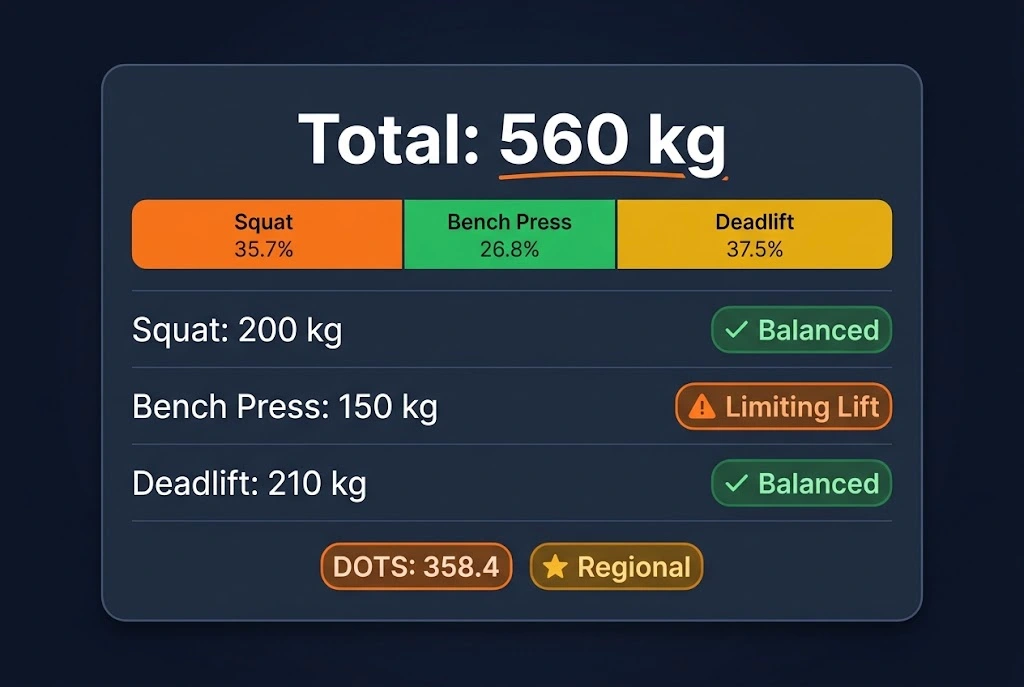
The stacked bar below the total shows the proportional share of each lift: squat in orange, bench press in green, and deadlift in yellow. At 200/150/210 kg (total 560 kg), the bar shows squat at 35.7%, bench at 26.8%, and deadlift at 37.5%. This gives an instant visual read on whether the total is squat-dominant, bench-light, or deadlift-heavy relative to the competitive norms the calculator benchmarks against.
Balance Breakdown: Identifying Your Limiting Lift
The balance section compares each lift's actual share against the IPF-average expected distribution: squat ~36%, bench ~27%, deadlift ~37%. A lift more than approximately 1% below its expected share is flagged as the limiting lift: the one whose targeted improvement would grow the total the fastest. For a 200/150/210 total, bench press at 26.8% falls just below its 27% expected share and is flagged accordingly. The limiting lift badge is colour-coded (orange for limiting, green for balanced or above) and paired with a coaching note on the implication.
DOTS Score, Wilks Score, and Competitive Level
When sex and bodyweight are provided, the calculator produces both a DOTS score and a Wilks score from the total, using the same formulas as the standalone DOTS Score Calculator and Wilks Score Calculator on this site. The Competitive Level Reference Table maps the DOTS score to an approximate competitive tier (recreational through elite), with the current level highlighted. A DOTS score of 358 is regional level for a male lifter: knowing where that sits on the competitive ladder gives the raw number context that a total alone cannot provide.
IPF Weight Class
Based on the entered bodyweight, the calculator displays the IPF weight class the lifter competes in. A 90 kg male competes in the 93 kg class; a 75 kg female competes in the 76 kg class. This is meaningful for comparison: a 560 kg total in the 93 kg class represents a very different competitive standard from the same total in the 74 kg class.
| Sex | Weight Classes (kg) |
| Male | 59 · 66 · 74 · 83 · 93 · 105 · 120 · 120+ |
| Female | 47 · 52 · 57 · 63 · 69 · 76 · 84 · 84+ |
Source: International Powerlifting Federation. These are IPF classes; other federations may use different bodyweight divisions.
Plan Attempts Mode: Competition Strategy Made Simple
Understanding the Three Strategies
Enter your realistic expected max for each lift on meet day, then select a strategy. The percentage determines how conservative or aggressive your three attempts are set relative to that ceiling.
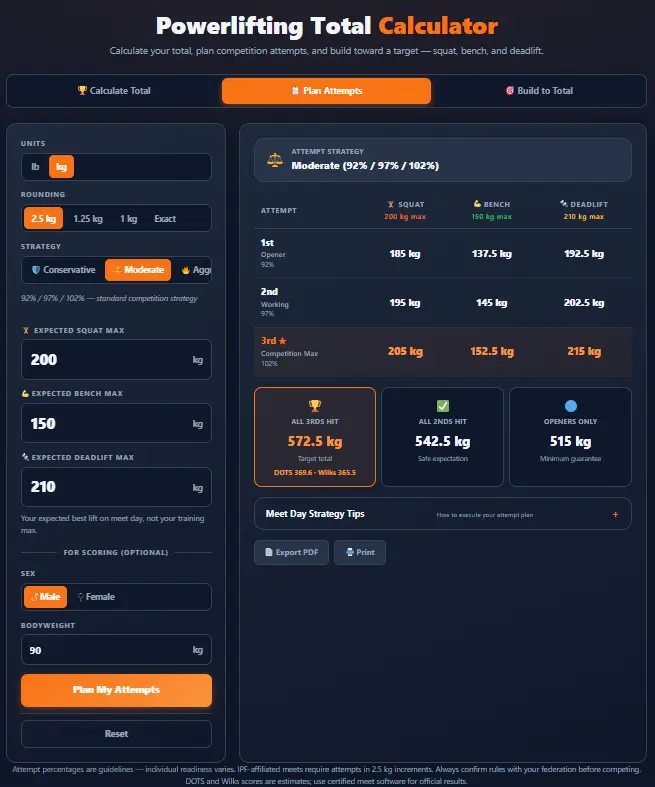
| Strategy | 1st Attempt (Opener) | 2nd Attempt (Working) | 3rd Attempt (Competition Max) |
| 🛡️ Conservative | 90% of expected max | 95% of expected max | 100% of expected max |
| ⚖️ Moderate (default) | 92% of expected max | 97% of expected max | 102% of expected max |
| 🔥 Aggressive | 93% of expected max | 98% of expected max | 105% of expected max |
Percentages are applied to your entered expected max, then rounded to the selected increment. IPF-affiliated meets require attempts in 2.5 kg increments; select 2.5 kg rounding for those events.
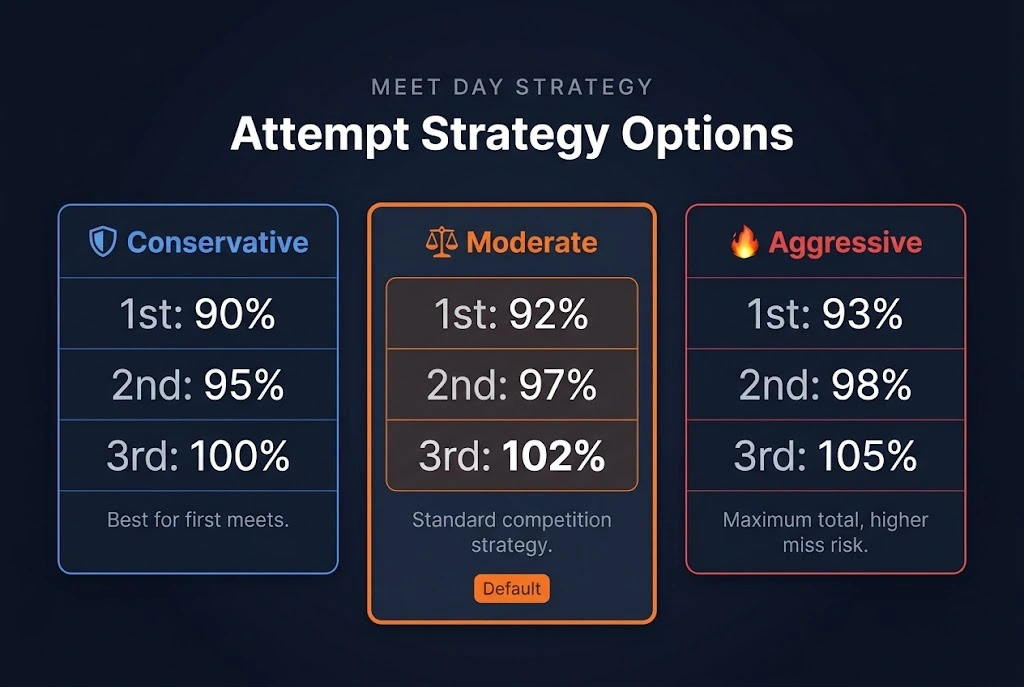
| Strategy | Best for | Risk level |
| 🛡️ Conservative | First meet; uncertain health or readiness; strong preference for a clean total | Low: maximizes the chance of completing all three attempts |
| ⚖️ Moderate | Standard competition; experienced lifter; realistic maxes entered | Standard: the most common approach across all competitive levels |
| 🔥 Aggressive | Record attempts; peak fitness; willing to risk a third-attempt miss for a PR total | High: the third attempt may be above the true current 1RM. |
Per the strength and conditioning guidelines on maximal performance, three-attempt competition planning should be calibrated to the specific performance context; a first meet has very different risk-reward trade-offs from a national championship qualifier.
Conservative: Safe Openers for Reliable Totals
The Conservative strategy opens at 90% of the expected max, heavy enough to feel like real competition weight but near-certain to make. The 100% third attempt is the expected max itself, not a reach beyond it. This eliminates third-attempt risk almost entirely in exchange for a slightly lower ceiling total. Use Conservative at every first meet, any meet where health or readiness is uncertain, and any situation where completion matters more than the number.
Moderate: The Standard Competition Approach
The moderate strategy (92/97/102%) is the most widely used competitive approach at all levels. Opening at 92% keeps the opener well within the lifter's capacity, while the 102% third attempt represents a modest but achievable PR on a good day. Most experienced coaches default to moderate unless there is a specific reason to go more conservative or more aggressive for a particular athlete.
Aggressive: Maximum Total, Higher Risk
The aggressive strategy (93/98/105%) sets the third attempt at 105% of the expected max. For a lifter with a 200 kg squat, that means attempting 210 kg as the third. The miss risk is real. Use this strategy only when the entered expected max is conservative (the true ceiling may be higher), the lifter has verified peak readiness, and the prize of the higher total justifies the risk of missing the third.
Reading the Attempt Table
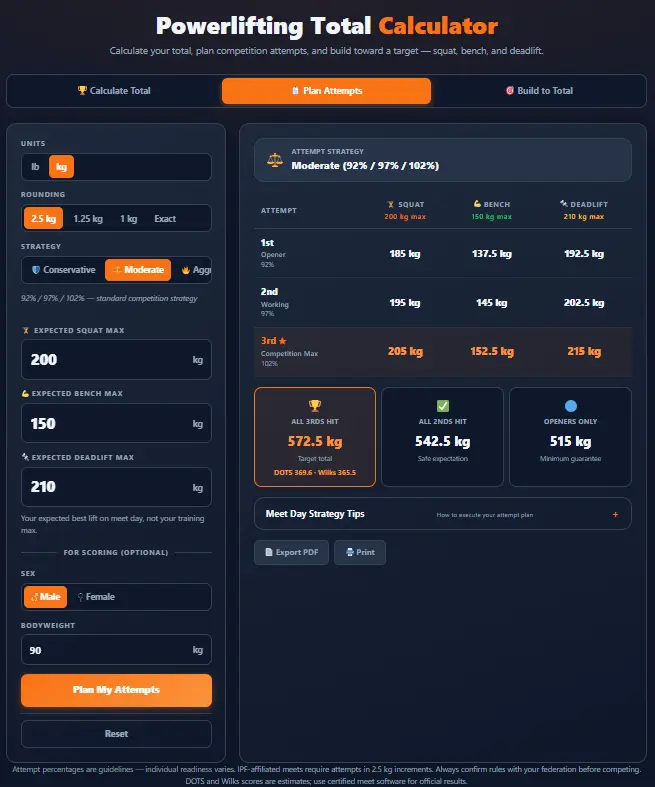
After pressing Generate Plan, the attempt table shows three rows (1st, 2nd, and 3rd) across three lifts. The third-attempt row is highlighted and marked ★ (Competition Max): it defines the projected competition total if all attempts go to plan. All weights are rounded to the selected increment.
Projected Totals: Three Scenarios
Below the attempt table, three projected totals show the range of outcomes. All three hits is the ideal competition total. All seconds hit is the reliable backup if third attempts miss. Openers only is the worst-case total where both the second and third attempts fail. These scenarios help lifters check whether their opener-only total is competitive in their division and whether hitting all seconds achieves the minimum goal even if thirds don't go.
Meet Day Strategy Tips
The Meet Day Tips section inside the Plan Attempts result provides coaching guidance for the day itself:
- Opener rule: Your opener should feel like a warm-up, not a grind. Choose a weight you've successfully completed for a triple in training, minimum.
- Second attempt: If the opener went well, take the planned second. If it felt harder than expected, stay conservative; a successful second is always the priority over a maximal third.
- Third attempt: Go for the third only when the second felt controlled. A missed third attempt in powerlifting results in a zero for that attempt, but your total is still based on the best successful lift in each movement.
- Federation rules: IPF-affiliated meets require attempts submitted in 2.5 kg increments. Always confirm your federation's specific rules on attempt timing and weight increments before finalising your plan.
Build to Total Mode: Work Backward from Your Goal
Setting a Target Total
Enter your goal total in the Target Total field. Common target-setting scenarios:
- A qualifying standard for a national championship (for example, 600 kg in the 93 kg class)
- A competitive milestone such as hitting a 2× bodyweight total across all three main lifts
- A DOTS score target: cross-reference with the DOTS Score Calculator to find the total required for a given DOTS at your bodyweight
- A round-number training benchmark (500 kg, 1,000 lb, or a specific fraction of bodyweight total)
Standard vs. Custom Lift Ratio
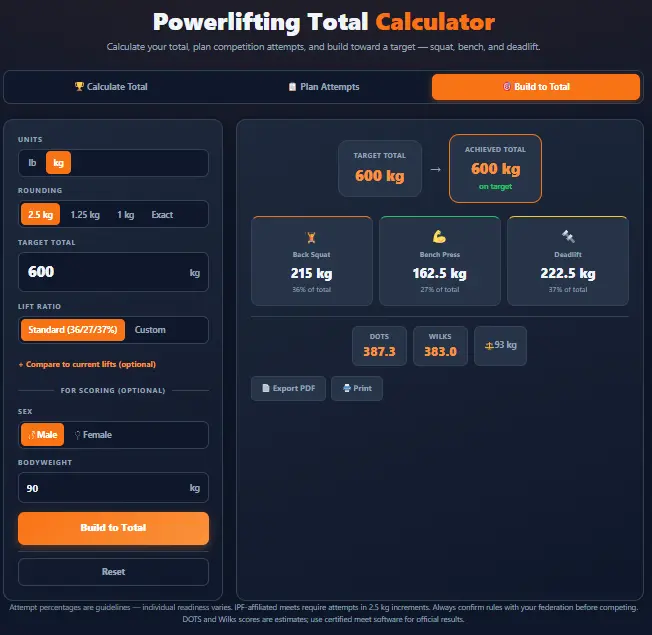
The standard ratio (36/27/37) distributes the target total across squat, bench press, and deadlift according to IPF-average competitive proportions. The custom ratio lets you enter your own percentages (summing to 100) for a more realistic split if your individual lift profile differs significantly from the average. A lifter who pulls substantially more than they squat might use a 33/25/42 split to produce targets that match their actual pattern rather than forcing a standard split onto an atypical profile.
The Gap Analysis: How Far Are You?
When current lift values are entered, the calculator shows exactly how much each lift needs to improve. The result covers both per-lift gaps and the overall total gap remaining.
| Current | Target (Standard 36/27/37) | Gap | |
| Squat | 200 kg | 216 kg (36%) | +16 kg |
| Bench Press | 150 kg | 162 kg (27%) | +12 kg |
| Deadlift | 210 kg | 222 kg (37%) | +12 kg |
| Total | 560 kg | 600 kg | +40 kg |
Gap values are rounded to the selected increment. The Achieved Total card shows the exact achievable total after rounding, which may differ slightly from the target.
The gap analysis converts a vague goal ("I want to hit 600 kg") into three specific lift targets with quantified improvements needed, something a training cycle can address directly. Use the Training Max Calculator to programme the gap for each lift, and the Strength Standards guide for population-level context on where each target sits.
What the 36/27/37 Distribution Means
These percentages represent the average split across competitive powerlifting totals, not a template every lifter should conform to. The distribution reflects a physiological pattern: the deadlift typically produces the highest absolute weight (large muscle groups, favorable biomechanics), the squat second-highest, and the bench press the lowest of the three. A lifter whose bench press represents only 23% of their total has a proportionally underdeveloped bench relative to their pulling and squatting capacity, even if their bench press in absolute terms is quite strong.
Using the Limiting Lift Concept in Training
The limiting lift badge is actionable: it tells you where adding strength produces the fastest total growth. If bench press is flagged as the limiting lift, a training block prioritizing bench press frequency and volume, while maintaining squat and deadlift, will produce a larger total increase than a uniformly distributed approach. This is distinct from "your weakest lift" in absolute terms. It's the lift whose proportional contribution to the total is furthest below its expected competitive share.
How Attempt Selection Actually Works at a Meet
The Importance of a Successful Opener
In powerlifting, the opener is the most strategically important attempt. A failed opener means the lifter must repeat the same weight or increase it for the second attempt; going lighter is not allowed. A successful opener establishes a baseline total immediately, settles nerves, confirms that technique is working on the day, and gives the coach real information to make the second-attempt decision. Choose an opener you could make on your worst day in training. The Conservative strategy's 90% opener is calibrated precisely to this principle.
Second Attempt: Building Your Working Weight
The second attempt is the working weight: what you'd be satisfied with if the third attempt fails. For most lifters, the second attempt represents their realistic competition best on a typical day. If the opener felt easier than planned, take the planned second. If the opener was a grind, hold the second or make only a minimal jump. What happens on the second determines whether the third attempt becomes a routine PR or a true ceiling test.
Third Attempt: Going for the Record
The third attempt is where strategy diverges most clearly by goal. In the moderate strategy, the 102% third represents a modest PR reachable in good conditions. In the aggressive strategy, the 105% third is a significant reach requiring near-perfect execution on the day. In IPF-affiliated meets, attempts must be submitted within a specific time window after the previous attempt and in 2.5 kg increments. See the International Powerlifting Federation for the current rulebook and timing protocols.
DOTS Score, Wilks Score, and Competitive Level
Why Bodyweight-Adjusted Scores Matter
Raw totals cannot be fairly compared across weight classes. A 600 kg total from a 66 kg lifter is a fundamentally different achievement from 600 kg at 120 kg bodyweight. DOTS and Wilks solve this by applying a bodyweight coefficient that, in theory, equalizes difficulty across the full competitive weight range. This is why Best Lifter awards at meets are determined by a coefficient score rather than the raw total.
DOTS vs. Wilks in This Calculator
Both scores are computed simultaneously when sex and bodyweight are provided. DOTS uses a 4th-degree polynomial calibrated on recent IPF competition data; Wilks uses an older 5th-degree polynomial from the 1990s dataset. For IPF-affiliated competition, DOTS is the current standard. For comparing against historical records or lifters in federations still using Wilks, the Wilks score remains the more appropriate reference. The standalone DOTS Score Calculator and Wilks Score Calculator provide deeper comparison context, including the lift balance analysis mode.
Reading the Competitive Level Reference Table
The Competitive Level table in Calculate Total results maps the DOTS score to a six-tier competitive classification: Recreational, Club, Regional, National, International, and Elite, with the current tier highlighted. A DOTS score of 358 is regional level, meaning it would be competitive at regional meets and is approaching national-qualifying territory in many federations. The thresholds here match those in the DOTS Score Calculator for consistency. For the full competitive context, see the Powerlifting & Competition guide.
Export, Print, and Competition Documentation
Export to PDF
All three modes support one-click PDF export, generated entirely in the browser with no server upload. The PDF adapts to the current mode:
- Calculate Total PDF: total, lift breakdown, balance analysis, DOTS and Wilks scores where available
- Plan Attempts PDF: full attempt table (all three lifts × three attempts), projected totals for all three scenarios, strategy label
- Build to Total PDF: target total, per-lift requirements, gap analysis against current lifts
The Plan Attempts PDF is particularly useful for handing to a handler or head coach at a meet, showing all pre-planned attempts for all three lifts on a single sheet.
The Print button opens the browser print dialog with a clean, ink-friendly stylesheet. The attempt table prints clearly for posting at a training station during meet-preparation weeks. Use "Save as PDF" in the browser as an alternative to the Export button.
Technical Notes and Disclaimer
Validation Rules
All computation runs client-side; no data is sent to any server.
| Input | Rule |
| Lift weights (Calculate Total) | Finite positive number; maximum 2,000 (any unit) |
| Target Total (Build to Total) | Finite positive number; maximum 10,000 (any unit) |
| Bodyweight (scoring) | Male: 40–210 kg; Female: 26.51–150.95 kg |
| Custom ratio (Build to Total) | Three percentages that sum to exactly 100 |
| Strategy (Plan Attempts) | Conservative, Moderate, or Aggressive |
Accuracy Disclaimer
DOTS and Wilks scores in this calculator are estimates derived from the published polynomial coefficients. Results may differ slightly from certified meet software due to rounding conventions. For official competition records and qualifying totals, always use your federation's certified calculation software. Attempt percentages are guidelines; individual readiness, training camp performance, and meet-day conditions all affect what is achievable.