Strength Standards Calculator
Enter your lifts and see how you rank — Beginner through Elite — for your bodyweight.
Your current bodyweight.
Leave blank for lifts you don't do.
This Strength Standards Calculator benchmarks five major barbell lifts against bodyweight-ratio standards, showing your exact strength level, Beginner through Elite, for each lift, how close you are to the next level, and what weight you need to get there.
What the Strength Standards Calculator Does
| Feature | What it does |
| 📊 Per-Lift Strength Levels | Each lift rated independently: Beginner, Novice, Intermediate, Advanced, or Elite |
| 🔥 Overall Strength Level | Average level across all entered lifts, your composite rating |
| 📈 5-Segment Progress Bars | Animated bar showing exactly where you sit within your current level and how far to the next |
| 🎯 Gap-to-Next-Level | Exact additional weight needed to cross the next threshold, plus the absolute target weight |
| 📋 Full Standards Table | Accordion showing every threshold weight at your bodyweight for all five lifts |
| ⚖️ lb / kg Switching | Flip between pounds and kilograms at any time; all inputs and results update instantly |
| ♂♀ Sex-Specific Standards | Separate multiplier tables for male and female athletes |
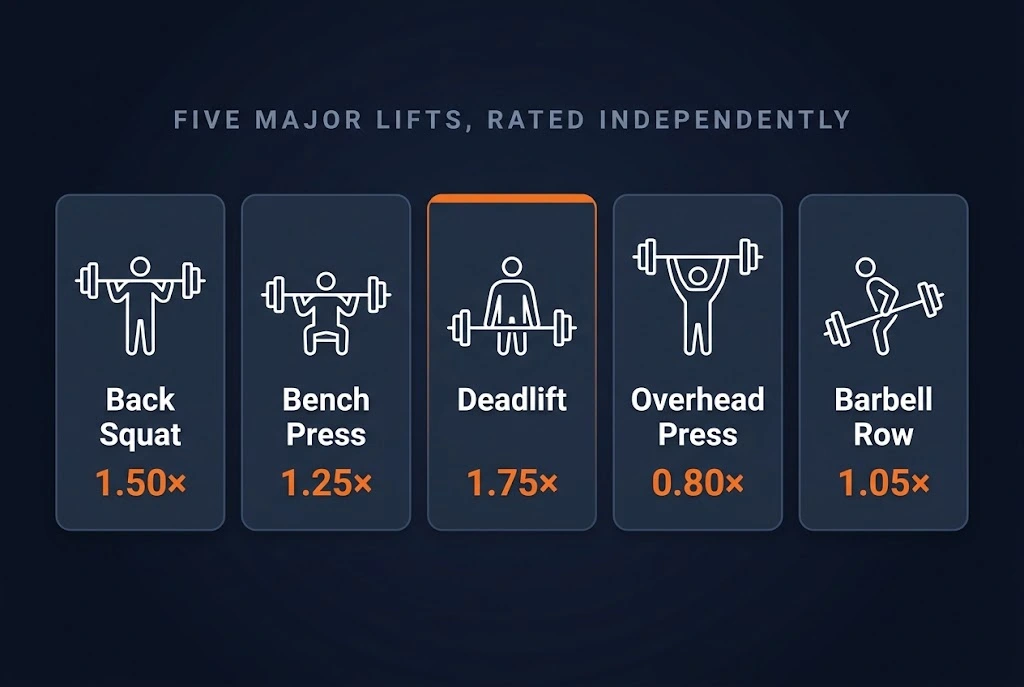
| 💪 Five Major Lifts | Back Squat, Bench Press, Deadlift, Overhead Press, Barbell Row |
| ⬇️ PDF Export | Downloads a full standards report as a PDF, generated entirely in the browser |
| Clean print view strips the UI and formats results for paper | |
| 📱 Mobile-Friendly | Fully responsive; works on phones, tablets, and desktops |
| ♿ Accessible | Keyboard navigable, ARIA-labelled, visible focus indicators |
Enter as few or as many lifts as you have, the calculator works with just one. The result is a per-lift rating, an overall composite level, and a concrete weight target for the next milestone.
How to Use the Strength Standards Calculator?
Step 1: Choose Your Sex and Units
Select Male or Female. The calculator uses separate bodyweight-multiplier tables for each sex, reflecting different strength distributions across the population. Then choose lb or kg. All input placeholders and results, including gap-to-next-level figures, update instantly when you switch units, even if results are already showing; no need to recalculate.
Step 2: Enter Your Bodyweight
Enter your current training bodyweight, not a competition weigh-in or walk-around weight unless those match your training context. The standards are most accurate between 66-300 lb (30-136 kg); a warning appears if you're outside this range, but results are still shown. Maximum accepted bodyweight is 400 kg (882 lb).
Step 3: Enter Your Lift 1RMs
Which Lifts to Enter
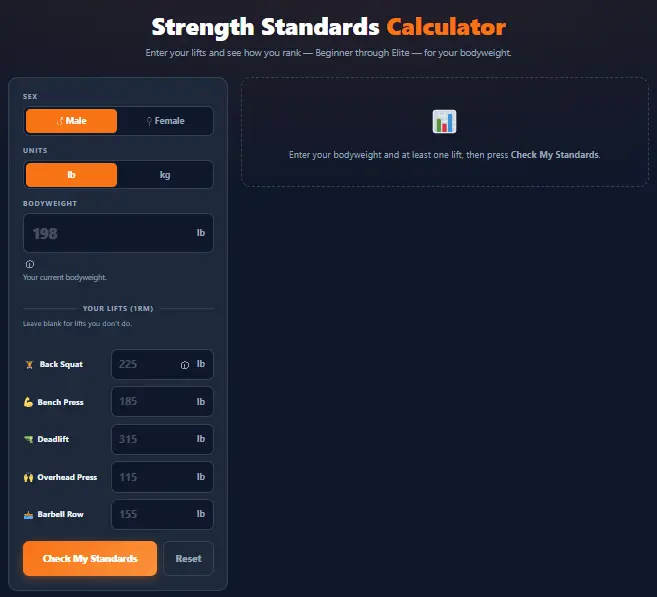
The calculator accepts any combination of the five major lifts, Back squat, Bench Press, Deadlift, Overhead Press, and Barbell Row. Leave any lift blank to skip it; the calculator works with as few as one lift entered. Enter your heaviest successful 1-rep effort for each lift. Use whichever deadlift variation you train, conventional or sumo. For the bench press, the standard assumes chest touch and full lockout; for the overhead press, it is standing with no leg drive.
What If You Don't Have a Tested 1RM?
Enter the heaviest weight you've successfully lifted for 1 rep in training, a gym PR counts. If you've never attempted a single, enter your last heavy working set weight rather than leaving the field blank. This calculator doesn't have built-in rep-to-1RM estimation, unlike the main 1RM calculator. If you want an estimated 1RM from a multi-rep set, use the one rep max calculator first, then enter the result here. Beginners still building that number can also start with 1RM for Beginners.
Step 4: Press Check My Standards and Read Your Results
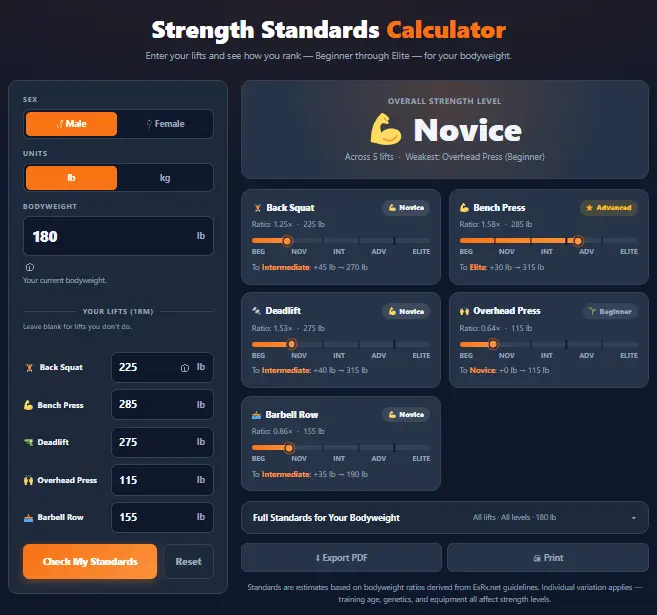
After pressing Check My Standards or pressing Enter in any field, three things appear: an Overall Strength Level card at the top showing your composite rating, individual lift cards below with a 5-segment progress bar, a level badge, and your gap-to-next-level figure, and a Full Standards Reference Table accordion you can expand. Each result component gets its own dedicated section below.
The Five Strength Levels: What Each One Actually Means
The Levels at a Glance
| Level | Training Profile | What it signals |
| 🌱 Beginner | 0-6 months of consistent training | Still learning movement patterns; linear progression working every session |
| 💪 Novice | 6 months - 2 years | Consistent gains; adding weight week to week; basic programming in place |
| 🔥 Intermediate | 2-5 years | Structured periodisation required; stronger than the vast majority of gym-goers |
| ⭐ Advanced | 5+ years, serious commitment | Club-level competitive strength; training cycles planned months ahead |
| 🏆 Elite | Rare, top-percentile athletes | National-level competitor; exceptional genetics and decade-plus of dedicated training |
Training ages are approximate. Individual genetics, program quality, and training consistency significantly affect progression timelines.
🌱 Beginner
A beginner-rated lift is one that virtually anyone can reach with a few months of consistent barbell training. At this level, any structured program works; the body responds to almost any stimulus. The priority is building movement quality and technique, not chasing numbers. Linear progression should be happening every session or every week.
💪 Novice
A Novice rating represents meaningful progress: the lift is above the natural baseline and reflects deliberate, consistent training. Novice lifters are stronger than the majority of the general population who train recreationally. Linear progression is still accessible at this level for most lifters.
🔥 Intermediate
Intermediate is a significant milestone. Reaching it on any lift requires genuine programming; linear progression has been exhausted, and more structured approaches are needed. Intermediate lifters are significantly stronger than typical gym-goers and are starting to think seriously about training variables.
⭐ Advanced
Advanced strength on any lift puts a lifter in a small percentage of the training population. Getting here typically takes 5+ years of consistent, well-structured training. Advanced lifters are often competitive at club and local meet level and work with coaches or carefully planned periodization blocks.
🏆 Elite
Elite ratings are uncommon. They represent top-percentile strength for any given population and typically correlate with competitive powerlifting at a national level. Reaching Elite on all five lifts simultaneously is an extraordinary achievement requiring exceptional genetics, a decade-long training commitment, and advanced programming. The calculator has no upper bound; scores above Elite are possible.
The "Getting Started" Sub-Level
If a lift is below the beginner threshold, meaning the bodyweight multiplier isn't yet met, the calculator shows a "Getting Started" sub-level instead of Beginner. This isn't a failure state. It means the lift is in its earliest development phase, and the gap-to-next-level will show exactly what's needed to reach Beginner, giving you a concrete first milestone.
Strength Standards by Lift and Bodyweight
Male Strength Standards: Bodyweight Multipliers
Each lift has its own multiplier per level. Multiply your bodyweight by the threshold to get the target weight for that level.
TABLE: Male Strength Standards (Bodyweight Multipliers)
| Lift | 🌱 Beginner | 💪 Novice | 🔥 Intermediate | ⭐ Advanced | 🏆 Elite |
| Back Squat | 1.00× | 1.25× | 1.50× | 1.75× | 2.25× |
| Bench Press | 0.75× | 1.00× | 1.25× | 1.50× | 1.75× |
| Deadlift | 1.00× | 1.50× | 1.75× | 2.25× | 2.75× |
| Overhead Press | 0.50× | 0.65× | 0.80× | 1.00× | 1.25× |
| Barbell Row | 0.65× | 0.85× | 1.05× | 1.25× | 1.50× |
Worked example: a 180 lb male who squats 250 lb has a ratio of 250 ÷ 180 = 1.39×. Novice threshold is 1.25×; the intermediate is 1.50×. He's rated Novice, and his gap to Intermediate is (1.50 × 180) − 250 = 270 − 250 = 20 lb.
Female Strength Standards: Bodyweight Multipliers
Female multipliers are lower in absolute terms but represent equivalent relative achievement within the population they're drawn from.
TABLE: Female Strength Standards (Bodyweight Multipliers)
| Lift | 🌱 Beginner | 💪 Novice | 🔥 Intermediate | ⭐ Advanced | 🏆 Elite |
| Back Squat | 0.50× | 0.75× | 1.00× | 1.25× | 1.50× |
| Bench Press | 0.35× | 0.50× | 0.65× | 0.85× | 1.00× |
| Deadlift | 0.60× | 0.90× | 1.15× | 1.40× | 1.75× |
| Overhead Press | 0.25× | 0.40× | 0.55× | 0.70× | 0.85× |
| Barbell Row | 0.40× | 0.55× | 0.75× | 0.95× | 1.15× |
Worked example: a 130 lb female who deadlifts 165 lb has a ratio of 165 ÷ 130 = 1.27×. Novice threshold is 0.90×; Intermediate is 1.15×. She's rated Intermediate, already above that threshold but short of Advanced (1.40×). Her gap to Advanced is (1.40 × 130) − 165 = 182 − 165 = 17 lb.
How to Read the Multiplier Tables
Three steps get you from a table to a target weight. First, find your lift's row. Second, multiply your bodyweight by each threshold multiplier to get the absolute weight for each level. Third, find where your actual 1RM sits; the highest multiplier threshold you meet or exceed is your level. The calculator does all of this automatically; the table is here so you can see the underlying math.
Why Bodyweight Multipliers Instead of Absolute Weights?
Absolute weights, saying "an Intermediate bench press is 200 lb," are unfair to lighter and heavier athletes alike. A 130 lb lifter benching 200 lb is extraordinarily strong; a 250 lb lifter doing the same is relatively less impressive. Bodyweight multipliers scale the standard proportionally, so a 1.25× bench means the same relative achievement at any bodyweight. These ratios follow the ExRx.net strength standards methodology, derived from population-level data for natural, drug-free athletes using standard equipment.
Understanding Your Progress Bar and Gap-to-Next-Level
How the 5-Segment Progress Bar Works
The progress bar spans the full range from Below Beginner to Elite, divided into five equal 20-point segments, one per level. Four marker dots at 20%, 40%, 60%, and 80% mark the level boundaries: Beginner, Novice, Intermediate, and Advanced thresholds. An orange dot shows your exact position within your current level, and the bar fills smoothly on first render. In plain English, within any level, your position is calculated based on how far through that level's range your ratio sits.
Reading the Gap-to-Next-Level Figure
Below each progress bar, the calculator shows: "To [Next Level]: +[X lb] → [target weight]." The additional weight is exact, not rounded, until the target absolute weight is calculated. That target weight is rounded to the nearest 5 lb (or 2.5 kg) for practical training use. When Elite is achieved, the card shows "🏆 Elite level achieved!" with no gap figure, since there's no next level. The formula behind it: Gap = (next threshold multiplier × bodyweight) − your current lift.
Using the Gap as Your Next Training Target
The gap figure is the most actionable output of the calculator, it converts an abstract level into a specific weight to hit. If you need 25 lb to reach Advanced on your deadlift and you're running a 12-week block, that's roughly 2 lb per week of progressive overload. Most gap figures are achievable within 1-3 training cycles with consistent programming.
A few practical steps for putting the gap figure to work:
- Write down the gap figure for your weakest lift
- Divide it by your planned training cycle length in weeks
- Compare this weekly increment to your current progression rate
- If the needed increment is larger than your current rate, adjust programming focus
Your Overall Strength Level: What It Means
How the Overall Level Is Calculated
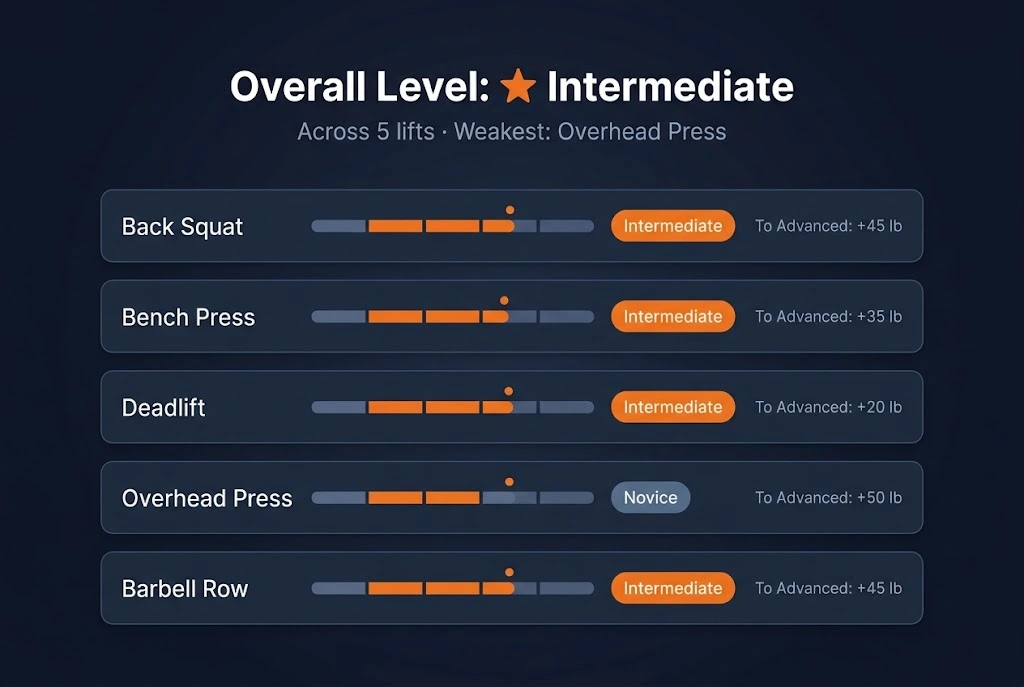
The overall level is the arithmetic average of all individual lift levels, rounded to the nearest whole level. If you enter three lifts rated Intermediate, Novice, and Advanced, the average is Intermediate. This is displayed on the top result card, and the subtitle line adapts: "Based on your [lift]" for a single entry, "All lifts rated [level]" when all are equal, or "Across [n] lifts · Weakest: [lift] ([level])" when levels differ.
What Imbalances Between Lifts Tell You
If your lifts rate very differently, an Advanced deadlift but a Novice bench press, for example, that's useful diagnostic information. It signals a muscle group or movement pattern that's been undertrained relative to the rest. A large spread between your highest and lowest-rated lifts is a stronger indicator of training imbalance than absolute weights are. Some asymmetry is normal; most people deadlift and squat at a higher level than they overhead press, but extreme gaps are worth addressing programmatically.
The "Weakest Lift" Indicator
When multiple lifts are entered at different levels, the subtitle explicitly names the weakest one, "Weakest: Bench Press (Novice)," for example. That's the lift to prioritize for bringing your overall level up. Use its gap-to-next-level figure as your primary near-term training target.
The Five Major Lifts: What the Standards Expect
Back Squat
The back squat is typically the highest-absolute-weight lift in the calculator. The standard assumes full depth, with a hip crease below the knee. Use high-bar or low-bar, whichever you train. The squat is often where trainees naturally have their highest level, due to high training frequency and carryover from other leg work. Male intermediate threshold: 1.50× bodyweight (270 lb at 180 lb bodyweight).
Bench Press
The bench press is the most commonly tested lift in gym culture but often the one where lifters are most asymmetrically undertrained relative to their other lifts. The standard assumes chest touch and full lockout, a paused touch-and-go bench. Grip width and foot position are free variables. Male intermediate threshold: 1.25× bodyweight (225 lb at 180 lb bodyweight).
Overhead Press
The overhead press is typically where lifters score their lowest level relative to their other lifts; OHP standards are demanding relative to typical gym training volume. The standard assumes a standing press from the front rack position, strict form (no leg drive, no hip-hinge assist), and full lockout overhead. Many intermediate lifters find OHP sits 1-2 levels below their squat and deadlift; this is normal and reflects the relatively lower training frequency most programs allocate to this lift.
Barbell Row
The barbell row is the pulling counterpart to the bench press and is the most variable of the five lifts in terms of technique standards. The calculator uses the bent-over barbell row (overhand or underhand, bar to lower chest or navel). The standard assumes controlled form, no aggressive hip hinge, or bouncing off the floor. Treat the standard as a guideline for horizontal pulling strength; the exact form variation matters less than consistency across measurements.
The Full Standards Reference Table: How to Use It
What the Table Shows
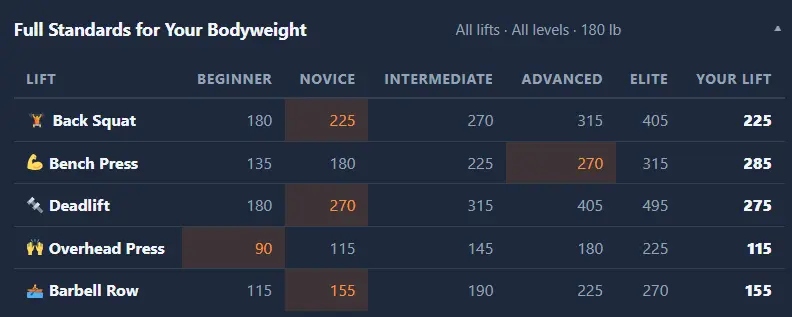
After calculating, an accordion labelled "Full Standards for Your Bodyweight" appears in the results section. Expanding it reveals a table with columns: Beginner, Novice, Intermediate, Advanced, Elite, and Your Lift. Your current level column is highlighted in orange, and your entered lift weight appears in the rightmost "Your Lift" column in bold. All threshold weights are calculated from the multipliers times your bodyweight, rounded to the nearest 5 lb or 2.5 kg for practical training use.
Using the Table for Long-Term Planning
The table lays out every level up to Elite for all five lifts simultaneously, at your exact bodyweight. Write down the Advanced and Elite columns for your primary lift, then use these as 6-month and 12-month goal anchors. If your bodyweight changes significantly, re-run the calculator with the new bodyweight; the threshold weights will update.
How These Standards Compare to Other Benchmarks?
Bodyweight Ratios vs. Wilks Score
The key difference: bodyweight-ratio standards evaluate each lift independently, while the Wilks score evaluates the combined total of three competition lifts (squat, bench, and deadlift). Bodyweight standards work for general strength training, including OHP and row, which don't appear in powerlifting totals. Wilks is the right tool when comparing powerlifting performance across bodyweights or against other competitors. The two serve different purposes and complement each other. If you compete or want a single composite score across your total, try the Wilks Score Calculator.
ExRx Standards vs. Federation Competition Standards
The standards in this calculator are derived from ExRx.net bodyweight-ratio guidelines and population-based averages for natural, drug-free athletes using standard equipment. They aren't federation-specific. Actual competition standards vary by federation, weight class, equipment category, and drug-testing status. An IPF Elite lifter operates at a significantly higher standard than "Elite" on these benchmarks. For general training and goal-setting, ExRx standards are the most widely used and practical reference; for competition-specific standards, consult your federation's classification tables. For the full population-level picture across ages and bodyweights, see Strength Standards & Benchmarks.
Using These Benchmarks for Goal Setting
The most practical use of the standards isn't classification, it's direction. Knowing you're Novice on bench press and need 25 lb to hit Intermediate gives you a specific, concrete target. Set one primary lift goal per training cycle using the gap figure, and use the full standards table as a long-term map. Reassess every 8-12 weeks.
Limitations and Important Notes
Who These Standards Are Most Relevant For
These standards are most accurate for natural, drug-free athletes using standard equipment (flat shoes, no wraps, no suit) with a bodyweight in the 66-300 lb / 30-136 kg range. Outside this range, particularly at very low or very high bodyweights, the multiplier approach becomes less representative, because very light and very heavy athletes often fall outside the population data used to derive the standards.
The standards are most accurate for:
- Drug-free strength athletes in their first 1-10 years of training
- General gym-goers using standard barbell equipment
- Athletes whose bodyweight is within the 66-300 lb validated range
- Lifters benchmarking progress at consistent bodyweight over time
What These Standards Don't Account For
These benchmarks don't account for age (teenagers and masters athletes may have different achievable standards), body composition (two lifters at the same bodyweight with different lean mass proportions may have different capacities), equipped lifting (wraps and suits significantly increase what's achievable beyond these standards), or individual genetic factors. Use these standards as motivational benchmarks and long-term planning tools, not as absolute measures of athletic capability.