
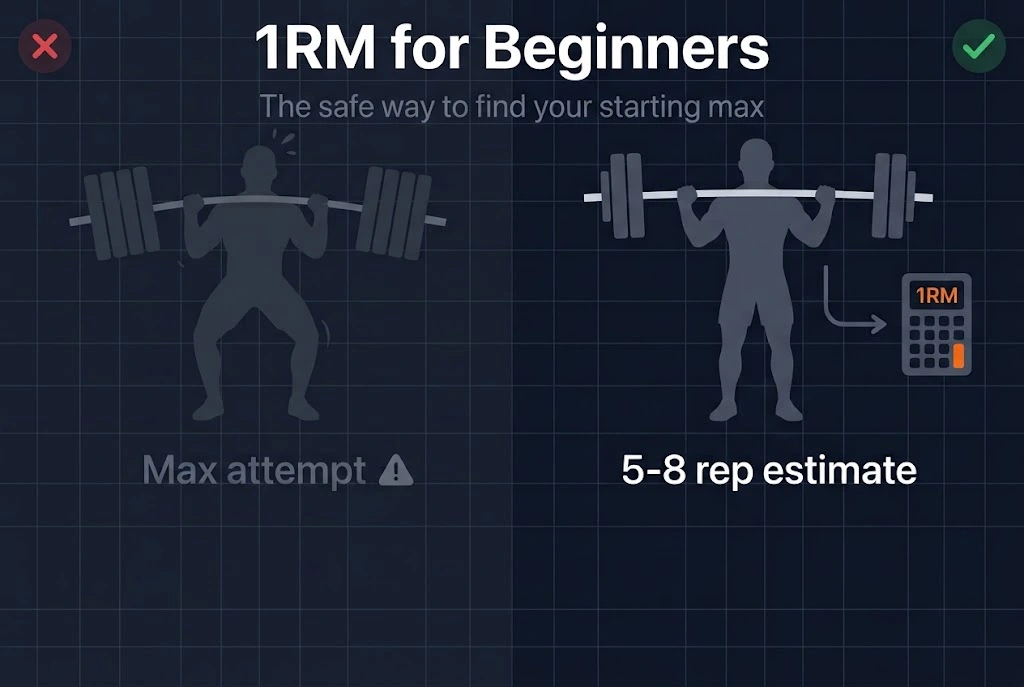
1RM for Beginners: A Safe Starting Guide
Your program says “work at 75% of your 1RM,” and you have no idea what your 1RM is. That’s the problem this guide solves. 1RM for beginners doesn’t mean loading the bar to a dangerous max and finding out the hard way. It means getting a reliable estimate from a set you can already do safely, so your program’s percentages actually mean something from your first session. Here’s how to find that number without a max attempt, what rep range to use, and when you’re eventually ready to test for real.
What Is 1RM and Why Should Beginners Care?
A 1RM (one-rep max) is the maximum weight you can lift once for a specific exercise with correct technique. That’s the whole definition. The pillar guide and the dedicated What Is One Rep Max (1RM)? article cover the concept in depth, so this guide stays focused on the part that matters to a new lifter.
Here’s why the number matters to you specifically. Almost every beginner program expresses its training weights as percentages of your 1RM: “squat 3 sets of 5 at 70%,” “bench at 65% for your first work set.” Those percentages are useless without a 1RM to calculate them from. Without an estimate of your max, you’re guessing at every working weight.
1RM as Your Strength Baseline
Think of your 1RM estimate as a starting point, not a target you have to hit in the gym. You never need to actually lift it. The number exists so your program can work correctly from day one. Even a rough estimate from a lighter set gives enough information to set your working weights accurately. For the deeper reasoning on why this number anchors your training, see Why Your 1RM Matters and the Progressive Overload guide.
What 1RM Means for Beginner Programming
Take a concrete case. Your program says “4 sets of 5 at 80%.” That 80% has to come from a number. Guessing wrong cuts both ways: too heavy risks injury and failed reps; too light means the session does nothing. A rough 1RM estimate from a sensible 5-8 rep set solves this on day one, giving you a weight appropriate for the intensity your program intends.
Should Beginners Test Their 1RM Directly?
Most beginners should not attempt a true 1RM test. This isn’t about effort or courage, and it isn’t a comment on how hard you’re willing to work. It’s about readiness. A max attempt asks your body to do two difficult things at once: produce maximum force and hold precise technique under a load you’ve never handled. In your first few months of training, the second one isn’t reliable yet, which makes the test both riskier and less accurate than it needs to be.
Why Most Beginners Aren’t Ready to Max Out
The mechanism is worth understanding. In the first months of training, strength gains come primarily from neuromuscular adaptation: your nervous system learning to recruit and coordinate motor units, not your muscles getting bigger. Your movement patterns aren’t automated yet. Under 90-100% of maximum load, the technique you’ve practised at moderate weights often breaks down before your muscle reaches its limit, producing an unreliable number even when the lift is completed safely. This is why ACSM’s position on resistance training for beginners recommends untrained lifters develop technique at submaximal loads before progressing to maximal testing.
The Safe Alternative: The Calculator Estimate
The solution is the calculator. You take a weight you can lift for 5-10 reps at genuine effort, enter the weight and reps, and it produces a reliable 1RM estimate. No max attempt required. That estimated number is accurate enough to set your beginner programming percentages, and it costs you almost nothing: a 5-rep estimation set adds no more fatigue than a normal working set. For the full picture on how accurate these estimates are and what affects them, see How Accurate Are 1RM Calculators?
How to Estimate Your 1RM as a Beginner (Step by Step)
This beginner max testing process uses a submaximal set, not a true max attempt, to produce an estimate accurate enough to set your first training weights.
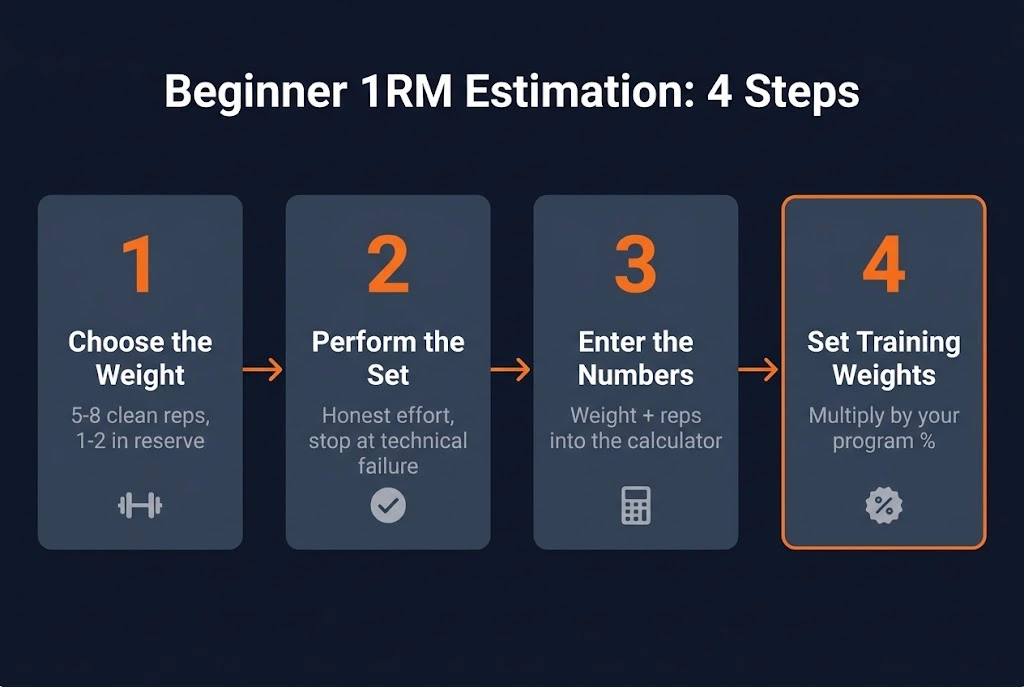
Step 1: Choose a Weight You Can Lift for 5-8 Clean Reps
Pick a weight that feels genuinely challenging: not so light the set is easy, not so heavy your form falls apart. The target is a weight where, after 5-8 reps, you have 1-2 reps left in reserve. If you’re brand new to barbell training, start between 50% and 70% of what you guess your maximum might be. Getting this slightly wrong is fine.
Step 2: Perform the Set at Maximum Honest Effort
Run the 5-8 reps with the same full technical control you use in every session. Stop when you hit your target reps, or when the next rep would force a form compromise: a rounded back, the bar drifting forward, and depth cut short. That point is technical failure, and it’s where you stop. Do not push to absolute muscular failure. The rep count has to be clean for the formula to be accurate. Record the exact weight and number of clean reps.
Step 3: Enter Your Numbers Into the Calculator
Go to the one rep max calculator, select your lift, and enter the weight and rep count. The calculator runs seven formulas at once. As a beginner, use the Epley result as your starting point, though all seven sit close together when the rep count is 5-8. The displayed estimated 1RM is your working baseline.
Here’s a worked example. If you squatted 60 kg for 6 clean reps, the Epley formula gives 60 × (1 + 6 ÷ 30) = 60 × 1.2 = 72 kg. Your estimated squat 1RM is approximately 72 kg. Every training percentage you need now comes from that number.
Step 4: Use Your Estimate to Set Initial Training Weights
Take the estimated 1RM and multiply by the percentages your program prescribes. If it says “work at 75% for 5 sets of 5,” multiply your estimate by 0.75 to get the working weight: 72 kg × 0.75 = 54 kg in the example above. Beginners often benefit from starting 5-10% below the prescribed percentage and working up as technique and confidence develop. This beginner training max approach builds in a margin while your form is still settling. The Percentage & Rep-Max Table in the calculator generates the full chart automatically, so you don’t have to run the math for each percentage by hand.
What Rep Range Should Beginners Use for 1RM Estimation?
Rep range is one of the most practical decisions in the whole estimation process, and beginners should not copy what experienced lifters do here. The optimal estimation input for a beginner is 5-8 reps, higher than the 3-5 reps recommended for advanced lifters. The reason comes down to technique.
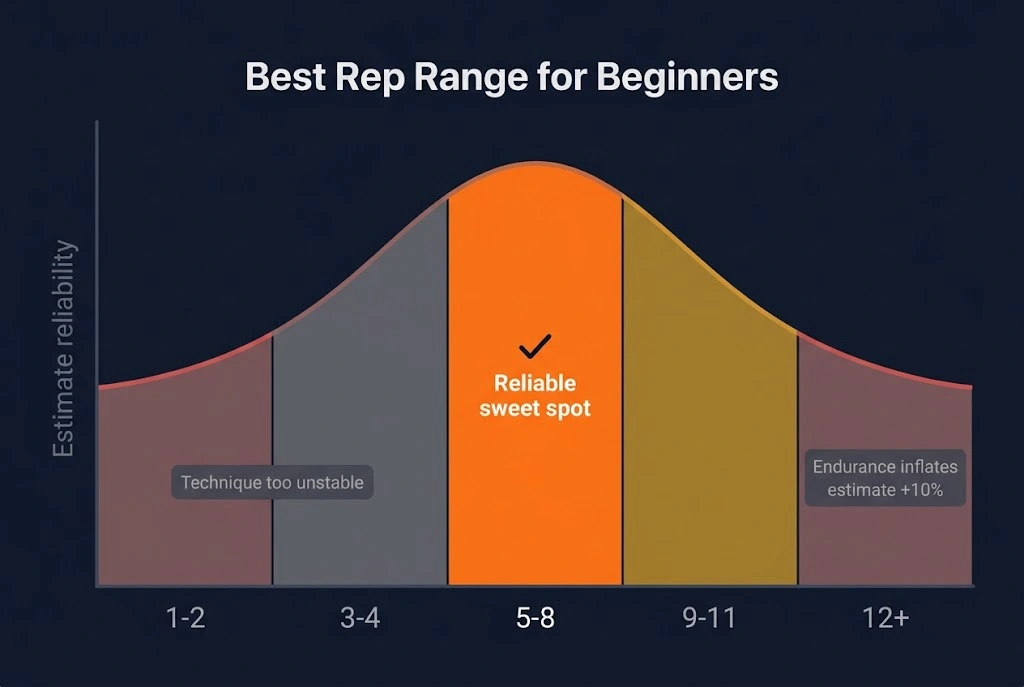
Why 5-8 Reps Is the Beginner Sweet Spot
Experienced lifters can estimate from 3-5 reps because their technique stays solid even at the high percentages a low-rep set requires. Beginners don’t have that consistency yet. A 3-rep attempt for a new lifter often pushes into heavy enough territory that form starts slipping before the set even produces useful data. A 5-8 rep set keeps you in a range where your form holds and the formula stays reliable. There’s a bonus at this rep range too: all seven formulas in the calculator produce similar outputs, typically within 2-3 kg of each other, so you don’t have to worry about which one to trust.
Why High-Rep Sets Produce Unreliable Estimates for Beginners
Going the other direction is just as much of a problem. Sets of 12 or more reps bring endurance and muscular fatigue in as major variables. At that point the estimate is measuring your ability to sustain repeated effort, not your maximum strength. Formulas are least accurate above 10 reps, often overestimating the true 1RM by 10-15% at 12+ reps. For a beginner, an overestimated 1RM is worse than no estimate at all: it produces training percentages that are too high and sets you up to fail your working sets from the first session.
When Are You Ready to Test Your 1RM Directly?
Most lifters are ready for a direct 1RM test after 3-6 months of consistent barbell training on the specific lift. That range isn’t arbitrary. It reflects the time technique takes to become automatic enough to hold under near-maximal load, which is the thing that’s missing early on.
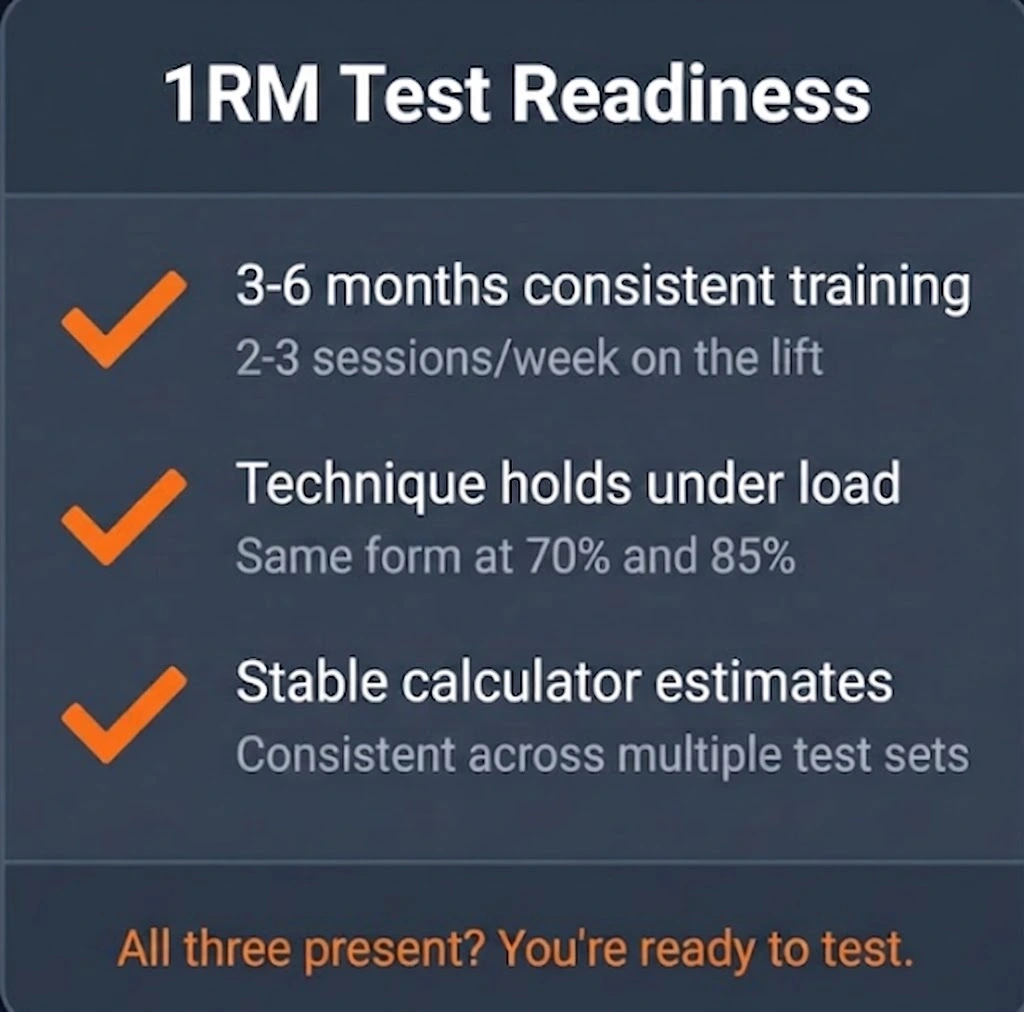
The 3-6 Month Milestone
“Three to six months of consistent training” means something specific: at least 2-3 sessions per week on the lift, with load progressing over that period. A lifter who has benched for five months but only once a week with no load increase hasn’t built the technique consistency a safe max test requires. The milestone is accumulated quality practice, not the calendar. Three focused sessions a week reaches readiness faster than one drifting session a week for twice as long.
Signs Your Technique Is Ready
Three clear signals tell you you’re there. First, your working-set technique looks the same whether you’re lifting 70% or 85% of your estimated max, with no form deviation as the load climbs. Second, experienced lifters or a coach have given you consistent positive feedback on your form. Third, your calculated 1RM estimates from submaximal sets have stayed stable across several test inputs rather than jumping around. When all three are present, you’re ready for a real test. At that point, work through the step-by-step 1RM testing protocol for how to run it safely.
Common Beginner Mistakes With 1RM
These mistakes are predictable, which means knowing them in advance is enough to avoid them.
Trying to Max Out Before the Technique Is There
The most damaging one is attempting a true 1RM in the first weeks of training. Under near-maximal load, a beginner’s bar path drifts, squat depth rises, or bracing collapses, producing a failed lift, an injury, or an unreliable number from a technically broken rep. The calculator exists precisely to sidestep this. An estimate from a clean 6-rep set is both safer and, at this stage of training, more useful than a shaky max attempt.
Using Too Many Reps for the Estimation Set
The second mistake runs the opposite way. A lifter picks a weight they can do 15 times because it “felt challenging,” feeds that into the calculator, and gets an inflated 1RM that pushes every training weight too high. Beginners frequently underestimate their own strength and default to weights they can lift 12-20 times. The fix is simple: choose a weight where 5-8 honest reps is genuinely the ceiling. If you get to 8 and could keep going, stop there and add weight next time.
Treating the Estimate as a Fixed Number
The third mistake is treating your first estimate as permanent. An estimated 1RM from a beginner’s first 5-rep test is a starting point, not a fixed anchor. In the first 3-6 months, strength improves fast, sometimes 5-10% per month. That means the estimate should be re-run every 4-6 weeks to keep your percentages accurate. It takes 30 seconds. Re-testing after a few weeks of training keeps your working weights meaningful as your strength climbs.
How to Use the 1RM Calculator as a Beginner
The beginner workflow is short. Go to the one rep max calculator and select your lift. For a non-standard exercise, choose any lift calculator option. Enter the weight and reps from your Step 2 set and read the estimated 1RM.
From there, open the Percentage & Rep-Max Table accordion. It generates every working weight from 50% to 100% of your estimate, so you read your loads straight off the table for whatever percentages your program calls for. One submaximal set, one number entered, and a full percentage chart ready to program from. Re-run it every few weeks as you get stronger.
Frequently Asked Questions
Your 1RM estimate, even an early and imprecise one from your first weeks of training, gives your program the number it needs to prescribe weights that actually fit you. Use the calculator with a 5-8 rep set, re-run it every 4-6 weeks as you get stronger, and save the direct max test for when your technique has had a few months to develop. Start with the One Rep Max Basics guide for the full context; check How Accurate Are 1RM Calculators? for what to expect from your estimate, and come back to the How to Test One Rep Max Safely protocol when you’re ready to test for real.