Powerlifting Guide & Competition
Powerlifting is the only sport that asks one question and answers it three times in a single afternoon: how much can you lift, once, with a judge watching? The three lifts each get three attempts, and the best of each adds up to a total. Everything else is the structure built around that question: weight classes, federations, scoring systems, attempt selection, and meet logistics. This powerlifting guide covers all of it, from understanding the sport and choosing a federation through to preparing for a first meet, reading a scoreboard, and peaking for competition.
What Is Powerlifting?
Powerlifting is a strength sport in which competitors attempt a maximum single repetition on three barbell lifts (squat, bench press, and deadlift), with the best successful attempt on each forming the lifter’s total. The lifter with the highest total in their weight class and equipment division wins.
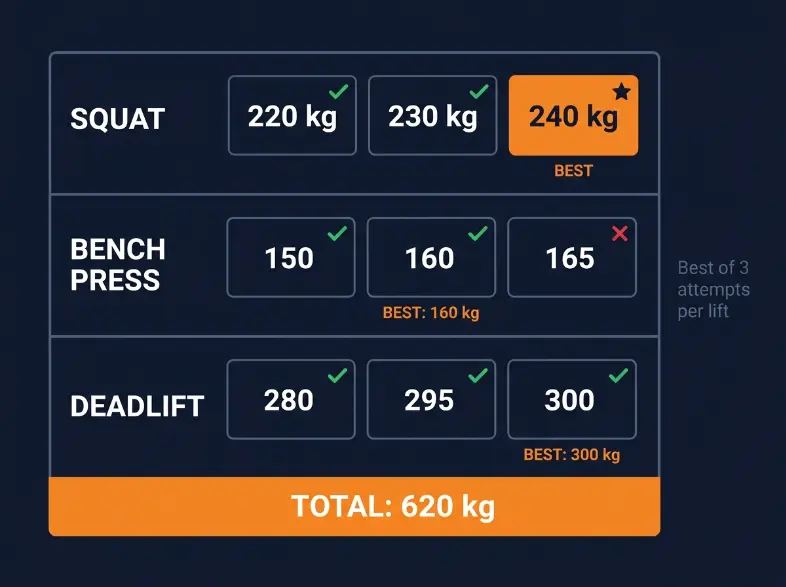
That definition is simple. The sport underneath it is not. Each attempt is evaluated by three judges against a set of technical standards specific to the federation holding the meet: squat depth, bench press pause duration, deadlift lockout, and command timing. Two of three judges must pass a lift for it to count. A lifter who fails all three attempts on any single discipline receives no total and cannot be ranked. This is known as bombing out.
The powerlifting total is the primary performance metric in the sport. Everything else derives from it: Wilks scores, DOTS scores, records, and qualifying standards. A lifter can win their weight class with a modest total if the competition is light and lose with a strong one if the competition is stiff. Understanding the total is where understanding the sport starts.
Powerlifting vs Bodybuilding vs Olympic Weightlifting
The three major barbell sports each have a defining question. Powerlifting asks, “How much can you lift once?” Bodybuilding asks, “How does your body look when developed and conditioned?” Olympic weightlifting asks, how explosively can you move a barbell overhead?
The training emphasis follows directly. Powerlifters train for maximal force production across the three competition lifts. Bodybuilders train for hypertrophy and body composition. Olympic lifters train for bar speed and technical precision on the snatch and clean and jerk.
The competitive format is equally different. Powerlifting uses three attempts per lift, judged against technical standards. Bodybuilding uses subjective judging of physique in multiple poses. Olympic lifting uses two events with three attempts each, judged against technical standards that favor speed over absolute load.
A lifter’s training can borrow from all three sports simultaneously. Most strength-focused athletes do. The distinction matters when you’re choosing which sport to compete in, because the judging criteria, the equipment allowed, and what counts as a win differ entirely.
Powerlifting Weight Classes
Powerlifters compete against others in the same bodyweight division. The IPF currently uses eight men’s weight classes: 59 kg, 66 kg, 74 kg, 83 kg, 93 kg, 105 kg, 120 kg, and 120+ kg. Women’s classes run at 47 kg, 52 kg, 57 kg, 63 kg, 69 kg, 76 kg, 84 kg, and 84+ kg. Other federations use slightly different class structures, and historical records may reference older class systems that have since changed.
Choosing a weight class involves two decisions. The first is whether you can compete at your current natural training bodyweight without a cut, finding the class above it. The second is whether cutting to a lower class gives enough competitive advantage to justify the performance cost.
Cutting weight to make a lower class is common in experienced competitive powerlifting. For a first meet, competing at or near your natural bodyweight is the right call. The logistics of making weight add complexity that beginners don’t need during an already unfamiliar process.
Powerlifting Federations: IPF, USPA, USAPL, and More
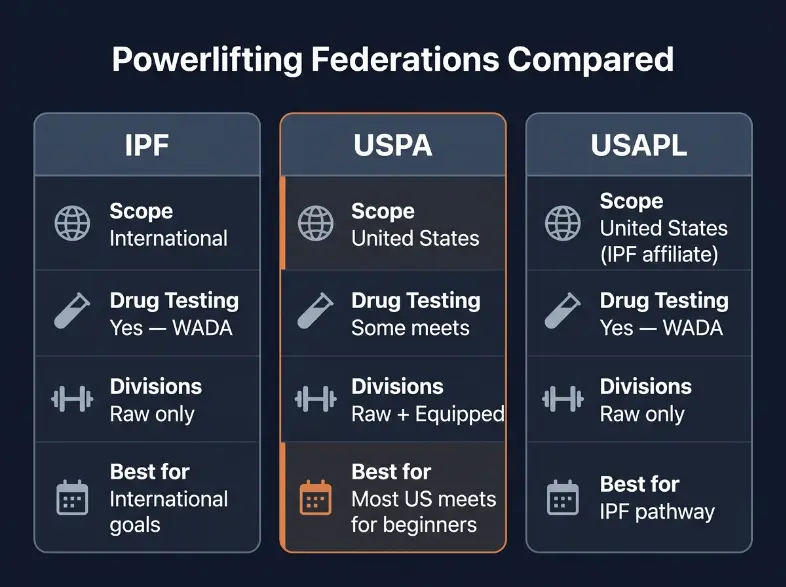
Powerlifting has no single governing body. Dozens of federations operate under different rules, drug-testing protocols, equipment standards, and record systems. Three are most relevant for lifters in the US and internationally.
IPF (International Powerlifting Federation) is the primary international body, drug-tested only, and operates under the strictest technical standards of any major federation. USAPL (USA Powerlifting) is the US IPF affiliate. To compete internationally under IPF sanction, you must accumulate qualifying totals through USAPL. For lifters whose long-term goal is IPF international competition, starting with USAPL ensures technical standards carry over directly.
USPA (USA Powerlifting Association) is the largest federation in the US by meet count. It hosts both raw and equipped divisions and runs both drug-tested and non-tested meets under the same umbrella. Meet frequency is high and geographic coverage is broad.
For a first meet, federation selection should be driven by which federation runs meets near you. The technical rule differences between federations matter less at the beginning than simply getting on the platform.
Equipped vs. Raw Powerlifting
Raw powerlifting allows a lifting belt and knee sleeves (some federations also permit knee wraps in a separate raw category). No other supportive gear. Equipped powerlifting allows a squat suit, knee wraps, and a bench shirt, each made from tight, elasticated material that stores energy through the eccentric phase and releases it during the lift.
The performance difference is significant. Equipped lifters regularly produce totals 20-40% higher than raw lifters at equivalent bodyweights. The two divisions are not comparable without specifying which applies, and records are maintained separately.
Most beginners start raw. The technique in raw powerlifting is closer to general barbell training, the gear requirements are minimal (a belt is enough to start), and the skill required to use equipped gear effectively takes considerable time to develop. Equipped lifting is a legitimate and competitive discipline, but it’s a separate skill on top of the lifting itself.
Drug-Tested vs. Untested Powerlifting
Drug-tested federations follow WADA protocols. Competitors are subject to in-competition testing and, in some federations, out-of-competition testing at any point during the competitive season. Positive tests result in disqualification and bans. USAPL and the IPF are drug-tested. The USPA runs some drug-tested meets and some non-tested meets under the same federation.
Untested federations do not conduct drug testing. This does not mean all competitors use banned substances, but it does mean that totals from untested meets are not directly comparable to those from tested competitions. Records are maintained separately by testing status.
For a new lifter, the decision between tested and untested comes down to personal goals rather than competitive level. Untested meets are not necessarily more competitive or less serious. The technical standards and judging quality depend far more on the specific federation and meet director than on testing status.
How to Prepare for Your First Powerlifting Meet
Most first-time competitors underestimate four specific areas, and overestimate the importance of their total going in.
The technical standards for each lift in your chosen federation are the first area. Squat depth, bench press pause duration, and deadlift lockout requirements vary between federations, and a lift that would pass in training under normal gym conditions may not pass under competition judging. Learn the commands for your federation specifically.
Meet-day logistics are the second. The weigh-in window, equipment check timing, the warm-up room schedule, and the order of flight assignments all affect how your day runs. Most first-time lifters don’t know these exist until they’re standing in the warm-up room unsure of when they should be lifting what weight.
The third area is the warm-up room itself. You will share a platform with other competitors, working on your own timing relative to the main platform. Mismanage the warm-up and you arrive at the bar either cold or already fatigued.
The fourth is attempt selection. Knowing your 1RM accurately before the meet, through the one rep max calculator or a supervised test, gives you a reliable basis for choosing openers. Without it, selection is guesswork.
Attempt Selection and Competition Warm-Up
These two decisions determine more meet results than the training program that preceded them.
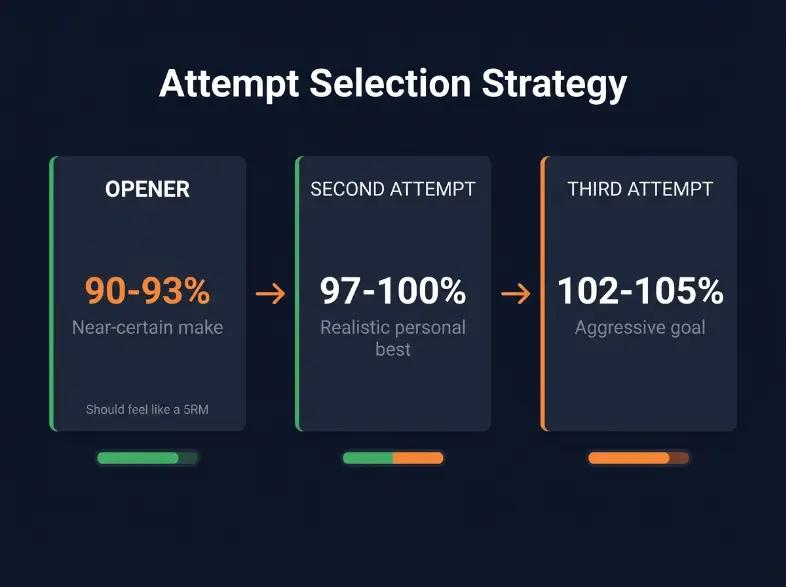
Attempt selection follows a predictable structure. Your opener should be a near-certain make: most coaches set it at 90-93% of the lifter’s expected maximum on that day, and it should be a weight you could lift five times fresh. The second attempt should represent a realistic personal best. The third is the aggressive attempt you’re actually building toward. Missing an opener creates a psychological and competitive hole that’s hard to recover from. A successful opener gives you two more chances to build.
Competition warm-up requires synchronising your readiness with your platform time. The warm-up room runs on its own timeline relative to the main platform, and lifters must track how many attempts are left before their flight goes on. A commonly used rule: reach your last warm-up set (typically 90-95% of your opener) with 2-3 attempts remaining on the platform before yours. The calculator’s Warm-Up Ramp generates progressive warm-up sets from an entered target opener, taking the calculation out of a high-pressure warm-up room environment.
How to Build a Powerlifting Peaking Program
Peaking is the 4-8 week phase before a meet in which training volume is systematically reduced while intensity rises toward competition-level loads. The core principle: maximum strength expression requires suppressing accumulated fatigue, not building new fitness. By the final week before a meet, the lifter should be fresher than at any other point in the training cycle.
The typical peaking structure reduces weekly volume by 30-50% while maintaining or increasing top-set intensity. Frequency may reduce from three squat sessions per week to two. Heavy singles begin appearing in training at 90-95% of expected openers, so the movement pattern and psychological demands of near-maximal lifting are familiar before meet day.
The calculator’s Percentage & Rep-Max Table is the planning tool for peaking loads. Enter the expected meet opener, and the table generates target weights at each percentage of that opener across the peaking weeks.
All-Time Powerlifting World Records
Context is essential before looking at the numbers. World records in powerlifting require specifying the federation, equipment division, and drug-testing status, because each combination maintains its own records independently.
In the IPF raw drug-tested category, which represents the most widely recognised drug-free standard, the records across all three lifts span extraordinary numbers. Ed Coan remains one of the most referenced names in powerlifting history for his performances across multiple weight classes in tested raw lifting during the late 1980s and 1990s. In equipped lifting, the totals are higher still: the elastic assistance from suits and shirts pushes numbers to levels unreachable in raw lifting.
The reason world records are relevant to non-elite lifters is calibration. Knowing where the absolute ceiling is helps place your own numbers in context. The gap between an elite gym lifter and a world record holder is larger than most people expect.
For context on where your numbers sit below the record level, the Strength Standards & Benchmarks guide covers population-level comparisons by bodyweight and classification tier.
The Calculator and Powerlifting
Most articles in this cluster cover competition structure and strategy rather than calculator-dependent programming. The one rep max calculator connects to powerlifting in three specific ways.
First, estimating your current 1RM on each competition lift gives you the data to set realistic attempt openers. Your opener should land around 90-93% of your estimated maximum.
Second, the Warm-Up Ramp generates progressive warm-up sets from your planned opener, which is the exact calculation you need to run in the warm-up room.
Frequently Asked Questions
Key Takeaways
Powerlifting is a formally structured sport built on three lifts, three attempts each, and a total that determines the winner. Success at a meet requires understanding the federation system, equipment divisions, weight classes, scoring, and meet logistics as well as the training that produces the numbers. The cluster in this series covers each dimension completely.