
Lift-Specific 1RM Guides
Your bench press 1RM tells you nothing about your squat. Every barbell lift has its own ceiling, its own strength standards, and its own programming logic, and tracking a single generic “strength number” across different movements is how programs fall apart when the bar goes on your back instead of in your hands. Choose your lift and find everything: standards, testing, form, programming, warm-up protocols, and common mistakes.
Why Every Lift Has Its Own 1RM
Strength is movement-specific. The motor pattern, the muscles under load, the bar position, the joint angles: all of it changes from lift to lift, which means the strength ceiling changes too. A 200 kg deadlift and a 140 kg squat are not the same person at two different percentages of one number. They’re two separate physical capacities built through two separate training histories.
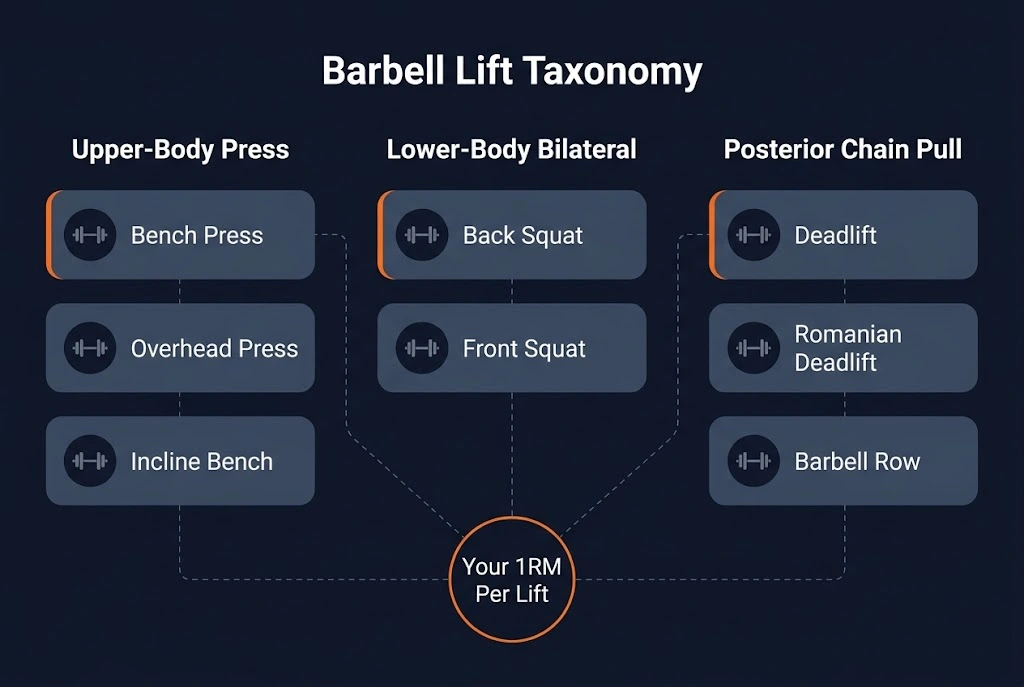
This matters for programming because percentages are always exercise-specific. When a program prescribes “work up to 80% for 3 sets of 5,” that 80% means 80% of your squat 1RM on squat day and 80% of your bench 1RM on bench day. Using your deadlift max to set bench weights produces incorrect loads in both directions. The calculator handles this by treating each lift as its own input. The lift selector changes the formula default and coaching context automatically when you switch exercises, because the math that works for a 10-rep bench set doesn’t apply cleanly to a 10-rep deadlift set. Grip fatigue, bar speed loss, and technical breakdown happen at different rates on different movements.
Track each compound lift separately. The guides below cover each one individually.
Bench Press 1RM
Horizontal pressing strength is the most commonly tracked upper-body quality in strength training, and the bench press is its standard measure. Most people mean bench when they ask “how much do you lift?” Its pressing pattern (barbell lowered to the chest, pressed to lockout) produces the highest absolute loads of any upper-body movement, and its 1RM is the reference point for upper-body pressing strength across almost every programming system that specifies intensity by percentage.
The calculator uses the Mayhew formula as the default for bench. Mayhew (1992) built his formula specifically from bench press testing data, which is why it tracks tested bench maxes more closely than general-purpose formulas at the same rep count. Select bench in the bench press one rep max calculator and the formula switches automatically.
The dedicated bench press guide covers how to increase your bench 1RM, strength standards by bodyweight, safe testing protocol, form for maximum strength output, warm-up ramp, programming approach, common technique mistakes, and elite-level benchmarks.
For the full guide: Bench Press 1RM Guide
Squat 1RM
Most percentage-based programs build from the squat first. It’s the primary lower-body bilateral strength benchmark, the one that loads the spine axially and demands the most from the posterior and anterior chain simultaneously. When programs specify leg-day intensity, the number they’re working from is almost always the back squat 1RM.
Squat standards run higher than bench standards for most lifters. A 1.5 times bodyweight squat is a reasonable intermediate benchmark; 2.0 times bodyweight places you in the advanced range. These ratios matter because the squat’s high absolute load means programming errors (using the wrong reference number) have a bigger effect on actual bar weight than they do on a lighter lift.
The squat 1RM guide covers strength standards by age and bodyweight, the full testing protocol including safety setup and ramp-up sets, form cues for maximum strength expression, programming approaches across different training ages, and the mistakes that cap the number before the muscles do.
Use the squat one rep max calculator to estimate yours, then the full guide: Squat 1RM Guide
Deadlift 1RM
Most lifters pull 20-30% more than they squat and 50-80% more than they bench. The deadlift is typically the highest-load lift in a training week, which makes its 1RM both the most impressive raw strength number and the hardest to test without cost. A failed deadlift at maximum load is more disruptive to recovery than a failed squat or bench, and the grip fatigue that accumulates across a high-rep deadlift set makes submaximal estimation less reliable than on other lifts.
It’s also one of the three competition lifts in powerlifting. The sum of those three 1RMs is the powerlifting total, the formal measure of full-body barbell strength in competition settings.
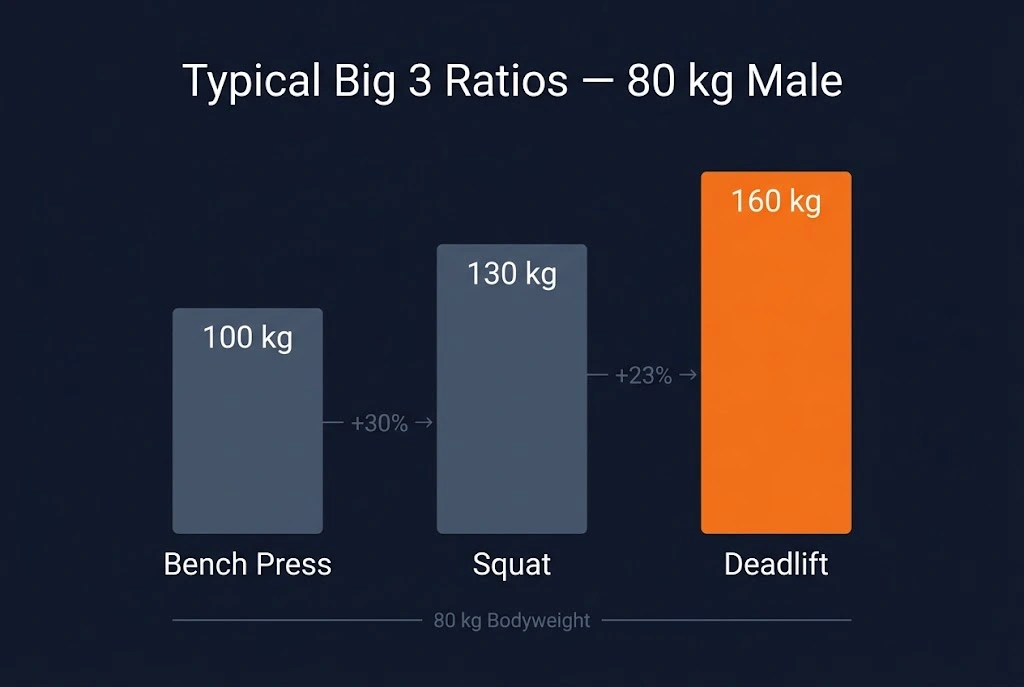
The deadlift guide covers strength standards, a step-by-step testing protocol that accounts for the deadlift’s specific fatigue profile, form for maximum force application, programming the pull across different training phases, and the common setup errors that cap people well below their actual ceiling.
Run your numbers in the deadlift one rep max calculator, then find the full guide: Deadlift 1RM Guide
Overhead Press 1RM
Standing without a bench, barbell pressed from shoulder to full lockout overhead: it’s the most technically demanding upper-body pressing movement in the calculator’s lift selection. It requires full-body tension (braced trunk, glutes engaged, bar path controlled) that horizontal pressing simply doesn’t demand. The margin for technical error is smaller, and under maximal load the shoulder complex is in a position that punishes instability more acutely than on bench.
Most lifters press 50-65% of their bench press 1RM overhead. If your ratio is significantly below that range, it often points to shoulder mobility limitations or a pulling-to-pressing imbalance rather than raw pressing weakness. The gap between bench and OHP is a diagnostic as much as it is a training metric.
The overhead press guide covers standards, a safe testing approach for a standing press, the form cues that distinguish a strong lockout from a dangerous one, programming the OHP alongside bench without accumulating too much shoulder volume, and the mistakes that stall progress before the shoulders are actually the limiting factor.
Start with the overhead press one rep max calculator, then the full guide: Overhead Press 1RM Guide
Barbell Row 1RM
Pressing strength and pulling strength don’t develop at the same rate. Tracking the barbell row alongside the bench press reveals whether they’re staying in balance, which matters for shoulder health and long-term pressing capacity. Most balanced lifters row between 80-100% of their bench press 1RM. If you’re pressing significantly more than you pull, that imbalance tends to show up eventually as shoulder or elbow issues rather than as a training metric.
The barbell row is the only horizontal pulling movement in the calculator’s current lift selection. It’s also the pulling counterpart that strength programs most often pair with bench in programming logic, making it the row worth tracking if you’re only going to track one.
The guide covers strength standards, the form debate between strict and body-English rowing, how to test a row 1RM safely, programming horizontal pulling relative to pressing volume, and the mistakes that shift load off the intended muscles before the weight even feels heavy.
Use the barbell row one rep max calculator and read: Barbell Row 1RM Guide
Front Squat 1RM
Bar on the front deltoids instead of the upper back: that positional change shifts the load forward, forces a more upright torso, and puts the quads in charge of a larger portion of the work than in a back squat. Most lifters front squat 75-85% of their back squat 1RM. A ratio significantly below that range often points to wrist or thoracic mobility limiting the rack position rather than actual quad weakness.
It’s in the calculator under the frontsq selection, using Epley as the formula default. Front squat 1RM testing is less common than back squat testing because the rack position failure mode is more technical than muscular, but it’s worth tracking if it’s a primary movement in your program.
The dedicated guide covers what a strong front squat 1RM looks like by bodyweight, how to set up a safe max attempt, and how to program it alongside the back squat without overlapping recovery.
Estimate yours: front squat one rep max calculator. Full guide: Front Squat 1RM Guide
Romanian Deadlift 1RM
A hip-hinge accessory movement that isolates the posterior chain through a controlled eccentric descent, with the bar stopping short of the floor between reps. It typically runs in the 8-15 rep range rather than the 1-5 rep range used for conventional deadlifts, which makes direct 1RM testing less practical and estimation formulas less reliable at those rep counts.
A dedicated RDL guide and calculator deep-link are in development for Phase 3. This section will expand with full standards, testing guidance, and programming content when that work is complete.
Incline Bench Press 1RM
Shifting the bench angle upward changes which part of the pectoral is under the most load. The incline press targets the clavicular head of the pectorals more directly than flat bench, and most lifters incline press 80-90% of their flat bench 1RM. How close your ratio is to that range reflects both shoulder mobility and how much incline work has featured in your training history.
A dedicated incline bench guide and calculator deep-link are in development for Phase 3. Full standards, testing protocol, and programming guidance will be added when that content is live.
How to Use the 1RM Calculator for Any Lift
Select your lift from the dropdown in the one rep max calculator. Each selection loads the appropriate formula default and coaching note for that movement: Mayhew for bench press, Epley for squat and deadlift, and so on. Enter the weight and rep count from a recent hard set, and the calculator returns your estimated 1RM.
From there, scroll to the Percentage & Rep-Max Table. It converts your 1RM into a full training load chart automatically, showing target weights at every 5% increment from 50% to 100% alongside predicted rep maxima for 1 through 12 reps. Run this for each major lift you track and you have a complete programming reference without doing percentage math by hand.
Once you have your per-lift numbers, the Strength Standards guide shows you where each one places you relative to your bodyweight and training age.
Frequently Asked Questions
Key Takeaways
Every barbell lift has its own strength ceiling, its own standards, and its own programming anchor. Your bench 1RM can’t stand in for your squat, and your deadlift number can’t set your overhead press loads. Track them separately, estimate between cycles with the calculator, and use the per-lift guides for everything specific to each movement.
Explore by lift:
- Bench Press 1RM Guide
- Squat 1RM Guide
- Deadlift 1RM Guide
- Overhead Press 1RM Guide
- Barbell Row 1RM Guide
- Front Squat 1RM Guide