
The Ultimate Guide to Progressive Overload: How to Build Sustainable Strength and Muscle
Progressive overload is the golden rule that quietly runs every good strength program. If the training stress stays the same, your body settles in, your baseline strength catches up, and what you used to feel hard turns into maintenance.
That’s why people stall even when they “train intensely.” Intensity without progression becomes repetition. You might sweat, you might feel sore, but you stop giving your body a reason to adapt.
Most blogs reduce progressive overload to “add weight every week” and toss in the Milo of Croton story. The story is fun, but it’s not the point. The point is physiology: your body is always trying to return to homeostasis. Progressive overload works because you apply slightly higher stress than last time, recover, and force a physiological adaptation.
If you want a simple way to keep progression honest, estimate your current strength first. Use the One Rep Max Calculator to set your training loads and track improvements without guessing.
1. Introduction: The Universal Law of Growth
Progressive overload is not a hack. It’s the mechanism behind getting stronger, building muscle, and improving performance over time. In strength training, “overload” means the training stress is high enough to disrupt your current equilibrium. “Progressive” means you keep that stress moving forward in a planned way.
Think of your body like a thermostat. Your muscles, nervous system, connective tissue, and energy systems all prefer stability. Training is a disruption. Recovery is the rebuild. Adaptation is the upgrade.
This lines up with two big ideas used in exercise science:
- General Adaptation Syndrome (GAS), often linked to the work of Hans Selye, describes how the body responds to stress in phases: alarm, resistance, and exhaustion if the stress is too high without recovery.
- SAID (Specific Adaptations to Imposed Demands) explains why your body adapts specifically to what you repeatedly ask it to do.
Progressive resistance training is simply the practical application of these concepts. You prescribe load (and other variables) so the stress is enough to push adaptation, but not so chaotic that recovery gets crushed.
2. The Science of Stress: Why Your Muscles Grow
To understand progressive overload, you need the “why” under the hood.
Training triggers adaptation because it creates stress. Your body reads that stress as a problem to solve.
For strength and muscle, the most important driver is mechanical tension. That’s the force your muscle fibers produce while contracting, especially when the load is challenging and the reps are performed with control. Mechanical tension pushes the body to improve:
- Muscle fiber recruitment (including higher-threshold motor units as effort rises)
- Neuromuscular efficiency (your nervous system gets better at coordinating force)
- Structural capacity (muscle tissue, tendons, and connective tissues become more resilient)
You’ll hear people talk about “micro-tears” and soreness. Micro-damage can happen, and it may play a role in hypertrophy, but soreness is not the target. You can get very sore with sloppy volume and still fail to build meaningful strength. Mechanical tension is the lever you can reliably program.
Hypertrophy itself can show up in different ways. Some lifters talk about “myofibrillar vs. sarcoplasmic” growth. The big practical takeaway is simpler: when you train with enough tension and you recover well, your body builds more contractile capacity and support structure. That’s how you move more weight and handle more work.
Progressive overload matters because it keeps that tension meaningful. If 225 for 5 used to be hard but now feels easy, the stress signal has changed. Your body does exactly what it’s supposed to do: it adapts, then it stabilizes. Progression is how you keep the signal alive.
3. The Core Progressive Overload Principles
If you want consistent gains, you need more than motivation. You need progressive overload principles that keep training productive and sustainable.
Here are four pillars that separate smart progression from random grind sessions.
Pillar 1: Specificity (SAID in real life)
You get better at what you practice. If your goal is a bigger squat, your program needs consistent squatting patterns under meaningful load. Accessories help, but they don’t replace the main demand.
Specificity also includes rep ranges and movement patterns. Strength is built heavily in lower rep ranges, but you still benefit from hypertrophy-focused work to support that strength.
Pillar 2: Individualization
Two lifters can run the same plan and get different results because their baseline strength, recovery capacity, injury history, sleep, and schedule are different.
This is where a training max helps. Instead of chasing a true 1RM constantly, many lifters base loads on an estimated or conservative max so they can progress without blowing up. If your max estimate is off, your “perfect program” becomes too easy or too punishing.
Pillar 3: Recovery is part of the prescription
Progressive overload only works if you adapt. No adaptation happens without recovery.
Progression is a three-part loop:
- Apply a stress you can recover from
- Recover enough to rebuild
- Reapply slightly higher stress
If you skip step 2, your performance stalls, then backslides. That’s not a “lack of discipline.” That’s biology.
Pillar 4: Variation without chaos
Variation protects joints, manages fatigue, and keeps the stimulus effective. Chaos kills tracking.
The best approach is usually stable main lifts with planned variations:
- Keep the main pattern consistent (squat, press, hinge, pull).
- Rotate accessories or rep targets over blocks.
- Use deloads or lighter weeks when fatigue is climbing.
Progressive overload principles require balancing intensity (how heavy) and volume (how much work). Push one too hard for too long and you will hit a wall.
4. How to Progressive Overload Without Hitting a Plateau
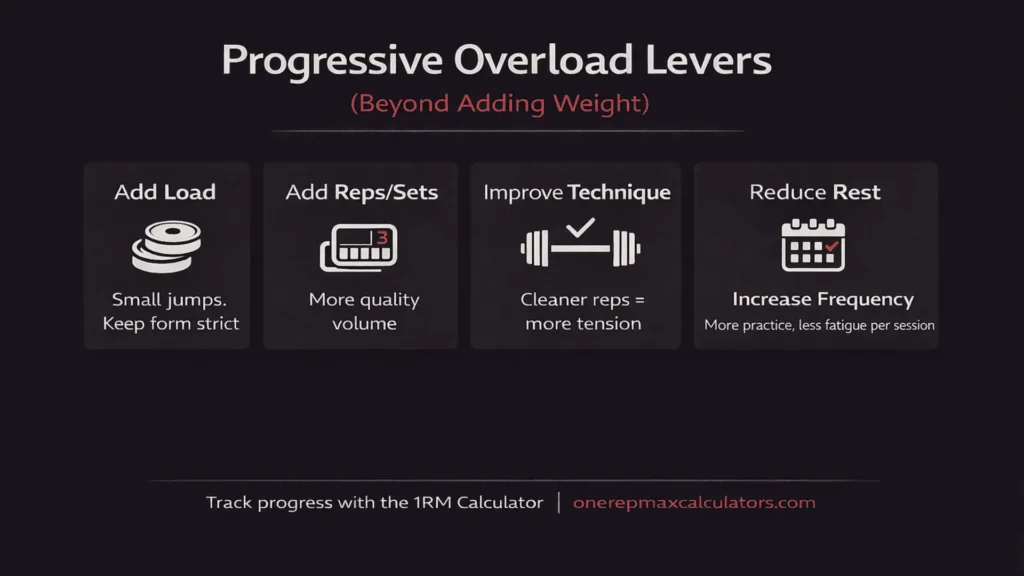
This is the part most people miss. How to progressive overload is not just adding plates. It’s learning to pull different levers so you can keep progressing even when weight jumps stop making sense.
Increasing resistance (classic weight progression gym method)
Yes, adding weight works. It’s just not the only tool.
A simple approach:
- Add small jumps when reps and technique stay strong. (ACSM)
- On upper-body lifts, micro-loading (small plates) can keep progress moving.
- On lower-body lifts, slightly bigger jumps can work, but only if form stays tight.
The mistake: forcing weight increases when your technique is breaking down. If your squat depth creeps up or your bench pauses disappear, you didn’t get stronger. You changed the lift.
This is where an estimated 1RM helps. Use the One Rep Max Calculator to see whether you’re actually trending up over time, even if your day-to-day performance fluctuates.
Increasing volume (sets and reps)
Volume progression is often the easiest way to keep overload going without wrecking form.
Examples:
- Keep weight the same, and add one rep per set each week.
- Keep reps the same; add one extra set.
- Add “back-off” sets after a heavy top set.
Volume has a cost. More volume increases fatigue. If your recovery is limited (busy schedule, poor sleep), volume progression needs tighter control.
Improving technique (efficiency and control)
Technique changes overload the right tissues and save your joints.
Real examples of “progressing” without adding weight:
- Better bracing and bar path mean more force transferred into the bar.
- Cleaner squat depth and consistent tempo make the same weight a stronger stimulus.
- Pausing the bench on the chest (even briefly) can make 185 feel like a new lift.
This is progression because mechanical tension becomes more honest. You’re earning the reps instead of cheating them.
Decreasing rest (density training)
If you keep the weight and reps the same but reduce rest times, you increase training density.
This can work well for accessories and hypertrophy blocks:
- The same work in less time increases stress.
- It also exposes weak links in conditioning and bracing.
Don’t use this to turn heavy compound lifts into cardio. For big strength lifts, rest is a performance tool.
Increasing frequency (how often you train a lift or muscle group)
Frequency can be a game-changer when managed well.
More practice means:
- Better skill on the lift
- More weekly volume spread out
- Less “all-or-nothing” fatigue from marathon sessions
A simple upgrade:
- Squatting 1x/week becomes squatting 2x/week (one heavy day and one lighter technique or volume day).
- Bench responds well to higher frequency for many lifters, especially when the sessions are controlled.
Frequency only helps if recovery supports it. If your joints feel beat up or performance slides, you went too far.
Quick “plateau filter” (ask yourself this)
When progress stalls, check:
- Did my technique degrade?
- Did my sleep, food, or stress change?
- Did my weekly volume jump too fast?
- Have I been pushing intensity with no lighter weeks?
Plateaus often have a simple cause. Fix that first before hunting exotic methods.
5. Real-World Progressive Overload Examples
Here’s how progressive overload examples look when you apply them in the real world.
Beginner approach: Linear progression
Beginners can progress fast because the nervous system adapts quickly and the baseline is lower. Linear progression works well when:
- You train the main lifts 2–3 times per week
- You add small weight increases regularly
- You keep technique strict
Example (bench press):
- Week 1: 3×5 @ 135
- Week 2: 3×5 @ 140
- Week 3: 3×5 @ 145
If you miss reps, don’t panic. Repeat the same weight next session and aim for cleaner reps. Consistency beats hero attempts.
Intermediate approach: Double progression
Once “add weight every session” stops working, double progression becomes your best friend.
How it works:
- Pick a rep range, like 6–10.
- Use the same weight until you hit the top of the range for all sets.
- Then increase weight and drop reps back down.
Example (dumbbell incline press, 3 sets, 6–10 reps):
- 60s: 8,7,6
- 60s: 9,8,7
- 60s: 10,9,8
- 60s: 10,10,9
- 60s: 10,10,10 (now increase)
- 65s: 7,6,6 (repeat the climb)
This method is perfect for building strength and muscle without constantly grinding.
A simple progressive overload workout log snippet
This is the kind of “boring” tracking that makes you strong.
Week 1
- Squat: 3×5 @ 225
- Bench: 3×5 @ 185
- Deadlift: 1×5 @ 315
Week 2
- Squat: 3×5 @ 230
- Bench: 3×5 @ 190
- Deadlift: 1×5 @ 325
Week 3
- Squat: 3×5 @ 230 (repeat, cleaner reps)
- Bench: 3×5 @ 192.5
- Deadlift: 1×5 @ 325 (same, faster bar speed)
That repeat week is not failure. It’s adjustment. Your training log tells the truth.
If you want to keep your load prescription consistent, estimate your 1RM every few weeks based on a solid set and use the [One Rep Max Calculator] to confirm you’re trending up.
6. Advanced Progressive Overload Techniques
For experienced lifters, progress often comes from smarter stress, not just more stress.
A few advanced progressive overload techniques worth knowing:
- Cluster sets: break one big set into mini-sets with short rest to maintain bar speed.
- Rest-pause: extend a set safely with brief pauses, great for hypertrophy accessories.
- Wave loading: planned up-and-down loading across weeks or within sessions to manage fatigue.
- Tempo manipulation / time under tension: slower eccentrics or pauses can increase mechanical tension without heavier loads.
These tools work best when they’re used like spices, not the whole meal. Overuse turns training into fatigue management instead of strength building.
7. Consistency Over Intensity
Progressive overload works when you treat it like a system, not a mood. You apply stress, recover, and repeat with small upgrades. Keep your technique honest, track your progress, and adjust the lever that makes sense for where you are right now.
If you want a clear number to guide your loading choices, use the One Rep Max Calculator and build your next block around it. Small steps, repeated, add up to big strength.