
Strength Training Recovery & Performance
Strength is built during recovery, not during training. The session is the stimulus: the stress that signals the body to adapt. The adaptation itself happens in the hours and days after it, provided you give it the conditions it needs. Most lifters manage training load carefully and treat recovery as an afterthought, then wonder why their 1RM stalls despite consistent effort. Strength training recovery is the other half of the adaptation equation, and this guide covers all of it: session spacing, sleep, active recovery, mobility, injury management, overtraining, and return to training.
What Is Strength Training Recovery?
The physiological process of repairing training-induced muscle damage, restoring neuromuscular function, and supercompensating: this is what strength training recovery means in practice.
That last part is worth understanding precisely. Supercompensation is not automatic. It requires adequate time, sufficient sleep, and appropriate nutrition. A session that delivers the right training stimulus followed by inadequate recovery does not produce the expected adaptation. It produces residual fatigue that accumulates across sessions until performance declines or injury occurs.
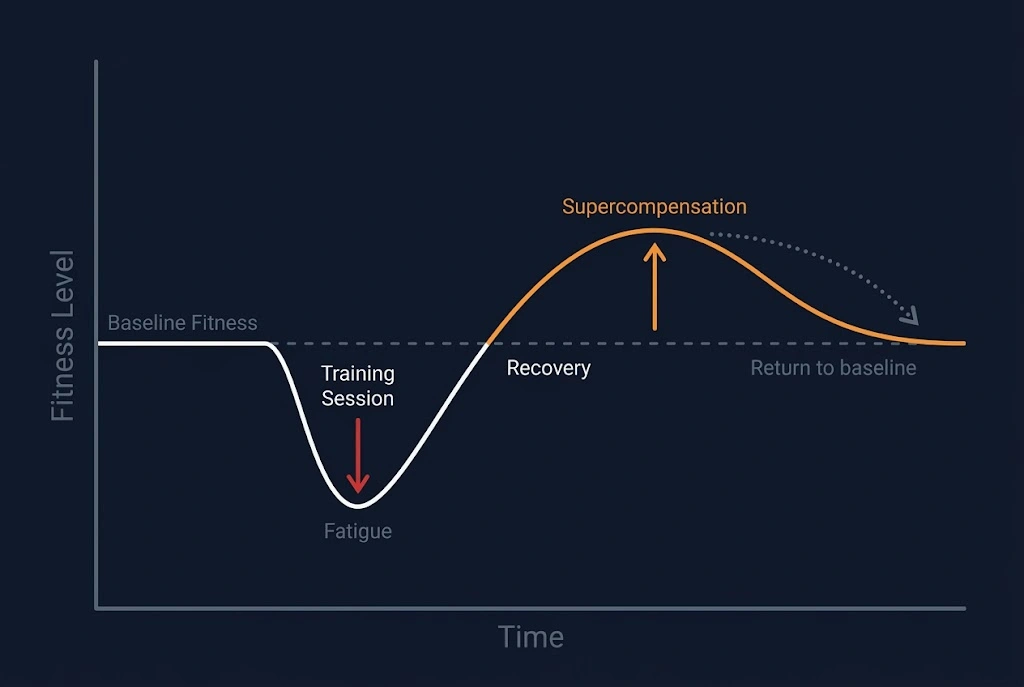
Recovery is not rest. Rest is the absence of activity. Recovery is an active physiological process. The distinction matters because passive inactivity is not always the right recovery strategy. Sleep quality, nutrition timing, and session spacing all actively determine how completely the body recovers before the next training stimulus.
Training and recovery are not separate elements of a program. They are two halves of the same adaptation cycle. A program that manages training load without managing recovery is running one half of the cycle well and leaving the other half to chance. The seven articles in this cluster cover the recovery half in full.
How Long to Rest Between Heavy Lifting Sessions
Required rest between sessions is determined by training intensity and volume, not by a fixed number of days. This distinction is the one most training schedules get wrong.
After a high-intensity session at 90% or more of 1RM, full CNS recovery typically takes 48-72 hours for most intermediate lifters. The muscles may feel recovered within 24 hours, but neuromuscular fatigue (the specific fatigue affecting force production capacity) follows a longer timeline. Scheduling another heavy session on the same lift before CNS recovery is complete will produce a sub-maximal session and add residual fatigue to the training cycle.
Lower-intensity accessory work can be scheduled after 24 hours without meaningfully compromising recovery. The governing variable is the intensity of the original session, not a general recovery rule.
In practical terms: most intermediate lifters can train the major compound lifts 2-3 times per week productively when high-intensity sessions are spaced 48-72 hours apart. Training frequency is fundamentally a recovery question: how often a lift can be trained effectively depends entirely on how quickly the lifter recovers from the previous exposure.
Strength Training Programming covers how session spacing and frequency shape weekly volume in full.
Sleep and Strength: How Sleep Impacts Your 1RM
Of all the recovery variables a strength athlete can control, sleep produces the largest, most direct effect on 1RM performance. And it’s the one most consistently underestimated.
The mechanism is specific. During deep slow-wave sleep (NREM stages 3 and 4), the body secretes the majority of its daily growth hormone output. Muscle protein synthesis (the cellular repair process that turns a training stimulus into actual strength adaptation) is highest during this sleep stage. CNS restoration, which determines maximal force production capacity, also depends on sleep architecture as much as total sleep hours.
The practical impact: a single night below 6 hours of sleep measurably reduces maximal force output the following day. This isn’t a subjective performance dip. It shows up in barbell numbers. Chronic sleep restriction averaging under 7 hours per night progressively suppresses 1RM across weeks, even when training load is held constant.
Two hours of sleep debt does not become recoverable with a single long night. Sleep restriction accumulates. Consistency matters more than occasional extended sleep.
Active Recovery: What to Do on Rest Days
Active recovery is low-intensity movement performed on rest days at an effort level that promotes blood flow without adding meaningful mechanical stress to muscles or connective tissue. Walking, light cycling, swimming, and easy mobility work all qualify. The defining characteristic is low intensity: if the session produces meaningful muscle damage or cardiovascular strain, it is no longer recovery. It is training.
The physiological rationale is straightforward. Light movement increases circulation to recovering tissue. That circulation accelerates two parallel processes: the clearance of metabolic waste products from the previous session and the delivery of nutrients and growth factors to repair muscle. Both processes are slower under passive rest.
The common mistake is treating rest days as mandatory full inactivity. For lifters training 3-5 days per week at moderate-to-high intensity, 20-30 minutes of light movement on off days consistently outperforms full inactivity for reducing soreness entering the next session and maintaining tissue quality across a training block.
Active recovery does not replace a planned deload. It is a session-to-session recovery tool, not a substitute for planned load reduction.
Mobility for Strength Athletes: Key Movements
Mobility in the context of strength training is not the same as flexibility. Flexibility is passive range of motion: how far a muscle can be stretched when not actively contracting it. Mobility is active range of motion under load: the range of motion you can control when moving a heavy barbell through a full pattern. Strength athletes need the latter. Passive flexibility without the strength to control it at depth provides no protective function.
Adequate mobility is the prerequisite for safe competition movement on every major barbell lift. Squat depth requires sufficient hip flexion, ankle dorsiflexion, and thoracic extension. The deadlift requires hip hinge range without lumbar compensation. The overhead press requires shoulder and thoracic mobility to achieve a stable lockout.
Lifters who train heavy without addressing mobility accumulate compensatory movement patterns over months and years. The bar path deviates to accommodate limited range. Secondary muscles compensate for the primary movers. These patterns eventually produce injury in the structure carrying the compensatory load. The practical priority: mobility work for strength athletes should target the specific ranges required by the competition lifts, not general flexibility. The Lift-Specific 1RM Guides cover the form standards that mobility work directly supports.
Injury Prevention for Heavy Lifters
Most strength training injuries are not acute traumatic events. A muscle does not tear and a tendon does not rupture without prior warning in the overwhelming majority of training-related cases. What actually happens is accumulated mechanical stress on inadequately recovered tissue, technique breakdown under fatigue, or progressive overload applied faster than connective tissue can adapt.
This matters for prevention because it means most injuries are predictable and largely avoidable. Connective tissue (tendons, ligaments, cartilage) adapts more slowly than muscle. A programme that increases loading faster than connective tissue can remodel will eventually produce a structural failure, even if the muscular strength to handle the weight exists.
The three highest-risk areas in heavy barbell training are the lower back (conventional deadlift, squat), the shoulder complex (bench press, overhead press), and the knee (squat, front squat). Each of these has specific technique cues and loading protocols that reduce injury risk, covered in full in the dedicated article.
The broader prevention framework: adequate recovery between sessions, mobility work targeting competition-lift ranges, progressive loading that respects connective tissue timelines, and technique review under near-maximal loads.
How to Come Back After a Lifting Injury
The most common post-injury mistake is returning to pre-injury loads as soon as pain resolves. Pain resolution and tissue healing are not the same timeline. Depending on the injury type, structural healing can lag pain resolution by weeks. A tendon that has stopped hurting is not necessarily a tendon that has finished remodeling. Returning to full load during this window creates the conditions for re-injury.
The return-to-training principle: progressive mechanical loading from sub-threshold levels, with the rate of progression determined by tissue response, not by how the lifter feels at a given moment. The better test: not “Does it hurt?” But how does the tissue respond to this load over the next 24-48 hours? ” Soreness that resolves within a day is generally acceptable. Pain that persists or worsens after a session signals the load is too high.
Returning lifters also need to recalculate their 1RM after injury absence. Detraining begins within 2-3 weeks of forced rest and accelerates over extended absence. Treating a pre-injury 1RM as the current baseline and programming from it will consistently over-prescribe loads during the return phase.
Overtraining Signs and How to Avoid It
Overtraining syndrome is not simply being tired after a hard training block. It exists on a spectrum that starts with normal accumulated fatigue and ends in the most severe cases with months of forced rest and a complete reset of training capacity.
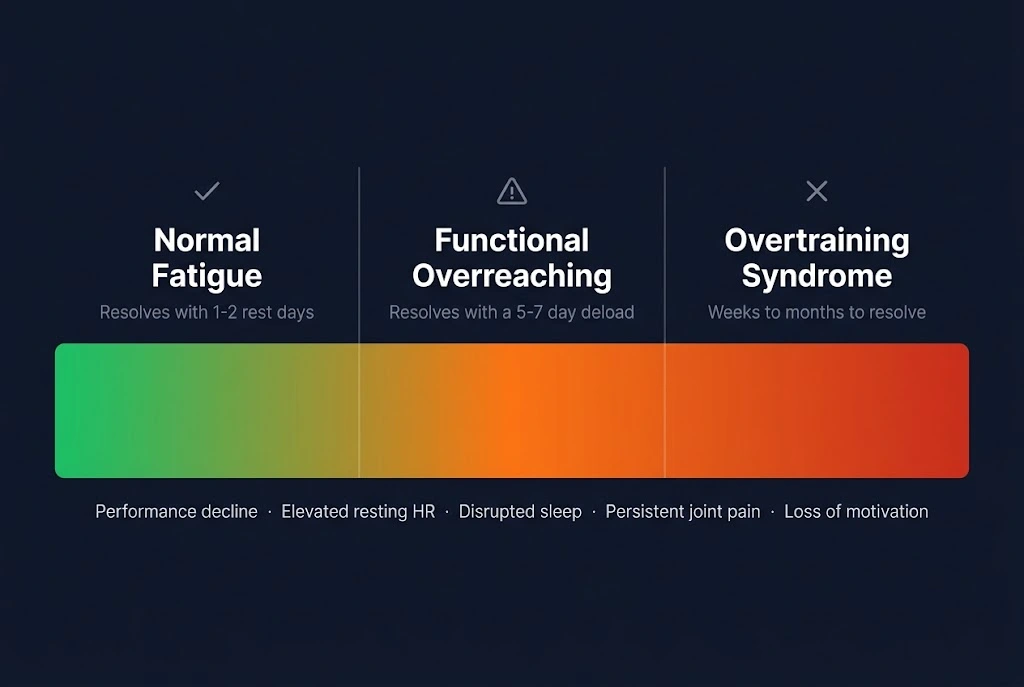
Three distinct states sit on this spectrum.
Normal accumulated fatigue is expected after hard sessions and resolves with 1-2 days of rest. It does not affect baseline motivation and does not impair performance outside of the specific fatigued muscle groups. This is a normal feature of progressive training.
Functional overreaching is a temporary performance decline produced by a demanding training block. Managed correctly, it is a deliberate tool: structured periodization creates periods of functional overreaching and uses the recovery phase that follows to produce adaptation above the pre-overreaching baseline. It resolves with 5-7 days of reduced training. The Strength Training Programming guide covers how to build planned deloads that manage this correctly.
Overtraining syndrome is the pathological endpoint of chronic under-recovery. It persists beyond a full deload week, affects mood, immune function, and sleep quality alongside strength performance, and requires weeks to months of significantly reduced training to resolve. The five most reliable early warning signs: performance declining across multiple sessions (not a single bad day), resting heart rate consistently above your normal baseline, sleep quality deteriorating despite physical fatigue, persistent joint or tendon discomfort that does not resolve with rest, and a pronounced loss of motivation unusual for your baseline.
If two or more of these persist for more than two weeks, the response is reduced training load: not better nutrition, not more caffeine, not pushing through.
Frequently Asked Questions
Key Takeaways
Recovery is the second half of the adaptation cycle. Training provides the stimulus; recovery produces the adaptation. Without structured attention to session spacing and fatigue management, the training stimulus consistently outpaces the body’s ability to adapt from it, and progress stalls. The seven articles in this cluster cover every recovery variable that affects strength performance.
One practical signal worth tracking: if your RPE is running higher than expected at a given percentage, the first variable to examine before adjusting programming is recovery quality. A 1RM that feels heavier than the numbers suggest is often a recovery problem before it is a programming problem.