
Lombardi Formula: Complete Guide
The Lombardi formula estimates your one-rep max using a power function rather than the additive scaling most other formulas use, which gives it a distinct behavior as reps rise: slightly above Epley at 1-5 reps, then progressively more conservative past 6. This guide covers the notation, worked examples, a full comparison against the other six formulas, the accuracy research, and when Lombardi’s output is the one worth trusting.
At a Glance
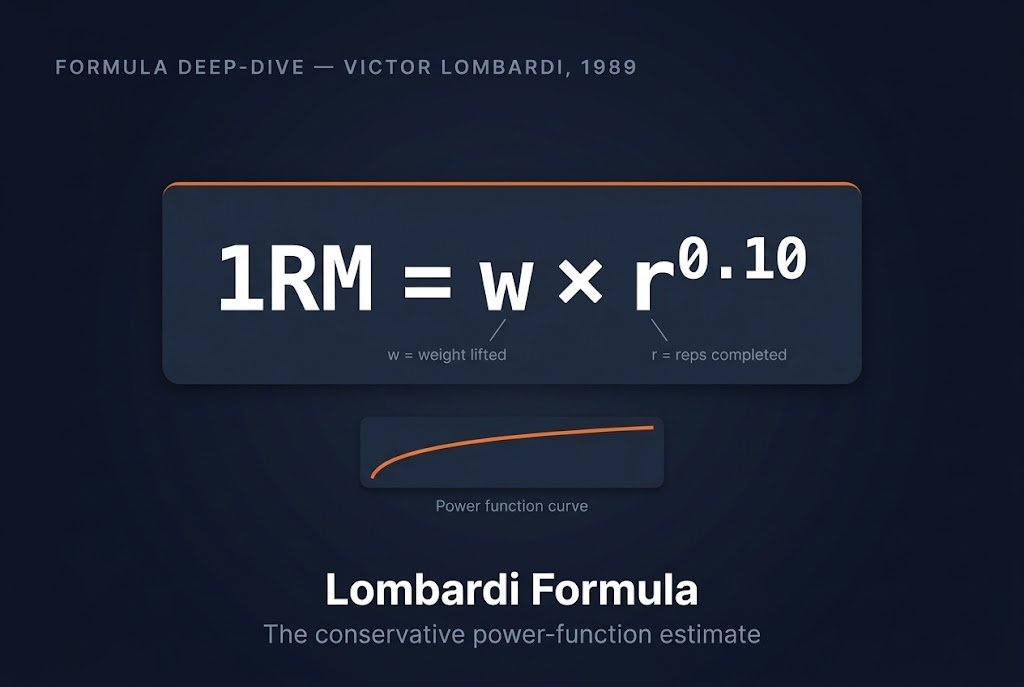
- Formula: 1RM = w × r^0.10 (where w = weight, r = reps)
- Type: Power function, grows more slowly than additive formulas
- Behavior at 1-5 reps: Slightly higher than Epley; very close to Brzycki
- Behavior at 6-10+ reps: Progressively more conservative than all additive formulas
- Best used when: Input set is 6-10 reps and you want a conservative estimate
- Developed by: Victor Lombardi (1989)
What is the Lombardi Formula?
The Lombardi formula estimates a lifter’s one-rep max by multiplying the weight lifted by the number of reps raised to the power of 0.10. Most other 1RM formulas use additive scaling, adding a fixed amount for each rep completed. Lombardi uses multiplicative scaling through a power function instead, producing a fundamentally different curve as reps climb.
The Notation and Plain English
Formula in notation:
1RM = w × r^0.10
Formula in plain English: multiply the weight you lifted by the number of reps you performed, raised to the power of 0.10.
Step by step:
- Count the exact number of clean reps completed (r)
- Raise r to the power of 0.10: calculate r^0.10
- Multiply by the weight used (w)
- The result is your estimated 1RM
Quick reference values for r^0.10:
| Reps (r) | r^0.10 | % above input weight |
| 1 | 1.000 | +0% |
| 3 | 1.116 | +11.6% |
| 5 | 1.175 | +17.5% |
| 8 | 1.231 | +23.1% |
| 10 | 1.259 | +25.9% |
| 12 | 1.282 | +28.2% |
Why a Power Function?
A power function with an exponent of 0.10 grows slowly and bends downward: each additional rep adds progressively less than the one before it. Epley, by contrast, adds a fixed r/30 increment regardless of how many reps came before. The result is a smoother, more conservative curve at higher rep counts. Lombardi effectively assumes the strength-to-endurance ratio is less favorable at high reps than the additive models assume.
Who Developed the Lombardi Formula?
Victor Lombardi published this formula in 1989, part of the same generation of prediction research that produced Epley (1985) and Brzycki (1993), a period when strength coaches were trying to reduce reliance on dangerous maximum-effort testing. Lombardi’s contribution was structural: a power function instead of a linear factor, meant to produce more stable estimates across a wider rep range than the additive models available at the time.
Lombardi Formula: Worked Examples
Bench Press: 80 kg × 5 Reps
Calculation:
1RM = 80 × 5^0.10 = 80 × 1.175 = 94.0 kg
Your estimated bench press 1RM is 94.0 kg. To set your training weights, open the Percentage & Rep-Max Table in the calculator and enter 94 kg, which generates your full load chart automatically.
Comparison check: Epley at 80 kg × 5 reps gives 80 × (1 + 5/30) = 80 × 1.167 = 93.3 kg. Lombardi runs 0.7 kg higher than Epley at 5 reps, close enough that the two formulas agree in practice.
Squat: 120 kg × 8 Reps
Calculation:
1RM = 120 × 8^0.10 = 120 × 1.231 = 147.7 kg
Your estimated squat 1RM is 147.7 kg.
Comparison check: Epley at 120 kg × 8 reps gives 120 × (1 + 8/30) = 120 × 1.267 = 152.0 kg. Lombardi runs 4.3 kg lower than Epley at 8 reps. The gap grows with rep count: Lombardi is the more conservative the estimate, the higher you go.
Lombardi vs the Other 6 Formulas: The Full Comparison
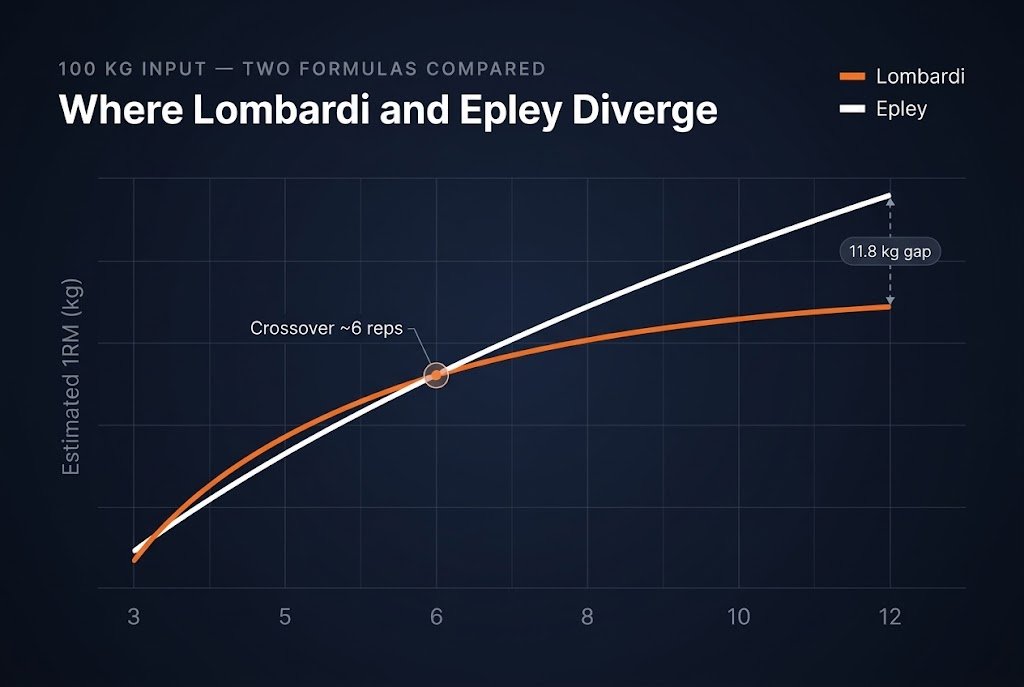
Against Epley alone, Lombardi looks like a minor variation. Against all seven formulas at once, its behavior is distinctive: near the top of the pack at low reps, at the bottom by the time reps climb.
| Reps | Lombardi | Epley | Brzycki | Lander | Mayhew | O’Conner | Wathan |
| 3 | 111.6 kg | 110.0 kg | 108.1 kg | 111.5 kg | N/A | 107.5 kg | N/A |
| 5 | 117.5 kg | 116.7 kg | 116.3 kg | 116.7 kg | 115.1 kg | 112.5 kg | 116.8 kg |
| 6 | 119.6 kg | 120.0 kg | 120.0 kg | 119.4 kg | 118.2 kg | 115.0 kg | 119.8 kg |
| 8 | 123.1 kg | 126.7 kg | 127.3 kg | 124.8 kg | 124.1 kg | 120.0 kg | 125.8 kg |
| 10 | 125.9 kg | 133.3 kg | 133.3 kg | 130.2 kg | 128.1 kg | 125.0 kg | 131.6 kg |
| 12 | 128.2 kg | 140.0 kg | 140.0 kg | 135.7 kg | 133.8 kg | 130.0 kg | 137.5 kg |
Bold marks where Lombardi leads the group (3-5 reps) versus where Epley and Brzycki pull ahead (6+ reps). Mayhew and Wathan show N/A at 3 reps due to formula constraints. Source: formula calculations using each equation in the calculator engine. Run all 7 formulas simultaneously for your own lifts using the one rep max calculator.
The Crossover Point: ~5-6 Reps
At 5 reps, Lombardi sits at 117.5 kg against Epley’s 116.7 kg, almost identical but slightly ahead. At 6 reps they cross: Lombardi drops to 119.6 kg, just under Epley’s 120.0 kg, and the gap widens with every rep after that. At 10 reps Lombardi runs 7.4 kg below Epley; at 12 reps, 11.8 kg below. This crossover is the defining trait of the power function, and it’s why Lombardi earns its keep for moderate-to-high rep sets rather than low-rep ones. See the Epley formula guide for the formula it’s crossing against.
How Accurate Is the Lombardi Formula?
LeSuer et al. (1997) is the only major validation study that tested Lombardi alongside the other formulas in this calculator. The honest finding: Lombardi performed moderately across all three competition lifts, tracking similarly to the others at low rep counts while showing less overestimation bias as reps rose. That conservative output at 6+ reps is simultaneously a strength (less likely to overestimate) and a weakness (may underestimate for fast-twitch-dominant athletes). The broader validation studies summarised in the research literature reach a similar conclusion.
Accuracy at a glance:
- At 1-5 reps: comparable to Epley and Brzycki, within 1-2 kg for most inputs
- At 6-10 reps: more accurate than Epley for lifters whose strength-endurance ratio sits below average
- At 10+ reps: the most conservative formula in the engine, least likely to overestimate
- Deadlift: like all seven formulas, underestimates the deadlift 1RM; add 5-10% to any deadlift output
For the broader accuracy picture across all seven formulas and every major lift, see How Accurate Are 1RM Calculators?
When to Use the Lombardi Formula
| Situation | Use Lombardi? | Reason |
| Input set: 1-5 reps | Yes, among options | Agrees closely with Epley; a slightly higher conservative baseline |
| Input set: 6-10 reps | Preferred | Power function models slower growth; less overestimation than additive formulas |
| Input set: 10+ reps | Best choice | Most conservative formula; reduces risk of overestimated training loads |
| Competition attempt selection | Caution | Conservative estimates may undersell your true ceiling; use a direct test instead |
| Bench press estimation | Acceptable | Mayhew is purpose-built for bench, but Lombardi works fine at 1-5 reps |
| High endurance-to-strength ratio lifter | Preferred | Conservative output better matches this population’s actual 1RM |
| Beginner 8-10 rep estimation | Recommended | Safer starting point; avoids overloaded training percentages |
Use the one rep max calculator to see Lombardi’s output alongside all six other formulas at once, and let the NSCA’s published load percentages cross-check whatever training weight you land on.
Limitations of the Lombardi Formula
- May underestimate for fast-twitch athletes. Lifters who generate high force in single-rep efforts relative to their multi-rep performance will consistently see Lombardi produce lower estimates than their actual 1RM.
- No lift-specific calibration. Lombardi was built as a generalist equation, not calibrated separately for bench press, squat, or deadlift the way Mayhew was derived from bench data or Epley was validated specifically on squat.
- Less familiar to coaches. Lombardi appears in fewer published programming resources than Epley, which can make its output harder to explain in a team or coaching setting.
- Grows too slowly at very low reps. At 1-2 reps, Lombardi’s output runs slightly higher than the evidence suggests the true 1RM should be. Brzycki is the more conservative and better-supported choice at that extreme.
How to Use the Lombardi Formula With the Calculator
The one rep max calculator runs all seven formulas at once, Lombardi included. Enter your lift, weight, and reps, then check the Lombardi row. If it sits noticeably below the others, your input landed at a moderate-to-high rep count (6+), and Lombardi is doing exactly what it’s meant to: giving the most conservative estimate in the group, intentionally. The Percentage & Rep-Max Table then generates training loads from whichever formula’s output you program from. For a full side-by-side look, see All 1RM Formulas Compared.
Frequently Asked Questions
The power function behind Lombardi makes it uniquely conservative at moderate-to-high rep counts, the right choice when you want an estimate that won’t overload your training percentages. It sits with Epley at 1-5 reps and pulls furthest below the group above 6. Run it alongside the other six rather than in isolation: a wide gap between Lombardi and Epley at your input rep count tells you something real about your strength-endurance profile. Start with 1RM Formulas & Calculations, compare it directly against Epley Formula: Complete Guide, or see the full field in All 1RM Formulas Compared.