
What Is a DOTS Score? How It Compares to Wilks
A DOTS score adjusts your powerlifting total for bodyweight, so a 60 kg lifter and a 120 kg lifter can be ranked on one scale. It was built in 2019 as a modern replacement for Wilks. Here’s the part most lifters get wrong: a 90 kg man with a 600 kg total scores 388.0 DOTS and 383.0 Wilks. Five points apart. If you only need your number, the DOTS Score Calculator gives it in seconds; the rest of this page explains where it comes from and when the difference matters.
At a glance:
- DOTS multiplies your total in kilograms by a bodyweight coefficient, on the same 500-point scale as the original Wilks
- Tim Konertz created it in 2019 for Germany’s BVDK federation
- The name stands for Dynamic Objective Team Scoring
- It’s fitted to newer raw competition data than Wilks
- The IPF doesn’t use it; the IPF-affiliated meets score with IPF GL Points
- Against Wilks, scores differ by 3.2% or less at every IPF class limit
What Is a DOTS Score?
Raw totals reward size, so a meet can’t crown one Best Lifter across its weight classes by total alone. It needs a bodyweight adjustment, and DOTS is one of the most common.
The mechanism is a single multiplication: your total times a coefficient that shrinks as bodyweight rises. The output is a unitless number you can compare against any lifter of the same sex. DOTS works in kilograms internally, so if you train in pounds, convert your total before you run the numbers.
Why DOTS Was Created
In 2019 the IPF dropped Wilks and switched to IPF Points. Germany’s BVDK runs team competitions, where every lifter’s score feeds a team total, and the new IPF formula didn’t suit that format. Tim Konertz built DOTS to fill the gap, fitting it to modern results from raw, drug-tested competition.
The IPF’s explanation of why Wilks was replaced points to data drawn from 1988 to 1994, very few women in the original dataset, and decades of changes in equipment and training since.
What “DOTS” Stands For
Dynamic Objective Team Scoring, according to its creator. Some websites list other expansions. They’re wrong; the name comes from its team-scoring origin.
The DOTS Formula
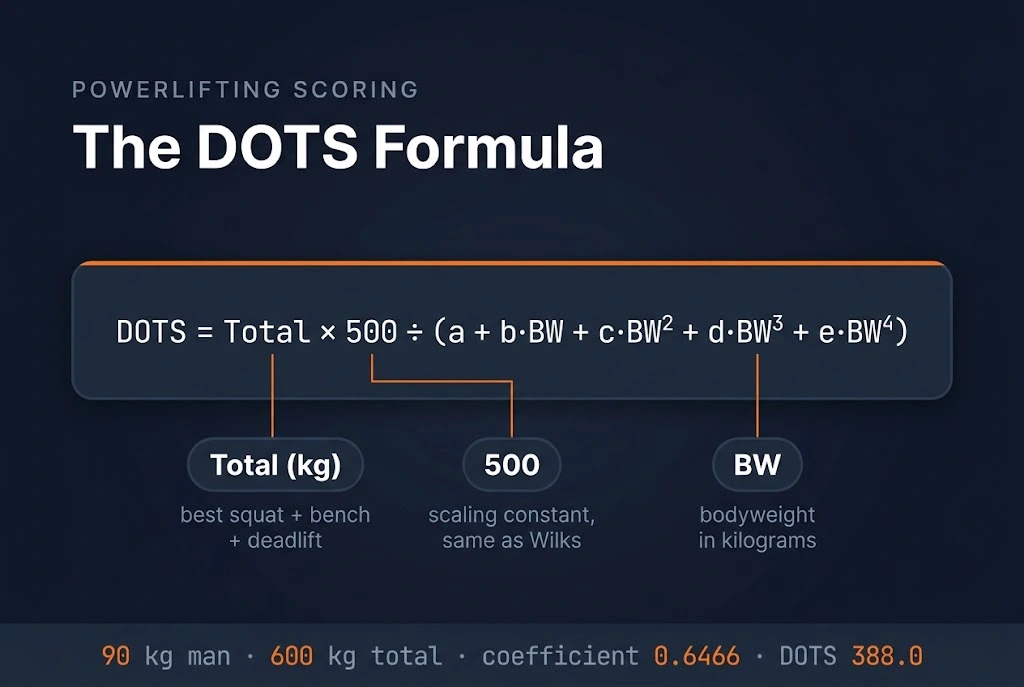
DOTS = Total (kg) × 500 ÷ (a + b·BW + c·BW² + d·BW³ + e·BW⁴)
In plain English, your total is multiplied by a coefficient, and that coefficient is 500 divided by a fourth-degree polynomial of your bodyweight in kilograms. That’s one term fewer than Wilks, which uses a fifth-degree polynomial. Men and women have separate constants.
| Constant | Men | Women |
| a | −307.75076 | −57.96288 |
| b | 24.0900756 | 13.6175032 |
| c | −0.1918759221 | −0.1126655495 |
| d | 0.0007391293 | 0.0005158568 |
| e | −0.000001093 | −0.0000010706 |
DOTS constants for men and women. These reproduce the published check value: a 521.6 kg total at 83.9 kg (male) scores 350.0.
The Shortcut: DOTS Coefficient by Weight Class
Nobody runs a fourth-degree polynomial in a gym. Multiply your total by the coefficient nearest your bodyweight below; the values sit at each IPF class limit, explained in powerlifting weight classes.
| Men | Coefficient | Women | Coefficient |
| 59 kg | 0.8559 | 47 kg | 1.3106 |
| 66 kg | 0.7835 | 52 kg | 1.2189 |
| 74 kg | 0.7237 | 57 kg | 1.1457 |
| 83 kg | 0.6751 | 63 kg | 1.0755 |
| 93 kg | 0.6363 | 69 kg | 1.0195 |
| 105 kg | 0.6031 | 76 kg | 0.9672 |
| 120 kg | 0.5743 | 84 kg | 0.9202 |
| 140 kg | 0.5480 | 100 kg | 0.8533 |
DOTS coefficient at each IPF class limit. Your real coefficient applies at your exact bodyweight, so an 80 kg lifter gets a slightly higher value than the 83 kg row shows.
A 400 DOTS takes a 467.4 kg total at 59 kg and a 696.5 kg total at 120 kg. On the women’s side, the same score takes 328.2 kg at 52 kg and 413.6 kg at 76 kg.
How to Calculate Your DOTS Score?
- Get your best squat, bench, and deadlift. Competition bests work, and so do recent training maxes. If you’ve never tested, estimate them with the one rep max calculator.
- Add the three lifts for your total: 220 + 150 + 230 = 600 kg.
- Convert to kilograms if you train in pounds by multiplying by 0.45359.
- Find your coefficient in the table above, or divide 500 by the polynomial at your bodyweight. At 90 kg, a man’s coefficient is 0.6466.
- Multiply your total by the coefficient: 600 × 0.6466 = 388.0 DOTS.
A second example shows how bodyweight swings the result. A 60 kg woman with a 380 kg total scores 421.2 DOTS, which beats the 90 kg man by 33 points even though she lifted 220 kg less. Relative to her size, hers is the stronger performance, and the formula says so.
What Is a Good DOTS Score?
For a raw lifter, 300 DOTS puts you in competitive shape for a local meet, and 400 makes you a national-level contender. The bands below give the rest of the scale.
| DOTS | Level | What it looks like |
| Under 200 | Beginner | First 6–12 months of barbell training |
| 200–299 | Intermediate | Consistent, structured training |
| 300–399 | Advanced | Competitive at local and regional meets |
| 400–499 | Elite | National-level contender |
| 500+ | World-class | International podiums and records |
Approximate DOTS levels for raw lifters. DOTS and original Wilks share a 500-point scale, so these bands match the site’s Wilks levels. Women and equipped lifters should compare within their own category.
Treat those bands as rough; a 350 means different things in a drug-tested federation with a deep class. For real numbers, sort the OpenPowerlifting rankings by DOTS and filter to your federation and weight class.
If you’re heading to your first meet, your score is a baseline, not a target. The first meet preparation guide covers what deserves your attention instead.
DOTS vs Wilks: The Honest Comparison
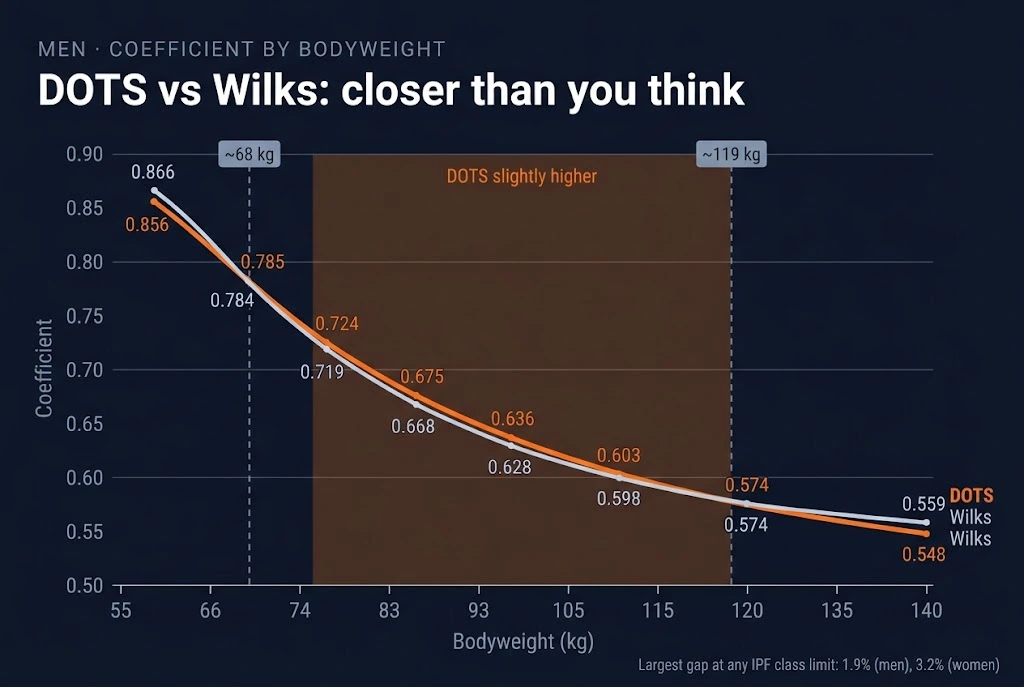
The two formulas are built the same way: total × 500 ÷ a bodyweight polynomial. DOTS drops one term and runs on newer data, and that’s most of the difference. For the majority of lifters, the two scores land within a few points of each other. If you want the full background on the older formula, see What Is a Wilks Score?
Who Scores Higher Under DOTS?
| Men | DOTS vs Wilks | Women | DOTS vs Wilks |
| 59 kg | −1.2% | 47 kg | −2.6% |
| 66 kg | −0.2% | 52 kg | −2.2% |
| 74 kg | +0.6% | 57 kg | −1.3% |
| 83 kg | +1.1% | 63 kg | +0.1% |
| 93 kg | +1.3% | 69 kg | +1.5% |
| 105 kg | +0.9% | 76 kg | +2.6% |
| 120 kg | −0.1% | 84 kg | +3.2% |
| 140 kg | −1.9% | 100 kg | +2.5% |
DOTS score compared with Wilks for the same total, at each bodyweight. Positive means DOTS scores higher.
Men between roughly 68 kg and 119 kg score slightly higher on DOTS. The lightest and heaviest men score slightly lower. For women the line falls at about 62 kg: lighter women lose a little under DOTS, and heavier women gain by as much as 3.2% at 84 kg. That pattern lines up with the long-running complaint that Wilks favored the lightest classes.
Does the Difference Matter?
For tracking your own progress, barely. A 3% gap won’t hide real progress.
It does matter in two places. The first is the top of a Best Lifter table, where a handful of points decides who takes the award, and a meet switching from Wilks to DOTS can reorder the podium. The second is the bodyweight extremes, where a 59 kg man or a 47 kg woman gives up a point or two. The practical rule is simple: pick one formula for tracking and stay with it, because switching between them muddies your own trend line.
What DOTS Fixes, and What It Doesn’t
DOTS fixes the age of the data. Wilks was fitted to results from a different era of the sport, and DOTS reflects how raw lifters perform now. Its shorter polynomial also gives a smoother curve across the normal bodyweight range.
What it leaves alone is the one-formula-for-everyone problem. DOTS has no separate classic and equipped versions, so an equipped total and a raw total run through the same equation. Accuracy still drops at extreme bodyweights, as it does for every polynomial formula, because there are far fewer lifters at 45 kg or 160 kg to fit the curve against.
DOTS vs Wilks 2 vs IPF GL
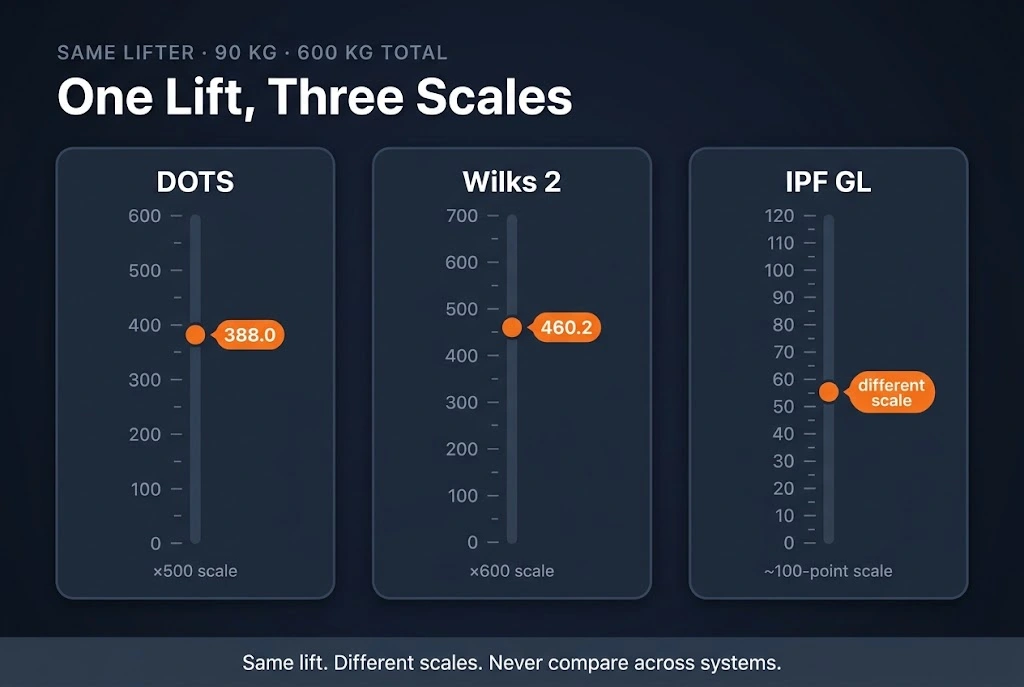
Four systems are in common use, and only two of them share a scale.
| System | Introduced | Scale | Main users | 90 kg man, 600 kg total |
| Wilks | 1990s | ×500 | Some non-IPF federations; online shorthand | 383.0 |
| DOTS | 2019 | ×500 | BVDK and many federations and meets | 388.0 |
| Wilks 2 | 2020 | ×600 | Powerlifting Australia and others | 460.2 |
| IPF GL Points | May 2020 | Roughly 100-point scale | IPF and all IPF affiliates | Not comparable |
The same lift scored four ways. Compare numbers only within one system; check your Wilks figure with the Wilks Score Calculator.
Wilks 2 is the trap. Its 600 multiplier lifts the same lifter from 388 DOTS to 460 Wilks 2 without an extra kilogram on the bar.
DOTS vs IPF GL
The IPF ranks Best Lifter with IPF GL (Goodlift) points, introduced in May 2020. GL uses a different exponential model with separate classic and equipped versions, and its scores sit on a much smaller scale, so a GL number can’t be lined up against a DOTS number. DOTS was among the formulas the IPF weighed before settling on GL. A 2025 analysis of powerlifting scoring systems compares the formulas side by side for anyone who wants the statistical detail. If you compete in an IPF affiliate, GL is your official number. Outside the IPF, or for comparing yourself across federations, DOTS is the formula we’d default to.
Common Mistakes with DOTS Scores
Most errors come from mixing systems or chasing the number for its own sake:
- Comparing a DOTS score with a Wilks 2 or IPF GL score. They’re on different scales, so the comparison is meaningless.
- Plugging in a total in pounds. The formula expects kilograms, and a pound total inflates your score by about 2.2 times.
- Using your class limit instead of your real bodyweight. An 80 kg lifter in the 83 kg class gets a higher coefficient than the class table shows.
- Switching formulas partway through a training year, then reading the jump or dip as progress.
- Cutting weight to raise the coefficient. Dehydration usually costs more on the platform than the bigger multiplier gives back.
How to Raise Your DOTS Score
You’ve got two levers: a bigger total, or a lower bodyweight with the same total. At 90 kg, every extra 10 kg on your total adds about 6.5 DOTS, and that strength stays with you into the next meet. Use the Powerlifting Total Calculator to find your limiting lift, then aim your next training block at it.
Using the DOTS Score Calculator
Enter your lifts, bodyweight and sex, and the DOTS Score Calculator returns your score at your exact bodyweight in lb or kg. If you only have rep sets, it estimates your maxes first. The level tables show where your score sits for raw and equipped lifters, and the lift balance view flags which lift is holding your total back.
Frequently Asked Questions
DOTS is Wilks rebuilt on modern data: same idea, same scale, small but real differences at the bodyweight extremes. Find out which system your federation uses, track your progress with one formula, and put your effort into the total. Run your numbers in the DOTS Score Calculator, then see the Powerlifting & Competition guide for how scoring fits into the rest of meet day.