What Is a Deadlift? Benefits and Why It Matters for Strength
The deadlift shows up in almost every strength program, usually with the biggest number on the page. Here’s the plain answer to what is a deadlift, and why that number gets so much attention.
A deadlift is a barbell lift where you pull a loaded bar from the floor in front of your feet until you stand fully upright with hips and knees locked. It’s a hip-hinge movement and one of powerlifting’s three lifts. Most lifters deadlift more than they squat; on our standards, the gap is 17–29% from Novice up.
What Is a Deadlift?
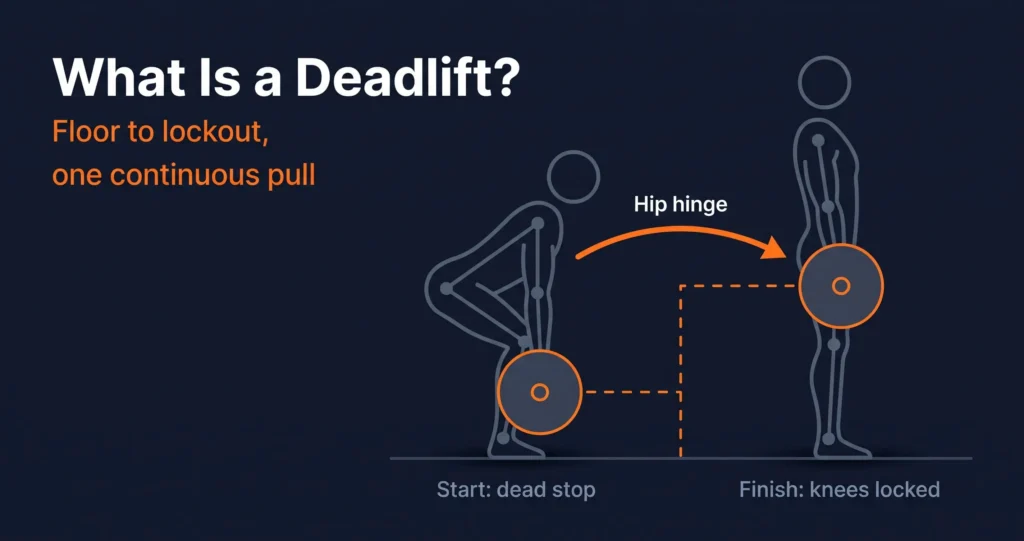
A deadlift is a compound lift that starts with the barbell resting on the floor and ends at lockout, standing tall with the bar against your thighs. It’s usually the heaviest weight you’ll ever hold.
The International Powerlifting Federation sets the official standard: “The lifter shall face the front of the platform with the bar laid horizontally in front of the lifter’s feet, gripped with an optional grip in both hands and lifted until the lifter is standing erect.” The finish is just as plain: “On completion of the lift the knees shall be locked in a straight position.” (IPF Technical Rulebook, 2026)
In gym terms: bar on the floor, any grip, stand up straight, lock your knees.
Why It’s Called a Deadlift
The usual explanation for the deadlift’s name is that the bar starts as dead weight, at a complete stop on the floor. There’s no lowering phase first, so the lift opens with the concentric half. Nobody has pinned down who coined the name, so treat this as the common story, not documented history.
You’ll also see it written as “dead lift”, two words. Same lift. “Death lift” is a misspelling or a joke, and “dead man lift” is another name for the same pull.
How a Deadlift Works: The Hip Hinge
The deadlift is built on the hip hinge: your hips travel back and forward while your spine stays roughly neutral and your knees bend only a little. It’s the loaded version of picking a box up off the floor, which is why people call it a hinge lift.
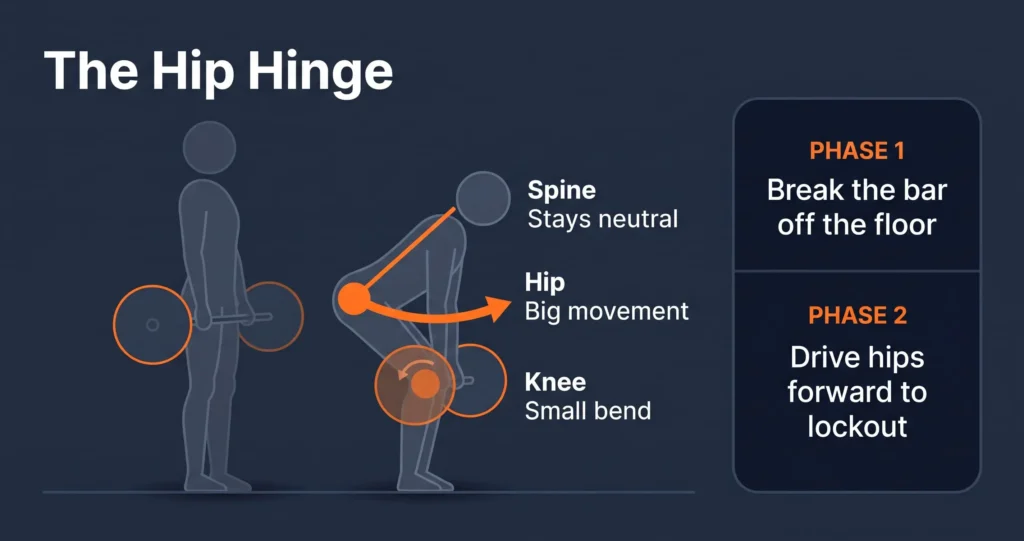
A rep has two halves: break the bar off the floor with your legs pushing and your back holding position, then drive your hips forward to stand tall. That hinge is why the lift loads your glutes and hamstrings harder than a squat does.
Main Types of Deadlift
Four deadlift types cover most of what you’ll see in a gym, and each changes the stance or the bar rather than the basic hinge.
| Type | What changes | Typical use |
| Conventional | Feet about hip-width, hands outside the knees | The default is allowed in powerlifting. |
| Sumo | Wide stance, hands inside the knees | Shorter bar path; also allowed in powerlifting |
| Trap bar (hex bar) | The lifter stands inside a hexagonal bar. | Beginners, athletes, lower back-friendly setup |
| Romanian (RDL) | Starts standing, lowers to mid-shin, knees soft | Hamstring and glute accessory work; not a floor pull |
Four common deadlift types. Conventional and sumo are both legal under the IPF rule’s “optional grip” and stance wording.
What Does a Deadlift Do?
A deadlift trains hip extension under heavy load. Your glutes and hamstrings straighten your hips while your quads help break the bar off the floor. Meanwhile, your back muscles and grip keep everything locked in place. The jobs split roughly like this:
- Glutes: the main drivers of the lockout.
- Hamstrings, which extend the hip alongside the glutes from the floor up.
- Quads help push the floor away in the first few inches.
- Back extensors (the erector spinae) hold your spine still under the load.
- Grip, often the first thing to fail on a heavy pull.
Is the Deadlift Back or Legs?
Both, but the deadlift is mostly a hip exercise. The glutes and hamstrings do the lifting. The erector spinae work very hard, but their job is to stop your spine moving, not to move the weight through a big range.
Train it for your back, and you get mostly isometric work, the muscles holding position while your hips move. Train it for your legs, and the payoff lands on the hamstrings and glutes; your quads get less than a squat gives them.
Deadlift Benefits Backed by Research
The deadlift benefits with the best evidence are lower-body maximal strength, jump gains on par with the squat, and, for some people with mechanical low back pain, less pain when training is supervised. Many listicle claims, such as hormone spikes and calorie burn, have no deadlift-specific evidence behind them.
| Benefit | What the evidence shows | Source |
| Lower-body maximal strength | 6 weeks of deadlift training raised deadlift 1RM more than squat training did (p = 0.017) | Nigro & Bartolomei, 2020 |
| Jump performance | Deadlift and squat groups improved jump performance similarly. | Nigro & Bartolomei, 2020 |
| Low back pain (selected people) | Supervised deadlift training helped patients with less disability, lower pain, and better back-extensor endurance at baseline. | Berglund et al., 2015 |
| Heavy loading for the whole posterior chain | The deadlift threshold is the highest of the five main lifts from Novice up (tied with the squat at Beginner) | onerepmaxcalculators.com standards data |
Deadlift benefits that hold up, with sources. Nigro F, Bartolomei S. J Hum Kinet. 2020;73:145–152. Berglund L et al. J Strength Cond Res. 2015;29(7):1803–1811.
Stronger Hips, Legs and Back
The strength benefit is the best documented. Federico Nigro and Sandro Bartolomei had 25 resistance-trained men train three times a week for 6 weeks, one group deadlifting and the other squatting (Nigro & Bartolomei, 2020). The deadlift group gained more on its deadlift 1RM (p = 0.017); the squat group gained more on its squat 1RM (p = 0.049).
You get the best at the lift you train.
The deadlift puts more weight on your hips than any other barbell lift, which leaves plenty of room for progressive overload.
Jump and Sport Performance
Jump performance improved in both groups of the same study, with no significant difference between deadlifters and squatters, and both programs included jumps. The authors concluded, “Results indicate that both the squat and the deadlift can result in similar improvement in lower body maximal strength and jump performance and can be successfully included in strength training programs.” For jump power, the deadlift is a good option. It isn’t a magic one.
The Deadlift and Your Lower Back
The deadlift’s link with lower back pain cuts both ways. Lars Berglund and colleagues had 35 people with mechanical low back pain deadlift for 8 weeks under a physical therapist with powerlifting experience (Berglund et al., 2015). The ones who benefited started with less disability, lower pain, and better scores on the Biering-Sørensen back-endurance test. The authors wrote that “it is important to ensure that clients have sufficient back extensor strength and endurance and a sufficiently low pain intensity level to benefit from training involving the deadlift exercise.” The study predicts who responds well; it doesn’t show the lift helps everyone with a sore back.
In the Nigro and Bartolomei trial, three people in the deadlift group developed lower back pain and were excluded, and the authors called for proper technique to limit injury risk. If your back already hurts, get assessed by a physiotherapist or doctor before you deadlift.
Other popular claims have thin direct support for the deadlift specifically:
- “Deadlifts spike testosterone.” Short-lived hormone changes after a session haven’t been shown to drive extra growth.
- “Deadlifts burn the most calories.” Any hard compound lift costs energy; there’s no deadlift-specific edge.
- “Deadlifts fix posture.” No controlled deadlift study has measured posture as an outcome.
- “Everyone must deadlift.” A trap bar pull or an RDL covers the hinge if the conventional version doesn’t suit your body.
Deadlift vs. Squat
The deadlift is a hinge that starts from the floor, while the squat is a knee-and-hip bend that starts standing with the bar on your back. The deadlift usually carries more weight, and the squat usually works the quads harder.
| Feature | Deadlift | Back squat |
| Movement pattern | Hip hinge | Squat |
| Starting position | Bar on the floor, at rest | Bar on the upper back, standing |
| First phase | Lifting (concentric) | Lowering (eccentric) |
| Main emphasis | Glutes, hamstrings, back extensors | Quads, glutes, adductors |
| Failed rep | Usually just set the bar down. | Needs safety pins or spotters |
| Powerlifting lift? | Yes | Yes |
Deadlift vs. back squat on pattern, start, and emphasis.
Which Is Heavier: Deadlift or Squat?
The deadlift is heavier for most people, and the site’s own standards show by how much. On the male bodyweight multipliers, the two thresholds are equal at Beginner, then the deadlift pulls ahead at every level after that.
| Level | Squat (× BW) | Squat (lb) | Deadlift (× BW) | Deadlift (lb) | Deadlift ÷ squat |
| Beginner | 1.00× | 180 | 1.00× | 180 | 1.00 |
| Novice | 1.25× | 225 | 1.50× | 270 | 1.20 |
| Intermediate | 1.50× | 270 | 1.75× | 315 | 1.17 |
| Advanced | 1.75× | 315 | 2.25× | 405 | 1.29 |
| Elite | 2.25× | 405 | 2.75× | 495 | 1.22 |
Male strength-standard thresholds at 180 lb bodyweight. Source: onerepmaxcalculators.com strength standards data.
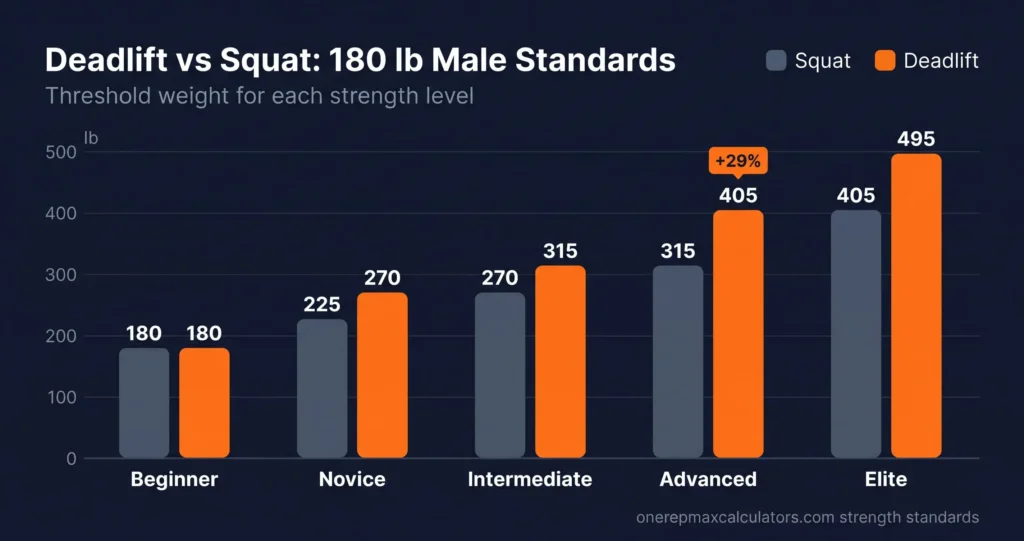
A 180 lb lifter who pulls 275 lb and squats 225 lb for sets of 5 estimates a 320 lb deadlift and a 265 lb squat. That’s a ratio of 1.21, right inside the 1.17–1.29 band. A deadlift lower than your squat usually means the hinge needs work.
Should You Do Both?
Yes, for most lifters. The two lifts share muscles but train different patterns, so dropping one leaves a gap the other can’t fill. A “dead lift squat” isn’t one combined move: they’re separate lifts, trained on different days or with the heavier one first.
Is the Deadlift a Power Lift or an Olympic Lift?
The deadlift is a power lift. It’s the last of the three lifts in a powerlifting meet, after the squat and bench press, and each lifter gets three attempts. It isn’t an Olympic weightlifting event, because weightlifting contests only the snatch and the clean & jerk.
That’s where “Olympic deadlift” searches get confused. Weightlifters do pull from the floor in training, using clean pulls and clean-grip deadlifts to build strength for the start of their lifts, but the deadlift itself is never contested at the Olympics.
Why the Deadlift Matters for Your 1RM
The deadlift 1RM is often your biggest number and a third of a powerlifting total. Most deadlift programs also set their working weights as percentages of it. Knowing what a one-rep max means is half the job, and a deadlift 1RM estimate from a hard set is the safest way to get the number.
Worked Example: From a Set of 5 to a Deadlift 1RM
Take a 180 lb man, the same example lifter used across these guides, who pulls 275 lb for 5 reps. The Epley formula gives 275 × (1 + 5 ÷ 30) = 320.8 lb, which rounds to a 320 lb estimated 1RM: 1.78× bodyweight, Intermediate on the site’s standards. Set the lift to deadlift in the one rep max calculator and it shows the Epley figure next to six other formulas.
| % of 1RM | Exact | Rounded load | Common use |
| 60% | 192 lb | 190 lb | Warm-up / technique work |
| 70% | 224 lb | 225 lb | Volume sets of 6–8 |
| 75% | 240 lb | 240 lb | Sets of 5–6 |
| 80% | 256 lb | 255 lb | Sets of 4–5 |
| 85% | 272 lb | 270 lb | Sets of 3 |
| 90% | 288 lb | 290 lb | Heavy doubles and singles |
Percentages of a 320 lb estimated deadlift 1RM, rounded to the nearest 5 lb. Calculated by onerepmaxcalculators.com. The “common use” column is general guidance, not a program.
Estimate First, Test Later
New lifters should estimate their deadlift 1RM from a hard set of 3–8 reps long before they try a true max. A heavy single on a lift that loads the lower back this much needs repeatable technique first. Once your form holds up under heavy triples, you can move on to testing a true one-rep max.
Common Deadlift Mistakes Beginners Make
Most beginner deadlift mistakes come from treating it like another lift or chasing the number too early:
- Treating the deadlift like a squat. Sinking your hips low turns a good hinge into a bad squat.
- Jerking the bar off the floor instead of pulling the slack out and building tension first.
- Maxing out in the first month, when an estimate from a set of 5 tells you nearly as much at a fraction of the risk.
- Using straps on every set for a prettier lift, then failing on grip when it counts.
- Grinding through back pain. Stop, and get it checked by a professional.
The deadlift form guide covers the setup and cues that fix most of these.
Frequently Asked Questions
Your next deadlift session is where this turns into a number. Work up to a weight you can pull for a hard set of 5 with good form, stop there, and enter the weight and reps for a deadlift 1RM estimate. Write down the 1RM it gives you and the 70% and 80% loads beside it, and build your next block from those.