
Strength Standards & Benchmarks
You benched 100 kg last week. Is that good? The honest answer: it depends on what you weigh. A 100 kg bench at 75 kg bodyweight is a different achievement from a 100 kg bench at 110 kg, and no raw number means anything without that context. Strength standards exist to give your 1RM a frame of reference, scaled to your bodyweight and training history. This guide covers published standards for every major barbell lift, the classification system behind them, and how to find where you sit.
What Are Strength Standards?
Published benchmarks express what typical lifters at each experience level can lift, scaled to bodyweight and gender. They come from population-level data collected across training facilities, competition results, and research programs. The most widely referenced online sources are ExRx (Exercise Prescription) and Symmetric Strength. For competitive powerlifting, the IPF publishes formal classification tables that define national and world-level standards.
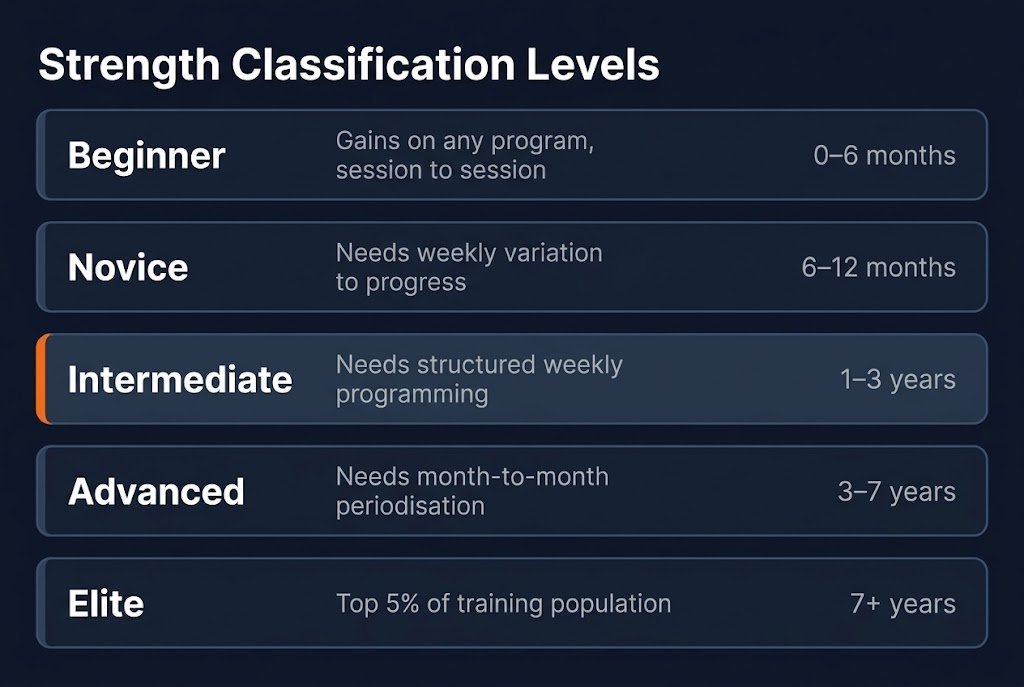
The standard classification system uses five tiers: Beginner, Novice, Intermediate, Advanced, and Elite. The version used most often in coaching and programming contexts was co-developed by Lon Kilgore and Mark Rippetoe in Practical Programming for Strength Training, and it ties each level to how a lifter responds to training rather than to a number on the bar.
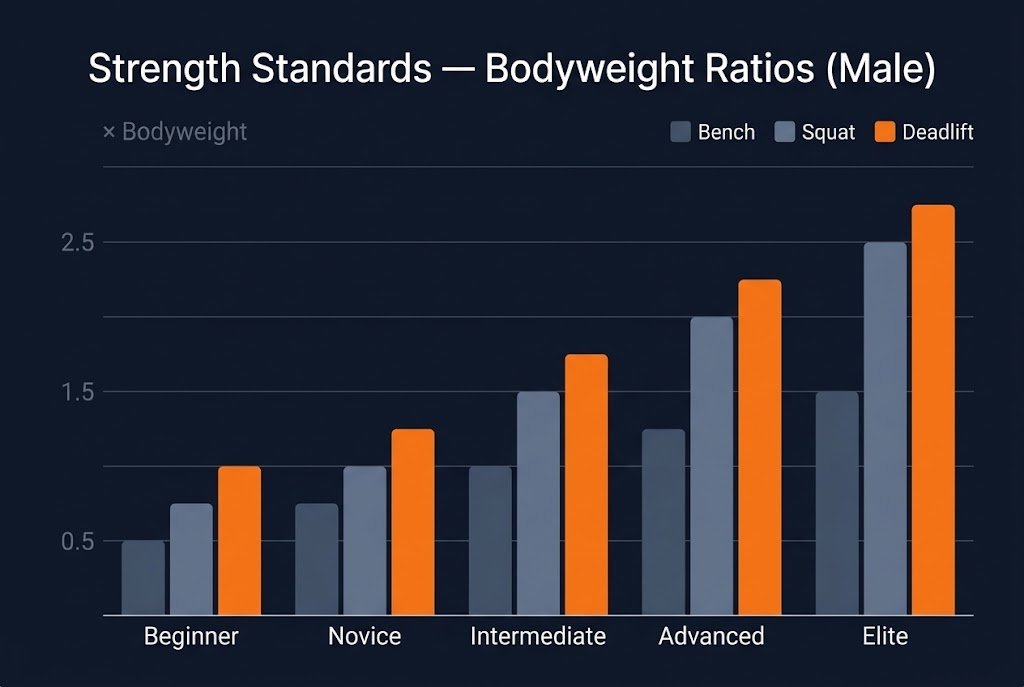
The benchmarks are expressed as bodyweight ratios. Here’s the approximate snapshot for male lifters across the Big 3:
| Level | Bench (xBW) | Squat (xBW) | Deadlift (xBW) |
| Beginner | 0.5 | 0.75 | 1.0 |
| Novice | 0.75 | 1.0 | 1.25 |
| Intermediate | 1.0 | 1.5 | 1.75 |
| Advanced | 1.25 | 2.0 | 2.25 |
| Elite | 1.5 | 2.5 | 2.75 |
Approximate bodyweight ratios for male lifters. Female standards and full tables by bodyweight range are in the dedicated cluster articles.
Average Bench Press by Age and Weight
Bench press standards are more bodyweight-dependent than most lifters realize. A 100 kg bench means intermediate at 80 kg bodyweight and barely novice at 100 kg bodyweight. That gap is why raw numbers in isolation are misleading and why the tables in the full article scale every benchmark across bodyweight bands rather than giving one number.
Age affects bench less than it affects lower-body lifts. A 35-year-old and a 25-year-old at the same bodyweight can use the same benchmark table without meaningful distortion. The age-related decline that shows up in squat and deadlift performance after 40 is less pronounced in horizontal pressing, partly because the bench press imposes lower systemic fatigue than lifts that load the spine axially.
Estimate your bench 1RM with the bench press one rep max calculator and compare against the full tables: Average Bench Press by Age and Weight
Average Squat by Age and Weight
The squat is the primary lower-body strength benchmark in percentage-based programming, and its standards run meaningfully higher than bench standards at every classification level. A 1.5 times bodyweight squat is generally considered the line between Novice and Intermediate for male lifters, and reaching it takes most people 1-2 years of consistent training.
Squat standards show greater age-related decline than bench. Masters-age lifters (40+) typically see more relative drop in squat performance than in pressing movements, which reflects the higher systemic recovery demand of heavy squatting and the cumulative effect of spinal loading over time. The dedicated article covers the decade-by-decade breakdown.
Use the squat one rep max calculator to get your number, then the full tables: Average Squat by Age and Weight
Average Deadlift by Age and Weight
Most lifters deadlift more than they squat, and significantly more than they bench. That makes the deadlift the highest absolute-load standard in the set, which has two practical effects: it’s the easiest lift for a beginner to make rapid progress on, and it’s the hardest to reach Elite status on. The gap between Beginner and Elite is wider on the deadlift than on any other barbell lift.
A 2.0 times bodyweight deadlift is a widely cited milestone for male intermediate lifters. It sits right at the boundary of what consistent training produces within a couple of years for most body types, and it’s a strong signal that foundational posterior chain strength is in place. Below that, programming the deadlift for more volume usually works. Above it, programming decisions start to matter a lot more.
Run your deadlift numbers through the deadlift one rep max calculator, then compare: Average Deadlift by Age and Weight
Strength Classification Levels: Beginner to Elite
Each tier in the five-tier classification corresponds to how a lifter responds to training stimulus, which makes the system useful for programming decisions.
Beginner lifters improve on almost any program. They can add weight to the bar every session because the neurological adaptation is still rapid. Novice lifters have exhausted session-to-session progression and need weekly variation to keep moving. Intermediate lifters require week-to-week structured programming and can no longer add weight on a simple linear ramp. Advanced lifters need month-to-month periodization across full training blocks, and gains come in smaller increments over longer timelines. Elite represents the top 5% or better of the training population at a given bodyweight.
One thing these labels make clear: classification is lift-specific. You can be intermediate on the deadlift and novice on the bench at the same time. Most lifters are. Assuming your weakest lift matches your strongest is how programs get built on bad data.
For the full breakdown of what each level means in practical programming terms: Beginner vs Intermediate vs Advanced Strength Standards
Strength Standards by Bodyweight
A 140 kg squat means different things for a 60 kg lifter and a 120 kg lifter. The first is squatting 2.3 times bodyweight (well into Advanced territory); the second is squatting 1.17 times bodyweight (Novice). Raw numbers without bodyweight context are meaningless for comparison, which is exactly why the standards exist as ratios rather than fixed weights.
The bodyweight-ratio method scales cleanly across weight classes, but it isn’t perfect. Heavier lifters tend to carry more non-muscular mass (organs, skeleton, stored body fat), which makes reaching the same bodyweight ratio harder as bodyweight increases. A 60 kg lifter hitting 2.0 times bodyweight is a more common occurrence than a 120 kg lifter doing the same. The full tables in the dedicated article account for this by providing absolute weight benchmarks across multiple bodyweight bands in both pounds and kilograms.
Once you know where your numbers sit, the Lift-Specific 1RM Guides hub shows you how to improve each lift individually.
For the dual-unit tables: Strength Standards by Bodyweight (lb and kg)
How Do You Compare to World Standards?
The gap between “Advanced by gym standards” and “competitive at a national level” is larger than most lifters expect. An Advanced bench press by ExRx classification (1.25 times bodyweight for a male lifter) sits well below the bottom tier of competitive IPF powerlifting at most weight classes.
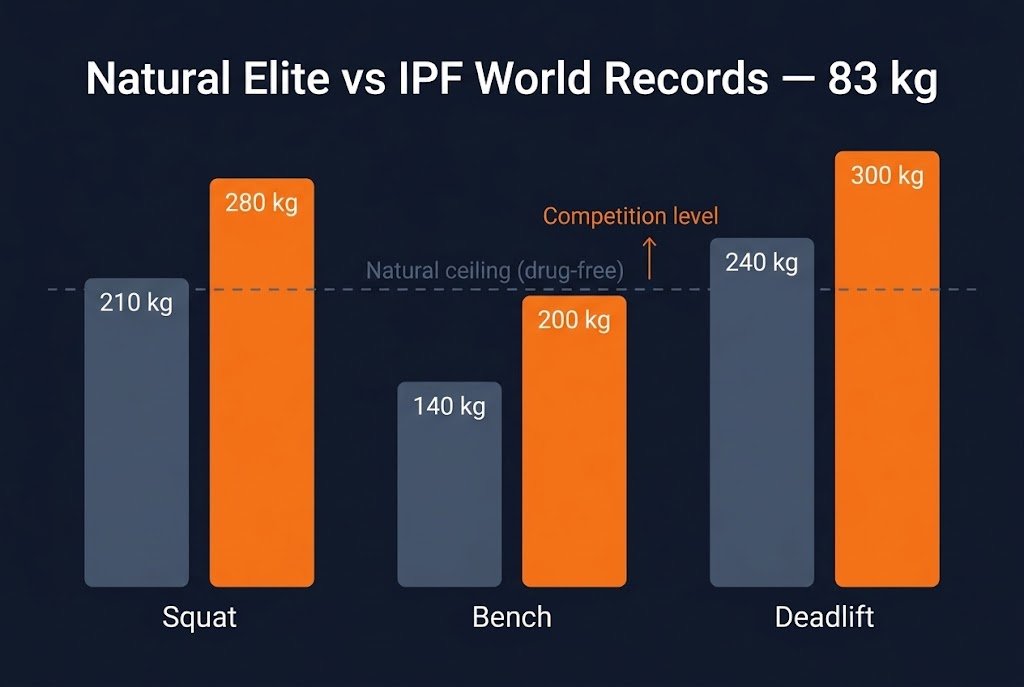
To put it in scale: in the IPF 83 kg class, world-level male competitors squat above 280 kg, bench press above 200 kg, and deadlift above 300 kg, all drug-tested and raw. Those numbers represent decades of full-time training combined with genetics that land in the far tail of the distribution. Knowing where the absolute ceiling sits is useful for calibration, not for targeting. For recreational lifters, reaching the ExRx or Symmetric Strength Elite tier is a legitimate lifetime goal. Matching competition records is a different category entirely.
Natural Strength Limits: What’s Achievable Without PEDs?
The published Elite tier in most standards tables includes data from both drug-tested and untested lifting. That matters for goal-setting. A natural lifter who trains for ten years with serious intent can realistically reach the ExRx or Symmetric Strength Elite classification on their best lifts. Matching IPF world records without pharmacological assistance is not a realistic expectation for any but the most genetically exceptional individuals.
The practical ceiling for a drug-free male lifter with several years of consistent training tends to sit around a 1.5 times bodyweight bench, a 2.0-2.5 times bodyweight squat, and a 2.5-3.0 times bodyweight deadlift, depending on body composition and limb proportions. These numbers represent the upper boundary of what structured programming can deliver without assistance. Knowing where that boundary is prevents the kind of frustration that comes from chasing numbers that aren’t available to you.
Strength Standards for Women
Female strength standards are a separate dataset, not a percentage reduction of male benchmarks. The relationship between male and female performance varies by lift: women’s lower-body strength (squat, deadlift) is closer to men’s in bodyweight-relative terms than women’s upper-body pressing strength (bench, overhead press). This reflects physiological differences in upper versus lower body muscle distribution, and it means that a single “women are X percent of men” adjustment across all lifts would produce inaccurate benchmarks in both directions.
The dedicated article provides full classification tables with bodyweight bands specific to female lifters across all five tiers (Beginner through Elite) for the bench press, squat, deadlift, and overhead press. The data comes from the same sources (ExRx, Symmetric Strength) but uses female-specific population data rather than derived values.
Teenage Strength Standards (16-18)
Teenage lifters should be assessed against age-specific benchmarks, not adult standards. Strength development between 16 and 18 follows a trajectory driven by hormonal growth, motor pattern learning, and neurological adaptation that adult standards don’t account for. Most published adult benchmarks overestimate what is typical for adolescent athletes, which creates discouraging misalignment when a 17-year-old compares their squat to a table built from data on 25-year-olds with six years of training history.
Masters Strength Standards (40+)
Strength does decline with age. The decline is real, it’s measurable, and it affects lower-body lifts more noticeably than pressing movements. Master’s standards are adjusted to reflect that reality rather than penalize what is a normal physiological process.
The good news: master athletes who train consistently often maintain near-peak strength into their 50s, and the rate of decline is much slower for lifters who never stop training than for those who take extended breaks and return. The dedicated article covers decade-by-decade breakdowns from the 40s through the 60s and beyond.
How to Use the Calculator to Find Your Classification
Open the one rep max calculator and select your lift. Enter the weight and reps from a recent hard set. The calculator returns your estimated 1RM across seven formulas. Take the average or the formula that best matches your tested history, then look up your bodyweight in the standards tables from the articles above to find your classification level.
The practical next step: use your classification to set your training direction. If you’re a novice on squat and an intermediate on deadlift, your squat programming should be more aggressive (higher frequency, more volume) than your deadlift programming. The classification tells you where you are and how your training should be structured to move up.
For readers who don’t yet have a 1RM to compare, the One Rep Max Basics guide covers how to calculate and test one.
Frequently Asked Questions
Key Takeaways
A 1RM only means something when you put it next to your bodyweight and compare it against people with similar training histories. The classification system (Beginner through Elite) does that across five tiers, and it’s lift-specific: your squat level and your bench level are independent assessments that should drive independent programming decisions. Get your numbers from the calculator, find the right table, and use the classification to set your next training direction rather than treating any single number as a verdict.