
Lander Formula: Complete Guide
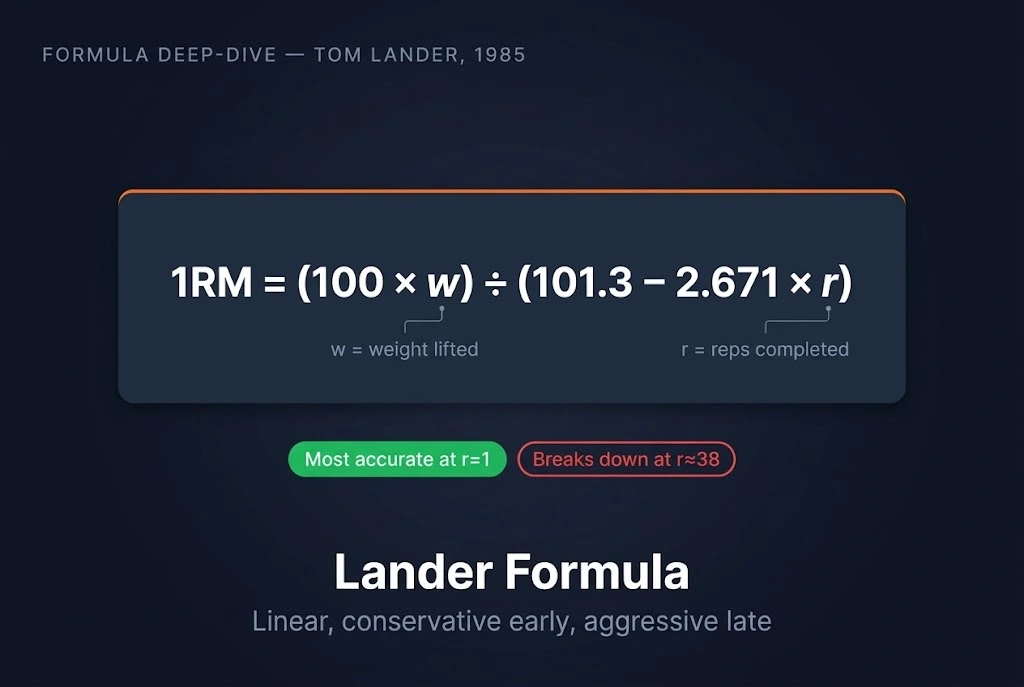
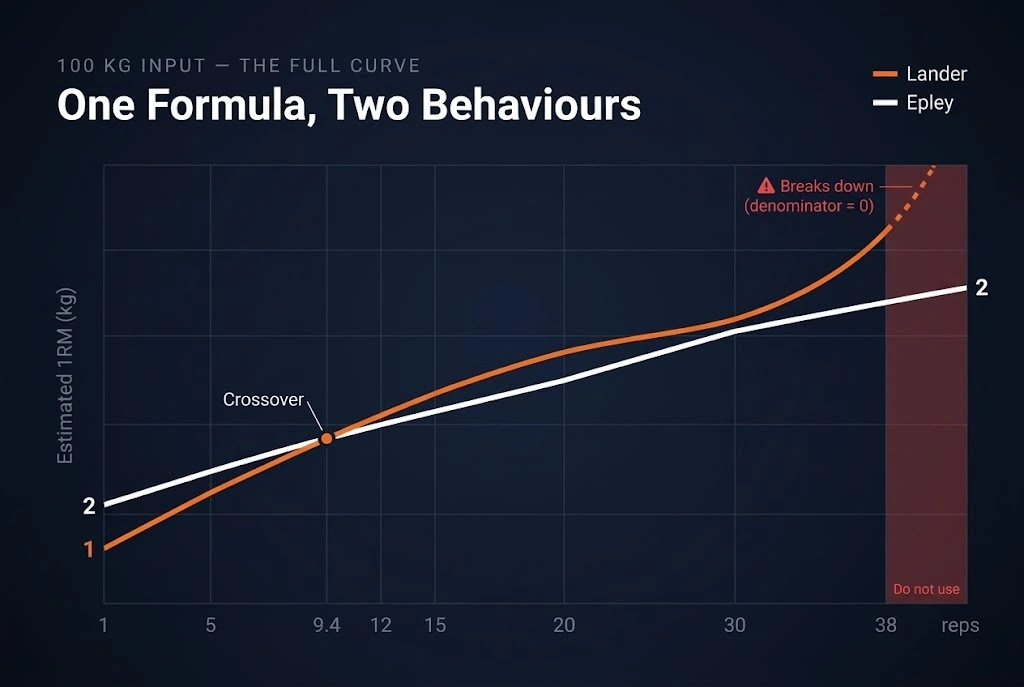
The Lander formula is the most conservative in the calculator at 1-9 reps and uniquely the most accurate of all seven at a single-rep input, but it crosses above Epley at exactly 9.4 reps and turns aggressive at high rep counts. That inverse trajectory, conservative at the start, aggressive by the end, sets it apart from every other formula here. This guide covers the notation, worked examples, exactly where the crossover happens, and the hard limit where it stops working entirely.
At a Glance
- Formula: 1RM = (100 × w) ÷ (101.3 − 2.671 × r)
- Type: Linear, the denominator is a straight line, unlike exponential Mayhew or Wathan
- At r=1: The most accurate formula in the engine, returning 101.4 kg from a 100 kg input (a 1.4% overestimate, versus Mayhew’s 8.9%)
- At 1-9 reps: More conservative than Epley, useful as a safe programming floor
- At 9.4 reps: Crosses Epley exactly, the point where the two formulas equalize
- At 10+ reps: More aggressive than Epley; matches Brzycki from 12+ reps
- Hard limit: Breaks down at r≈38, where the denominator hits zero
- Developed by: Tom Lander (1985, NSCA Journal)
What Is the Lander Formula?
The Lander formula uses a linear denominator to predict maximum strength from a submaximal multi-rep set. Unlike the additive formulas (Epley) or the exponential ones (Mayhew, Wathan), the denominator here is simply a straight-line function of rep count, which makes it transparent and easy to reason about but also creates a hard breakdown point at high rep counts.
The Notation and Plain English
Formula notation:
1RM = (100 × w) ÷ (101.3 − 2.671 × r)
In plain English: multiply your weight by 100, then divide by the result of subtracting 2.671 times your rep count from 101.3.
Step by step:
- Multiply your rep count (r) by 2.671
- Subtract that from 101.3 to get the denominator
- Multiply your weight (w) by 100
- Divide step 3 by step 2 for your estimated 1RM
Lander quick reference, 100 kg input at key rep counts:
| Reps (r) | Denominator | Lander 1RM | Epley 1RM | Difference |
| 1 | 98.6 | 101.4 kg | 103.3 kg | Lander −1.9 kg |
| 3 | 93.3 | 107.2 kg | 110.0 kg | Lander −2.8 kg |
| 5 | 87.9 | 113.7 kg | 116.7 kg | Lander −3.0 kg |
| 8 | 79.9 | 125.1 kg | 126.7 kg | Lander −1.6 kg |
| 10 | 74.6 | 134.1 kg | 133.3 kg | Lander +0.8 kg |
| 12 | 69.3 | 144.4 kg | 140.0 kg | Lander +4.4 kg |
| 15 | 61.3 | 163.3 kg | 150.0 kg | Lander +13.3 kg |
The gap narrows as reps approach 9.4, the crossover point. Past it, Lander progressively overtakes Epley.
Why a Linear Denominator?
The linear structure (101.3 − 2.671r) means each rep subtracts a fixed 2.671 from the denominator, unlike Mayhew and Wathan’s exponential decay or Epley’s additive scaling. That makes the formula easy to compute by hand, but it carries a consequence: when r reaches 101.3 ÷ 2.671 ≈ 37.9, the denominator hits zero and the estimate goes infinite. Past r=38, the denominator turns negative and the formula breaks entirely, a reflection of the computational constraints of pre-calculator strength coaching in 1985.
Who Developed the Lander Formula?
Tom Lander published the formula in the NSCA Journal in 1985, the same year Boyd Epley published his own additive formula, both part of the same generation of research seeking to eliminate the need for dangerous maximal tests. Lander’s paper, “Maximum based on reps” (NSCA J. 1985;6(6):60-61), introduced the linear denominator approach used here. Some online sources incorrectly attribute this formula to Lyle McDonald. The calculator uses Tom Lander’s 1985 equation specifically, not any formula from Lyle McDonald, whose work describes different approaches to 1RM estimation with different structures and constants entirely
Lander Formula: Worked Examples
Example 1: Conservative Low-Rep Input, 80 kg × 3 Reps
Calculation:
1RM = (100 × 80) ÷ (101.3 − 2.671 × 3) = 8,000 ÷ 93.29 = 85.8 kg
Comparison: Epley gives 88.0 kg. Lander runs 2.2 kg more conservative, meaning working percentages come in slightly lighter, reducing overreach risk in a new training block.
Example 2: Mid-Range Input, 120 kg × 8 Reps
Calculation:
1RM = (100 × 120) ÷ (101.3 − 2.671 × 8) = 12,000 ÷ 79.93 = 150.1 kg
Comparison: Epley gives 152.0 kg. Lander runs 1.9 kg more conservative, and at 8 reps the two are converging toward the crossover at 9.4, so the gap is nearly closed. Both are usable here; Lander stays the slightly safer estimate.
Lander vs the Other 6 Formulas: The Full Comparison
Lander traces a U-shaped relationship against the field: most conservative at low reps, crossing Epley at 9.4, then second-most-aggressive at 12+ reps, behind only Brzycki, which it nearly matches.
| Reps | Lander | Epley | Brzycki | Mayhew | Lombardi | O’Conner | Wathan |
| 3 | 107.2 kg | 110.0 kg | 105.9 kg | 114.0 kg | 111.6 kg | 107.5 kg | 109.0 kg |
| 5 | 113.7 kg | 116.7 kg | 112.5 kg | 119.0 kg | 117.5 kg | 112.5 kg | 116.6 kg |
| 8 | 125.1 kg | 126.7 kg | 124.1 kg | 126.3 kg | 123.1 kg | 120.0 kg | 127.7 kg |
| 10 | 134.1 kg | 133.3 kg | 133.3 kg | 130.9 kg | 125.9 kg | 125.0 kg | 134.7 kg |
| 12 | 144.4 kg | 140.0 kg | 144.0 kg | 135.4 kg | 128.2 kg | 130.0 kg | 141.5 kg |
| 15 | 163.3 kg | 150.0 kg | 163.6 kg | 141.7 kg | 131.1 kg | 137.5 kg | 150.9 kg |
Bold marks where Lander sits above Epley (10+ reps). At 3-9 reps, Lander runs below Epley; past 9.4 reps it overtakes it.
The 9.4-Rep Crossover: Where Lander Turns Aggressive
At r=9.4, Lander and Epley both land at roughly 131.2-131.3 kg, virtually identical. Below that point, Lander is the more conservative choice. Above it, Lander turns more aggressive and the gap widens quickly: at 12 reps it’s 4.4 kg above Epley, at 15 reps it’s 13.3 kg above. That’s not a flaw, it reflects the mathematical trajectory of the linear denominator, but it’s a real consideration for anyone estimating from a high-rep set. Lander shouldn’t be used with inputs above 10 reps. For the additive formula it’s crossing, see Epley Formula: Complete Guide, and for how this crossover connects to rep-max conversion generally, see Rep Max Equivalency.
The Brzycki Convergence at 12+ Reps
At 12 reps, Lander (144.4 kg) and Brzycki (144.0 kg) are virtually identical. At 15 reps, they give 163.3 kg versus 163.6 kg, indistinguishable from any practical standpoint. Both use a linear denominator structure (Brzycki’s equivalent is 36 ÷ (37−r)), and both converge to the same aggressively high estimates at high rep counts. That shared structure explains the convergence and confirms that neither Lander nor Brzycki should be used with 12+ rep inputs for 1RM estimation.
How Accurate is the Lander Formula?
Lander was included in the LeSuer et al. (1997) validation study that tested seven formulas across all three competition lifts. Like every formula in that study, it showed a correlation greater than 0.95 with actual 1RM, though correlation alone doesn’t guarantee small absolute errors. Lander’s accuracy is best read by rep range.
Accuracy at a glance:
- At r=1: The most accurate formula in the engine, outputting 101.4 kg from a 100 kg input (a 1.4% overestimate), closer to the theoretically correct value than any other formula at this rep count
- At r=3-9: Conservative estimates within ±2-3 kg below Epley, reliable for programming and unlikely to overload training percentages
- At r=10-12: A growing gap above Epley, 0.8-4.4 kg higher in this range, moderate reliability only
- At r=15+: Significant overestimation, 13+ kg above Epley; don’t program from this range
For the broader validation research across all 7 formulas and how Lander’s accuracy fits the wider picture, see How Accurate Are 1RM Calculators?
Limitations of the Lander Formula
- Breaks down above r≈37.9. The denominator reaches zero at that point and turns negative beyond r=38, producing a nonsensical negative 1RM. Treat any input above 35 reps as invalid; even 30-37 reps produces wildly inflated estimates.
- Aggressive and unreliable at r=10+. Lander’s linear structure grows faster than warranted past 9.4 reps. At 15 reps, it sits 13.3 kg above Epley from the same input, enough to meaningfully overload training percentages.
- Unvalidated by lift-specific research. Unlike Mayhew (bench-calibrated) or Epley (squat-validated by LeSuer et al.), Lander was never published with lift-specific accuracy data. Treat it as a generalist formula.
- Sometimes confused with Lyle McDonald’s work. The formula here is Tom Lander’s, NSCA Journal 1985, with different authorship and methodology entirely. Results cited as “Lyle McDonald” have the source wrong.
How to Use the Lander Formula with the Calculator?
The one rep max calculator runs Lander alongside all six other formulas at once. Its output is most useful when the input set is 1-9 reps, where it reliably provides a conservative floor. When Lander sits noticeably above the Epley and Mayhew outputs at 10+ rep inputs, that signals your input wasn’t reliable; retest with a heavier weight for fewer reps. Use the Percentage & Rep-Max Table to convert any estimate into a full training load chart, cross-checked against the NSCA’s published training load chart.
When to use Lander versus other formulas:
- Use Lander when your input is 1-9 reps and you want a conservative programming floor. It consistently reads below Epley in this range, reducing the risk of overloading working sets in a new block.
- Use Epley for general-purpose estimation at any rep range. It’s better calibrated across both low and high rep inputs.
- Avoid Lander with inputs above 10 reps. At that point, Lombardi or Mayhew is the more appropriate conservative choice.