
All 1RM Formulas Compared: Which is Most Accurate?
Different 1RM calculators give different results because they use different formulas, and the differences are larger than most lifters realize. From the same working set of 100 kg × 5 reps, the seven formulas produce estimates ranging from 112.5 kg to 119.0 kg, a 6.5 kg spread. At 12 reps, that spread grows to 16.2 kg. At 15 reps: 32.5 kg. If you’ve ever wondered which formula is the most accurate 1RM formula, the full answer is below: research-grounded comparisons by exercise and rep count, plus a decision framework for every common scenario.
Key findings at a glance:
- No single formula is most accurate across all exercises and rep counts
- At 1–5 reps, the formulas agree within 6.5 kg: all are reasonably reliable
- At 10+ reps, the spread grows to 9.7 kg (r=10), 16.2 kg (r=12), and 32.5 kg (r=15)
- For bench press: Brzycki (low reps) and Mayhew (moderate reps) are best validated
- For squat: Epley has the lowest error in peer-reviewed testing (~3%)
- For deadlift: every formula underestimates; add 5–10% to any output
- The average of all active formulas is the most defensible single number at any rep count
The Seven 1RM Formulas: Complete Overview
What They All Do
All seven formulas take two inputs—the weight lifted and the rep count—and return an estimated 1RM. All were developed in the period 1985–1994, when sports scientists were systematically building submaximal alternatives to dangerous maximal-effort tests. All have been tested in peer-reviewed research; LeSuer et al. (1997) is the benchmark comparison, which compared all seven simultaneously on bench press, squat, and deadlift in a controlled study.
The Four Mathematical Types
The seven formulas fall into four structural families, which explains much of their divergent behavior at higher rep counts.
- Linear additive (Epley, O’Conner): Adds a fixed percentage per rep. Transparent and easy to compute. O’Conner adds 2.5%/rep; Epley adds 3.33%/rep.
- Linear denominator (Brzycki, Lander): Divides by a linear function of rep count. Conservative at low reps; explosive and unreliable above 10–12 reps.
- Power function (Lombardi): Uses r^0.10. The slowest growth rate; the most conservative formula at 10+ reps.
- Exponential decay (Mayhew, Wathan): Uses e^(−c × r). Most mathematically stable at high rep counts; the two formulas use different decay rates and produce noticeably different results above 8 reps.
| Formula | Author | Year | Type | Formula Notation | Best validated for |
| Epley | Boyd Epley | 1985 | Linear additive | w × (1 + r/30) | Squat; general use |
| Brzycki | Matt Brzycki | 1993 | Linear denominator | w × 36/(37−r) | Bench press (1–5 reps) |
| Lander | J. Lander | 1985 | Linear denominator | 100w/(101.3−2.671r) | Moderate ranges (6–9 reps) |
| Lombardi | Victor Lombardi | 1989 | Power function | w × r^0.10 | Conservative estimates; 6–12 reps |
| Mayhew | Mayhew et al. | 1992 | Exponential decay | 100w/(52.2+41.9e^−0.055r) | Bench press (5–12 reps) |
| O’Conner | O’Conner et al. | 1989 | Linear additive | w × (1 + r/40) | Conservative floor; any lift |
| Wathan | Dave Wathan | 1994 | Exponential decay | 100w/(48.8+53.8e^−0.075r) | General; balanced across all rep counts |
The Master Comparison Table: All 7 Formulas, Every Key Rep Count
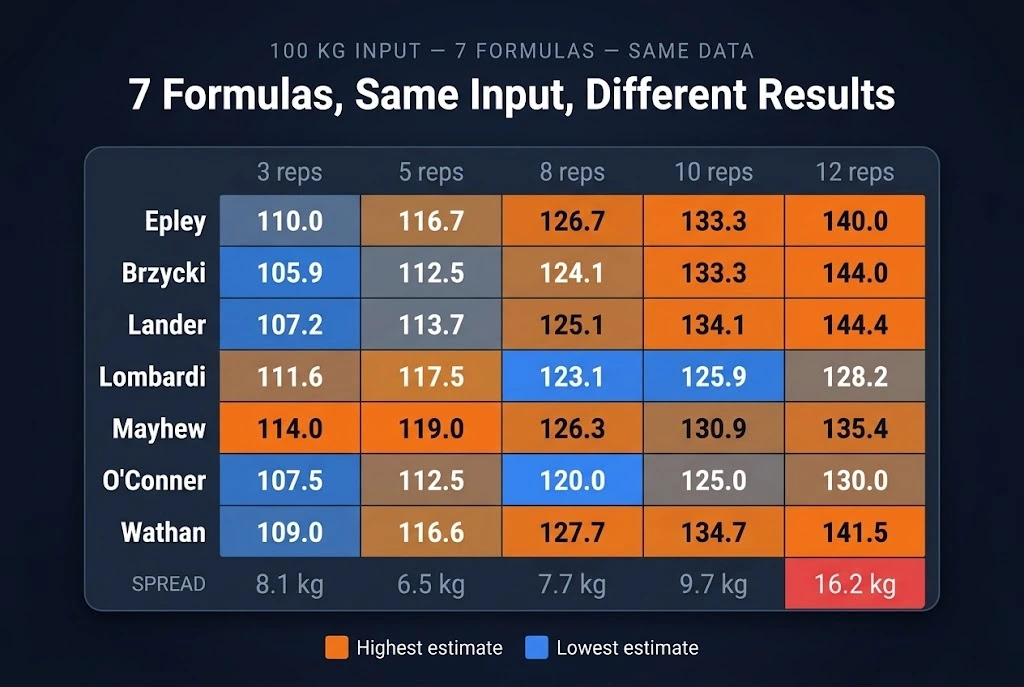
From the same 100 kg input, the seven formulas produce a widening range of predictions as rep count rises. This is the reference table the other formula guides all point back to. The Spread column is the most important column in it.
| Reps | Epley | Brzycki | Lander | Lombardi | Mayhew | O’Conner | Wathan | Spread |
| 1 | 103.3 | 100.0 | 101.4 | 100.0 | 108.9 | 102.5 | 101.3 | 8.9 kg |
| 3 | 110.0 | 105.9 | 107.2 | 111.6 | 114.0 | 107.5 | 109.0 | 8.1 kg |
| 5 | 116.7 | 112.5 | 113.7 | 117.5 | 119.0 | 112.5 | 116.6 | 6.5 kg |
| 8 | 126.7 | 124.1 | 125.1 | 123.1 | 126.3 | 120.0 | 127.7 | 7.7 kg |
| 10 | 133.3 | 133.3 | 134.1 | 125.9 | 130.9 | 125.0 | 134.7 | 9.7 kg |
| 12 | 140.0 | 144.0 | 144.4 | 128.2 | 135.4 | 130.0 | 141.5 | 16.2 kg |
| 15 | 150.0 | 163.6 | 163.3 | 131.1 | 141.7 | 137.5 | 150.9 | 32.5 kg |
Bold = highest output at that rep count. All values from 100 kg input, rounded to 1 decimal. Spread = max − min across all 7 formulas at that rep count. Generate personalized values for your own 1RM using the one rep max calculator.
Reading the Spread Column
The spread column is the most important data point in the entire comparison. It shows how much the seven formulas disagree at each rep count: from 6.5 kg at r=5 (reasonable agreement) to 32.5 kg at r=15 (effectively no consensus). The practical rule: when the spread exceeds 10 kg, no single formula should be trusted as a precise estimate. Use the lowest rep count possible for estimation sets, and treat any result above 10 reps as a rough starting point only.
Three Findings That Stand Out From the Data
- Only Brzycki and Lombardi correctly return 100% at r=1. Every other formula overestimates at a 1-rep input. Mayhew’s overestimate is the worst (108.9 kg from 100 kg: 8.9% over). This matters for any formula used to estimate 1RM from a near-maximal single.
- Lander and Brzycki become dangerously aggressive above 12 reps. At r=15, both produce estimates around 163 kg from a 100 kg input, 13 kg above Epley. These linear-denominator formulas are not appropriate for moderate-to-high rep estimation.
- Mayhew is the only formula that moves from #1 (at low reps) to mid-table (at high reps). At r=3 it’s the highest-output formula; at r=12 it ranks fifth. Its exponential structure produces high estimates at low reps, reflecting its bench press calibration, but decelerates relative to the linear-denominator formulas above 8 reps.
Which Formula Is Most Accurate? The Research Answer
LeSuer et al. (1997): The Landmark Study
The LeSuer et al. (1997) validation research tested all seven formulas simultaneously on 67 subjects across bench press, squat, and deadlift: the most thorough comparison study available. Four key findings: all formulas showed high correlations with actual 1RM (r above 0.95), but high correlation does not mean small absolute error; Epley performed best on the squat (~3% error), making it the most validated formula for lower-body lifts; all seven formulas systematically underestimated the deadlift across every formula and population tested; and Mayhew performed well on bench press, reflecting its bench-specific calibration. For the broader accuracy picture, see How Accurate Are 1RM Calculators?
Reynolds et al. (2006): The 5RM Sweet Spot
Reynolds et al. (2006) compared 1RM, 5RM, 10RM, and 20RM inputs on bench press. The 5-rep submaximal set produced the highest prediction accuracy (R² = 0.993), explaining over 99% of variance in actual 1RM. Accuracy degraded substantially at higher rep ranges. The practical conclusion: rep count matters more for accuracy than formula choice at low reps. Use any formula at 5 reps, and accuracy will be far higher than using the “best” formula at 10 reps.
The Core Finding: No Formula Wins on All Three Fronts
The honest research summary is three specific claims. For bench press at 1–5 reps: Brzycki is most accurate. For bench press at 6–12 reps: Mayhew is most accurate. For squat: Epley produces the lowest absolute error (~3%). There is no formula that performs best across all lifts and rep counts. This is why the consensus average across all active formulas is consistently the most defensible approach: reducing the impact of any one formula’s systematic bias without requiring the user to know in advance which formula is optimal for their specific situation.
The Individual Variation Factor
Even the “best” formula for a given lift and rep count explains only some of the variance in actual 1RM. Individual differences in muscle fiber composition, fatigue state, and technique stability at high intensities mean two lifters with identical working sets can have true 1RMs differing by more than 10%. The research on individual variation in reps per percentage confirms the number of reps achievable at any given percentage of 1RM varies by ±3–5 reps across individuals, making any single formula’s output an estimate of the population average, not the individual’s actual maximum.
Accuracy by Exercise: Lift-Specific Recommendations
Bench Press: Brzycki (Low Reps) and Mayhew (Moderate Reps)
The bench press has the best formula support of any lift. Brzycki was well-validated on bench press data at 1–5 reps and is among the most accurate at this rep count. Mayhew was calibrated specifically on bench press subjects and performs best at 5–12 reps. For any bench press estimation, these two formulas deserve the most weight in the comparison. The calculator pre-selects Mayhew as the bench press default because of this. See the Brzycki Formula: Complete Guide and the Mayhew Formula: Complete Guide.
Squat: Epley Is the Research-Validated Choice
LeSuer et al. found Epley produced approximately 3% error on the squat, the lowest absolute error of any formula tested on lower-body lifts. Wathan, which tracks Epley closely at all rep counts (never deviating more than ±2 kg from r=1 to r=15), is a strong secondary choice. For any lower-body lift estimation, Epley and Wathan are the most defensible formula pair. See Epley Formula: Complete Guide and Wathan Formula: Complete Guide.
Deadlift: Why Every Formula Underestimates
No formula accurately predicts the deadlift 1RM. LeSuer et al. confirmed all seven equations significantly underestimate it, a finding attributed to how the near-maximal deadlift technique optimizes differently from the submaximal technique that produced the estimation input. The practical adjustment: add 5–10% to any formula’s deadlift output. No specific formula performs best on deadlifts: use any, but apply the adjustment. See the Lander Formula: Complete Guide for the Formula-by-Formula Deadlift Analysis.
Overhead Press: General-Purpose Formulas Only
No formula was specifically calibrated for overhead press. Epley and Wathan, as the strongest general-purpose formulas, are the most appropriate defaults. The conservative output of O’Conner is also useful here: the overhead press is where most intermediate lifters have the largest gap between estimated and actual 1RM due to lower training frequency and more session-to-session variability. See O’Conner Formula: Complete Guide.
Accuracy by Rep Range: Where the Formulas Agree and Collapse
1–5 Reps: The High-Accuracy Zone
At 1–5 reps, the seven formulas agree within 6.5 kg from a 100 kg input (at r=5). At r=3, the spread is 8.1 kg. In this zone, the choice of formula matters least: any formula, or the average of all seven, will produce an estimate within ±3–5% of the true 1RM for most trained lifters. Reynolds et al. confirmed that the 5-rep input set produces R² = 0.993 on bench press: the highest accuracy achievable from any submaximal approach. The most important rule in 1RM estimation: use the lowest practical rep count. A 3-rep set fed into any formula outperforms a 10-rep set fed into the “best” formula. For the full rep-range context, see Rep Max Equivalency.
6–10 Reps: Where Formula Choice Starts to Matter
At 8 reps, the spread has grown to 7.7 kg and the ranking has shifted: Wathan now leads (127.7 kg) while O’Conner trails (120.0 kg). At 10 reps the spread is 9.7 kg. Formula choice begins to produce meaningfully different training programmes at this rep range. For lifters constrained to 6–10 rep sets, the recommendation shifts: bench press → Mayhew; squat and deadlift → Epley or Wathan; general use → average of all active formulas.
11–15+ Reps: Formula Divergence Becomes Dangerous
At r=12, the spread is 16.2 kg. At r=15, it reaches 32.5 kg: Brzycki (163.6 kg) and Lander (163.3 kg) produce estimates 32 kg above Lombardi (131.1 kg) from the same input. This is not a minor rounding difference; it is a programming-critical discrepancy that would produce dangerously different training loads. Never use Brzycki or Lander above 12 reps. At this rep count, only Lombardi, Mayhew, and Wathan: the three bounded formulas: remain in a plausible range. Even then, any r=12+ estimate should be treated as a rough floor, not a programming anchor.
The Conservative-to-Aggressive Spectrum
Not all formulas aim for the same estimate. Some are intentionally conservative (O’Conner, Lombardi) and others become aggressive as rep count rises (Lander, Brzycki). Understanding the spectrum helps lifters choose the formula appropriate for their goal.
| Rank | At r=5 | At r=8 | At r=10 |
| #1 (Highest) | Mayhew (119.0) | Wathan (127.7) | Wathan (134.7) |
| #2 | Lombardi (117.5) | Epley (126.7) | Lander (134.1) |
| #3 | Epley (116.7) | Mayhew (126.3) | Brzycki (133.3) |
| #4 | Wathan (116.6) | Lander (125.1) | Epley (133.3) |
| #5 | Lander (113.7) | Brzycki (124.1) | Mayhew (130.9) |
| #6 | Brzycki (112.5) | Lombardi (123.1) | Lombardi (125.9) |
| #7 (Lowest) | O’Conner (112.5) | O’Conner (120.0) | O’Conner (125.0) |
When to Choose a Conservative Estimate
Three situations call for the lowest formula output. First, starting a new training block with an untested 1RM: the most conservative estimate (O’Conner at moderate reps, Lombardi at high reps) produces the safest starting training loads, reducing the risk of overloading from day one. Second, returning from injury or detraining: starting too heavy costs weeks, starting too light costs nothing. Third, when the estimation set was above 10 reps: at high rep counts, a conservative formula is more likely to represent the true 1RM than an aggressive one, because muscle endurance increasingly dominates performance. See O’Conner Formula: Complete Guide and Lombardi Formula: Complete Guide.
When to Choose an Aggressive Estimate
The higher-end formulas (Mayhew at low reps, Wathan at 6–10 reps) are appropriate in two scenarios. First, the estimation set was a genuinely maximal effort at a low rep count (1–3 reps) for a fast-twitch dominant athlete: their true 1RM expression likely exceeds what additive formulas predict from a light submaximal set. Second, the lifter has a history of consistently testing above calculator estimates: direct evidence that their rep-to-max curve is steeper than the formula models. In these cases, the highest-output formula at the relevant rep count may be a correction for systematic under-prediction. See Mayhew Formula: Complete Guide and Wathan Formula: Complete Guide.
The Case for the Average: Why the Calculator Uses All 7
Why No Single Formula Can Be “Best”?
The research data makes clear that Epley is best for squat, Brzycki best for bench at low reps, and Mayhew best for bench at moderate reps. These three facts already imply the optimal formula depends on context the formula itself doesn’t know: the specific lift and the rep count used. A calculator that commits to one formula is implicitly claiming that formula is optimal for the user’s situation: a claim it cannot make. The Lander Formula: Complete Guide documents an additional finding: Lander is most accurate at r=1, where it returns 101.4 kg from a 100 kg input, closer to the true value than Epley’s 103.3 kg.
The Average as Systematic Bias Reduction
When seven independently developed models agree on a value, their consensus is more trustworthy than any single prediction. Averaging across all active formulas reduces the influence of any one formula’s systematic bias. The spread between formulas at a given rep count is also information: a proxy for estimation uncertainty that no single formula can provide. A tight spread at r=5 (6.5 kg) is the signal that the consensus is reliable; a wide spread at r=15 (32.5 kg) is the signal to treat the average with caution.
Which Formula Should I Use? The Decision Framework
| Scenario | Best Formula(s) | Avoid |
| Bench press, 1–5 reps | Brzycki, Mayhew | Mayhew at r=1–2 (overestimates) |
| Bench press, 6–12 reps | Mayhew | Brzycki above 10 (becomes aggressive) |
| Squat, any rep count | Epley, Wathan | Lander and Brzycki above 12 |
| Deadlift, any formula | Any + add 5–10% | (all underestimate) |
| Conservative floor estimate | O’Conner (5–11 reps), Lombardi (12+ reps) | Lander and Brzycki at high reps |
| High-rep input (10+) | Mayhew, Wathan, Lombardi | Lander, Brzycki (unreliable above 12) |
| General programming | Average of all 7, or Epley + Wathan | Single formula without checking rep range |
| New training block (conservative) | O’Conner | : |
| Fast-twitch athlete who consistently tests high | Mayhew, Wathan | O’Conner (too conservative) |
The Safest Default Position
For lifters who don’t want to analyse seven formulas: use a 5-rep estimation set and take the average of all active formulas. The 5-rep rep count collapses the spread to 6.5 kg, the tightest consensus the formulas produce. The average at this rep count is within ±3–5% of the true 1RM for most trained intermediate lifters, accurate enough for any percentage-based programming.
Using This Comparison with the Calculator
The one rep max calculator runs all 7 formulas simultaneously and displays the average alongside every individual estimate. Applying this comparison when you calculate:
- Select your exercise: the calculator applies ⭐ star ratings to the recommended formulas for your lift
- Use a 5-rep estimation set wherever possible: the tightest consensus at the lowest practical rep count
- Check the spread: if all 7 formulas agree within 5 kg, use the average; if the spread exceeds 10 kg, drop to a lower rep count and re-test
- For bench press: focus on the Brzycki and Mayhew rows; toggle the others off to see the bench-specific consensus
- For deadlift: use the average, then add 5–10% to any output before setting competition openers
After estimating your 1RM, use the Percentage & Rep-Max Table to generate your full training load chart.
Frequently Asked Questions
The answer to which formula is most accurate depends entirely on the lift and the rep count: there is no universal winner. The data in this article gives every scenario a defensible recommendation. For the individual formula breakdowns behind every row in the master table, start with 1RM Formulas & Calculations.