
Mayhew Formula: Complete Guide
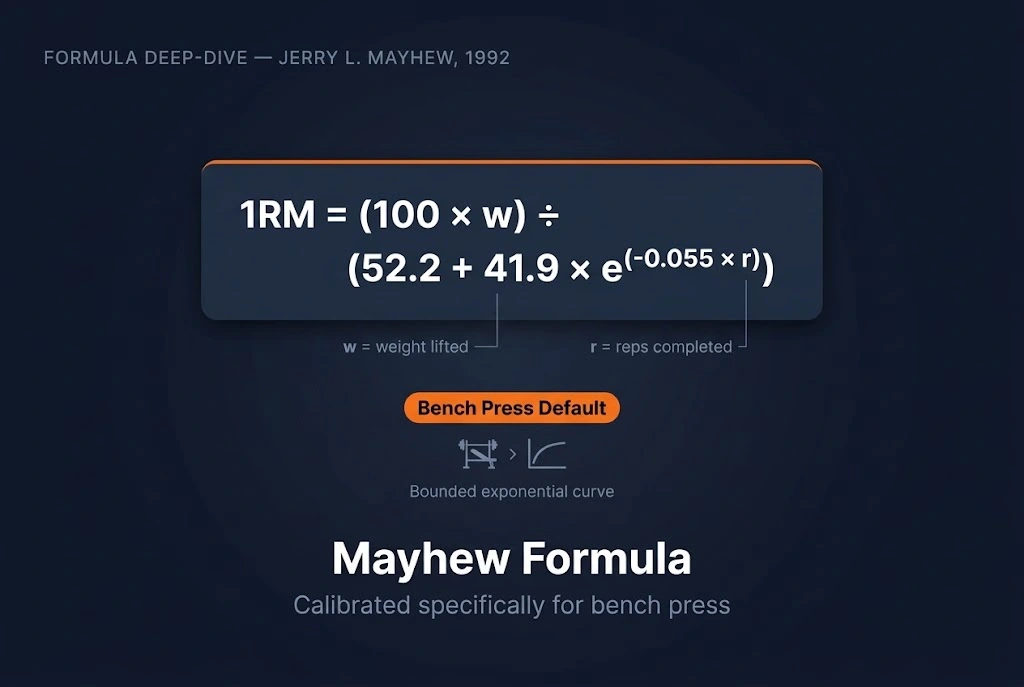
The Mayhew formula is the only one in this calculator built from bench press data specifically, which is exactly why the calculator pre-selects it the moment you choose bench press from the dropdown. This guide covers the exponential notation, worked examples, the crossover against Epley, where the accuracy holds up, and a limitation worth knowing: it breaks down at 1-2 rep inputs.
At a Glance
- Formula: 1RM = (100 × w) ÷ (52.2 + 41.9 × e^(-0.055 × r))
- Type: Exponential decay, uses Euler’s number e for an S-shaped prediction curve
- Calibrated on: Bench press data specifically, the only lift-specific formula in the engine
- Behavior at 3-7 reps: Runs higher than Epley, a unique trait at low rep counts
- Behavior at 8+ reps: Slightly more conservative than Epley and Brzycki
- Best rep range: 6-12 reps on bench press; not valid at r=1 or r=2
- Developed by: Jerry L. Mayhew (1992)
What Is the Mayhew Formula?
The Mayhew formula estimates maximum bench press strength from a multi-rep submaximal set using an exponential decay function. Unlike the additive formulas (Epley, Brzycki), its denominator shrinks as rep count rises, producing a curve matched to the strength-endurance relationship researchers observed in bench press testing specifically, not a generic barbell-lift pattern.
The Notation and Plain English
Formula notation:
1RM = (100 × w) ÷ (52.2 + 41.9 × e^(-0.055 × r))
In plain English: multiply your weight by 100, then divide by the sum of 52.2 and 41.9 multiplied by Euler’s number (e ≈ 2.718) raised to the power of -0.055 times your rep count.
Step by step:
- Multiply your rep count (r) by -0.055 to get the exponent
- Raise e (2.71828) to that power, giving the exponential decay term
- Multiply by 41.9 and add 52.2 to get the denominator
- Divide (100 × weight) by that denominator for your estimated 1RM
Quick reference: Mayhew from 100 kg at key rep counts
| Reps (r) | e^(-0.055r) | Denominator | Estimated 1RM (100 kg input) |
| 3 | 0.847 | 87.7 | 114.0 kg |
| 5 | 0.760 | 84.0 | 119.0 kg |
| 8 | 0.644 | 79.2 | 126.3 kg |
| 10 | 0.577 | 76.4 | 130.9 kg |
| 12 | 0.517 | 73.9 | 135.4 kg |
| 15 | 0.438 | 70.6 | 141.7 kg |
The denominator shrinks as reps increase; the exponential decay creates a mathematically bounded prediction curve. Get your own personalized output at any weight and rep count with the one rep max calculator.
Why an Exponential Decay Function?
As rep count rises, e^(-0.055r) decreases toward zero, pulling the denominator toward its floor of 52.2. That creates an upper bound: no matter how many reps you perform, the estimate can never exceed roughly 1.92 times your weight (100w ÷ 52.2). This bounded shape reflects something additive formulas miss: past a certain point, more reps at a given weight stop telling you much new about your maximum. The curve flattens rather than climbing forever, unlike Epley, whose output grows without limit as reps increase.
Who Is Jerry Mayhew?
Jerry L. Mayhew is one of the most prolific researchers in 1RM estimation. He published the bench press-specific formula in 1992, calibrated on college-level bench data, and continued refining 1RM prediction methods for over two decades as lead author on accuracy studies cited throughout the sports science literature. His later work, including a 2008 study, extended the research to female populations. Mayhew is the only formula here where the same person both created the equation and produced most of the research validating it, uniquely self-validated relative to the other six.
Mayhew Formula: Worked Examples
Bench Press: 80 kg × 8 Reps
Calculation:
1RM = (100 × 80) ÷ (52.2 + 41.9 × e^(-0.055 × 8)) = 8,000 ÷ (52.2 + 41.9 × 0.644) = 8,000 ÷ (52.2 + 26.98) = 8,000 ÷ 79.18 = 101.0 kg
Comparison: Epley at 80 kg × 8 reps gives 101.3 kg. The two formulas are virtually identical at 8 reps, right at the point where they converge.
Bench Press: 90 kg × 5 Reps
Calculation:
1RM = (100 × 90) ÷ (52.2 + 41.9 × e^(-0.055 × 5)) = 9,000 ÷ (52.2 + 41.9 × 0.760) = 9,000 ÷ (52.2 + 31.84) = 9,000 ÷ 84.04 = 107.1 kg
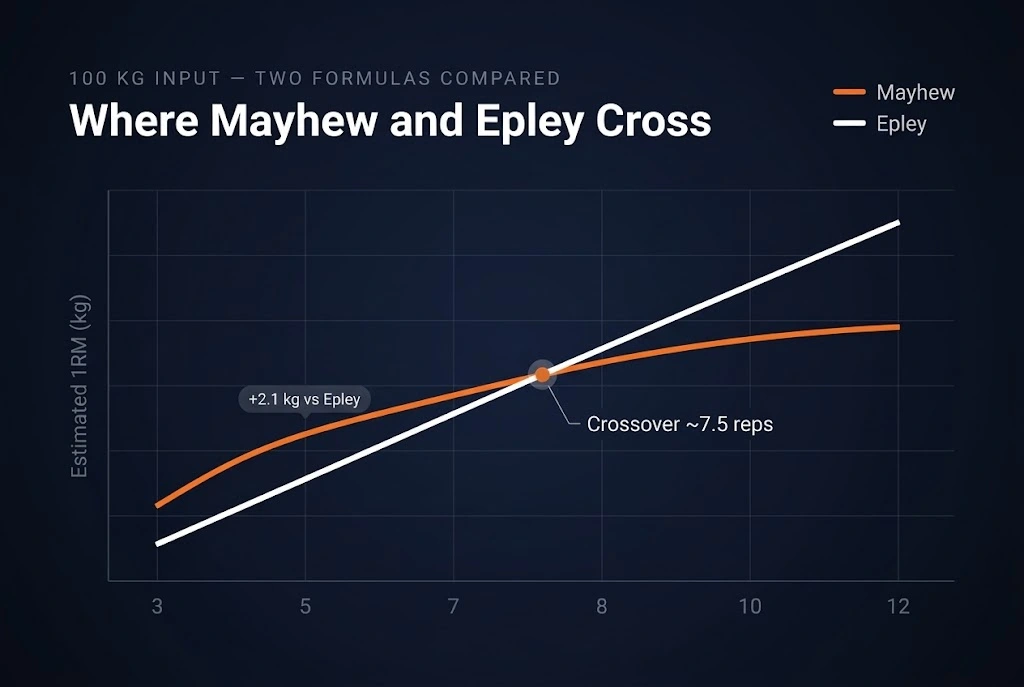
Comparison: Epley at 90 kg × 5 reps gives 105.0 kg. Mayhew runs 2.1 kg higher at 5 reps, and for bench press specifically, that higher estimate reflects the formula’s bench-calibrated data rather than an error.
Mayhew vs. the Other 6 Formulas: The Full Comparison
Where Mayhew sits in the full seven-formula spectrum depends entirely on rep count: highest output at 3 reps, more conservative than Epley from 8 reps onward.
| Reps | Mayhew | Epley | Brzycki | Lander | Lombardi | O’Conner | Wathan |
| 3 | 114.0 kg | 110.0 kg | 105.9 kg | 107.2 kg | 111.6 kg | 107.5 kg | 109.0 kg |
| 5 | 119.0 kg | 116.7 kg | 112.5 kg | 113.7 kg | 117.5 kg | 112.5 kg | 116.6 kg |
| 8 | 126.3 kg | ≈126.7 kg | 124.1 kg | 125.1 kg | 123.1 kg | 120.0 kg | 127.7 kg |
| 10 | 130.9 kg | 133.3 kg | 133.3 kg | 134.1 kg | 125.9 kg | 125.0 kg | 134.7 kg |
| 12 | 135.4 kg | 140.0 kg | 144.0 kg | 144.4 kg | 128.2 kg | 130.0 kg | 141.5 kg |
Bold marks the highest output at that rep count (Mayhew leads 3-7 reps); ≈ marks the crossover where Mayhew and Epley converge (8 reps). Run all seven formulas for your own numbers with the one rep max calculator.
The Crossover at 7-8 Reps: What It Means
At 7 reps, Mayhew (123.9 kg) sits 0.6 kg above Epley (123.3 kg). At 8 reps, it drops 0.4 kg below Epley (126.3 vs 126.7 kg). The exact crossover lands at roughly 7.5 reps. Below that, Mayhew assumes strength expression stays relatively high at low rep counts, matching bench press patterns. Above it, the exponential decay produces a more conservative estimate than Epley’s linear scaling. This transition is validated by Mayhew’s own research: the formula shifts correctly between the strength-dominant range (3-7 reps) and the endurance-influenced range beyond it. See Epley Formula: Complete Guide for the formula it’s converging with.
How Accurate Is the Mayhew Formula?
Accuracy varies sharply by lift here, and that’s the caveat worth holding onto. For bench press in the 6-12 rep range, Mayhew is among the most accurate formulas available. For every other lift, accuracy is unpredictable, because it was never calibrated outside bench press data.
The Bench Press Advantage
The formula was calibrated on college-level bench press performance data. Reynolds et al. (2006) confirmed that submaximal bench press tests, particularly 5-rep sets, produce high prediction accuracy, an R² of 0.993. That validation is the evidence base behind the calculator’s choice to default to Mayhew for bench press. For programming purposes, bench press estimates from Mayhew in the 6-12 rep range can be used directly to set training percentages through the Percentage & Rep-Max Table, which also cross-checks cleanly against the NSCA’s published training load percentages.
Accuracy on Squat, Deadlift, and Other Lifts
On non-bench lifts, Mayhew’s accuracy is unvalidated. Its higher predictions at 3-7 reps reflect bench-specific strength patterns that don’t generalise to the squat, deadlift, or overhead press. For squats, Epley is better-validated, with LeSuer et al. (1997) reporting about 3% error. For deadlifts, every formula underestimates, and Mayhew’s tendency to run high at low rep counts makes it a poor pick for setting conservative programming targets on that lift specifically. For the full accuracy picture across all seven formulas, see How Accurate Are 1RM Calculators?
Limitations of the Mayhew Formula
- Not valid at 1-2 rep inputs. At r=1, the formula outputs 108.9 kg from a 100 kg input, an 8.9% overestimate. At r=2, it outputs 111.4 kg. Mayhew was calibrated on submaximal multi-rep sets and doesn’t reduce correctly at near-maximum single-rep inputs. If your input set is 1-2 reps, use Epley or Brzycki instead.
- Unvalidated on non-bench lifts. Derived entirely from bench press data, the formula should be treated as unreliable for the squat, deadlift, overhead press, and barbell row. Epley is the better starting point for those.
- Mathematically complex by hand. Unlike Epley’s single multiplication and addition, Mayhew requires computing an exponential, e raised to a power involving your rep count. In practice, this means it should only be used through a calculator; manual computation invites rounding errors.
- Less useful above 15 reps. Beyond that point, the denominator nears its floor and the formula’s rate of growth becomes unrealistically slow. Don’t use a set above 15 reps as input.
Why the Calculator Uses Mayhew for Bench Press
When you select bench press in the bench press one rep max calculator, Mayhew is pre-selected because it was calibrated specifically on bench press data, making it the most appropriate starting estimate for that lift. All seven formulas still run at once, so you can compare Mayhew’s output against the rest. Use the Percentage & Rep-Max Table to convert any output into a full training load chart.
Three things to check when you get a Mayhew estimate for bench:
- If the Mayhew result runs noticeably higher than the other six formulas, your input set was in the 3-6 rep range, which is expected and correct for bench press.
- If your input was 1 or 2 reps, disregard the Mayhew row entirely and use Epley or Brzycki instead.
- If you’re applying the estimate to a non-bench lift, weight Mayhew’s output less than Epley’s for squat, and less than all formulas for deadlift, where adding 5-10% to any output is the safer call.
For a full side-by-side analysis of all seven formulas: All 1RM Formulas Compared
Frequently Asked Questions
The exponential decay function and bench press-specific calibration make Mayhew the right choice for bench press 1RM estimation from a moderate rep set, and the reason it’s the calculator’s default there. Its limitations are real: not valid at 1-2 reps, unvalidated on non-bench lifts, and harder to compute by hand than the additive formulas. Treat its output alongside the other six and use the spread to judge how much to trust any single number. Start with 1RM Formulas & Calculations, compare it directly against the Epley Formula: Complete Guide, or see the full field in All 1RM Formulas Compared.