
Wathan Formula: Complete Guide
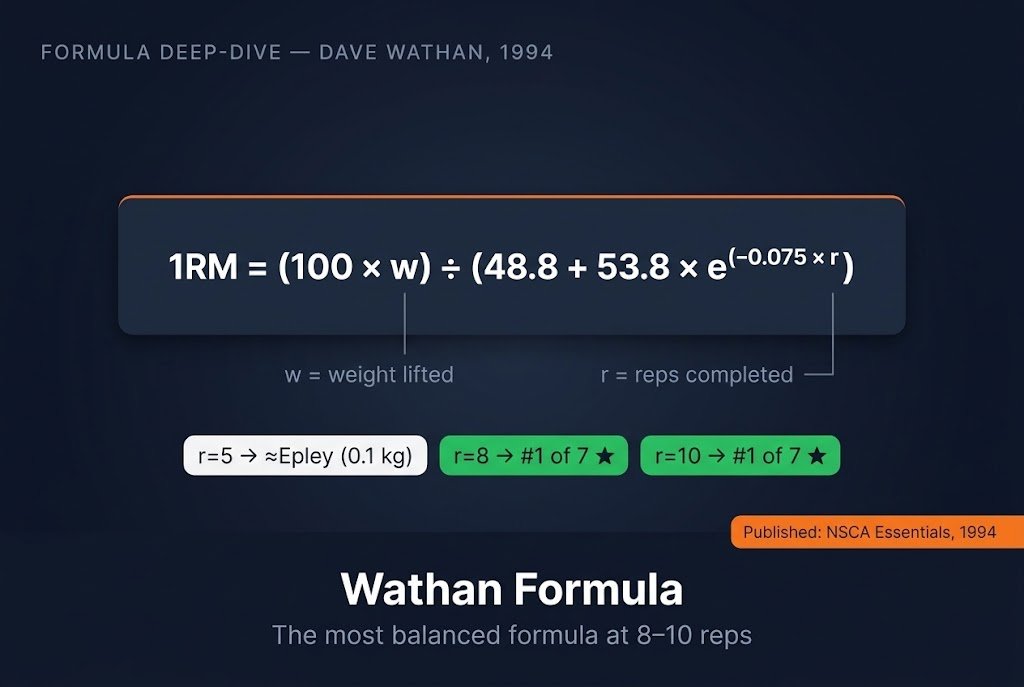
The Wathan formula is the only one of the seven formulas in the calculator that ranks first among all seven at the most commonly programmed training rep counts: 8 and 10 reps. That single fact makes it worth understanding on its own terms. This guide covers the notation, two worked examples, the mathematically precise crossover with Epley at approximately 5 reps, the NSCA publication context, and the practical guidance on when to choose it over the other formulas.
At a Glance
- Formula: 1RM = (100 × w) ÷ (48.8 + 53.8 × e^(−0.075 × r))
- Type: Exponential decay: same structure as Mayhew, but with a faster decay rate (−0.075 vs Mayhew’s −0.055)
- At 1–5 reps: Slightly more conservative than Epley, narrowing to 0.1 kg at r=5
- At 6–10 reps: Slightly more aggressive than Epley; ranks #1 of all 7 formulas at r=8 and r=10
- Bounded gap: Never deviates more than ±2 kg from Epley across r=1 to r=15
- Best use case: Moderate-to-high rep sets (6–12 reps); general-purpose balanced estimation
- Published by: Dave Wathan (1994), NSCA’s Essentials of Strength Training and Conditioning
What Is the Wathan Formula?
The Wathan formula is a 1RM estimation equation that uses exponential decay to model the relationship between rep count and percentage of maximum load. It shares its mathematical structure with the Mayhew Formula but uses different constants and a faster decay rate, which makes it more aggressive at moderate rep counts than Mayhew. The result is a formula that tracks Epley very closely across all rep ranges while producing the highest estimate of all seven formulas in the 8–10 rep zone.
The Notation and Plain English
Formula notation:
1RM = (100 × w) ÷ (48.8 + 53.8 × e^(−0.075 × r))
In plain English: Multiply your weight by 100. Divide by the sum of 48.8 and 53.8 multiplied by Euler’s number (e ≈ 2.718) raised to the power of −0.075 times your rep count.
Step by step:
- Multiply your rep count (r) by −0.075 to get the exponent
- Raise e (2.71828) to that power, giving the exponential decay term
- Multiply by 53.8 and add 48.8 to get the denominator
- Divide (100 × weight) by that denominator for your estimated 1RM
Wathan quick reference, 100 kg input:
| Reps (r) | Wathan 1RM | Epley 1RM | Gap (Wathan − Epley) |
| 1 | 101.3 kg | 103.3 kg | −2.0 kg |
| 3 | 109.0 kg | 110.0 kg | −1.0 kg |
| 5 | 116.6 kg | 116.7 kg | −0.1 kg (virtually identical) |
| 6 | 120.3 kg | 120.0 kg | +0.3 kg |
| 8 | 127.7 kg | 126.7 kg | +1.0 kg ★ Wathan #1/7 |
| 10 | 134.7 kg | 133.3 kg | +1.4 kg ★ Wathan #1/7 |
| 12 | 141.5 kg | 140.0 kg | +1.5 kg |
| 15 | 150.9 kg | 150.0 kg | +0.9 kg |
The gap narrows from −2.0 kg at r=1 to −0.1 kg at r=5, crosses to positive at r=6, peaks at +1.5 kg around r=12, then narrows again toward r=15.
Wathan vs. Mayhew: Same Structure, Different Behavior
Both Wathan and Mayhew share the same exponential decay formula structure: 1RM = (100w) ÷ (a + b × e^(−c × r)). The key difference is in the constants. Wathan’s decay rate (c = 0.075) is faster than Mayhew’s (c = 0.055), which causes the denominator to decrease more steeply as rep count increases, producing higher estimates at moderate rep counts. At r=8, Wathan gives 127.7 kg, and Mayhew gives 126.3 kg. At r=10: Wathan 134.7 kg, Mayhew 130.9 kg, a 3.8 kg difference from the same input. Unlike Mayhew, which was calibrated specifically on bench press data, Wathan was developed as a general-purpose formula valid across compound lifts.
Who Developed the Wathan Formula?
Dave Wathan published the formula in 1994 in the NSCA’s Essentials of Strength Training and Conditioning, the standard reference textbook for the CSCS credential. This makes Wathan the most professionally published of the seven formulas in the calculator: it appeared in the textbook used to train a generation of strength and conditioning coaches, not in a research journal or coaching newsletter. Its inclusion reflects the NSCA’s vetting of practical 1RM estimation tools for professional coaches. Dave Wathan is the only formula author in this engine whose primary contribution appeared in a coaching textbook.
Wathan Formula: Worked Examples
Bench Press: 80 kg × 5 Reps
Calculation:
1RM = (100 × 80) ÷ (48.8 + 53.8 × e^(−0.075 × 5)) = 8,000 ÷ (48.8 + 53.8 × 0.6873) = 8,000 ÷ (48.8 + 36.98) = 8,000 ÷ 85.78 = 93.3 kg
Comparison: Epley at 80 kg × 5 reps also gives 93.3 kg. The two formulas are virtually identical at 5 reps, the difference under 0.1 kg. At this rep count, choosing between Wathan and Epley makes no practical difference.
Squat: 100 kg × 8 Reps
Calculation:
1RM = (100 × 100) ÷ (48.8 + 53.8 × e^(−0.075 × 8)) = 10,000 ÷ (48.8 + 53.8 × 0.5488) = 10,000 ÷ (48.8 + 29.53) = 10,000 ÷ 78.33 = 127.7 kg
Comparison: Epley gives 126.7 kg from the same input. Wathan is 1.0 kg higher. At 8 reps, Wathan ranks first of all 7 formulas, making it the most optimistic estimate at the most common strength-hypertrophy rep range. For the Rep Max Equivalency context on where 8 reps sit in the intensity spectrum, see that guide.
Wathan vs. the Other 6 Formulas: The Full Comparison
Wathan’s trajectory across the seven-formula spectrum is unlike any other: conservative at low reps, virtually identical to Epley at 5, the highest-output formula at 8–10, and the most bounded of the formulas at 15+ reps. No other formula in the engine describes that specific path.
| Reps | Wathan | Epley | Brzycki | Lander | Lombardi | Mayhew | O’Conner |
| 3 | 109.0 kg | 110.0 kg | 105.9 kg | 107.2 kg | 111.6 kg | 114.0 kg | 107.5 kg |
| 5 | 116.6 kg | 116.7 kg | 112.5 kg | 113.7 kg | 117.5 kg | 119.0 kg | 112.5 kg |
| 8 | ★ 127.7 kg | 126.7 kg | 124.1 kg | 125.1 kg | 123.1 kg | 126.3 kg | 120.0 kg |
| 10 | ★ 134.7 kg | 133.3 kg | 133.3 kg | 134.1 kg | 125.9 kg | 130.9 kg | 125.0 kg |
| 12 | 141.5 kg | 140.0 kg | 144.0 kg | 144.4 kg | 128.2 kg | 135.4 kg | 130.0 kg |
| 15 | 150.9 kg | 150.0 kg | 163.6 kg | 163.3 kg | 131.1 kg | 141.7 kg | 137.5 kg |
★ = Wathan is the highest-output formula at r=8 and r=10. At r=5, Wathan (116.6 kg) and Epley (116.7 kg) are virtually identical. At r=12+, Lander and Brzycki overtake Wathan. Run all 7 formulas for your lift using the one rep max calculator.
The Crossover at ~5 Reps: From Conservative to Aggressive
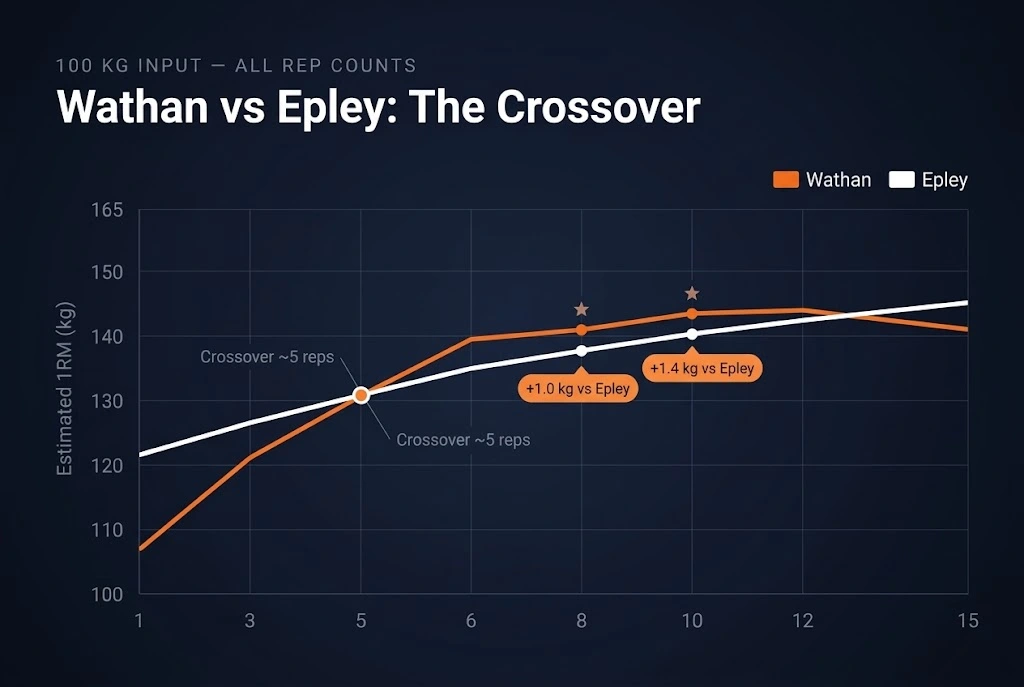
Below approximately 5.2 reps, Wathan is slightly more conservative than the Epley Formula: by 2 kg at r=1, narrowing to 1 kg at r=3, reaching near-zero (0.1 kg) at r=5. Above 5 reps, the positions flip: Wathan becomes slightly more aggressive, reaching its peak deviation of +1.5 kg above Epley around r=12, then narrowing again toward r=15. The faster exponential decay rate is what drives this: Wathan’s denominator decreases more steeply per rep than Epley’s linear rate, so estimates grow more quickly from the moderate rep range onward. That crossover at ~5 reps is the defining characteristic of the formula.
Why Wathan Stays Bounded: Unlike Lander and Brzycki
At 15 reps, Lander Formula gives 163.3 kg and Brzycki gives 163.6 kg from a 100 kg input, 13+ kg above Epley. Wathan gives 150.9 kg, only 0.9 kg above Epley, tracking the reference formula with a level of consistency; no linear-denominator formula matches at that rep count. This bounded behavior is a product of the exponential decay function: as r increases, the exponential term approaches zero and the denominator converges toward its floor constant (48.8). The formula never diverges explosively the way linear-denominator formulas do above 10 reps, which is why it remains a defensible general-purpose formula at rep counts where Lander and Brzycki become unreliable. The Lombardi Formula is the other formula that stays bounded at high reps, though for a different mathematical reason.
How Accurate Is the Wathan Formula?
Wathan was included in the validation research across all 7 formulas testing bench press, squat, and deadlift accuracy. Its accuracy characteristics reflect its bounded, Epley-adjacent behavior: reliable across a wide rep range without the extreme values that reduce trust in other formulas at high rep counts.
Accuracy at a glance:
- At 1–5 reps: Slightly more conservative than Epley; reliable and appropriate for programming; understates by 1–2 kg from a 100 kg input
- At 6–10 reps: Produces the highest estimate of all 7 formulas; may overestimate slightly for lifters with lower strength-endurance ratios
- At 10–15 reps: Remains bounded within ±2 kg of Epley while Lander and Brzycki diverge dramatically; the most stable high-rep formula after Mayhew
- Deadlift: Like all 7 formulas, underestimates the deadlift 1RM: add 5–10% to any deadlift output
For the full cross-formula accuracy picture and how Wathan’s bounded behavior compares, see How Accurate Are 1RM Calculators?
When to Use the Wathan Formula
| Situation | Use Wathan? | Reason |
| Input set: 1–5 reps | ✅ Acceptable | Near-identical to Epley; slightly conservative floor; appropriate for general use |
| Input set: 5–10 reps | ✅ Preferred | Produces the highest estimate at 8–10 reps; right choice when conservative formulas seem to undercount your ceiling |
| Input set: 10–15 reps | ✅ Good choice | Stays bounded near Epley while Lander and Brzycki diverge explosively |
| Input set: 15+ reps | ⚠️ Caution | Like all formulas, reliability decreases above 15 reps; Wathan remains more stable than Lander and Brzycki but still carries meaningful uncertainty. |
| Bench press | ✅ Acceptable | General-purpose; Mayhew and Brzycki are more bench-specific at low reps. |
| Deadlift or squat | ✅ Recommended | Strong general-purpose formula for lower-body lifts; recommended alongside Epley |
| Conservative safety floor | ⚠️ Not recommended | Use O’Conner or Lombardi for the conservative floor. Wathan runs above Epley at 6+ reps. |
Limitations of the Wathan Formula
- Most aggressive of the reasonable formulas at 8–10 reps. While Wathan never diverges explosively like Lander or Brzycki at high reps, it does rank first at 8–10 reps, producing the most optimistic estimate at the most common training rep counts. For lifters who want a conservative starting point for new training blocks, O’Conner or Lombardi will be less likely to overshoot.
- No lift-specific calibration. Like Epley, the Wathan formula is a general-purpose model. It was not calibrated on bench press data specifically (unlike Mayhew) or validated separately for squat, deadlift, or overhead press in its original publication.
- Mathematically complex to compute by hand. Requires calculating an exponential (e raised to a fractional power), unlike Epley’s simple multiplication. In practice, always use the formula through the calculator rather than estimating by hand.
- Less independently validated than Epley or Mayhew. Wathan’s primary citation is a textbook chapter rather than a peer-reviewed journal study. This means it has less independent validation evidence than some of its peers, though its textbook publication reflects professional vetting rather than a limitation.
How to Use the Wathan Formula With the Calculator
The one-rep-max calculator runs Wathan alongside all 6 other formulas simultaneously. The Wathan row is most notable at 8–10 rep inputs, where it sits at the top of the results. If you see Wathan ranking first, check two things: whether your rep count is 8–10 and whether you consistently test higher than Epley predicts. If both are true, Wathan’s estimate may reflect your actual ceiling more accurately. Use the Percentage & Rep-Max Table to convert any Wathan output into a training load chart.
Frequently Asked Questions
The Wathan formula’s bounded Epley-adjacent behavior, NSCA textbook origin, and distinctive #1 ranking at 8–10 reps put it in a unique position among the seven. For lifters who train in the hypertrophy rep range and find Epley consistently underestimates their tested maxes, Wathan is the formula to weight more heavily. Run it alongside the other six rather than in isolation; the spread between all seven is as informative as any individual estimate. Start with 1RM Formulas & Calculations, compare it directly against the Epley Formula, or see the full field in All 1RM Formulas Compared.