What Is Powerlifting? Beginner’s Complete Guide
Powerlifting is a competitive strength sport in which athletes attempt to lift the maximum possible weight for one repetition across three barbell lifts: the back squat, the bench press, and the deadlift. The sum of the heaviest successful lift in each discipline is the lifter’s “total,” and the highest total within a bodyweight class wins the competition. Knowing what is powerlifting as a sport, rather than a training style, means understanding the rules, the judging, and how meets actually work. This guide covers all of it, from the legal standards for each lift to how to register for your first competition.
At a glance:
- Powerlifting is a competitive strength sport built on three lifts: back squat, bench press, and deadlift
- Each lift gets three attempts; only the best successful attempt counts
- The total (best squat + best bench + best deadlift) determines placement within a weight class
- Competitions are divided by sex, bodyweight class, and equipment category (raw or equipped)
- DOTS and Wilks scores allow comparison across different bodyweight classes
- No minimum strength level is required to enter: powerlifting has a place for every starting point
What Is Powerlifting?
Powerlifting is a strength sport centered on three barbell movements: the back squat, the bench press, and the deadlift, performed under standardized judging conditions. Competitors receive three attempts per lift; judges evaluate each attempt and issue a verdict using a white (pass) or red (fail) light system. The sport is governed internationally by the International Powerlifting Federation (IPF) and its affiliated national bodies, which set technical rules, administer drug testing, and certify competition results.
There’s an important distinction to make early: “powerlifting” as a training style and “powerlifting” as a competitive sport are not the same thing. Millions of gym-goers squat, bench, and deadlift in their training programs, but competitive powerlifting means performing those three lifts on a competition platform under independent judging, with verified weights and published results.
What Powerlifting Is Not: Clearing Up the Confusion
Three confusions come up constantly. First, powerlifting is not Olympic weightlifting. Olympic weightlifting is a completely separate sport using the snatch and the clean and jerk: explosive overhead movements governed by the International Weightlifting Federation (IWF) and contested at the Olympic Games. Different lifts, different federation, different physical demands. Second, powerlifting is not strongman. Strongman involves varied event-based challenges: vehicle pulls, log presses, atlas stones, and yoke carries. Powerlifting is a pure barbell sport with three fixed movements. Third, “powerlifting-style training” is not the same as competing. A powerlifter running a squat-bench-deadlift program is not a powerlifter until they’ve stepped on a platform.
The Three Competition Lifts
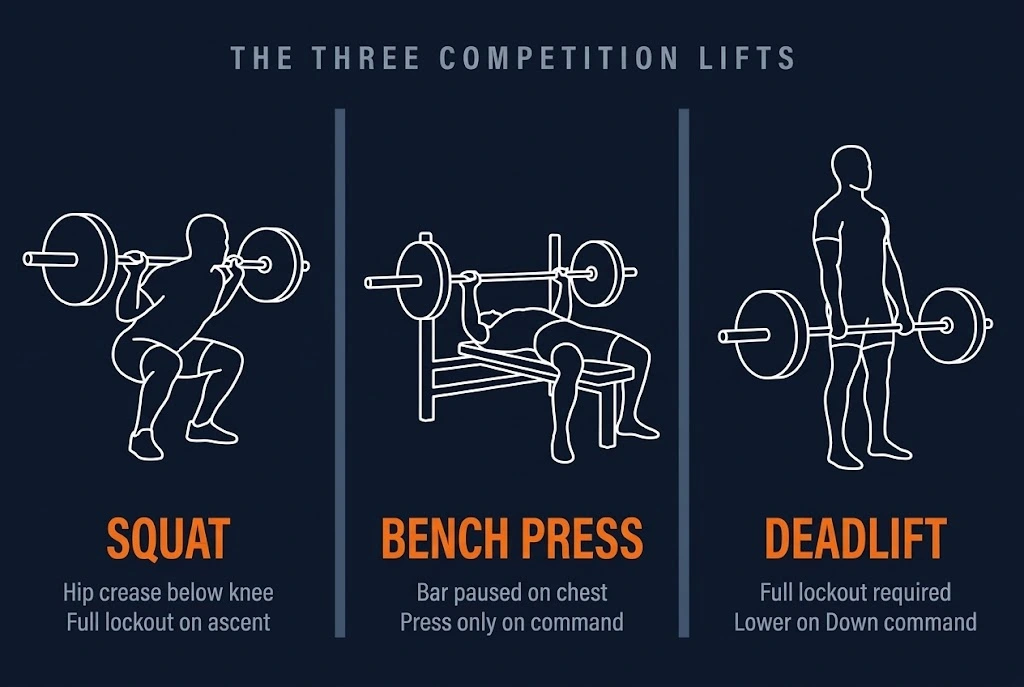
Every powerlifting competition is built from the same three movements. Understanding the legal standard for each, beyond simply how to perform the movement, is what separates a trained gym-goer from a prepared competitor.
| Lift | Starting command | Legal standard | Failing command | Common faults |
| Back Squat | “Squat” | Hip crease below top of knee at the bottom; full lockout at top | “Rack” | Squatting high; rebounding out of the hole; stepping forward |
| Bench Press | “Start” → “Press” | Bar touches chest, stays motionless until “Press” command; full lockout overhead | “Rack” | Bouncing bar off chest; foot movement; bar contact with the uprights |
| Deadlift | No command to lift | Full lockout: hips and knees locked, shoulders behind the bar; controlled descent on “Down” | “Down” | Hitching, re-bending knees, dropping bar |
1. The Back Squat
The squat is typically the heaviest lift in competition and the first lift performed on meet day. The barbell is placed across the lifter’s upper back. From an upright position, the lifter descends until the hip crease drops below the top of the knee. This depth requirement is the most commonly judged standard in powerlifting and the most frequently missed by new lifters who have only ever trained for parallel depth in the gym.
What makes a legal squat:
- Stand with the bar on the back, then wait for the “Squat” command
- Descend until the hip crease is clearly below the top of the knee (below parallel)
- Stand back to full lockout without any downward movement during the press
- Wait for the “Rack” command before returning the bar to the rack
- Three independent judges issue a white (good lift) or red (no lift): two whites are needed to pass
2. The Bench Press
The bench press is the only upper-body lift in competition. The bar is unracked with arms fully extended, lowered under control to the chest, and held motionless on the chest until the “Press” command is given. The paused bench press, with the bar touching the chest and staying still rather than bouncing, is the legal standard. The pause can last several seconds before the command is given: a fact that routinely surprises first-time competitors used to touch-and-go training.
What makes a legal bench press:
- Lift-off with arms extended; the start signal is given once the bar is motionless
- The bar is lowered to the chest and held there until the “Press” command, with no movement allowed
- The bar is pressed to full lockout with no bar-down movement during the press
- Feet remain flat on the floor or on blocks throughout
- Buttocks remain on the bench at all times
3. The Deadlift
The deadlift is the third and typically the crowd-favorite lift: the bar starts on the floor and is lifted to a standing lockout position. It’s unique among the three lifts in that there is no command to begin: the lifter initiates when ready and then must receive and follow the “Down” command to lower the bar under control. Both conventional (feet hip-width) and sumo (wide stance) styles are legal.
What makes a legal deadlift:
- Stand the bar to full lockout: hips and knees locked, shoulders pulled back behind the bar
- No hitching allowed: the bar may not rest on the thighs to assist the lift
- Knees must not re-bend once the bar passes them during the ascent
- Bar must be lowered under control on the “Down” command, not dropped
- Bar must not touch the floor between attempts on the same lift
How a Powerlifting Meet Works
The competition structure is what most beginners know least about, and the unknown logistics are often harder to face than the lifting itself.
The Three-Attempt System
Each lifter receives three attempts per lift. The typical strategy is to open with a safe, near-certain make, take the second at a working weight, and push for a competition maximum on the third. The order of attempts across all competitors in a session is determined by declared weights: the lightest weight attempted goes first, and the heaviest last. After each attempt, a lifter must declare their next weight within a short time window.
The Judging System: White Lights and Red Lights
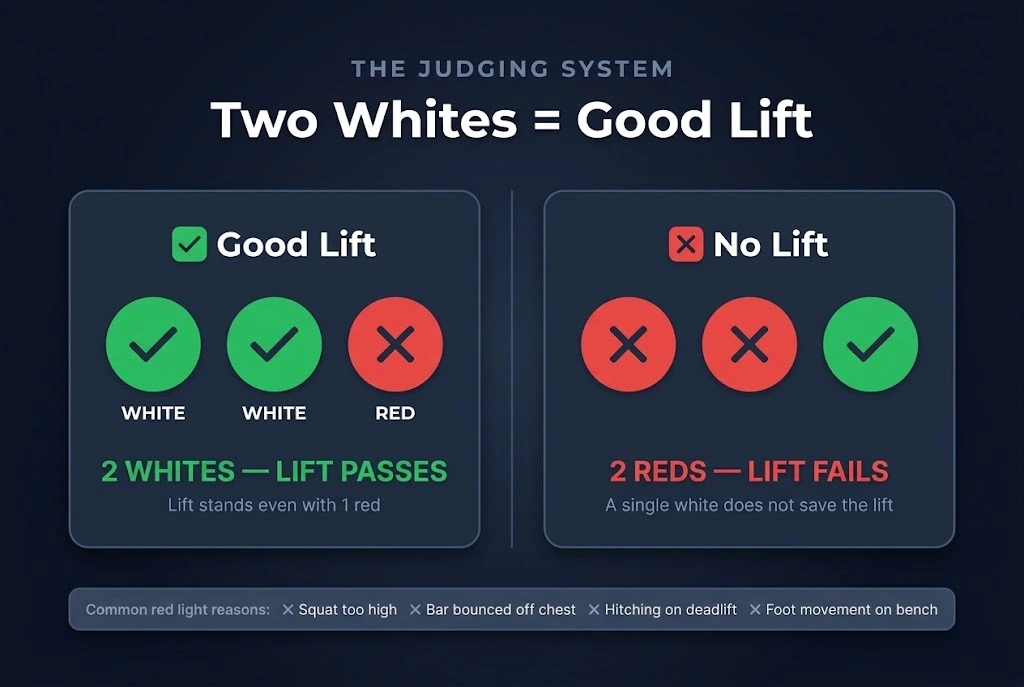
Three judges observe each lift from different angles. Each independently issues a white light (lift passed) or red light (lift failed) via their console. Two white lights out of three is a good lift. A red light may be accompanied by a paddle indicating the specific reason: foot movement, high squat, or press command ignored. New lifters sometimes don’t realize that a 2-1 decision in their favor still passes, and a 2-1 decision against them still fails.
Your Total and What Happens If You Miss
The competition total is the sum of the best successful attempt from each of the three lifts. Squat 200 kg, bench 130 kg, deadlift 240 kg across any of your three attempts at each lift, and your total is 570 kg. The critical rule for beginners: miss all three attempts on the squat and you “bomb out”: no total, and the competition ends for you. You cannot proceed to the bench press or deadlift without a successful squat. The opener must be made, which is why conservative openers are a strategic priority; treating them as weak is a mistake beginners make once.
A Typical Meet Day Timeline
Most meets follow the same sequence. Morning: equipment check-in, weigh-in, rack height declarations, and handler registration. Warm-up room: lifters warm up independently while the session progresses. Platform session: each flight of competitors completes all three squat attempts, then bench, then deadlift in order. Awards: totals are finalized, DOTS and Wilks scores are calculated, and placings are determined within each weight class and equipment category. Full meet days run 6–10 hours; bring food, water, and patience.
Equipment Categories: Raw vs. Equipped
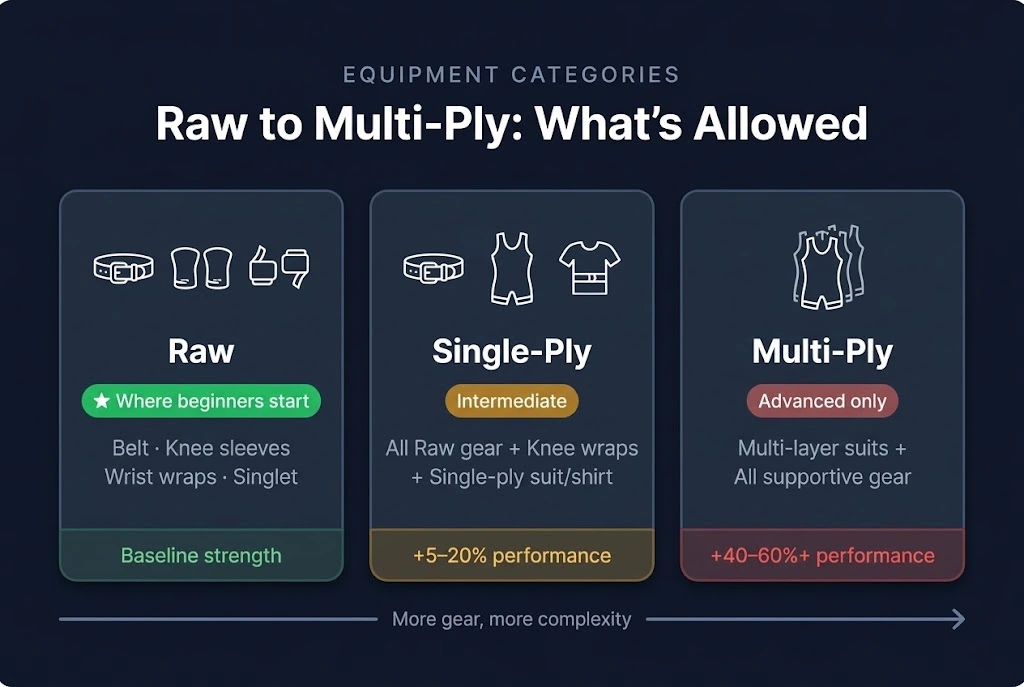
The equipment category a lifter enters determines what supportive gear is allowed. For beginners, the right answer is almost always raw.
| Category | What’s allowed | Additional gear | Performance effect |
| Raw (Classic Raw) | Belt, knee sleeves (no wraps), wrist wraps, singlet | Standard equipment | Baseline strength expression |
| Single-Ply | Above + knee wraps + single-ply squat suit, bench shirt, deadlift suit | Supportive single-layer gear | Typically 5–20% more weight lifted |
| Multi-Ply | Above + multi-layer suits, stiff boards | Highly restrictive supportive gear | Can allow 40–60%+ more weight |
Raw (Classic Raw): Where Most Beginners Start
The Raw category allows only a belt, knee sleeves, and wrist wraps. Most competitive powerlifters, and virtually all recreational competitors, compete raw. It’s the closest the sport comes to “How strong are you without artificial carry?” and requires the least investment in specialized equipment. Raw federations like the IPF’s Classic Raw division have grown to dominate the sport in participation over the past decade. Start here. For the federation context that governs which equipment is approved, see the Powerlifting Federations Guide.
Equipped Lifting: Single-Ply and Multi-Ply
Equipped lifting introduces supportive gear: squat suits, bench shirts: that reduces the range of motion and stores elastic energy, allowing heavier weights to be lifted. Single-ply uses one-layer supportive suits; multi-ply uses multiple stiff layers with dramatically higher carry. Equipped lifting has a smaller competitive community and requires significant investment in both gear and technique specific to using it. No beginner should consider equipped lifting until several years of raw competition experience are in place.
Powerlifting Weight Classes
Competitions divide by bodyweight to ensure fair comparison between lifters of similar physiques. The current IPF weight classes are the most commonly used reference, though other federations may use different divisions.
| Male | Female |
| Up to 59 kg | Up to 47 kg |
| Up to 66 kg | Up to 52 kg |
| Up to 74 kg | Up to 57 kg |
| Up to 83 kg | Up to 63 kg |
| Up to 93 kg | Up to 69 kg |
| Up to 105 kg | Up to 76 kg |
| Up to 120 kg | Up to 84 kg |
| 120+ kg (Open) | 84+ kg (Open) |
Source: International Powerlifting Federation. Weight class structures vary by federation: check your specific federation’s current rulebook before registering.
Choosing Your Weight Class
For a first meet: don’t cut weight. Register at your natural training bodyweight and find which class you fall into. Weight cutting: deliberately reducing bodyweight before weigh-in to compete in a lower class: is an advanced competition strategy that has no place in a first meet experience. Focus on the lifts.
Comparing Lifters Across Weight Classes: DOTS and Wilks Scores
The Wilks Score and DOTS Score
A 60 kg lifter who totals 450 kg and a 100 kg lifter who totals 550 kg cannot be compared on raw numbers alone. The Wilks score (developed by Robert Wilks in 1998) and the more recent DOTS score are mathematical coefficients that adjust a lifter’s total for their bodyweight, allowing meaningful comparison across weight classes. A lighter lifter who achieves a higher bodyweight-adjusted score “beats” a heavier lifter in absolute terms for Best Lifter awards. The Wilks Score Calculator and DOTS Score Calculator compute these from any total and bodyweight.
Why Relative Strength Is the Sport’s Real Measure
Your first total will look modest in absolute numbers: that’s expected and irrelevant. On a bodyweight-adjusted basis, a first-meet total from a beginner may represent strong relative performance for the experience level and weight class. Use the Powerlifting Total Calculator to enter your current training maxes and see your projected total, DOTS score, and competitive level before stepping on the platform.
Powerlifting vs Similar Strength Sports
Powerlifting vs Olympic Weightlifting
The confusion between these two sports is amplified by the word “weightlifting” being used as a generic term for lifting weights. Olympic weightlifting is a separate discipline using the snatch (single overhead movement) and the clean and jerk (two-phase overhead lift), governed by the International Weightlifting Federation (IWF) and contested at the Olympic Games. Different lifts, different governing body, different training demands. Powerlifting generally favours heavier, more muscular builds; Olympic weightlifting requires exceptional mobility and explosive power. The two sports share very little beyond the presence of a barbell.
Powerlifting vs Strongman
Strongman is an event-based sport combining a variety of tasks: vehicle pulls, log presses, stone loading, yoke carries, atlas stones. No two competitions are identical. Powerlifting is a pure barbell sport with three fixed movements and standardised conditions. Many powerlifters train strongman events in the off-season, but they are distinct competitions with separate governing structures. Powerlifting is more accessible for beginners because the three lifts are already standard in gym training.
Powerlifting vs Bodybuilding
Bodybuilding is judged on physique appearance: muscularity, symmetry, conditioning: rather than lifting performance. A bodybuilder and a powerlifter may use similar exercises in training, but they compete for entirely different outcomes. Powerlifting has no appearance component. A powerlifter can win a competition with a physique that would score poorly in a bodybuilding show, and vice versa. Some lifters pursue both (termed “powerbuilding”), but the competitive goals are entirely separate.
How to Get Started in Powerlifting
Is Powerlifting Safe?
Address this question directly: the research on powerlifting injury rates (Siewe et al., 2011) shows the sport has a relatively low injury rate per training hour compared to many team sports and other strength disciplines. The most common injuries involve the shoulder, lower back, and knee, and are associated with overloading too early or poor technique: both preventable. For beginners, the risk-reduction strategy is simple: start light, master technique first, and increase load progressively. The injury risk of powerlifting is not a reason to avoid it; it’s a reason to take programming and coaching seriously from the start.
What You Need to Start
To train for powerlifting: a barbell, a squat rack, and a flat bench: standard equipment in any commercial gym. No specialised powerlifting gym is required to start. To compete: a singlet, belt, knee sleeves, and wrist wraps. All can be purchased for under $150 for a first meet. Specialised footwear (flat-soled shoes for deadlift, squat shoes for squat), chalk, and a handler are optional but recommended.
How to Find Your First Competition?
The OpenPowerlifting database lists results from hundreds of federations globally and is the best place to understand what competitive performance looks like at local and national levels for your weight class. To find upcoming meets, search the website of your national federation: USAPL in the United States, CPU in Canada, British Powerlifting in the UK: and look for their meet calendar. Your first meet should be a local club or regional event, not a national championship.
How Your 1RM Calculator Fits into Powerlifting Training
Powerlifting training is percentage-based: working sets are prescribed as fractions of the 1RM. Knowing your 1RM, or a reliable estimate of it, is the foundation of running any structured powerlifting programme. The one rep max calculator estimates your 1RM from any multi-rep training set. The Training Max Calculator converts it to the conservative training max most programmes use. The Powerlifting Total Calculator projects your competition total, DOTS, and Wilks scores from your current training numbers. These tools together replace the guesswork that holds most beginners back from knowing whether they’re ready to compete. For the foundational concepts behind these numbers, see the One Rep Max Basics guide.
What to bring to your first meet:
- ✅ Singlet (IPF-approved brand and style for the federation you’re competing in)
- ✅ Belt (powerlifting-legal thickness: typically 10 mm for Classic Raw)
- ✅ Knee sleeves (not wraps for Classic Raw)
- ✅ Wrist wraps (most federations allow up to 1 m in length)
- ✅ Flat-soled shoes for deadlift (squat shoes are not allowed for deadlift in most federations)
- ✅ Chalk (many meets provide communal chalk; confirm in advance)
- ✅ Food and water for a full day: meets typically run 6–10 hours
- ✅ A handler or coach (optional but strongly recommended for first meets)
Frequently Asked Questions
Powerlifting is one of the most accessible competitive strength sports: the three lifts are already part of most gym training, equipment requirements for Raw beginners are minimal, and competitions exist at every level from local clubs to world championships. Whether you want to compete or simply use the sport’s structure to give your training a target, the sport accommodates every starting point. Start at the Powerlifting & Competition guide for the full picture, enter your training maxes in the Powerlifting Total Calculator to see your projected numbers, and plan your attempt strategy with How to Choose Your Powerlifting Attempts.