Powerlifting vs Bodybuilding vs Olympic Lifting
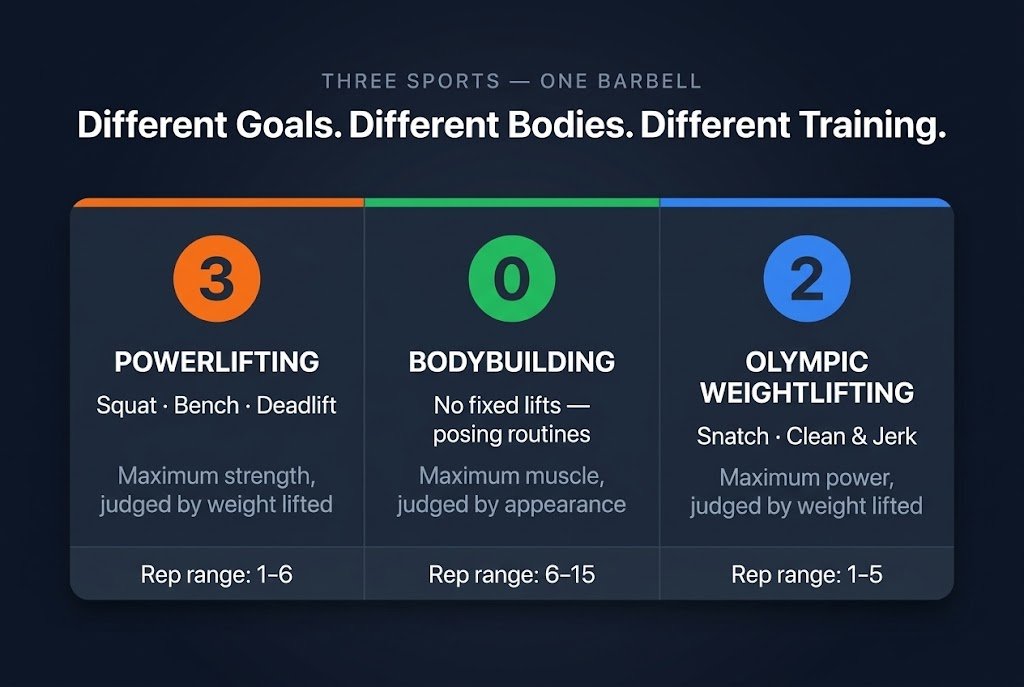
All three sports involve barbells and progressive overload. That’s where the similarities end. Powerlifting vs. bodybuilding is a comparison of maximum strength against maximum muscle: the training overlaps, but the purpose doesn’t. Add Olympic weightlifting and you have three distinct sports with three entirely different physical goals, each with its own competition format, physique outcome, and path to mastery. This article covers the genuine differences, what the research shows, and a decision framework for anyone choosing between them.
At a glance:
- Powerlifting: Squat, bench, and deadlift: maximum strength, judged objectively by total weight lifted
- Bodybuilding: No competition lifts: maximum muscle and aesthetic symmetry, judged subjectively by appearance
- Olympic Weightlifting: Snatch and clean and jerk: maximum explosive power, judged objectively; an Olympic sport since 1896
- All three use barbells in training, but the goal, method, and physique outcome are entirely different
- You can combine elements of any two: but competing in more than one simultaneously is difficult
- 1RM calculation and percentage-based training are central to powerlifting and Olympic lifting; hypertrophy rep ranges to bodybuilding
Powerlifting vs Bodybuilding: The Fundamental Difference
The confusion clears when you focus on purpose rather than equipment. A powerlifter does hypertrophy work to build the muscle that supports heavier strength gains. A bodybuilder uses heavy compound work to stimulate the muscle growth they will eventually display on stage. Both train with the same barbell. What that training is for is entirely different, and that difference determines the rep ranges, the splits, the periodization, and the physique outcome.
The Master Comparison: Three Sports at a Glance
This table is the reference. Every dimension that matters across the three sports in one place.
| Dimension | Powerlifting | Bodybuilding | Olympic Weightlifting |
|---|---|---|---|
| Competition goal | Highest total (squat + bench + deadlift, in kg) | Best physique: size, symmetry, conditioning: judged subjectively | Highest total (snatch + clean and jerk, in kg) |
| Competition lifts | Back squat, bench press, deadlift | No standard lifts: posing routines | Snatch, clean and jerk |
| Judged by | Objective: total weight lifted | Subjective: panel of judges | Objective: total weight lifted |
| Olympic sport? | No | No | Yes (since 1896) |
| Governing body | IPF (International Powerlifting Federation) | IFBB (International Federation of Bodybuilding) | IWF (International Weightlifting Federation) |
| Primary physical quality | Maximal strength | Muscle hypertrophy and conditioning | Explosive power and technical mastery |
| Training rep range | 1–6 (competition lifts); 6–12 (accessories) | 6–15 (primary); 1–6 for compound strength | 1–5 (snatch/C&J); 3–8 (accessories) |
| Technique complexity | Moderate | Low-moderate | Very high: years to develop |
| Diet emphasis | Performance-focused; weight class management near meets | Central: cutting and peaking phases | Performance-focused; weight class management |
| Time for the first competition. | 6–12 months for most | 12–24 months (natural) | 12–24+ months minimum |
Powerlifting: Maximum Strength in Three Barbell Lifts
Competition Format and Competitive Goal
Powerlifting is scored objectively: the combined weight of the best squat, bench press, and deadlift attempts determines placement within a bodyweight class. No judges decide who looks strongest: the weight on the bar is the only arbiter. DOTS and Wilks scores compare performances across weight classes, allowing lighter lifters to win Best Lifter awards at meets where a heavier competitor has a larger absolute total. For the full competitive structure, see What Is Powerlifting?
How Powerlifters Train
Powerlifting training centers on the three competition lifts at high intensity: typically 80–95% of 1RM for low-to-moderate reps (1–5 per set) across 2–3 sessions per week per lift. Accessory work (Romanian deadlifts, rows, and dumbbell pressing) addresses muscular weaknesses that limit competition performance. Periodization runs in 8–16 week cycles, leading to a competition peak. Rest periods between heavy sets run 3–5 minutes. Cardio is minimal: not necessarily because it harms strength development, but because recovery capacity is directed toward the primary lifts. The Powerlifting Total Calculator can project a competition total and DOTS score from any set of current training maxes
What Powerlifting Training Does to Your Body
Powerlifting produces significant maximal strength increases through primarily neural adaptations: more efficient motor unit recruitment and reduced neural inhibition, alongside meaningful hypertrophy at higher training volumes. Powerlifters typically carry more muscle mass and higher body fat than Olympic lifters and are often heavier relative to their height than bodybuilders at the same lean mass. The physique is functional and muscular but not typically “stage-ready” in the bodybuilding sense: definition and conditioning are not training priorities in powerlifting.
Bodybuilding: Maximum Muscle, Maximum Symmetry
Competition Format and Competitive Goal
Bodybuilding competitions judge the appearance of the athlete’s physique: muscle size, symmetry, balance between muscle groups, and conditioning (low body fat revealing muscle definition). Athletes perform mandatory poses and free-posing routines assessed by a judging panel. There is no athletic performance in the competition itself: the competition is a display. The IFBB (International Federation of Bodybuilding and Fitness) governs the professional circuit. Natural bodybuilding federations such as WNBF and INBA/PNBA require drug testing; the IFBB Pro League does not.
How Bodybuilders Train
Bodybuilding training uses moderate-to-high rep ranges (6–15 reps primarily) to maximize metabolic stress and mechanical tension in target muscle groups. Training splits isolate individual muscle groups across the week (chest day, back day, arm day) rather than full-body sessions. Weekly volume per muscle group is typically higher than in either strength sport. The research on the mechanisms of muscle hypertrophy (Schoenfeld, 2010) confirms that progressive overload, metabolic stress, and mechanical tension—all central to bodybuilding training—are the primary drivers of muscle growth. Diet management is equally central to bodybuilding training as the lifting itself.
What Bodybuilding Training Does to Your Body
Bodybuilding produces the greatest absolute muscle development of the three sports, particularly in the muscle groups targeted by the training split. The outcome: maximum muscle with visible definition at low body fat is achievable through bodybuilding methods more efficiently than through either of the other two sports. However, a bodybuilder’s strength relative to their muscle mass is often lower than a powerlifter’s, and their power output is lower than an Olympic lifter’s. More muscle does not automatically mean more strength or more speed.
Olympic Weightlifting: Maximum Power in Two Technical Lifts
Competition Format and Competitive Goal
Olympic weightlifting is governed by the International Weightlifting Federation (IWF) and has been an Olympic sport since 1896. Competition involves two lifts: the snatch (bar from floor to overhead in one movement) and the clean and jerk (bar from floor to shoulder, then from shoulder to overhead: two distinct phases). Three attempts are allowed per lift; the heaviest successful lift from each counts toward the combined total. The athlete with the highest total in a bodyweight class wins: the same objective format as powerlifting, but with completely different lifts requiring completely different physical qualities.
How Olympic Lifters Train
Olympic lifting training is the most technically demanding of the three sports. The snatch and clean and jerk require years of dedicated technique development: mobility, timing, coordination, and explosive power must develop simultaneously, and no shortcuts exist. Serious competitors train 5–7 days per week, with multiple daily sessions at elite level. Squats (front and back), pulls, and pressing work supplement the competition lifts. Rep ranges are typically very low for the competition lifts (1–4 per set); accessories may run to 6–10 reps.
What Olympic Lifting Training Does to Your Body
Olympic lifters develop exceptional explosive power and full-body coordination alongside meaningful muscle mass, particularly in the legs, upper back, and shoulders. Research confirms Olympic lifting produces strength gains comparable to traditional resistance training, but the specificity is to the Olympic lifts themselves rather than to powerlifting movements. Olympic lifters frequently carry impressive physiques without traditional hypertrophy-focused programming because the high-velocity, full-body nature of the snatch and clean and jerk is itself a powerful stimulus for muscle development in the primary movement muscles.
Head-to-Head: What the Research Shows
Which Builds the Most Strength?
| Outcome | Leader | Notes |
|---|---|---|
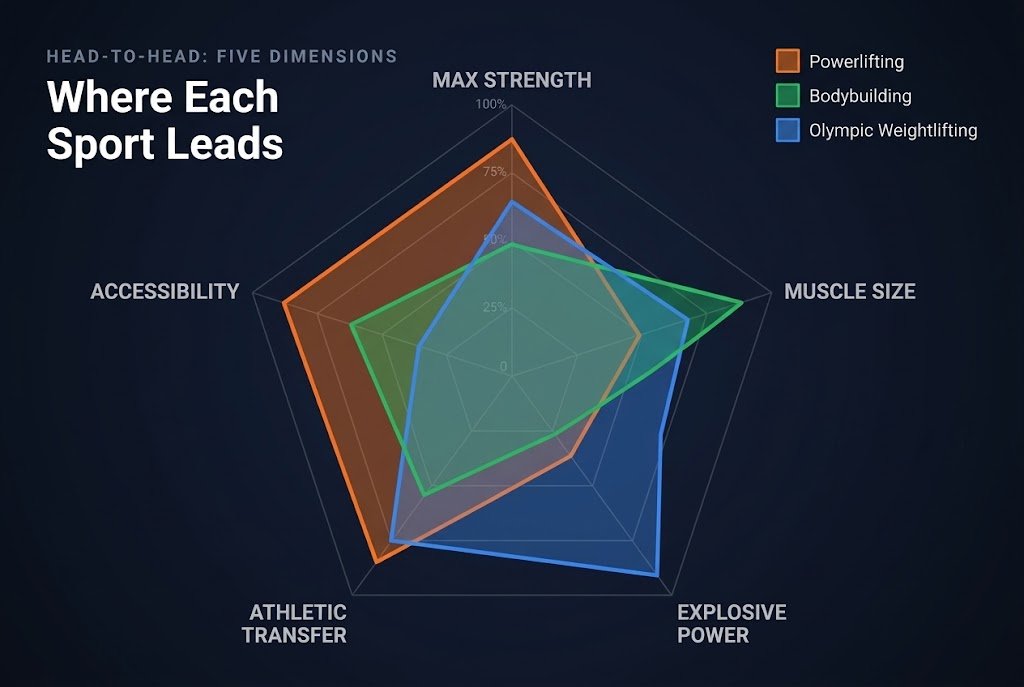
| Maximum strength in squat/bench/deadlift | Powerlifting | Specificity: compete in what you train |
| Maximum muscle size | Bodybuilding | Higher volume, isolation, diet management |
| Explosive power and rate of force development | Olympic Weightlifting | High-velocity lifts uniquely develop the force-velocity curve |
| Athletic performance transfer | Olympic Weightlifting | Power, speed, coordination carry to most sport contexts |
| Physique definition and aesthetics | Bodybuilding | Conditioning and low body fat are competition-specific goals |
| Barrier to first competition | Powerlifting (lowest) | Squat, bench, deadlift trainable in 6–12 months |
| Scientific evidence base | Powerlifting and Bodybuilding | More research on these modalities than on Olympic lifting specifically |
Powerlifting wins on specificity for squat, bench, and deadlift strength: because the training is identical to the test. The research on muscular strength and athletic performance (Suchomel et al., 2016) establishes that maximal strength underlies performance across virtually every physical domain. Olympic lifters build significant strength through heavy squats and pulls, but their 1RM in powerlifting movements is typically lower than a trained powerlifter’s, because competition emphasis diverges. Bodybuilders develop functional strength but generally trail powerlifters in 1RM performance relative to muscle mass. For population-level strength benchmarks across all three sports’ primary movements, see the Strength Standards guide.
Which Builds the Most Muscle?
Bodybuilding wins for maximum muscle development. Higher weekly volume per muscle group, isolation exercises, and diet management across controlled surplus and deficit phases produce greater absolute hypertrophy than either strength sport. The gap is smaller than many expect: powerlifters who train with meaningful accessory volume often achieve muscle development comparable to natural bodybuilders, and the two sports’ training overlaps substantially in the 6–12 rep accessory work. The specificity advantage of bodybuilding is significant but not absolute: particularly in the legs and upper back, where powerlifting’s squat and deadlift volume drives comparable growth.
Which Develops the Best Athletic Performance?
Olympic weightlifting has the strongest evidence base for improving athletic performance in other sports: specifically explosive power, rate of force development, and speed: because the snatch and clean and jerk develop the force-velocity curve in a way that conventional barbell strength training cannot replicate. This is why Olympic lifting derivatives (hang power cleans, power snatches, jump pulls) are standard in conditioning programmes for athletes in football, rugby, sprinting, and field sports. Powerlifting produces strong absolute strength that transfers to many contexts, but less force-velocity curve development than Olympic lifting.
Which Has the Most Accessible Entry Point?
Powerlifting wins. The squat, bench press, and deadlift are movements most gym-goers have already practised. The bar to a first powerlifting competition: 6–12 months of consistent barbell training: is lower than either Olympic lifting (which demands years of technique development before competition) or bodybuilding (diet management, conditioning, posing, and presentation requirements make a debut genuinely complex). A lifter who squats, benches, and deadlifts regularly can enter a local meet with confidence; the same timeline would be insufficient for a serious Olympic lifting debut.
Can You Combine Them? Hybrid Approaches
Most lifters don’t commit to a single sport permanently. Real-world training is messier and more interesting than that.
- Powerbuilding: the most popular hybrid: programming the big three at powerlifting intensities (1–6 reps) alongside bodybuilding-style accessory volume (8–15 reps). Builds both strength and size without fully committing to either sport’s competition structure.
- Olympic derivatives for powerlifters: many strength coaches add power cleans, hang snatches, or jump training to develop the explosive component that pure powerlifting training underemphasises.
- Bodybuilding off-season for powerlifters: deliberate hypertrophy phases between competition cycles build muscle mass that supports future strength gains; standard practice in advanced powerlifting periodisation.
- Olympic lifting as conditioning: some bodybuilders and powerlifters use light-to-moderate Olympic lifting derivatives for conditioning work without committing to the sport’s full technical demands.
What “Powerbuilding” Actually Means
Powerbuilding is a training philosophy, not a sport or federation. It programmes the powerlifting lifts at strength-specific intensities alongside hypertrophy-focused accessory work at bodybuilding rep ranges. The result combines functional strength with closer-to-bodybuilder muscle development. It is not optimised for either sport’s competition performance: it is a lifestyle approach for lifters who want both qualities without a single competitive focus.
Which Is Right for You? The Decision Framework
| If your primary goal is… | Choose… | Why |
|---|---|---|
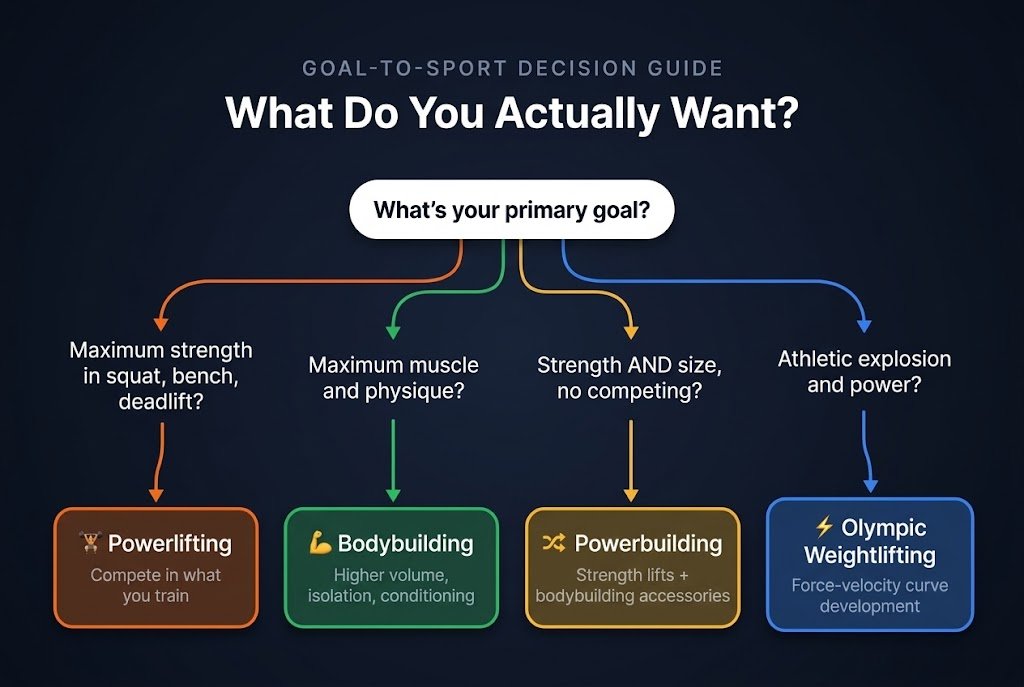
| Maximal barbell strength (squat, bench, deadlift) | Powerlifting | Specificity: you compete in exactly what you train |
| Maximum muscle size and aesthetic development | Bodybuilding | Higher volume, isolation, conditioning phases |
| Athletic explosion, speed, full-body power | Olympic Weightlifting | Unique development of the force-velocity curve |
| Both strength and size without competing | Powerbuilding (hybrid) | No competition commitment required |
| Objective performance measurement | Powerlifting or Olympic Lifting | Judged by weight lifted, not appearance |
| Competing at a meet within 6–12 months | Powerlifting | Lowest technique barrier to first competition |
| The most technically demanding challenge | Olympic Weightlifting | Snatch and C&J take years to develop well |
| Physique comparison and improvement | Bodybuilding | The only sport where your physique is the competition |
You Don’t Have to Choose One Forever
Many lifters move between these sports across their training life: powerlifting in their 20s, bodybuilding off-seasons, Olympic derivatives for athletic development. The skills are not mutually exclusive. Most powerlifters do hypertrophy work; most bodybuilders train heavy compound lifts; many strength coaches incorporate Olympic lifting derivatives regardless of competitive focus. What matters is aligning current training emphasis with the current primary goal. That goal can change, and the training can change with it.
How This Site’s Tools Apply to All Three Sports
| Tool | Powerlifting | Bodybuilding | Olympic Weightlifting |
|---|---|---|---|
| One Rep Max Calculator | ✅ Core tool: estimates 1RM for all three competition lifts | ✅ Sets compound lift training weights | ✅ Useful for squat, press, and pull accessory work |
| % of 1RM Calculator | ✅ Generates training weights at every prescribed percentage | ✅ Sets accessory work intensity | ✅ Sets training weights for pulls and squats |
| Training Max Calculator | ✅ Core tool for 5/3/1 and percentage-based programmes | : | : |
| Powerlifting Total Calculator | ✅ Projects competition total, DOTS, Wilks from training numbers | : | : |
| Strength Standards Calculator | ✅ Benchmarks lifts against population data | ✅ Tracks compound lift progress | ✅ Benchmarks accessory lift strength |
The One Rep Max Basics guide explains why 1RM estimation is the foundation of percentage-based training for both powerlifters and Olympic lifters: and why understanding the calculation makes every program on this site more useful.
Frequently Asked Questions
Three sports, one barbell, completely different goals. Powerlifting tests how much you can lift in three movements. Bodybuilding tests how your body looks after months of training and diet management. Olympic weightlifting tests how explosively you can move a barbell overhead after years of technical development. The right sport is whichever aligns with what you actually want from your training, and none of them prevent you from drawing on the other two when it serves you. Start with the Powerlifting & Competition guide for the full competitive context; see What Is Powerlifting? If powerlifting’s structure is your next step, or run the Powerlifting Total Calculator to project your numbers before a first meet.