What Is a Wilks Score? How to Calculate Yours
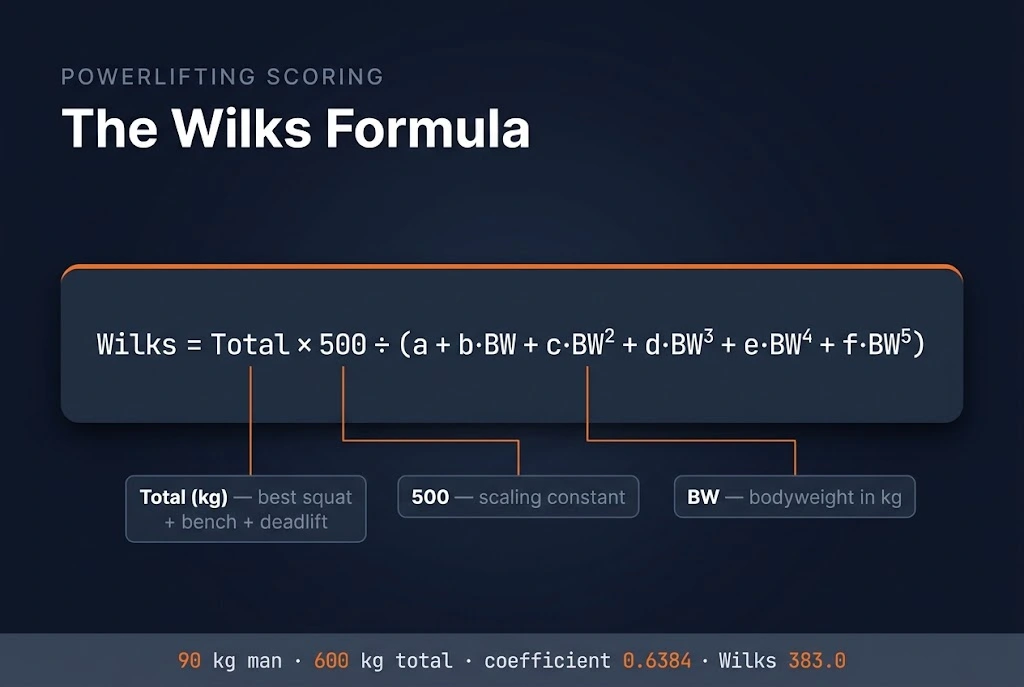
A Wilks score is a number that adjusts a powerlifting total for bodyweight, so a 60 kg lifter and a 120 kg lifter can be ranked on one scale. Here’s why that matters: a 600 kg total at 90 kg bodyweight scores 383.0 Wilks, while a 461.8 kg total at 59 kg scores 400. The lighter lifter wins. This guide covers the formula, a hand calculation, what counts as a good score, and why the IPF no longer uses it. If you only want your number, the Wilks Score Calculator gives it instantly.
At a glance:
- A Wilks score is your powerlifting total (kg) multiplied by a bodyweight coefficient
- The coefficient shrinks as bodyweight rises, so heavier lifters need bigger totals for the same score
- Robert Wilks of Powerlifting Australia created it in the 1990s
- The IPF used it for Best Lifter awards until the end of 2018, then moved to IPF Points (2019) and IPF GL Points (2020)
- It’s still the most common pound-for-pound shorthand online: “a 400 Wilks lifter”
- Wilks 2 (2020) runs on a different scale and isn’t interchangeable with the original
What Is a Wilks Score?
Raw totals favor heavier lifters. A 120 kg lifter will almost always outlift a 66 kg lifter in absolute terms, so totals alone can’t decide who had the best performance across a whole meet. Weight classes solve that inside each division, but Best Lifter awards and cross-class rankings need a single number that works for everyone.
The Wilks score provides it. Your total gets multiplied by a coefficient tied to your bodyweight, and the result is a unitless score you can compare against any other lifter of the same sex. The formula works in kilograms internally, so convert first if you lift in pounds. If the idea of a total is new to you, What Is Powerlifting? explains how the three lifts combine into one.
Who Created It, and Where Is It Used Today?
Robert Wilks of Powerlifting Australia developed the formula in the 1990s, and the IPF adopted it as its Best Lifter formula for roughly two decades. Today it lives on in some non-IPF federations, in informal awards at local meets, and above all as the internet’s default strength shorthand. The IPF itself now ranks lifters with IPF GL Points, covered in the scoring systems section below.
Why Bodyweight Changes Everything
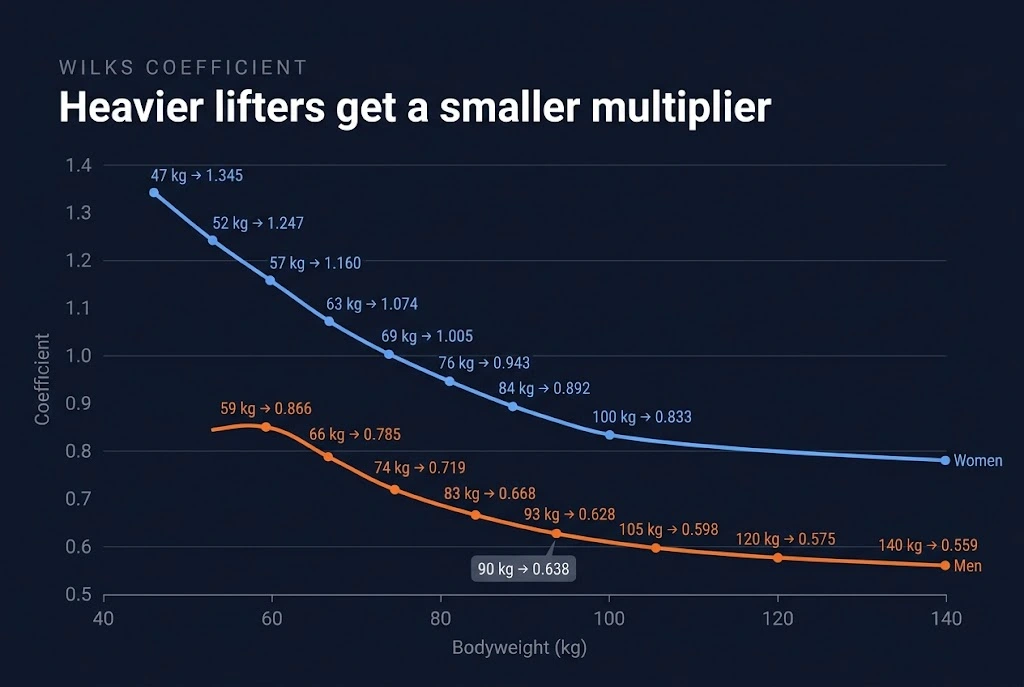
Strength rises with bodyweight but along a curve. Doubling your bodyweight doesn’t double your total, because extra mass brings diminishing returns in force production. The Wilks polynomial models that curve: lighter lifters get a larger multiplier, and the multiplier flattens out at the heavy end, where each extra kilogram of bodyweight adds less to strength.
The Wilks Formula Explained
The Equation
Wilks = Total (kg) × 500 ÷ (a + b·BW + c·BW² + d·BW³ + e·BW⁴ + f·BW⁵)
In plain English: your total is multiplied by a coefficient, and that coefficient equals 500 divided by a fifth-degree polynomial of your bodyweight in kilograms. Men and women use separate constants.
| Constant | Men | Women |
| a | −216.0475144 | 594.31747775582 |
| b | 16.2606339 | −27.23842536447 |
| c | −0.002388645 | 0.82112226871 |
| d | −0.00113732 | −0.00930733913 |
| e | 7.01863 × 10⁻⁶ | 4.731582 × 10⁻⁵ |
| f | −1.291 × 10⁻⁸ | −9.054 × 10⁻⁸ |
The Shortcut: Wilks Coefficient by Weight Class
You don’t need the polynomial to estimate your score. Multiply your total by the coefficient nearest your bodyweight in the table below, calculated at each IPF class limit. For how those classes are set, see powerlifting weight classes.
| Men: bodyweight | Coefficient | Women: bodyweight | Coefficient |
| 59 kg | 0.8662 | 47 kg | 1.3449 |
| 66 kg | 0.7852 | 52 kg | 1.2466 |
| 74 kg | 0.7193 | 57 kg | 1.1604 |
| 83 kg | 0.6675 | 63 kg | 1.0740 |
| 93 kg | 0.6282 | 69 kg | 1.0048 |
| 105 kg | 0.5976 | 76 kg | 0.9429 |
| 120 kg | 0.5749 | 84 kg | 0.8917 |
| 140 kg | 0.5588 | 100 kg | 0.8326 |
The coefficient is calculated at your exact bodyweight, not your class limit. A lifter weighing 80 kg gets a slightly higher coefficient than the 83 kg value. Use the calculator for exact results.
Same Score, Different Totals
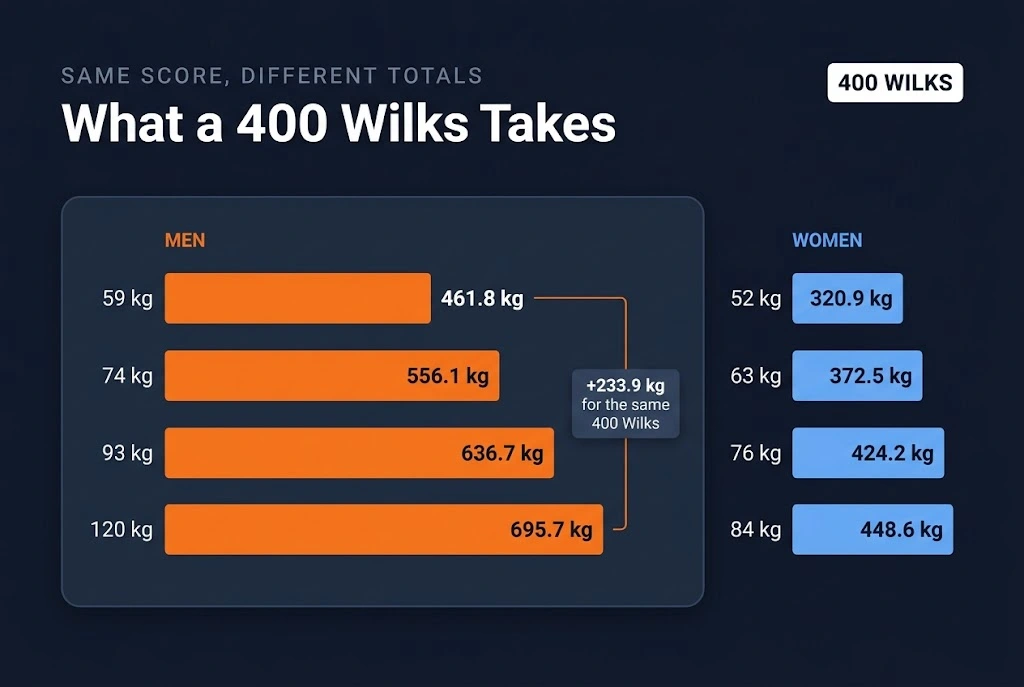
Here’s what a 400 Wilks demands at different body weights:
| Men | Total needed | Women | Total needed |
| 59 kg | 461.8 kg | 52 kg | 320.9 kg |
| 74 kg | 556.1 kg | 63 kg | 372.5 kg |
| 93 kg | 636.7 kg | 76 kg | 424.2 kg |
| 120 kg | 695.7 kg | 84 kg | 448.6 kg |
The 120 kg man needs 233.9 kg more on his total than the 59 kg man to earn the same score. That gap is the formula doing its job: both performances are rated as equally strong for the lifter’s size.
How to Calculate Your Wilks Score?
- Get your best squat, bench, and deadlift. Use competition bests or recent training maxes. No tested maxes? Estimate them with the One Rep Max calculator.
- Add them for your total. Example: 220 + 150 + 230 = 600 kg.
- Convert to kilograms if needed. Multiply pounds by 0.45359. A 1,320 lb total is 598.7 kg.
- Find your coefficient. Use the table above, or divide 500 by the polynomial at your exact bodyweight.
- Multiply. Total × coefficient = your Wilks score.
Worked Example
| Step | Value |
| Total | 600 kg |
| Bodyweight | 90 kg (male) |
| Coefficient (500 ÷ polynomial) | 0.6384 |
| Wilks score | 600 × 0.6384 = 383.0 |
Now a second lifter: a 60 kg woman with a 380 kg total scores 423.7. She outscores the 90 kg man by over 40 points while lifting 220 kg less, because her total is far larger relative to her size.
Or skip the math.
The Wilks Score Calculator runs all of this instantly. It accepts lb or kg, can estimate your maxes from rep sets, and shows Wilks, Wilks 2, and DOTS side by side so you can see all three numbers at once.
What Is a Good Wilks Score?
A “good” score depends on sex, equipment, drug testing, and federation, so treat these bands as a rough guide for raw lifters.
| Wilks | Level | What it looks like |
| Under 200 | Beginner | First 6–12 months of barbell training |
| 200–299 | Intermediate | Consistent, structured training; stronger than most gym-goers |
| 300–399 | Advanced | Competitive at local and regional meets |
| 400–499 | Elite | National-level contender |
| 500+ | World-class | International podiums and records |
An approximate guide, not a federation standard. These match the levels used in the site’s Wilks calculator.
For real benchmarks, browse the OpenPowerlifting rankings, which can be sorted by Wilks and filtered by federation and class. That shows what lifters at your bodyweight are actually posting. If you’re heading to your first competition, treat your score as a baseline rather than a target; the first meet preparation guide covers what to focus on instead.
Wilks vs Wilks 2 vs DOTS vs IPF GL
Four scoring systems are in common use, and their numbers can’t be swapped for one another.
| System | Introduced | Scale | Who uses it? | 90 kg man, 600 kg total |
| Wilks | 1990s | ×500 | Some non-IPF federations; online shorthand | 383.0 |
| Wilks 2 | 2020 | ×600 | Powerlifting Australia; some others | 460.2 |
| DOTS | 2019 | ×500 | Various federations and meets | 388.0 |
| IPF GL Points | May 2020 | Roughly 100-point scale | IPF and all IPF affiliates | Different scale; not comparable |
Never compare scores across systems directly. A 400 Wilks and a 400 Wilks 2 are very different achievements.
Wilks 2: Same Name, Different Scale
Robert Wilks published an updated version in 2020, built on newer competition data and a 600 multiplier in place of 500. For the same lift, Wilks 2 scores land roughly 20% higher than the original Wilks, so the 90 kg lifter above jumps from 383.0 to 460.2 without lifting an extra kilogram. The update aimed to reduce bias at very light and very heavy bodyweights, but the IPF never adopted it. A 2025 analysis of powerlifting scoring systems compares the formulas and notes the change in scale. Always check which version someone means before comparing numbers.
DOTS
DOTS is a newer polynomial formula on the same ×500 scale as original Wilks, so the two produce similar numbers for mid-range bodyweights: 388.0 versus 383.0 in the example above. It was among the formulas the IPF evaluated in 2020 before settling on GL Points, and it’s widely used outside the IPF. The DOTS Score Calculator works the same way as the Wilks one.
IPF GL Points: What the IPF Uses Now
Since May 2020, the IPF has ranked the best lifter using IPF GL (Goodlift) points, with separate formulas for classic and equipped lifting. GL scores sit on a much smaller scale, so a GL number can’t be lined up against a Wilks number. If you compete in an IPF affiliate, GL is the score printed on your official result.
Criticisms of the Wilks Formula
The formula has known weaknesses, most of them acknowledged by the IPF itself:
- Old data. It was built from 1990s competition results, with relatively few female lifters in the dataset.
- Weight-class bias. The IPF concluded it favoured some bodyweight ranges over others.
- One formula for everyone. Original Wilks doesn’t separate classic from equipped lifting.
- Extremes. Accuracy drops at very light and very heavy bodyweights.
The IPF’s own proposal to replace the Wilks formula set out these problems before the 2019 switch. None of this makes Wilks useless. It remains a sensible personal benchmark and the common language lifters use to compare strength across sizes; it simply isn’t the official IPF measure anymore.
How to Raise Your Wilks Score?
You have two levers: increase your total or lower your bodyweight while keeping the total. Raising the total is almost always the better choice. At 90 kg, every extra 10 kg on your total adds about 6.4 Wilks points, and that strength carries into every future meet. Use the Powerlifting Total Calculator to find your limiting lift, the one where extra work will lift your total fastest. Avoid cutting weight purely to chase a score; dehydration usually costs more on the platform than the bigger coefficient gives back.
Frequently Asked Questions
A Wilks score is a simple idea, your total times a bodyweight multiplier, and it remains the common language of pound-for-pound strength. Before comparing numbers, check which system your federation actually uses. Then calculate yours with the Wilks Score Calculator, compare it with the DOTS Score Calculator, and see the Powerlifting & Competition guide for how scoring fits into competition.