
Block Periodization Explained
Your squat climbed for a year. Now it hasn’t moved in five weeks, and the programs you’re looking at are split into phases with names like “accumulation” and “realization.” That structure is block periodization, and the order of those phases does most of the work.
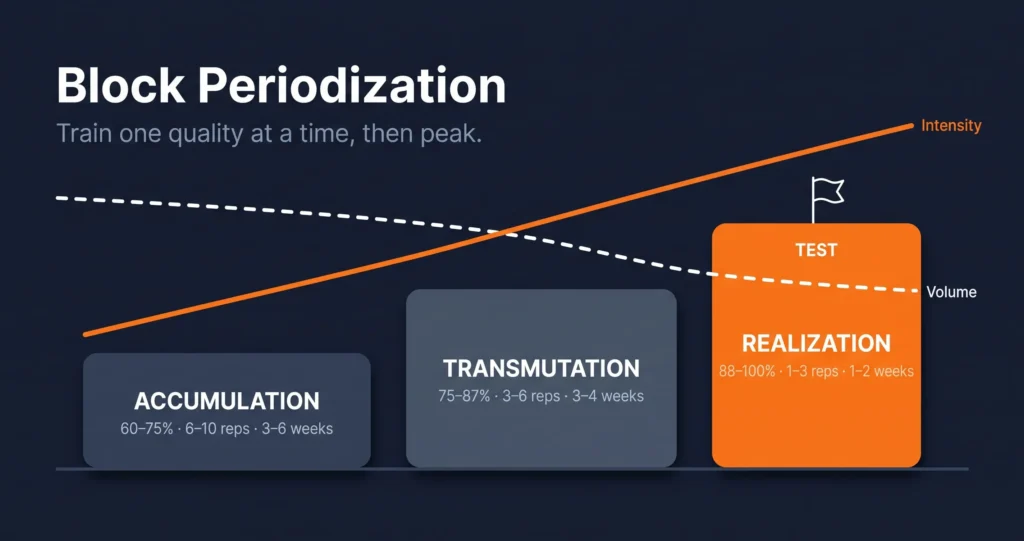
Block periodization splits a training cycle into consecutive 2–6 week blocks, each focused on one quality. Accumulation builds muscle and work capacity, transmutation converts it into maximal strength, and realization peaks that strength for a test or meet. It works best for intermediate lifters whose linear progress has stalled.
What Is Block Periodization?
Block periodization is a planning model that trains one or two qualities per multi-week block instead of chasing size and strength in the same week. Vladimir Issurin, who formalized it, describes the model as “the sequencing of specialized training cycles, i.e. blocks, which contain highly concentrated workloads directed to a minimal number of targeted abilities.” It applies progressive overload across phases, with each block raising the ceiling the next one trains against.
Where Block Periodization Came From
Block periodization grew out of a reaction against Lev Matveyev’s traditional model, which in the 1960s divided the season into long periods of mixed training. Yuri Verkhoshansky, working with Soviet track athletes, found that concentrated loading (weeks built around one dominant stimulus) produced bigger jumps than training everything at once. Vladimir Issurin later formalized that work into the block model.
Issurin’s 2010 review in Sports Medicine names four problems with the traditional approach (Issurin, 2010). Mixed training triggers conflicting physiological responses, and long multi-target periods pile up fatigue. Advanced athletes get too little stimulus for any single quality, and the model can’t deliver more than one real peak per season.
That last problem is the one powerlifters feel. If you compete two or three times a year, a plan built around a single annual peak leaves you under-prepared for most of your meets.
Why Training One Quality at a Time Works
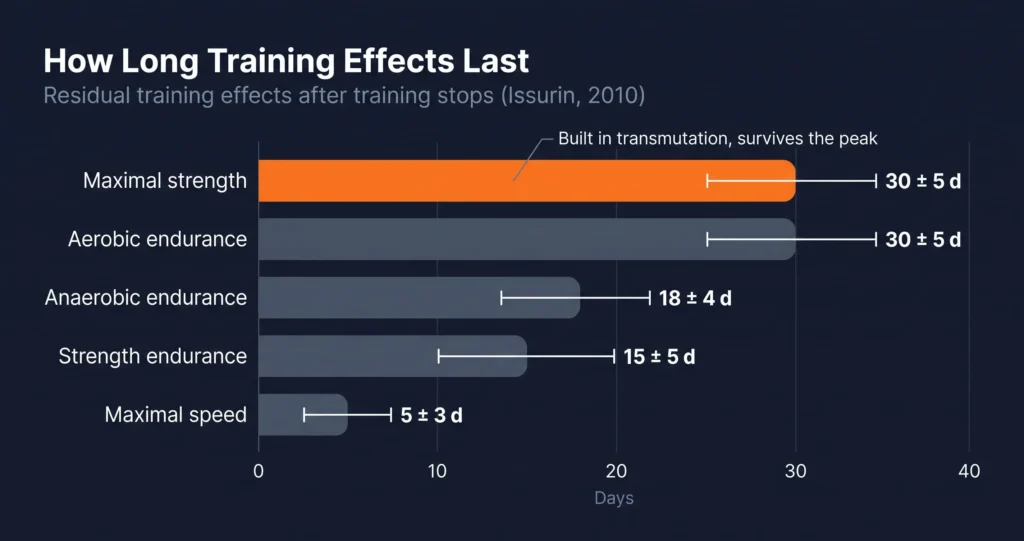
Block periodization works because of residual training effects: a quality you’ve built decays over a predictable window after you stop training it. Maximal strength holds for roughly a month. Strength endurance fades in about two weeks, and bar speed is gone within days.
| Training Quality | Residual Duration | What It Means for a Lifter |
| Aerobic endurance | 30 ± 5 days | General conditioning holds through a full-strength block. |
| Maximal strength | 30 ± 5 days | Strength built in transmutation survives a 1–2 week peak and taper. |
| Anaerobic glycolytic endurance | 18 ± 4 days | High-rep “burn” capacity fades within about 2–3 weeks. |
| Strength endurance | 15 ± 5 days | Volume tolerance from accumulation fades fastest, so accumulation comes first. |
| Maximal speed (alactic) | 5 ± 3 days | Bar speed and sharpness must be trained in the final days before a test. |
Residual durations reported by Issurin (2008, 2010). Qualities with long residuals are built early; short-residual qualities are trained last. Source: Issurin VB, Sports Medicine 2010.
Maximal strength holds for about a month after you stop training it. Bar speed fades in days. That gap decides the block order.
The block order follows those numbers. A four-week accumulation block won’t erase your strength, because the max-strength residual outlasts it. The sharpness you need on test day gets trained in the final week, when there’s no time left for it to fade.
The Three Blocks: Accumulation, Transmutation, Realization
Across a block periodization cycle, volume falls and intensity climbs from one block to the next. That trade-off between training volume vs intensity is what lets each block set up the one after it.
| Block | Typical Length | Intensity (%1RM) | Reps per Set | Volume | Primary Goal |
| Accumulation | 3–6 weeks | 60–75% | 6–10 | High | Muscle, work capacity, technique practice |
| Transmutation | 3–4 weeks | 75–87% | 3–6 | Moderate | Convert size into maximal strength. |
| Realization | 1–2 weeks | 88–100% | 1–3 | Low (cut 40–60%) | Peak strength, shed fatigue, test, or compete |
Volume drops and intensity climbs from block to block. Plug your 1RM into the 1RM percentage calculator to turn any column into bar weights.
Accumulation Block
The accumulation block is the highest-volume phase of block periodization: 4–5 sets of 6–10 reps at 60–75% of 1RM on the main lifts, plus 3–4 accessory movements. Its job is to build muscle cross-sectional area and the work capacity to survive the heavier blocks later.
Keep one weekly top set at roughly 80% on each competition lift, so heavy-bar skill doesn’t rust while volume does its work.
Expect strength to feel flat by week 3 or 4. Fatigue masks it, and it clears once volume comes down.
Transmutation Block
The transmutation block converts the muscle and work capacity built in accumulation into maximal strength. Sets drop to 3–6 reps at 75–87% of 1RM, usually for 4–5 sets, and accessory work gets trimmed to make room for heavier main-lift sessions.
This is where most of the measurable 1RM gain shows up. Watch bar speed on your heavy triples: if it holds while the loads rise, the block is doing its job. Fatigue keeps building, though, and that leftover fatigue is why realization exists.
Realization Block
The realization block is the short, heavy peak at the end of a block periodization cycle. It runs 1–2 weeks of doubles and singles at 88–95% or higher, with total volume cut 40–60% so fatigue dissipates and the strength built in transmutation shows up on the bar.
The block ends with a 1RM attempt or a meet. If you’re testing in the gym, plan your warm-up jumps and attempt selection in advance so you test your one rep max safely.
Two weeks is the ceiling.
Stretch realization longer and you’re grinding near-max weights after the strength-endurance residual has already faded, which adds fatigue without adding strength.
Sample 12-Week Block Periodization Program
This template fits an intermediate lifter training 3–4 days a week with a test or meet in week 12. The worked loads use a squat example, and the same percentages carry over to the other competition lifts.
How to Set Your Training Percentages?
Every block periodization prescription scales off your 1RM, so that number has to be honest. Use a max tested within the last 8–12 weeks, or estimate one from a recent hard set of 3–5 reps with the one rep max calculator. An inflated 1RM wrecks block periodization faster than any other mistake, because every percentage in every block inherits the error.
Round loads to the nearest 5 lb (or 2.5 kg). Here’s the conversion for one session:
- Start with your current squat 1RM: 405 lb
- Multiply by the session’s prescription, e.g., 77.5% → 405 × 0.775 = 313.9 lb
- Round to the nearest 5 lb → 315 lb
- Load it: a 45 lb bar plus three 45 lb plates per side = 315 lb
- Repeat for every lift and block, or let the 1RM percentage calculator handle the multiplication
The 12-Week Template
Here’s the full block periodization cycle, worked for a lifter with a 405 lb squat.
| Weeks | Block | Main-Lift Prescription | Squat Load (405 lb 1RM) | Focus |
| 1–2 | Accumulation | 5 × 8 @ 65–67.5% | 265–275 lb | Volume, technique, muscle |
| 3–4 | Accumulation | 5 × 8 @ 70–72.5% | 285–295 lb | Peak volume load |
| 5 | Transition | 3 × 5 @ 65% | 265 lb | She’d fatigue before heavier work. |
| 6–7 | Transmutation | 5 × 4 @ 77.5–80% | 315–325 lb | Build maximal strength. |
| 8–9 | Transmutation | 4 × 3 @ 82.5–85% | 335–345 lb | Heavier triples, fewer accessories |
| 10 | Realization | 3 × 2 @ 87.5–90% | 355–365 lb | Doubles, volume cut ~40% |
| 11 | Realization | 2 singles @ 92.5–95% | 375–385 lb | Heavy singles, taper |
| 12 | Test | Work up to a 1RM attempt. | 405+ lb | Test or compete |
Loads rounded to the nearest 5 lb. Swap in your own 1RM with the 1RM percentage calculator. This is a template, not a prescription for every lifter, so adjust block length using the guidance below.
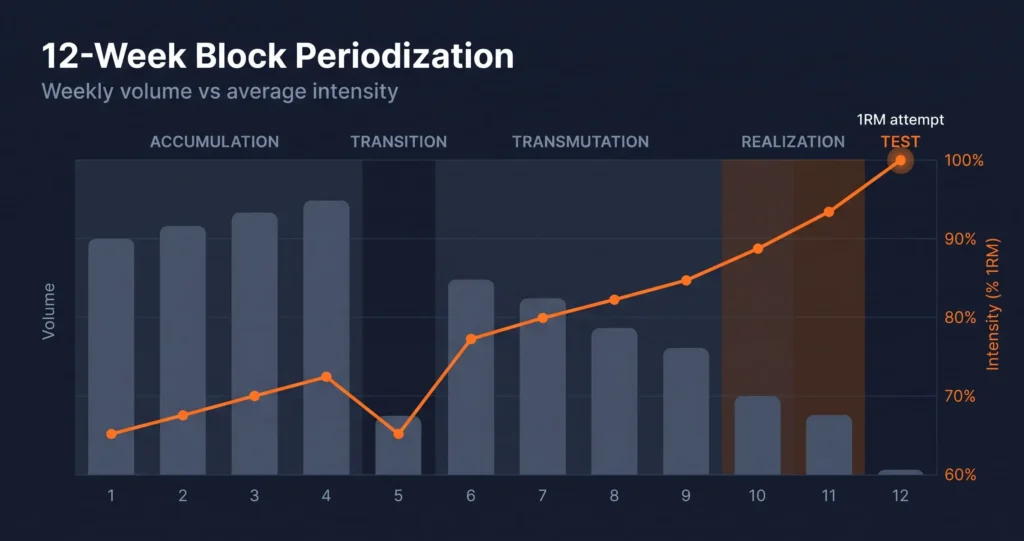
Accumulation gets four weeks because that’s long enough to build a meaningful volume residual without letting heavy-bar skill go stale. Week 5 drops to 3 × 5 at 65%, which clears the fatigue four weeks of 5 × 8 leaves behind, so transmutation starts fresh. Realization gets two weeks and no more, since the strength-endurance residual sits around 15 days.
Run squat and bench exactly as written. Deadlift can drop one set from each prescription because its recovery cost per set is higher. Accessory work shrinks from 3–4 movements during accumulation to 1–2 in realization.
Moving Between Blocks
Moving between blocks is where most block periodization cycles get adjusted on the fly. Take the transition week between accumulation and transmutation whenever fatigue is high, which it usually is after four weeks of 5 × 8. Skip it only if bar speed on your last accumulation sessions still looks sharp.
At the end of transmutation, re-estimate your 1RM from a hard triple and recalculate the realization percentages from that number. A lifter who added 15 lb during transmutation is otherwise peaking off stale math.
Block length can flex as well. Extend a block by one week if you’re still progressing in it, and cut it short if reps slow down for two sessions in a row. After the week-12 test, the next cycle starts again at accumulation, with every percentage rebuilt from the new max.
Block Periodization vs. Linear and Undulating Periodization
Block periodization trains one focus per multi-week block, then switches focus for the next block. Linear periodization keeps a single focus and raises the load every session or week, while daily undulating periodization (DUP) rotates rep ranges inside each week.
| Feature | Linear Periodization | Daily Undulating (DUP) | Block Periodization |
| How load changes | Rises every session or week | Rep range rotates within each week | Changes block to block |
| Qualities trained at once | One (strength) | Several, rotated daily | One or two per block |
| Best fit | Novices (0–12 months) | Intermediates wanting variety | Intermediates/advanced with a test date |
| Typical cycle length | Runs until progress stalls | Ongoing weekly rotation | 8–16 weeks to a peak |
| Built-in peak | No | No | Yes (realization block) |
| Fatigue management | Deload after stalls | Spread across the week | Planned transition weeks and taper |
Block periodization is the only one of the three with a peak written into its structure, which is why powerlifters favor it for meet prep.
What the Research Shows
The research on block periodization is thinner and more mixed than most program write-ups suggest. Painter et al. (2012) put 31 Division I track and field athletes through 10 weeks of either block or DUP training (Painter et al., 2012). Strength and rate-of-force-development trends favored the block group, but the differences between groups weren’t statistically significant.
The block group reached those gains on less volume load, which gave it the better training-efficiency score. The authors concluded that “a block training model is more efficient than a DUP model in producing strength gains.”
Bartolomei et al. (2014) compared block and traditional periodization in 24 resistance-trained men training four times a week for 15 weeks, with volume equated between groups (Bartolomei et al., 2014). Block was likely better for upper-body power and possibly better (around 60% likelihood) for maximal bench strength. Lower-body strength showed no difference.
Block periodization has no proven strength advantage over other models.
Its documented edge is efficiency: similar gains from less total work, plus a planned peak. Both studies used small samples of trained athletes, so neither one tells you anything about novices.
Who Should Use Block Periodization (and Who Shouldn’t)
Block periodization fits lifters who’ve run out of easy progress and have a date to peak for. Novices should stay on linear progression, which delivers months of session-to-session gains that block periodization trades away for structure a beginner doesn’t need yet. The strength training guides cover the programs that come before and after this one.
- Lifters with 12+ months of consistent barbell training whose weekly progression has slowed to a crawl
- Powerlifters with a meet 10–16 weeks out, since the realization block is a built-in peak
- Anyone training toward a fixed test date, such as a gym 1RM day or a military fitness test
- Not for novices: if you can still add weight session to session, linear progression will move your total faster
- A poor fit if you can’t train at least 3 days a week, because each block needs enough sessions to deliver its concentrated stimulus
Common Block Periodization Mistakes
These are the setup errors that sink most block periodization cycles before week 12 arrives:
- Running accumulation for only one or two weeks. That’s too short to build a residual worth anything, so transmutation has little to convert.
- Setting every block from an old or inflated 1RM. For a lifter with a true 405 lb squat, logging 425 turns the 85% triples (360 lb) into 89% triples, and the block becomes a grind by week two.
- Dropping all heavy work during accumulation. Without a weekly top set near 80%, the first transmutation session feels foreign even though you’re stronger than when you started.
- Stretching realization past two weeks. Issurin puts the strength-endurance residual at about 15 days, so a long peak stacks near-max singles on top of fading work capacity.
- Starting block periodization as a novice. You give up months of linear gains for a structure designed for lifters who’ve stopped adapting session to session.
Of the five, the inflated 1RM does the most damage, because the error compounds through every block that follows it.
How to Use the 1RM Percentage Calculator with Block Training
Enter your current 1RM into the 1RM percentage calculator and it returns bar weights across the full percentage range. No recent tested max? Estimate one first from a hard set of 3–5 reps with the one rep max calculator.
Read off the loads for each block: 65–72.5% for accumulation, 77.5–85% for transmutation and 87.5–95% for realization. Run it again at the end of transmutation once you’ve re-estimated your max from a hard triple, so the realization singles come from current numbers.
Block Periodization FAQs
Start with the calendar. Count back 12 weeks from your test or meet date, and that’s your first accumulation session. Get an honest 1RM from a recent test or a hard set of 3–5, then build every block’s loads from it. If your date is closer than 10 weeks out, shorten accumulation first, because transmutation is where the 1RM gains show up and realization can’t drop below a week.