
Daily Undulating Periodization (DUP) Explained
You’ve stopped adding weight every week, and the programs you’re reading now give the same lift a “volume day” on Monday and a “heavy day” on Friday. That setup is daily undulating periodization, and it’s the most common next step for lifters who’ve outgrown linear progress.
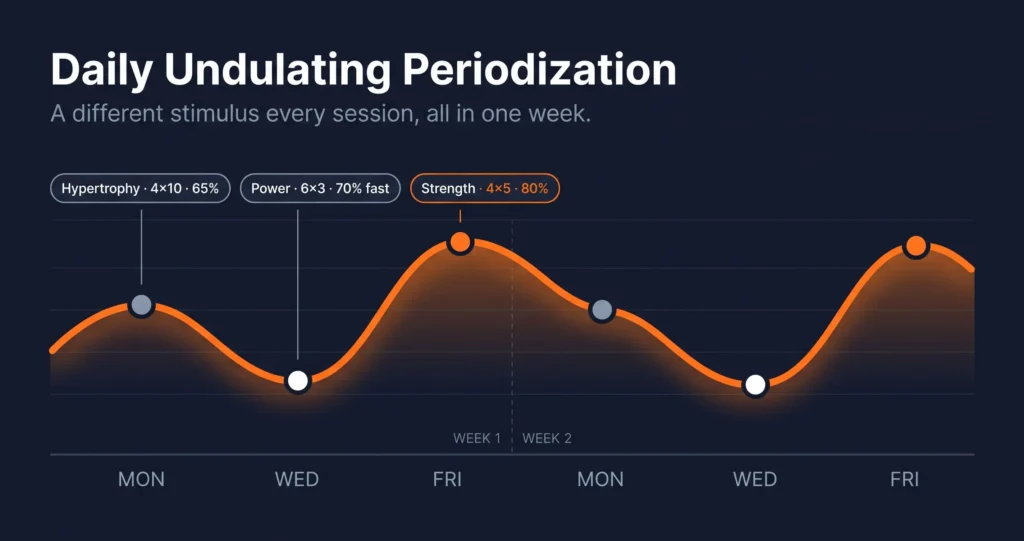
Daily undulating periodization (DUP) changes the rep range and load each time you train a lift, so one week mixes a high-rep hypertrophy day, a fast power day, and a heavy strength day. A 2022 meta-analysis found it builds more 1RM strength than linear periodization in trained lifters, but not in beginners.
What Is Daily Undulating Periodization?
Daily undulating periodization is a training model that changes the rep range and load every session for the same lift, so a single week covers every session type instead of spreading them across month-long phases. The “daily” refers to each training session for a lift: a lifter who benches on Monday, Wednesday, and Friday gets a different prescription each time, with rest days in between. DUP sits under the umbrella of nonlinear periodization, alongside weekly undulating periodization (WUP), which keeps one rep range for a whole week and changes it the next.
Where DUP Came From
Daily undulating periodization traces back to Charles Poliquin, who popularized undulating loading for strength athletes in the late 1980s. Its first head-to-head test came in 2002, when Matthew Rhea’s group put 20 men on either a linear or a daily undulating program for bench press and leg press, three days a week for 12 weeks (Rhea et al., 2002). The linear group moved from 8RM to 6RM to 4RM in four-week phases. The DUP group ran all of those rep targets inside one week: 8RM on Monday, 6RM on Wednesday, 4RM on Friday.
DUP produced significantly larger strength gains. The authors put it plainly: “Making program alterations on a daily basis was more effective in eliciting strength gains than doing so every 4 weeks.”
Michael Zourdos later adapted the model for powerlifters, testing day order and pairing DUP with RPE-based loading.
Why Changing the Stimulus Every Session Works?
Daily undulating periodization lets you train a lift three times a week without grinding every session, because a lighter or faster day sits between the hard ones. That fatigue management is the first reason it works. The second is exposure: you handle 80% or more of your max every single week, instead of waiting eight weeks for a strength phase to arrive.
Training several qualities at once also keeps any of them from sitting idle long enough to fade. High-rep work comes back every Monday instead of vanishing for a month.
The strength edge probably isn’t coming from extra muscle. Moesgaard et al. (2022) found no hypertrophy difference between models and pointed toward neural adaptations instead, concluding that “trained individuals benefit from daily or weekly undulations in volume and intensity when the aim is maximal strength” (Moesgaard et al., 2022).
How a DUP Week is Structured?
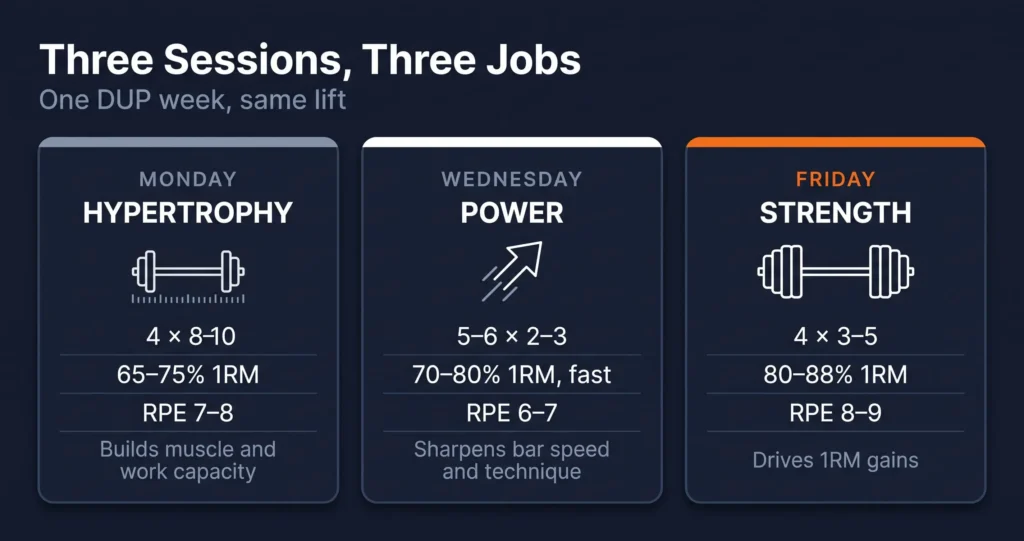
A standard daily undulating periodization week trains each main lift three times, with every session sitting at a different point on the volume–intensity scale. It’s the training volume vs intensity trade-off spread across one week instead of across months.
| Day | Session Type | Sets × Reps | Load (%1RM) | Target RPE | Main Goal |
| Monday | Hypertrophy | 4 × 8–10 | 65–75% | 7–8 | Muscle and work capacity |
| Wednesday | Power | 5–6 × 2–3 | 70–80%, moved fast | 6–7 | Bar speed, technique under load |
| Friday | Strength | 4 × 3–5 | 80–88% | 8–9 | Maximal strength, 1RM-specific practice |
Hypertrophy → power → strength is the day order that performed best in Zourdos et al. (2016). Get exact loads from the 1RM percentage calculator or set them by feel with the RPE calculator.
The Three Session Types
The hypertrophy day is the volume engine of a DUP week: 8–10 reps per set at 65–75%, stopped a rep or two short of failure. The power day uses a submaximal load, typically 70–80%, moved as fast as you can for doubles and triples, so it builds bar speed and keeps technique sharp with very little fatigue. The strength day is the heavy one, triples and fives at 80–88%, and it carries over most directly to a 1RM.
To see how rep counts from 3 to 10 line up against percentages of your max, the rep max equivalency chart maps them side by side.
The power day is the session most lifters cut when time gets tight. That’s the wrong cut, because it’s the lowest-fatigue day of the week.
Does the Order of DUP Days Matter?
In daily undulating periodization, day order matters, at least for the bench press. Zourdos et al. (2016) split 18 college-aged male powerlifters into two groups for 6 weeks, training the competition lifts on three non-consecutive days (Zourdos et al., 2016). One group ran hypertrophy → strength → power (HSP); the other ran hypertrophy → power → strength (HPS). Strength days were sets to failure at a fixed percentage, so the researchers could compare how much total volume each group lifted.
The HPS group lifted more total volume on squat and bench and gained significantly more on bench 1RM. Effect sizes favored HPS on squat and bench (above 0.50), with no deadlift difference.
Put the strength day last, after the power day, so you walk in fresh for the heaviest work of the week. With only 9 lifters per group over 6 weeks, treat that as a strong default rather than a law.
2-Day and 4-Day DUP Variations
Daily undulating periodization needs each lift trained at least twice a week, and three sessions per lift is the sweet spot. On a two-day setup, alternate a hypertrophy day and a strength day and drop the power day. On four days, run an upper/lower split so each lift gets two sessions with a different session type each time, or keep the 3-day rotation and add a second hypertrophy day.
If you’re still working out how often to train each lift, settle that first and fit DUP around it.
Train a lift once a week, and you’re no longer running DUP. That’s weekly undulating periodization.
Sample 8-Week DUP Program
This template is a 3-day HPS daily undulating periodization week for an intermediate lifter, worked through on the bench press.
How to Set Up DUP Loads
Every percentage in daily undulating periodization depends on an honest 1RM. Estimate yours from a recent hard set of 3–5 reps with the one rep max calculator instead of trusting a max from last year, and if you’re stuck between two numbers, take the lower one. A 1RM that’s 10 lb too high turns every strength day into a grinder by week 3.
- Estimate your current 1RM for each main lift. Worked example: bench press 1RM = 225 lb
- Pick your frequency: 3 sessions a week with each lift trained every session, or 2 sessions per lift on a 4-day split
- Order the week: hypertrophy → power → strength
- Convert each day’s percentage into a bar weight and round to the nearest 5 lb. Worked example: 80% × 225 = 180 lb for the Friday 4 × 5
The 8-Week Template
Here’s the full 8-week daily undulating periodization cycle for a lifter with a 225 lb bench.
| Weeks | Monday: Hypertrophy | Wednesday: Power | Friday: Strength |
| 1–2 | 4 × 10 @ 65% (145 lb) | 6 × 3 @ 70% (160 lb), fast | 4 × 5 @ 80% (180 lb) |
| 3–4 | 4 × 8 @ 70% (160 lb) | 6 × 2 @ 75% (170 lb), fast | 4 × 4 @ 82.5% (185 lb) |
| 5–6 | 4 × 6 @ 75% (170 lb) | 5 × 2 @ 77.5% (175 lb), fast | 4 × 3 @ 85% (190 lb) |
| 7 (deload) | 3 × 8 @ 60% (135 lb) | 4 × 2 @ 65% (145 lb) | 3 × 3 @ 70% (160 lb) |
| 8 (test) | 3 × 8 @ 60% (135 lb) | 4 × 2 @ 70% (160 lb) | Work up to a 1RM, or AMRAP at 85% (190 lb). |
Loads rounded to the nearest 5 lb. Swap in your own max with the 1RM percentage calculator. After week 8, recalculate from the new 1RM and run the cycle again.
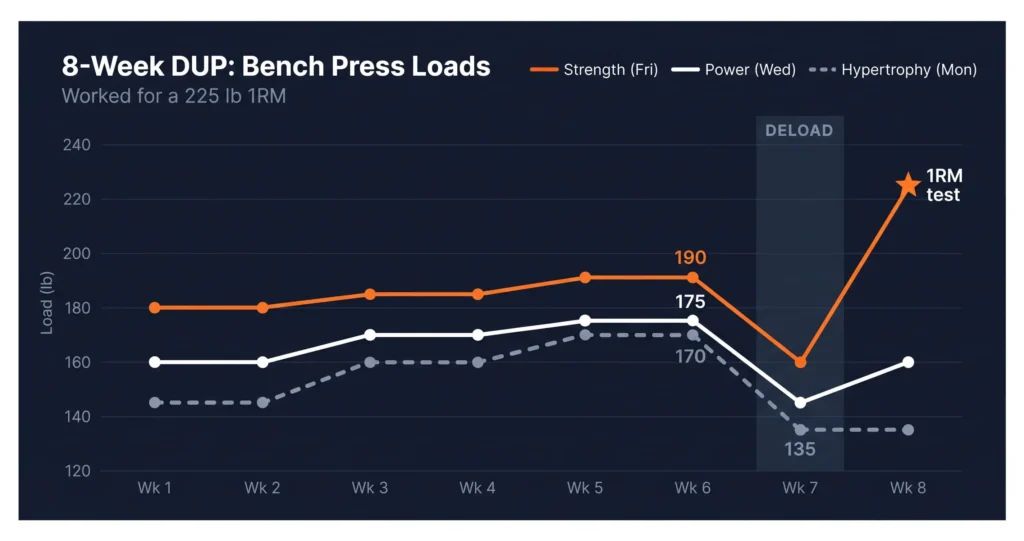
Each day runs on its own track. Reps drop and the load climbs about 2.5–5% every two weeks, which is how progressive overload works inside a DUP week. Week 7 is a deload at 60–70%, and week 8 tests the strength gain with either a true 1RM attempt or an AMRAP at 85%.
Run the squat on the same template. For deadlifts, swap the hypertrophy day for Romanian deadlifts or paused pulls, because sets of 10 on conventional deadlifts cost more recovery than they return.
Percentages or RPE?
Percentages work in a daily undulating periodization program when your 1RM is current and your recovery is predictable. RPE targets let the load move with how you feel on the day. RPE 8 means you finished the set with 2 reps left in the tank, so on a bad-sleep Friday an RPE 8 triple might land at 175 lb instead of the 190 on paper.
Run your first cycle on percentages so you learn what each day should feel like. Then switch the strength day to RPE and keep the other two days on percentages. The RPE calculator converts a target like “3 reps at RPE 8” into a bar weight.
DUP vs Linear, Weekly Undulating, and Block Periodization
Linear periodization changes its emphasis every 3–4 weeks, and weekly undulating periodization changes it every week. Daily undulating periodization changes it every session, while block periodization stacks focused multi-week blocks toward a single peak.
| Feature | Linear | Weekly Undulating | Daily Undulating (DUP) | Block |
| How often emphasis changes | Every 3–4 weeks | Every week | Every session | Every 2–6 week block |
| Qualities trained per week | One | One | Two to three | One or two |
| Minimum sessions per lift | 1–3 | 1–2 | 2–4 | 2–4 |
| Best fit | Novices | Lifters on 1–2 sessions per lift | Intermediates, off-season powerlifters | Intermediate/advanced with a test date |
| Built-in peak | No | No | No | Yes |
DUP gives you the most variety per week. Block periodization gives you the cleanest peak. Many powerlifters run DUP in the off-season, then switch to a block before a meet.
What the Research Shows
Daily undulating periodization and its weekly cousin build slightly more 1RM strength than linear programs, and the advantage shows up only in lifters who are already trained.
| Study | Who | Length | Finding |
| Rhea et al., 2002 | 20 men, bench + leg press | 12 weeks | DUP produced significantly greater strength gains than LP with equated volume and intensity |
| Zourdos et al., 2016 | 18 male powerlifters | 6 weeks | Hypertrophy → power → strength order beat hypertrophy → strength → power for bench 1RM |
| Moesgaard et al., 2022 | Meta-analysis of 35 studies | Varied | Undulating > linear for 1RM (ES 0.31): trained ES 0.61, untrained ES 0.06; no hypertrophy difference |
Sources: JSCR 2002, JSCR 2016, Sports Medicine 2022. ES = effect size; 0.2 is small, 0.5 moderate.
Moesgaard et al. (2022) pooled 35 volume-equated studies and found undulating periodization beat linear for 1RM with an effect size of 0.31 (Moesgaard et al., 2022). The subgroup split carries the real message: trained lifters showed an effect size of 0.61, untrained lifters just 0.06. Muscle growth didn’t differ between models (ES 0.05).
That’s a real but modest edge, and it appears only once you’re past the novice stage.
The meta-analysis pools daily and weekly undulating programs under one label, so it doesn’t isolate DUP on its own. And with hypertrophy equal across models, DUP’s payoff shows up in your 1RM, with no extra muscle attached.
Who Should Use DUP (and Who Shouldn’t)
Daily undulating periodization fits lifters who’ve stalled on weekly linear progress and can train each lift at least twice a week. Beginners should stay on linear progression: the untrained subgroup in Moesgaard 2022 showed no DUP advantage, and a beginner can still add weight every session. The rest of the strength training guides cover the programs that come before and after this one.
- Intermediate lifters whose weekly linear progress has stalled after 6–12+ months of consistent training
- Anyone who can train each main lift at least twice a week, ideally three times
- Powerlifters in the off-season who want strength and size work in the same week
- Lifters who get bored or beat up running one rep scheme for weeks at a time
- Not for beginners: if you can still add weight every session, linear progression gets you stronger faster with less to manage
Common DUP Mistakes
Most daily undulating periodization cycles that stall trace back to one of five setup errors.
Rotating rep ranges isn’t progression.
- Training every session to failure. The lighter days exist to manage fatigue, and grinding the hypertrophy day at RPE 10 leaves nothing for Friday’s heavy work.
- Treating power day as a junk day. Moving 70% slowly with sloppy reps throws away the week’s lowest-fatigue technique practice.
- Putting the strength day straight after the hypertrophy day. Zourdos et al. (2016) found the hypertrophy → power → strength order produced more bench strength, so give the heavy day the freshest slot.
- Running DUP on one session per lift per week. That’s weekly undulating periodization, and you lose the frequency DUP depends on.
- Never progressing the loads. Each day’s track still needs heavier loads or fewer reps every 1–2 weeks, or you’ve built a plateau with more variety in it.
How to Use the RPE and 1RM Percentage Calculators With DUP
Setting up daily undulating periodization loads starts with the one rep max calculator, which estimates your current max from a recent hard set. Enter that max into the 1RM percentage calculator and fill in each day of the 8-week template, from 65% on the first Monday up to 85% on the week 5–6 strength day.
When you move the strength day to RPE, open the RPE calculator. Enter a recent set and how hard it felt, and it returns the load for a target like 3 reps at RPE 8. After the week-8 test, run all three again from your new max.
Frequently Asked Questions
Start with one number. Get an honest 1RM for each lift, set Monday as hypertrophy, Wednesday as power and Friday as strength, and load the first two weeks straight from the percentages. Leave RPE alone until you’ve felt what each day is supposed to be like; autoregulating a session you’ve never run is guesswork.