
How to Peak for a 1RM Attempt
Your max-out day is three weeks away, and you want to walk in neither beat up nor rusty. Knowing how to peak for a 1RM comes down to two moves: cut most of the volume and keep the bar heavy until the last few days before the attempt.
To peak for a 1RM, cut training volume by roughly 40–60% over the final one to two weeks, keep the bar heavy at 85% of your max or more, then rest 2–7 days before the attempt. A 2020 review found intensity-maintained tapers improved strength by 1–6%.
What Does Peaking for a 1RM Mean?
Peaking for a 1RM is the final 2–3 weeks before a max attempt, when you cut training volume hard, keep the loads heavy, and rest briefly so accumulated fatigue clears. The strength itself comes from months of progressive overload; a peak clears away the fatigue that’s hiding it. The heavy singles along the way do one more job, rehearsing the exact skill a 1RM demands.
Why Lifting Less Makes You Stronger on Test Day
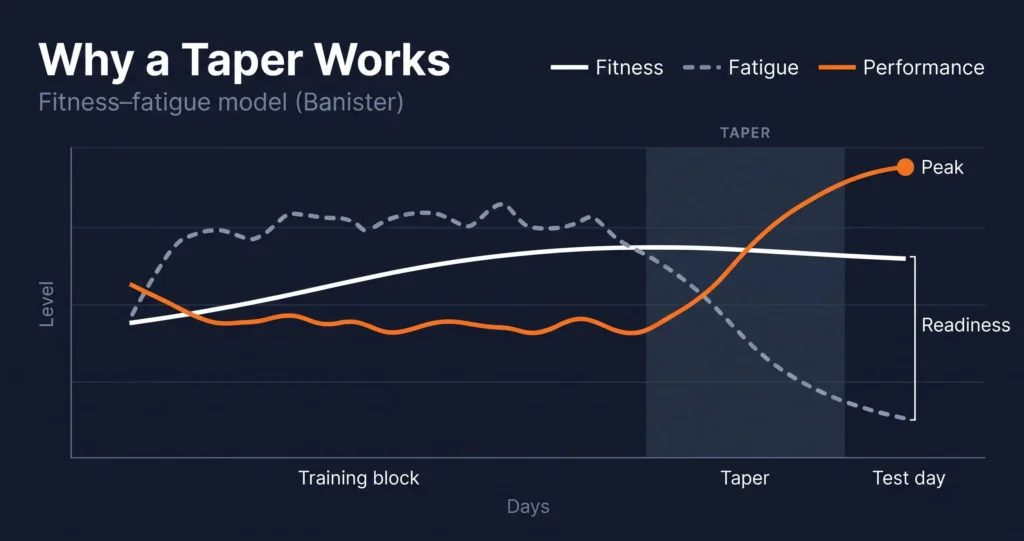
Peaking for a 1RM works because of Eric Banister’s fitness–fatigue model, first described in 1975. Every hard session builds fitness and fatigue at the same time. Fitness fades slowly over weeks, while fatigue clears in days, so when you cut the workload, fatigue drops faster than fitness and performance rises for a short window.
The strength-specific numbers come from Travis et al. (2020), a review of tapering for powerlifting (Travis et al., 2020). Maximal strength can hold for roughly 30 ± 5 days without training. Full rest longer than 7 days, though, has cost lifters 1–4% of their max.
Those two figures set the shape of a peak: 2–3 weeks long, with the full-rest portion kept under a week.
Taper vs. Training Cessation
A taper cuts your training load while you keep training; training cessation is complete rest. Tapers differ mainly in how the volume comes down, from steady per-session cuts to one sudden drop.
| Model | How Volume Drops | Typical Length | Best Use for a 1RM Peak |
| Linear taper | The same amount was removed each session. | 1–3 weeks | Simple to plan; fine for a first peak |
| Exponential taper | Large early cuts, then smaller ones | 1–2 weeks | Strongest overall evidence (Bosquet 2007) |
| Step taper | One sudden constant cut (e.g., 50%) | About 1 week | Short peaks and gym test days |
| Training cessation | Complete rest | 2–7 days | Final days before the attempt; longer than 7 days loses strength |
Sources: Bosquet et al., Medicine & Science in Sports & Exercise 2007; Travis et al., Sports 2020. Most lifters combine a 1–2 week taper with 2–7 days of rest.
Bosquet et al. (2007) pooled 27 studies of competitive athletes and found the best taper lasted 2 weeks, with volume cut exponentially by 41–60% and intensity and frequency left alone (Bosquet et al., 2007). Most of those athletes came from endurance sports, which is why the Travis 2020 powerlifting review matters for lifters.
A taper is the clearest real-world case of training volume vs intensity: volume comes down hard while intensity is protected.
Before You Start a Peak
Peaking for a 1RM can’t make up for a training block that never happened. Check these before you count backward from test day:
- At least 6–8 weeks of structured training behind you, ideally ending in heavy triples and doubles
- A current estimated 1RM from a hard set in the last two weeks, entered in the one rep max calculator rather than taken from an old PR
- A fixed test date or meet day you can count backward from
- Technique that holds up on singles at 90%. If your form breaks at 90%, it’ll break at 100%
- Three weeks without extra stressors you can control, such as a new program or an aggressive diet cut
How long you peak for a 1RM depends on how much fatigue you carry. Two weeks of taper plus a few days of rest suits most intermediate lifters, while three weeks suits lifters squatting twice bodyweight or more, since stronger lifters build more fatigue per session. A novice needs only 3–5 easy days.
Treat those as coaching rules of thumb. They line up with the 1–2 week taper Travis et al. (2020) recommend, though no study has tested these exact cutoffs. If you’re still building that base, start with the strength training guides.
How to Peak for a 1RM: The 3-Week Plan
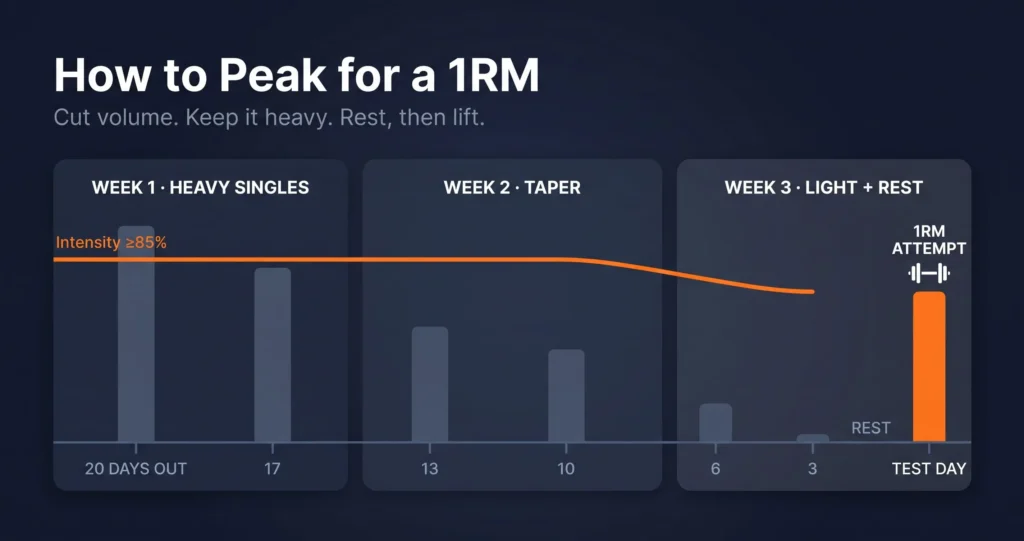
The worked example is a lifter with a 405 lb estimated squat 1RM who tests on a Saturday, counted as day 0. Each row of the 3-week peak below is one squat session, and the week-by-week reasoning follows.
| Days Out | Session | Sets × Reps @ %1RM | Load (405 lb e1RM) | Purpose |
| 20 | Week 1, Mon | 1 × 1 @ 90% + 3 × 3 @ 85% | 365 / 345 lb | Heavy single practice, last real volume |
| 17 | Week 1, Thu | 1 × 1 @ 92.5% + 2 × 3 @ 85% | 375 / 345 lb | Heavier singles start dropping |
| 13 | Week 2, Mon | 1 × 1 @ 95% + 2 × 2 @ 85% | 385 / 345 lb | Heaviest single of the peak |
| 10 | Week 2, Thu | 1 × 1 @ 90% + 2 × 2 @ 80% | 365 / 325 lb | Last heavy squat; rehearse the opener. |
| 6 | Week 3, Mon | 3 × 2 @ 75%, fast | 305 lb | Keep the groove, build bar speed. |
| 3 | Week 3, Wed | 2 × 1 @ 70% | 285 lb | Last session; then rest |
| 0 | Test day | Opener → second → third | 370 → 390 → 410 lb | See the attempt table below. |
Loads rounded to the nearest 5 lb. Squat reps drop from 17 in week 1 to 10 in week 2 (about a 40% cut) and 8 in week 3, while every session touches 85% or more until day 10. Run your own numbers with the 1RM percentage calculator.
The plan in five steps:
- Set your peak targets from a current estimated 1RM, or from a training max at 90% of it
- Run week 1 with a heavy single at 90–92.5% plus 2–3 back-off sets of 3 at 85%
- Taper in week 2: cut total reps by 40–60%, keep at least one set at 85% or more each session, and do your last heavy squat about 10 days out
- Go light in week 3 with two short sessions at 70–75%, then take 2–3 full rest days
- On test day, open at about 91% of your e1RM, take about 96% second, and attempt 100–102% third
Week 1: Heavy Singles, Last Real Volume
Week 1 of peaking for a 1RM sets your targets and gives you the last real volume of the cycle. Base the percentages on your estimated 1RM, or on a training max at 90% of it if recent sessions have been up and down; the training max calculator gives you that number. Each session opens with a heavy single at 90–92.5%, followed by 2–3 back-off triples at 85%.
That single should move at a speed you’d call fast for heavy.
If 90% grinds in week 1, lower the targets now.
Waiting until test day to find out your numbers were too high costs you the attempt. Bench and deadlift follow the same pattern at their own training frequency.
Week 2: The Taper
Week 2 is where peaking for a 1RM becomes a true taper: total reps drop 40–60% while every session still touches 85% or more, in line with both Bosquet 2007 and Travis 2020. The heaviest single of the whole peak, 95%, lands 13 days out. The last heavy squat comes at day 10, which leaves time for that fatigue to clear before the attempt.
Pritchard et al. (2019) tested a taper like this in 11 strength-trained men (Pritchard et al., 2019). A taper week that cut volume by about 70% improved jump power, and the higher-intensity version tended to come out ahead. The authors concluded: “A strength-training taper with volume reductions had a positive effect on power, with a tendency for the higher-intensity taper to produce more favorable changes in strength and power.”
It’s a small crossover study, and it measured jumps and isometric pulls rather than 1RMs. Read it as support for keeping the bar heavy during the taper, with no specific 1RM gain attached.
Week 3: Light Work and Rest
Week 3, the final week of peaking for a 1RM, is two short, light sessions at 70–75% to keep the movement pattern sharp, followed by 2–3 full rest days. Travis et al. (2020) summarize the evidence this way. Strength athletes tapering for powerlifting:
“should (1) reduce training volume by approximately 30–70%, (2) maintain training intensity ≥85% 1RM, or (3) use either an exponential or step taper model to manipulate the distribution of work over a 1–2 week period, followed by (4) a short-term training cessation spanning 2–7 days.”
Two to seven days of rest is the window to stay inside. Test-week sessions should leave you feeling like you did almost nothing; if you’re sore two days later, the light day was too heavy. Sleep is the one recovery lever worth guarding this week, and the recovery guides cover how much you need.
When to Do Your Last Heavy Session for Each Lift
When you peak for a 1RM, deadlifts need the longest gap between the last heavy session and a max attempt, the bench press needs the shortest, and the squat falls in between. These timings come from long-standing powerlifting practice, and no controlled study has tested them.
| Lift | Last Heavy Single | Last Session of Any Kind | Why |
| Squat | 7–10 days out | 3–4 days out | Large muscle mass; moderate recovery cost |
| Bench press | 4–7 days out | 2–3 days out | Smallest muscle mass; recovers fastest |
| Deadlift | 10–14 days out | 5–7 days out | Highest systemic and lower-back fatigue |
Common powerlifting practice, not study-derived limits. Stronger lifters usually need the longer end of each range.
Deadlift fatigue sits mostly in the lower back and grip, and it clears slowly, so heavy pulling stops 10–14 days out. The bench press uses the least muscle mass of the three lifts and bounces back fastest. Use these ranges as the starting point for your first peak, then shift them based on how each lift felt on test day.
How to Choose Your Attempts on Test Day?
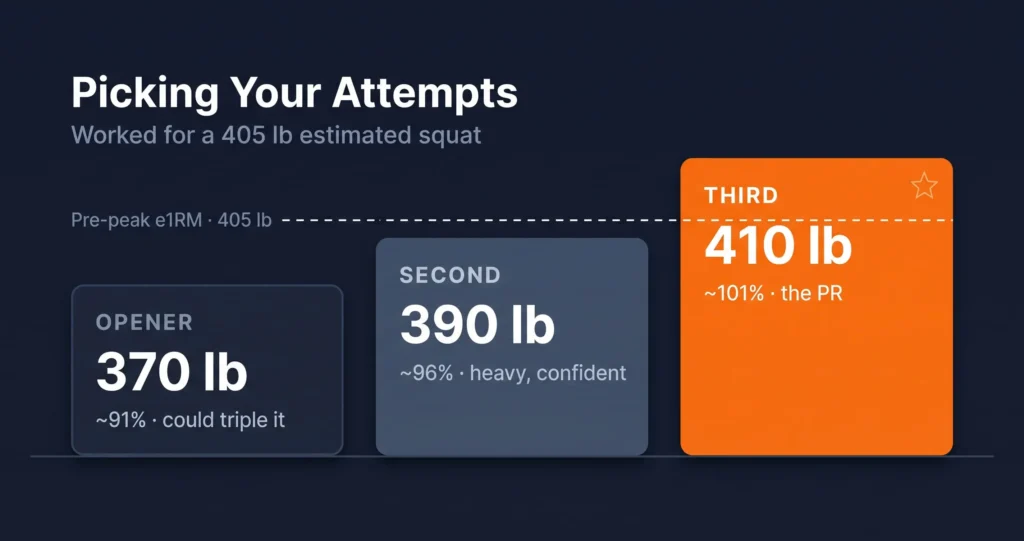
Attempt selection is the payoff of peaking for a 1RM. Start with an opener you could triple on a bad day, about 90–92% of your estimated 1RM. Take a confident second at about 96–97%, and save the third for the PR.
| Attempt | % of e1RM | Load | What It Should Feel Like |
| Opener | ~91% | 370 lb | A weight you could triple on a bad day |
| Second | ~96% | 390 lb | Heavy but confident; sets up the third |
| Third | ~101% | 410 lb | The PR. Choose it based on how the second moved |
A well-run peak typically adds a few percent, so a third at 100–102% of your pre-peak estimate is ambitious but realistic. Calculate your own attempts with the 1RM percentage calculator.
Warm up with progressively heavier singles; the warm-up ramp in the calculator builds those jumps for you, working up from the bar to your opener. Give yourself 3–5 minutes between attempts. If the second moves slowly, make the third a small 5 lb PR instead of a big jump. For the full test-day safety setup, including spotters and safety arms, read how to test your one rep max safely.
Common Peaking Mistakes
Most failed attempts to peak for a 1RM come down to doing too much too late, or changing something that was already working.
Peak weeks are for rehearsal.
- Testing your max in the gym a week before the real attempt. A true 1RM grinder 7 days out puts back the fatigue the taper just removed.
- Cutting intensity along with volume. Two weeks of light weights leave you rusty on heavy singles, and the research points to keeping loads at 85% or more while the sets come down.
- Resting 10 days “to be safe.” Travis et al. (2020) report that rest beyond 7 days costs 1–4% of maximal strength, which on a 405 lb squat is 4–16 lb and can be your whole PR.
- Opening too heavy. An opener at 95% turns a bad warm-up day into a missed attempt, while 90–92% gets a lift on the board and builds confidence.
- Changing equipment or technique during the peak. A new belt or a wider stance three weeks out adds a variable you’ve never tested under a max.
How to Use the Calculators to Plan Your Peak
Planning how to peak for a 1RM starts with the one rep max calculator: enter your best recent hard set to get the estimated 1RM every number in the peak depends on. If your training has been inconsistent, run that estimate through the training max calculator for more conservative percentages. The 1RM percentage calculator turns those percentages into each session’s loads and your three attempts. On test day, the warm-up ramp builds your jumps from the empty bar up to the opener.
Frequently Asked Questions
The first step to peak for a 1RM is putting the test date on the calendar. Count back 20 days, and that’s your first heavy-single session. Then get an honest estimated 1RM this week from a hard set of 3–5 reps, because every load in the peak and every attempt on the day comes from that one number. A guessed max wastes three weeks of careful work.