Deadlift Muscles Worked: What the Deadlift Trains
Ask a few lifters what the deadlift trains, and you’ll hear “back,” “hamstrings,” or just “everything.” The deadlift muscles’ work list is long, but the muscles don’t share the same job, and they don’t peak at the same moment of the pull.
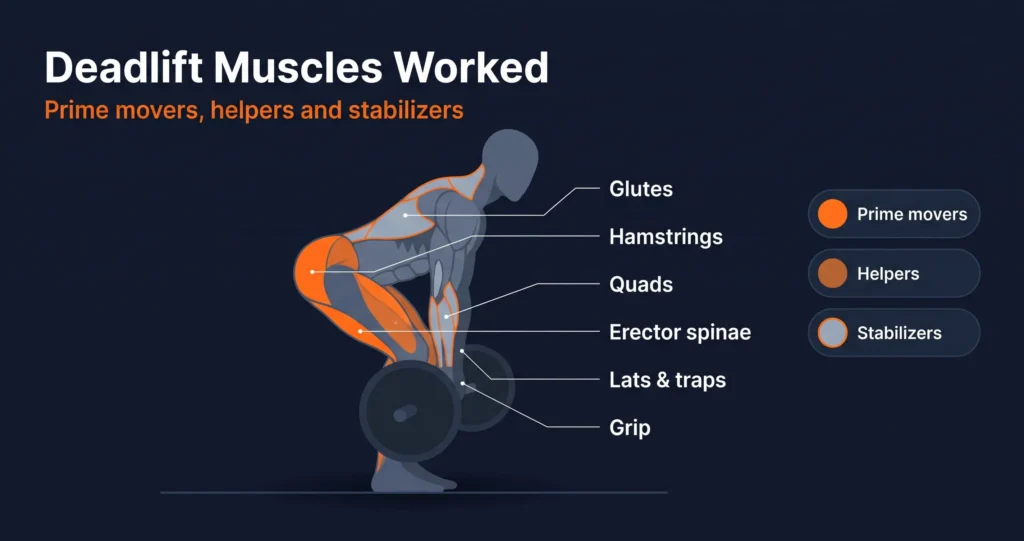
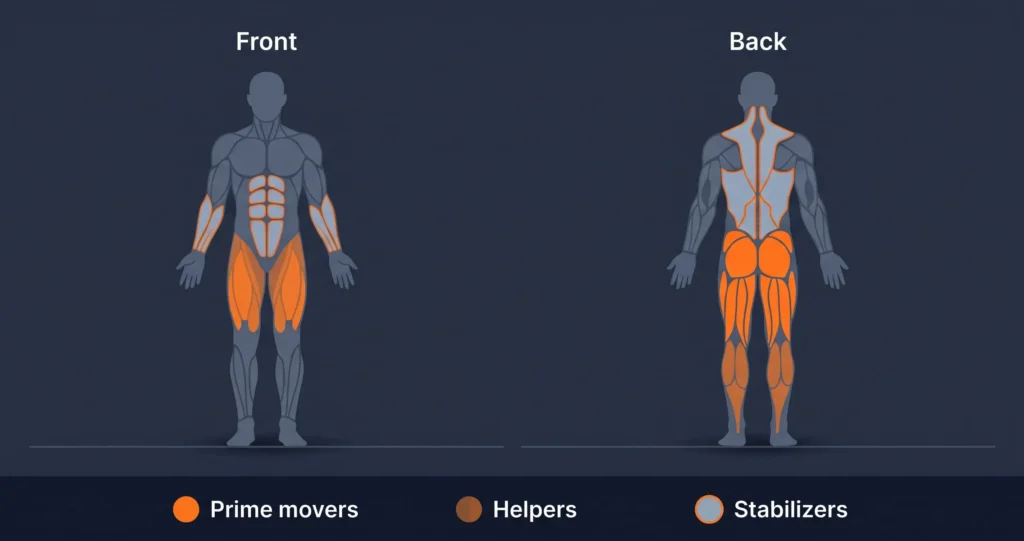
The deadlift works your glutes and hamstrings as prime movers, your quads and adductors as helpers, and your erector spinae, lats, traps, core, and grip as stabilizers. The mix changes by phase and style: a trap bar raised vastus lateralis EMG about 24% over a straight bar in one study.
For the basics of what a deadlift is, and for the other lifts, see the lift-specific 1RM guides. Below, each muscle is sorted by role, by phase of the pull and by variation.
What Muscles Does a Deadlift Work?
The deadlift is a compound lift that trains nearly every muscle from your calves to your hands. Your glutes and hamstrings straighten the hips while your quads straighten the knees off the floor. Everything above the hips, from the back muscles to your grip, holds the bar and your spine in position.
| Muscle group | Role | What it does in the deadlift |
| Gluteus maximus | Prime mover | Extends the hips; drives the lockout |
| Hamstrings | Prime mover | Extends the hips; works harder as the knees straighten |
| Quadriceps | Helper (synergist) | Extends the knees to break the bar off the floor |
| Adductors | Helper | Assist hip extension; more involved in wide stances |
| Calves (gastrocnemius, soleus) | Helper | Stabilize the ankle and knee; gastrocnemius peaks mid-pull. |
| Erector spinae | Stabilizer | Holds the spine neutral against the load |
| Lats and trapezius | Stabilizer | Keep the bar close; hold the shoulders in place. |
| Core and forearm flexors | Stabilizer | Brace the trunk; hold the bar (grip). |
Deadlift muscles grouped by role. Roles summarized from EMG findings in Escamilla et al. (2002), Camara et al. (2016), and Moreira et al. (2023).
Prime Movers: Glutes and Hamstrings
In the deadlift, the glutes and hamstrings create the hip extension that carries the bar from knee height to lockout. They don’t peak together. Rafael Escamilla’s EMG study found hamstring activity was greater when the knees were nearly straight, while gluteus maximus activity was greater when the knees were more bent, lower in the pull (Escamilla et al., 2002). Your glutes do more early; your hamstrings take over as you stand up.
Helpers: Quads, Adductors, and Calves
The deadlift’s helper muscles do most of their work before the bar reaches your knees. Your quads straighten the knees to break the bar off the floor, and Vinícius Moreira’s group found the rectus femoris most active at lift-off (Moreira et al., 2023). The adductors (inner thighs) assist hip extension and get more involved the wider your stance. The calves contribute quietly: Moreira measured the highest lateral gastrocnemius activation at mid-pull, and Escamilla found medial gastrocnemius activity higher in conventional pulls than in sumo.
Stabilizers: Back, Lats, Traps, Core, and Grip
The deadlift’s stabilizers don’t move the bar much, but you can’t pull more than they can hold.
Erector Spinae
The erector spinae, the long muscles either side of your lower spine, work mostly isometrically in the deadlift: they fight to keep your spine neutral while the hips do the moving. Moreira found erector spinae activation highest at lift-off, where your trunk leans furthest forward and the load pulls hardest on your back. Your lower back gets trained hard without the spine moving much.
That’s the whole point.
Lats and Trapezius
In the deadlift, the lats pull the bar into your body so it stays over mid-foot; that’s the standard coaching explanation rather than a measured result. The traps hold your shoulders against a load that wants to drag them down. Escamilla found middle trapezius activity greater lower in the pull and upper trapezius activity greater near lockout.
Core and Grip
Your core braces your trunk through every deadlift rep. In Escamilla’s study, wearing a belt increased rectus abdominis activity and reduced external oblique activity, so a belt changes how your abs work rather than switching them off. Grip, meaning the forearm flexors, holds the bar, and for many lifters it’s the first thing to fail on a near-max pull.
For a quick scan, the deadlift muscle groups are:
- Glutes
- Hamstrings
- Quads, mainly off the floor
- Lower back (erector spinae)
- Upper back: lats and traps
- Forearms and core, which hold the bar and brace the trunk
Deadlift Muscles Worked by Phase
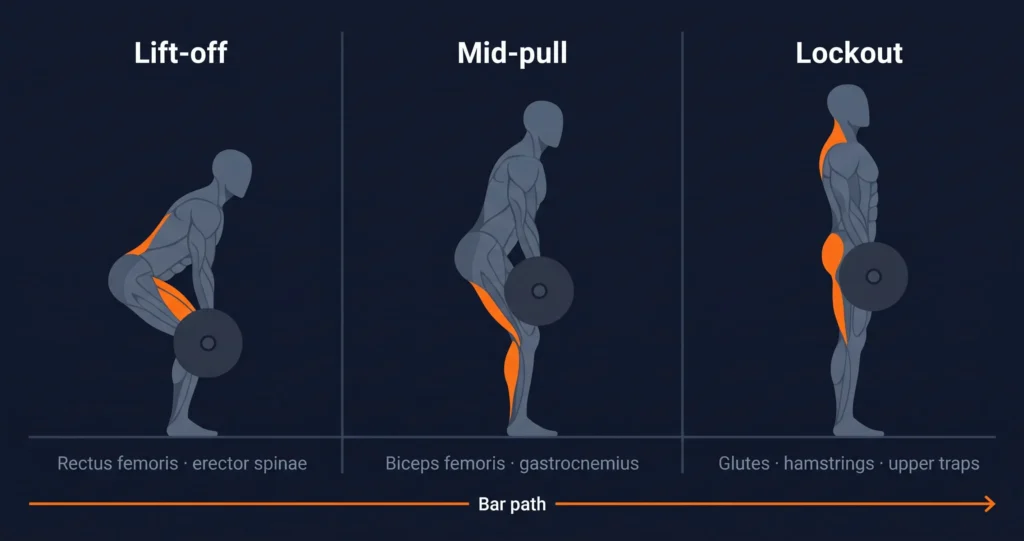
The deadlift muscles worked change as the bar rises. Quads and lower back work hardest breaking the bar off the floor, hamstrings and calves peak as the bar passes the knees, and glutes, hamstrings and upper traps finish the lockout.
| Phase | Bar position | Highest-activation muscles | Study |
| Lift-off | Leaving the floor | Rectus femoris, erector spinae | Moreira et al., 2023 |
| Lower pull | Floor to below knee | Quadriceps, gluteus maximus, paraspinals, middle trapezius | Escamilla et al., 2002 |
| Mid-pull | Around the knees | Biceps femoris, lateral gastrocnemius | Moreira et al., 2023 |
| Upper pull / lockout | Above the knee to standing | Hamstrings, gastrocnemius, upper trapezius | Escamilla et al., 2002 |
Peak muscle activation by deadlift phase. Moreira used isometric pulls at three positions (n = 20 experienced men); Escamilla measured 16 muscles across knee-angle intervals (n = 13 collegiate football players). Methods differ, so treat the table as a pattern, not exact values.
Off the Floor
Off the floor, the deadlift leans hardest on your quads and erector spinae, because your knees are at their most bent and your trunk leans furthest forward. Moreira’s team summed it up: “The RF and ERE showed greater activation in the lift-off position, while in the mid-pull position, there was greater activation of the BF and GAL muscles.” Maximal force, though, was highest at mid-pull. Those were isometric pulls against a fixed bar, so they show where you can push hardest, not where a moving bar slows.
Past the Knees
Once the bar passes your knees, the deadlift hands the job to the hip extensors. With the knees nearly straight, the quads have less to do, and the outer hamstring (biceps femoris) and calves peak. It’s also where conventional deadlifters most often stall.
Lockout
At lockout, the deadlift finishes with your glutes completing hip extension while the hamstrings stay switched on and your upper traps hold the shoulders back. Competition rules require knees locked at the finish, which is why a soft lockout gets red-lighted.
What EMG Can and Can’t Tell You
Every deadlift muscle claim on this page comes from electromyography (EMG), which measures electrical activity in a muscle. It doesn’t measure growth or strength gains, so a higher EMG reading doesn’t guarantee more muscle. The studies also used different loads: 12 RM sets in Escamilla, 65% and 85% of 1RM in Camara, and isometric pulls in Moreira. Compare the patterns across studies. Don’t compare the numbers.
How Each Deadlift Variation Changes the Muscles Worked?
Every deadlift variation trains the same muscle groups; stance and bar shape shift the work between your knees and your hips. Sumo and trap bar pulls use more quads, the conventional straight-bar pull uses more hamstrings and calves, and Romanian and stiff-leg versions put almost everything on the hips and hamstrings.
| Variation | More emphasis on | Less emphasis on | Evidence |
| Conventional | Hamstrings (biceps femoris), medial gastrocnemius, erector spinae | Quads (vs sumo and trap bar) | Escamilla 2002; Camara 2016 |
| Sumo | Vastus medialis, vastus lateralis, tibialis anterior | Medial gastrocnemius | Escamilla 2002 |
| Trap (hex) bar | Vastus lateralis (~24% higher EMG) | Biceps femoris (~13% lower), erector spinae on the way down (~18% lower) | Camara 2016 |
| Romanian | Semitendinosus (vs stiff-leg) | Gluteus maximus (vs stiff-leg) | Coratella 2022 |
| Stiff-leg | Gluteus maximus (vs Romanian) | Semitendinosus (vs Romanian) | Coratella 2022 |
Muscle emphasis by deadlift variation. Trap-bar percentages calculated from Camara et al.’s (2016) reported normalized EMG means (vastus lateralis concentric 1.199 vs 0.968; biceps femoris concentric 0.723 vs 0.835; erector spinae eccentric 0.614 vs 0.753, hex vs straight).
Conventional Deadlift
The conventional deadlift, a straight bar with your hands just outside your knees, puts the highest demand on the hamstrings and calves of any floor pull. Kevin Camara’s group found the straight bar produced more biceps femoris activity on the way up and more erector spinae activity on the way down than a hex bar (Camara et al., 2016).
Sumo Deadlift
The sumo deadlift uses a wide stance with your hands inside your knees. In Escamilla’s study of 13 football players lifting 12RM loads, sumo produced significantly more activity in two of the quads (vastus medialis and vastus lateralis) and in the tibialis anterior at the front of the shin, while conventional produced more in the medial gastrocnemius. The authors didn’t crown a winner: “Athletes may choose to employ either the sumo or conventional deadlift style, depending on which muscles are considered most important according to their training protocols.” Keep in mind these were football players on 12RM sets, not powerlifters near a max.
Trap Bar Deadlift
On a trap bar deadlift you stand inside the bar, so the load sits in line with your body instead of in front of it. Camara tested 20 men with deadlifting experience: the hex bar produced higher vastus lateralis activity, and the straight bar higher biceps femoris activity. Their 1RMs were almost identical, 181.4 kg straight and 181.1 kg hex (about 400 lb vs 399 lb).
At submaximal loads the hex bar also gave higher peak force, power and velocity. The authors concluded that “These results suggest that the barbells led to different patterns of muscle activation and that the hexagonal barbell may be more effective at developing maximal force, power, and velocity.”
Romanian and Stiff-Leg Deadlifts
Romanian and stiff-leg deadlifts both start standing and lower the bar without touching the floor, so they’re hip-hinge accessories rather than floor pulls. Giuseppe Coratella’s team tested 10 competitive bodybuilders at 80% of 1RM and found “the RD appeared to target the semitendinosus more than the SD, while the latter excited the gluteus maximus more.” (Coratella et al., 2022) A step-Romanian, standing on a box, raised posterior-chain activity overall. Ten very experienced lifters is a small sample.
Hamstring Deadlift: Which Version Hits Hamstrings Most?
For a hamstring deadlift, pick a straight-bar version over a trap bar, and a Romanian deadlift if you want the inner hamstring (semitendinosus) in particular. Camara measured about 16% higher biceps femoris activity on the straight bar than on the hex bar, and Coratella found the Romanian deadlift hit the semitendinosus harder than the stiff-leg version.
The conventional deadlift is a hamstring exercise. The Romanian deadlift is a better one, because the hamstrings stay under tension through a longer range on every rep and the bar never rests on the floor. That reasoning is coaching logic, not a measured result, but it’s why most programs give the hamstring slot to RDLs.
Use Your Deadlift 1RM to Find the Weak Muscle
Where a heavy deadlift slows down or fails points to the muscle group limiting your 1RM. Stalling off the floor usually means quads or lower back; stalling at the knees points to hamstrings and hips; failing at lockout points to glutes, upper back or grip. That’s the practical use of what your one-rep max measures: it tells you how strong the weakest link in the chain is.
| Where the bar slows or stops | Likely limiting muscles | Common accessory |
| Won’t leave the floor | Quads, erector spinae | Deficit deadlift, front squat |
| Just below the knees | Quads → hamstrings handoff, lats | Paused deadlift below the knee |
| At or just above the knees | Hamstrings, glutes | Romanian deadlift |
| Near lockout | Glutes, upper back | Hip thrust, rack pull, good morning |
| Bar slips from the hands | Grip (forearm flexors) | Heavy holds, double-overhand warm-ups |
Sticking-point guide based on the phase-activation pattern in the deadlift phase table. This is a coaching heuristic, not a diagnostic test; technique faults can cause the same stalls.
Worked Example: Finding the Weak Link at 320 lb
Take a 180 lb man who deadlifts 275 lb for 5 reps. The Epley formula puts his estimated 1RM at 320 lb (320.8, rounded to the nearest 5 lb); you can get the same figure from a deadlift 1RM estimate or the one rep max calculator.
He works up to a heavy single at 95% of that: 320 × 0.95 = 304, rounded to 305 lb. The bar leaves the floor fast, then slows hard at the knees.
Matched against the sticking-point table, that stall points at the hip extensors, his hamstrings and glutes. So he adds Romanian deadlifts as the accessory, applies progressive overload to them for a training block, and re-estimates his deadlift 1RM from a fresh set of 5 at the end.
Why Variation 1RMs Differ
Your trap bar, sumo and conventional deadlift maxes won’t always match, because each variation loads the muscles differently. Camara’s group happened to line up at about 400 lb on both bars, but many lifters pull noticeably more on one. Estimate each variation separately.
Common Mistakes About Deadlift Muscles
Most mistakes about deadlift muscles come from reading too much into which muscle “gets hit”:
- Treating the deadlift as a back-day lift. Your glutes and hamstrings move the bar; your back holds it.
- Picking a variation for “more muscles”. Every version trains the same groups and only shifts the emphasis.
- Reading EMG percentages as growth guarantees.
- Skipping direct grip work, then blaming your hamstrings for a missed lockout.
- Pulling the same way every session. Rotate variations to work different weak points, and balance training volume vs intensity across the week.
Frequently Asked Questions
On your next heavy deadlift set, watch or film exactly where the bar slows down. Match that spot to the sticking-point table, pick the accessory beside it, and enter the set for a deadlift 1RM estimate so you have a starting number. Run the accessory for a block, test a new set of 5, and see whether the number and the stall point both moved.