Equipped vs. Raw Powerlifting: Key Differences
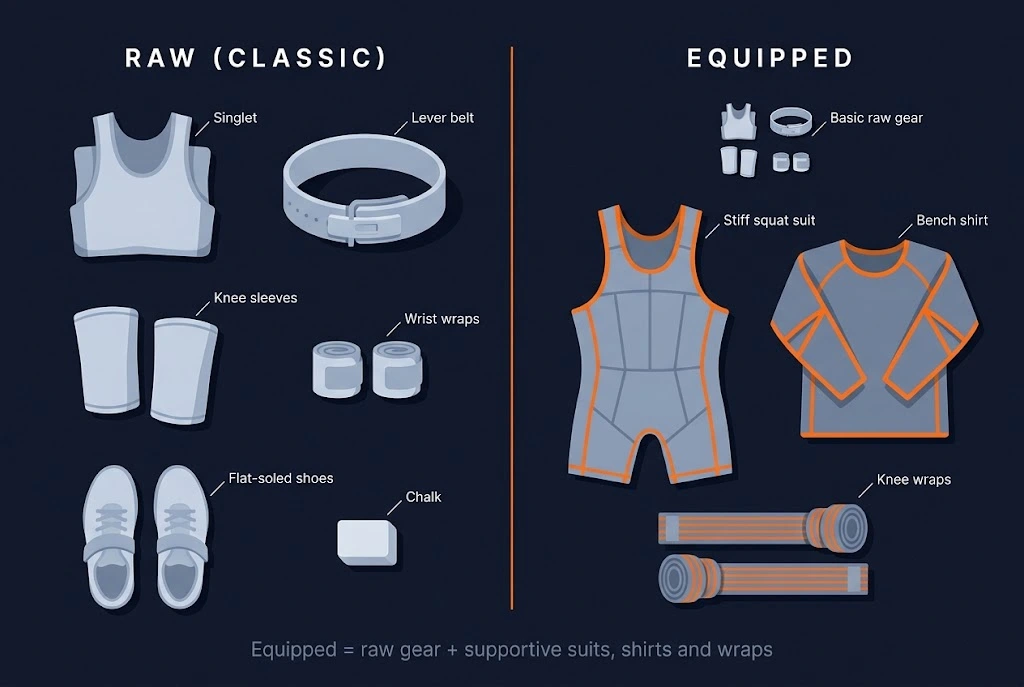
The registration form asks you to tick “Classic” or “Equipped,” and the difference decides what you’re allowed to wear. Here’s equipped vs. raw powerlifting in one paragraph. Raw, which the IPF calls Classic, lets you lift in a belt, knee sleeves, and wrist wraps. Equipped adds stiff supportive gear (a squat suit, a bench shirt, a deadlift suit, and knee wraps) that lets you move more weight. The two are scored and ranked separately. If you’re still learning how a meet works, start with What Is Powerlifting?
At a glance:
- Raw (Classic) allows a belt, knee sleeves, and wrist wraps, so the weight moves mostly under your own power
- Single-ply equipped adds a squat suit, bench shirt, deadlift suit, and knee wraps
- Multi-ply uses layered, stiffer gear and is run by some non-IPF federations, never the IPF
- Gear usually adds most to the bench and squat and least to the deadlift
- Raw and equipped totals are ranked separately, and IPF GL Points use a different formula for each
- Most lifters, and nearly all first-timers, compete raw
Equipped vs Raw Powerlifting at a Glance
| Raw (Classic) | Equipped (single-ply) | Multi-ply | |
| Supportive gear | Belt, knee sleeves, wrist wraps | Raw gear plus squat suit, bench shirt, deadlift suit, knee wraps | Layered suits and shirts in stiffer materials |
| Effect on weights | Baseline | Heavier, especially bench and squat | Heaviest |
| Learning curve | Low | High; using the gear is its own skill. | Very high |
| Cost of kit | Low | Higher, with suits and shirts on top of raw gear | Highest |
| Offered by the IPF | Yes. | Yes. | No |
| Popularity | Largest by far | Smaller, specialist | Smallest |
| Good for a first meet | Yes. | Rarely | No |
Raw, single-ply, and multi-ply powerlifting compared. Exact gear rules vary by federation.
What Is Raw (Classic) Powerlifting?
Raw means the bar moves mainly because of your muscles. The belt, sleeves, and wraps you’re allowed give some support, but not much: a belt helps you brace, sleeves keep your knees warm and add a little rebound, and wrist wraps stop your wrists from folding under a heavy bench. None of them stores much energy on the way down.
The IPF calls this category “Classic.” Raw has grown into the sport’s main event over the past fifteen years. In IPF competition data from 2012 to 2022, classic results outnumbered equipped ones by roughly three to five times, depending on sex.
What Is Equipped Powerlifting?
Equipped lifters compete in tight garments made from stiff, heavy fabric. Single-ply gear uses one layer of that fabric, while multi-ply stacks several layers and adds stiffer materials. Each piece does a different job.
Squat Suit
A one-piece suit that pulls tighter the deeper you sit. As you descend, it stretches across your hips and thighs, then helps drive you out of the hole. Most equipped squatters pair it with knee wraps. The suit changes technique: stances usually get wider, and hitting depth takes practice because the suit resists every centimeter.
Bench Shirt
A shirt so tight it fights the bar on the way down, then adds a rebound off the chest. Lifters have to learn their “touch point,” the exact spot the bar meets the chest, and a lot of shirt training uses boards to control that depth. Many lifters find the bench gains more from gear than any other lift.
Deadlift Suit and Knee Wraps
A deadlift suit mainly helps break the bar off the floor, and plenty of lifters gain less from it than they expect. Knee wraps are long elastic strips wound hard around the knee. They store far more energy than sleeves, which is why they’re banned in IPF Classic.
How Supportive Equipment Actually Works
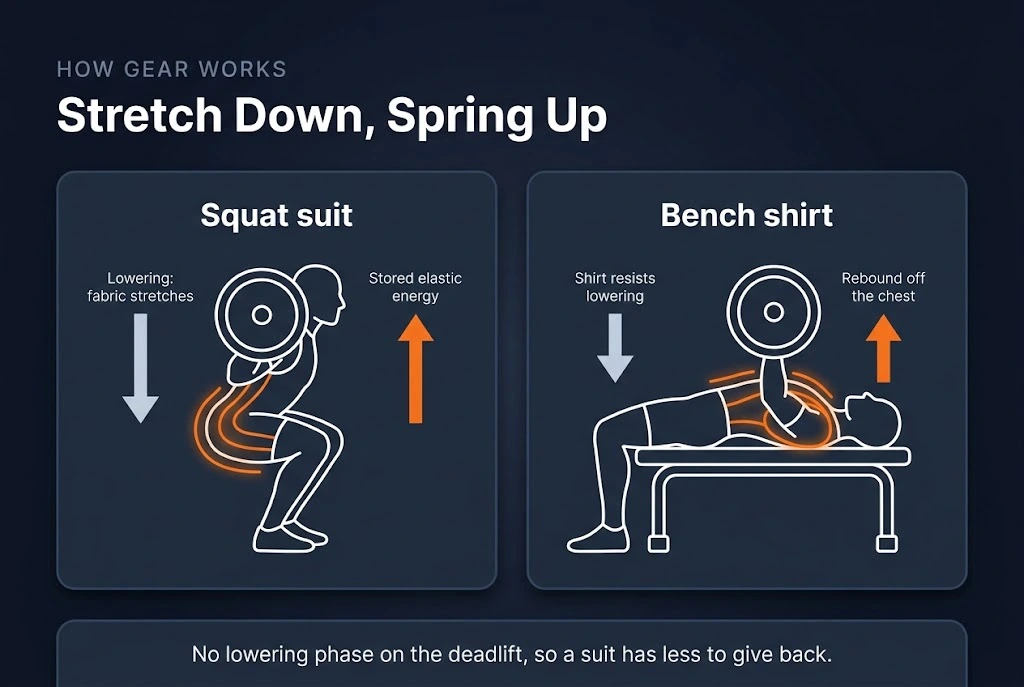
Stiff fabric works like a spring. As you lower the bar, the suit or shirt stretches and resists. At the bottom of the lift, that stored tension pushes back, adding force at exactly the point where you’re weakest.
That’s why gear helps the squat and bench more than the deadlift. Both start at the top with a lowering phase that loads the fabric before you push. The deadlift starts from a dead stop on the floor, so there’s no lowering phase to store energy, and a deadlift suit can only help by tightening as you set your position.
Gear is also awkward to live with. A competition suit can take two people and several minutes to pull on. It restricts your range of motion, so you need to train in it regularly to groove the movement. Equipped lifting is its own skill set, with its own coaching and its own training cycles.
Equipment Rules: What’s Allowed in Each Category
| Item | Classic / Raw | Equipped |
| Singlet | Yes. | Yes, the squat suit doubles as the singlet. |
| Belt | Yes. | Yes. |
| Wrist wraps | Yes. | Yes. |
| Knee sleeves | Yes. | Yes. |
| Knee wraps | No | Yes. |
| Squat suit | No | Yes. |
| Bench shirt | No | Yes. |
| Deadlift suit | No | Yes. |
Gear allowed under typical IPF-style rules. Other federations differ; check your rulebook.
In the IPF, every supportive item has to be a model from the federation’s approved list, and an unlisted belt or suit fails equipment check no matter how good it is. Read the IPF technical rules and approved equipment list before you spend money; other federations keep their own lists.
Same Words, Different Meanings Across Federations
| Term | What it usually means | Watch out for |
| Classic (IPF) | Raw with knee sleeves, no wraps | Matches “Raw” in many US federations |
| Raw | Belt, sleeves, wrist wraps | Exact rules vary by federation |
| Classic Raw (USPA) | Raw plus knee wraps | Not the same as IPF Classic |
| Raw with wraps | Raw plus knee wraps | Used by several non-IPF federations |
| Equipped / Single-ply | One-layer suits and shirts | The IPF’s only equipped category |
| Multi-ply | Several layers, stiffer materials | Not offered by the IPF |
Equipment category names and what they mean in different federations.
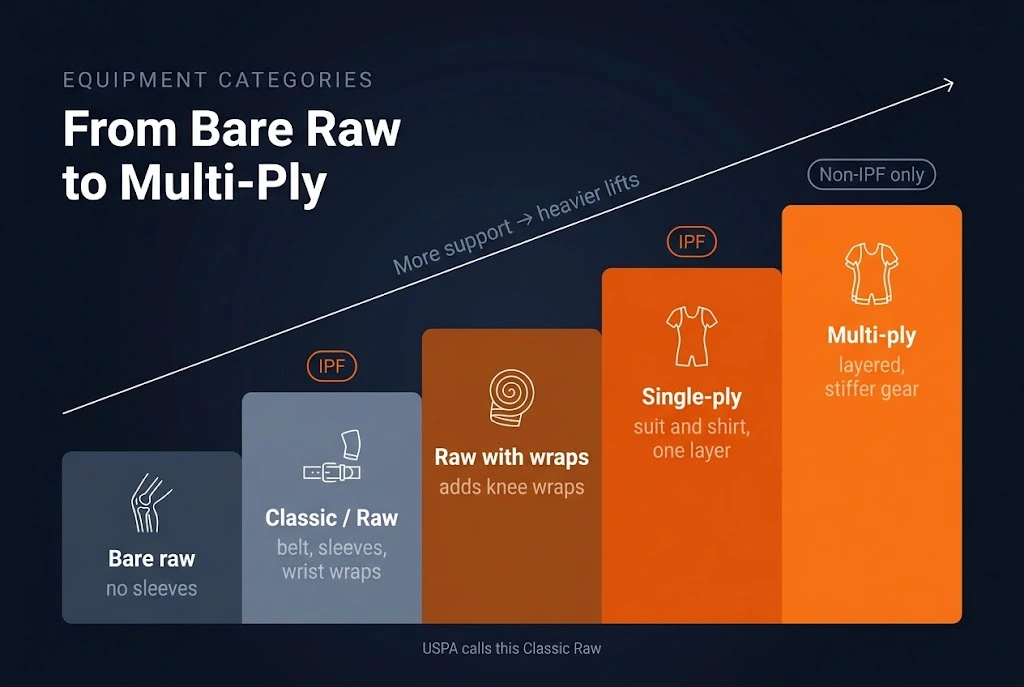
This is the trap. The word “Classic” means sleeves only in the IPF and sleeves plus wraps in USPA, so a lifter who trains in wraps for a USPA Classic Raw meet can’t use them at an IPF Classic meet. Read the category definition in your federation’s rulebook before you register, and if you’re still choosing between organizations, powerlifting federations compares the main ones.
How Much Does Equipment Add?
Which Lifts Gain the Most
Across competition data, gear tends to add the most to the bench and squat and the least to the deadlift. You can see it in how totals are split. Equipped lifters carry a larger share of their total in the squat and bench than classic lifters do, as a 2023 study of classic and equipped lift ratios found across tens of thousands of IPF results.
Treat that as a tendency. How much a lifter gains depends on the gear, its fit, time spent training in it, and build, so some get big bench gains and almost nothing from a deadlift suit, while others find the opposite.
Same Lifter, Both Categories
| Squat | Bench | Deadlift | Total | IPF GL | |
| Classic | 155 kg | 90 kg | 165 kg | 410 kg | 64.04 |
| Equipped | 180 kg | 95 kg | 195 kg | 470 kg | 63.02 |
| Difference | +25 kg | +5 kg | +30 kg | +60 kg | −1.02 |
One Masters 2 lifter in the 66 kg class who entered both categories at an IPF-affiliated national masters meet in July 2026. Source: OpenPowerlifting.
Gear added 60 kg to this lifter’s total, yet the two GL scores are almost identical. That’s by design: IPF GL Points use separate formulas for classic and equipped, so an equipped total isn’t rewarded just for being heavier. This lifter also gained most on the deadlift and least on the bench, which shows how individual the carryover can be.
Scoring and Records: Kept Separate
Raw and equipped totals are never ranked against each other. Every federation keeps separate records for each category, and a meet with both runs separate placings. The IPF goes a step further for Best Lifter, with separate GL formulas so a classic lifter and an equipped lifter are each judged against their own category.
The older coefficient systems don’t make that distinction. A DOTS score or Wilks score runs a raw total and an equipped total through the same equation, so a 450 DOTS equipped means less than a 450 DOTS raw. Compare those scores only within one category. When you project a total in the Powerlifting Total Calculator, use the level tables for the category you’ll actually enter.
Pros and Cons of Each
| Raw | Equipped | |
| Pros | Cheap and simple; biggest competitive fields; strength carries over to general training | Heaviest weights in the sport; a distinct technical challenge; smaller fields |
| Cons | Lower absolute numbers | Costly gear; steep learning curve; needs helpers to suit up; gear fit changes with bodyweight |
Trade-offs between raw and equipped powerlifting.
On paper that looks even. For most lifters it isn’t: raw’s low cost and big fields make it the better place to spend your first few years, and equipped lifting suits people who enjoy technique for its own sake.
Which Should You Choose?
| If you | Choose |
| Are you entering your first meet? | Raw / Classic |
| Want the biggest competitive field | Raw / Classic |
| Love technical skills and very heavy weights. | Equipped, after building a raw base |
| Want to lift in the IPF’s equipped division | Single-ply equipped |
| Want maximum gear | Multi-ply in a non-IPF federation |
Choosing a powerlifting equipment category by goal.
Start raw. You’ll learn the commands, the judging and your own meet-day nerves without also fighting a suit. If gear tempts you later, check these first:
- Build a solid raw base, because gear magnifies your technique and won’t fix it
- Find a coach or training partners who already lift in gear
- Budget for gear that fits and for refitting if your bodyweight changes
- Check your federation’s approved equipment list before you buy anything
Once you’ve picked a category, the first meet preparation guide covers the weeks before the platform.
Common Mistakes with Equipment Categories
The most common one is registering by name instead of by rule. “Classic” sounds like “Classic Raw,” and lifters turn up to an IPF meet with knee wraps that fail equipment check. Read the definition, not the label.
The second is buying a suit or shirt first and learning to use it later. Gear bought online without a fitting, or without someone experienced to check it, often ends up too loose to help or too tight to bench in. Equipped lifting starts with a coach, then the gear.
The third is comparing numbers across categories. An equipped 250 kg squat and a raw 220 kg squat can’t be ranked against each other, which is why records and GL formulas keep them apart.
Finally, don’t treat raw as a stepping stone. Many of the strongest lifters in the sport never wear a suit.
Using the Calculators with Raw and Equipped Lifts
The 1RM formulas behind the one rep max calculator, including Epley and Brzycki, were built from unequipped lifting. They work well for your raw training sets. They don’t transfer cleanly to equipped lifts, because a rep set in tight gear doesn’t follow the same fatigue curve: the suit or shirt helps more on early reps when it’s fresh and less as you tire.
For equipped lifting, set your targets from heavy singles and doubles done in gear. For the background on where formula estimates drift even in raw lifting, see How Accurate Are 1RM Calculators?
Frequently Asked Questions
Raw tests your muscles; equipped tests your muscles and how well you’ve mastered the gear. Start raw, learn exactly what your federation’s category names allow, and look at gear later if the technical side appeals. The Powerlifting & Competition guide shows where equipment fits among the other choices you’ll make before your first meet.