Powerlifting Weight Classes: Complete Breakdown
A 120 kg lifter who totals 700 kg and a 59 kg lifter who totals 450 kg can’t be ranked against each other on raw numbers. Powerlifting weight classes fix that by grouping lifters of similar bodyweight so totals compete on fair terms. The system runs deeper than one table, though. The IPF uses one class structure, several large federations use another, and a second layer of age divisions runs alongside every bodyweight class. This guide covers the current IPF tables, age divisions, federation differences, the weigh-in, and how to pick your class. New to the sport? Start with What Is Powerlifting?
At a glance:
- The IPF uses 8 open male classes (59 to 120+ kg) and 8 open female classes (47 to 84+ kg)
- Your class is set by bodyweight on the official scale at weigh-in, not your training weight
- Age divisions (Sub-Junior, Junior, Open, and Masters) run in parallel within every weight class
- IPF-affiliated meets weigh in 2 hours before your session; many non-IPF federations use a 24-hour weigh-in
- For your first meet, compete at your natural training bodyweight with no weight cutting
- Federations differ, so always check your federation’s current rulebook before registering
What Are Powerlifting Weight Classes, and Why Do They Exist?
Heavier lifters carry more muscle and gain a mechanical advantage under a loaded bar, so they lift more in absolute terms. Without bodyweight divisions, the heaviest athletes would win nearly every meet regardless of how strong they are for their size. Splitting competitors into classes means a lifter is ranked against others who carry a similar amount of mass, and placings within a class are decided purely by total.
A second layer sits on top of that. Bodyweight-adjusted scores such as DOTS and Wilks let organizers compare lifters across different classes, which is how Best Lifter awards and federation-wide rankings are decided. Classes settle who wins the 83 kg division; coefficient scores settle who had the strongest performance in the building.
How Bodyweight Is Determined
Your class is decided on the official scale at the weigh-in, not by what you weigh in the gym. In IPF-affiliated competition, each class is a range: the 83 kg class covers 74.01 kg to 83.00 kg, so you must weigh above the class below and at or under your class limit. If you’re over, you can usually re-weigh as many times as you need within the weigh-in window. Miss the limit by the end of that window, and the outcome depends on the meet: some local events move you up a class, while championship meets may remove you from the category entirely. Some non-IPF federations let lighter lifters enter a heavier class voluntarily, so check the rulebook.
Current IPF Powerlifting Weight Classes
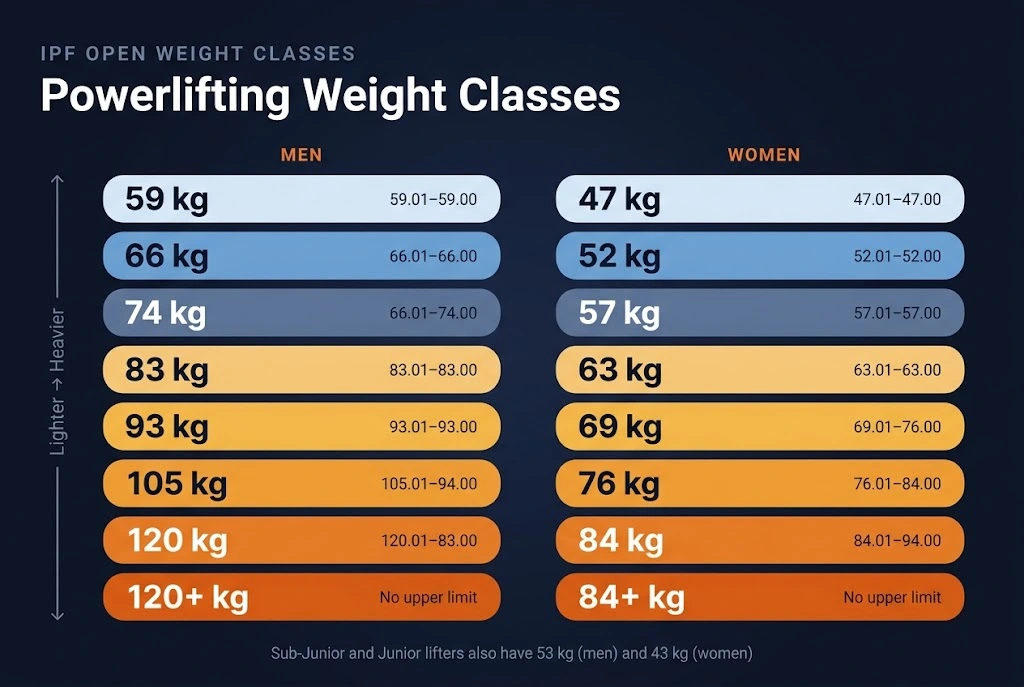
| Class | Male Limit | Female Limit | What to know |
| 1st | Up to 59 kg | Up to 47 kg | Lightest open class; DOTS matters most when comparing these lifters to the wider field. |
| 2nd | Up to 66 kg | Up to 52 kg | Deep, technically strong fields at national level |
| 3rd | Up to 74 kg | Up to 57 kg | Consistently among the most heavily entered male classes |
| 4th | Up to 83 kg | Up to 63 kg | Well attended at local and regional meets |
| 5th | Up to 93 kg | Up to 69 kg | Large fields in both sexes; a common landing spot as lifters add mass |
| 6th | Up to 105 kg | Up to 76 kg | Often where lifters settle after outgrowing the class below |
| 7th | Up to 120 kg | Up to 84 kg | Heavy-class field with high absolute totals |
| 8th | 120+ kg | 84+ kg | No upper limit; the heaviest class in the sport |
Source: International Powerlifting Federation. Sub-Junior and Junior lifters also have access to an extra light class (53 kg men, 43 kg women). Verify current rules before registering, as federations revise them periodically.
The Heaviest Class: No Upper Limit
The 120+ kg (male) and 84+ kg (female) classes are open-ended. A lifter weighing 121 kg competes on the same platform as one weighing 160 kg, and placings are decided on total alone. That gap in bodyweight makes coefficient scores especially useful for heavyweights who want a fairer read on where they rank. The DOTS Score Calculator shows how your total compares once bodyweight is factored in.
How the Weight Classes Changed from the Old System?
Search for weight classes online and you’ll find conflicting tables. The reason is history. Before 2011, IPF male classes ran 52, 56, 60, 67.5, 75, 82.5, 90, 100, 110, and 110+ kg. The IPF replaced that structure in 2011 with the current male classes, and the female classes were revised again later, when 69 kg and 76 kg replaced the old 72 kg class. Any source listing a 67.5 kg or 82.5 kg class is describing the pre-2011 system or a federation that still uses older divisions.
Age Divisions: The Other Way Competitions Are Divided
Bodyweight is one axis of competition. Age is the second. Every weight class contains lifters from several age divisions who share the same platform, but rankings and records are kept separately for each division.
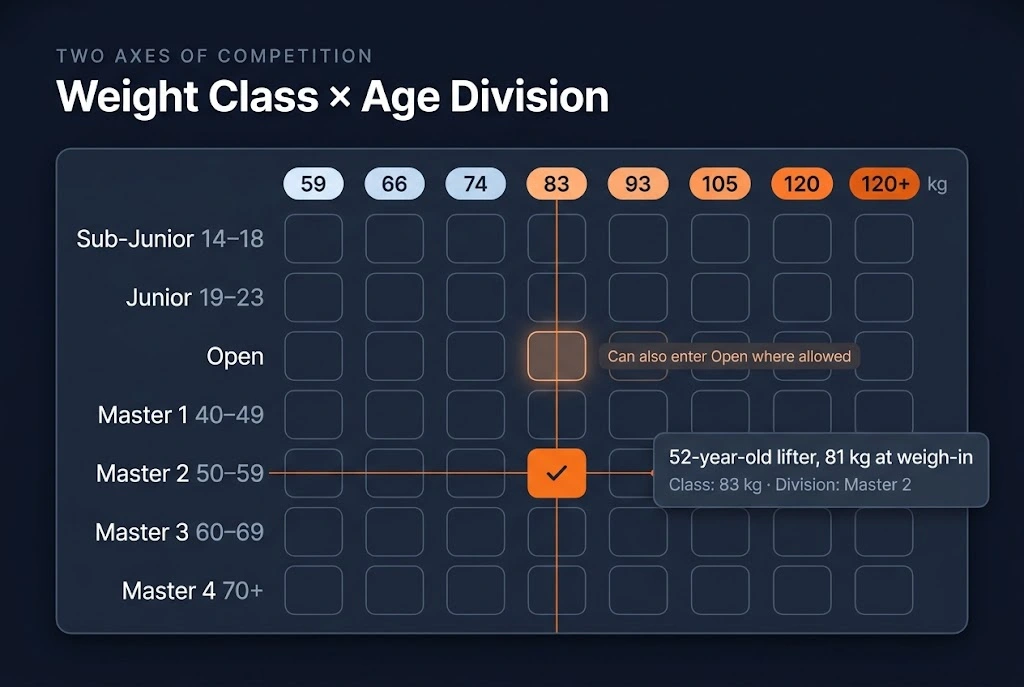
| Division | Age Range | Notes |
| Sub-Junior | 14–18 years | Own rankings and records; competes on the same platform as Open |
| Junior | 19–23 years | A full competitive division where many fast-rising athletes compete |
| Open | No age restriction | The default division and the largest field for comparison |
| Master 1 | 40–49 years | First masters bracket; highly competitive in most federations |
| Master 2 | 50–59 years | Separate records and rankings from Master 1. |
| Master 3 | 60–69 years | Smaller fields; national records often within reach |
| Master 4 | 70+ years | The oldest bracket, with its own records |
Age is usually counted by the calendar year you reach that age. Sub-Juniors and Juniors can often also enter Open, and Masters can enter Open, but no one can enter a younger division. Check your federation’s double-entry rules.
What This Means for Your Registration
Registration asks for two things: a weight class and an age division. A 22-year-old at 74 kg enters the 74 kg class in the junior division, and that total can count toward junior 74 kg rankings as well as open 74 kg rankings where double entry is allowed. Records stay separate for each division. For a first meet, most lifters simply enter Open, since it’s the default and holds the most data for comparison.
Weight Classes Across Major Federations
Many lifters hit the same snag: they see different classes on different sites. That’s because federations don’t all follow the IPF.
| Federation | Uses IPF Weight Classes? | Notes |
| IPF | ✅ Defines them | 59/66/74/83/93/105/120/120+ (M); 47/52/57/63/69/76/84/84+ (F) |
| Powerlifting America | ✅ Yes | The current IPF-affiliated US federation, formed after the 2021 split |
| USA Powerlifting (USAPL) | ✅ Same classes | Independent of the IPF since 2021, but kept the same class structure |
| USPA | ❌ Different | More granular classes closer to the old IPF system |
| WPC / GPC | ❌ Different | Own class structures, generally older and more granular |
| CPU (Canada) | ✅ Yes | IPF affiliate |
| British Powerlifting | ✅ Yes | IPF affiliate |
Always verify your specific federation’s current rulebook before registering. Classes can be revised.
The USAPL-IPF Split: Why It Matters
In 2021, the IPF ended its affiliation with USA Powerlifting (USAPL) following a policy dispute between the two organizations. USAPL continues to operate independently and remains one of the largest powerlifting organizations in the United States. Powerlifting America became the IPF’s affiliated federation in the US. For American lifters, the practical effect is simple: a route to IPF international championships now runs through Powerlifting America, and USAPL results don’t qualify for IPF events. Both organizations use the same weight classes, so the split changes your federation choice rather than your class.
For Non-IPF Federations: How to Find Your Classes
If you compete in USPA, WPC, GPC, or another non-IPF federation, set the IPF tables aside and download your federation’s current rulebook from its website. The OpenPowerlifting database collects results from hundreds of federations and lets you filter by federation, weight class, and age division. It’s the quickest way to see what totals look like in your specific class before you register.
How to Choose the Right Powerlifting Weight Class?
Knowing which class you fall into is step one. Choosing the class that serves your lifting is a separate decision, and it changes as you gain experience.
The Beginner Rule: Compete at Your Natural Training Weight
For a first meet, your class is whichever one your everyday training bodyweight falls into. Don’t cut, don’t bulk toward a heavier class, and don’t do anything deliberate to your bodyweight. That takes the scale out of the equation and leaves your attention on the lifts. Once you’ve weighed yourself on a few normal mornings, use these criteria:
- You sit more than 5 kg under the class limit: you’re comfortably in that class; your natural weight is right
- You sit within 1–2 kg of the limit: decide early whether to hold that weight or let it settle toward the class below
- You sit right at the limit: normal overnight weight loss often covers it, but confirm the weigh-in format first
- You sit just over the limit: compete in the class above, or reduce deliberately to make the lower class, which is a decision for experienced competitors
How Competitive Each Class Is?
Field depth varies by class and federation. The middle male classes (74 kg to 93 kg) tend to draw the most entries, while the lightest and heaviest classes usually have smaller fields. Bigger fields mean more competition for podium places, but placing is rarely the point of an early meet. Search the OpenPowerlifting database for recent results in your class and federation, then compare them against your projected total. For population-level context on what counts as strong for your bodyweight, see the Strength Standards guide.
Moving Up or Down a Class: The Strategic Decision
Moving up makes sense when you’re constantly fighting the scale to stay under a limit and the effort is costing you performance, or when you’ve been building mass and your total is climbing with it. Moving down makes sense when your natural weight already sits near the lower limit and dropping a little wouldn’t hurt your strength. Run the numbers before you commit. The DOTS Score Calculator and Wilks Score Calculator show how your score changes at different bodyweights, and the Powerlifting Total Calculator projects your total and competitive level at either class. Make the decision at the start of a training block, never in meet week.
The Weigh-In: How It Works and What to Expect
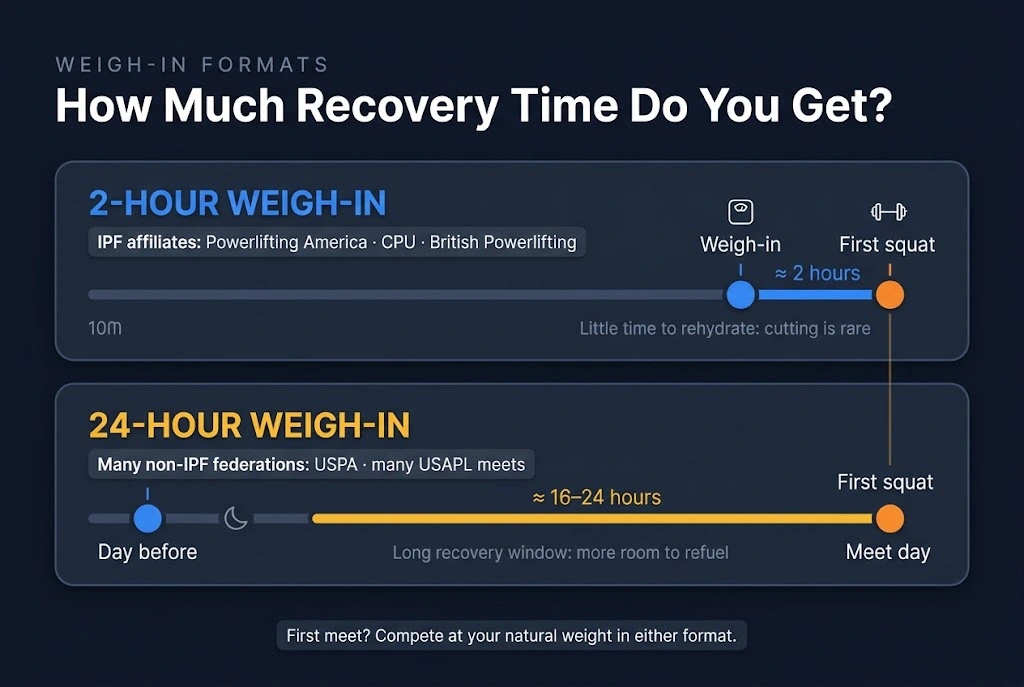
The weigh-in is where weight classes are enforced. A little operational knowledge removes most of the stress.
2-Hour vs 24-Hour Weigh-In
IPF-affiliated meets, including Powerlifting America, CPU, and British Powerlifting events, use a 2-hour weigh-in: the window opens two hours before your session starts and closes shortly before lifting begins. That leaves very little time to rehydrate, which is one reason aggressive cutting is rare at IPF meets. Many non-IPF federations, including USPA and many USAPL meets, use a 24-hour weigh-in held the day before competition, which gives lifters a long recovery window. Confirm the format when you register, because it changes how you plan the day before.
What Happens at Weigh-In: Step by Step
- Arrive during your assigned weigh-in window with your ID and federation membership card
- Step on the official scale in minimal clothing; the reading becomes your official competition bodyweight
- If you’re over, re-weigh within the same window; once the window closes, the result stands
- Submit your opening attempts for all three lifts to the meet table
- Submit your squat and bench rack heights, measured in advance at your training gym
- Have your equipment checked if inspection isn’t run separately
For the full meet-week checklist that surrounds the weigh-in, see How to Prepare for Your First Meet.
Weight Cutting in Powerlifting: What It Is and Whether You Should Do It
What Weight Cutting Means
Weight cutting means deliberately lowering bodyweight before weigh-in to make a lighter class, usually through water restriction, sweating, and reduced food intake in the final days. A lifter who walks around at 88 kg might cut to make 83 kg, weigh in, then rehydrate before lifting. The goal is to lift with the strength of the heavier bodyweight against lighter competition. How much a lifter can recover depends heavily on the weigh-in format: 24 hours allows substantial rehydration, while 2 hours allows very little.
Why Beginners Should Not Cut Weight
For a first meet, a cut adds risk without a meaningful payoff. Dehydration weakens grip and slows bar speed, food restriction disrupts sleep, and managing the scale competes for attention with everything else meet week demands. The few kilograms gained in class position don’t matter when the goal is making all nine attempts and posting a first total. Compete at your natural weight for your first several meets. Weight management is a tool for experienced lifters with a stable baseline and a reason to use it.
Para-Powerlifting Weight Classes
Para Powerlifting: Bench-Only Competition
Para powerlifting is the Paralympic form of the sport, contested on the bench press only and governed by World Para Powerlifting under the International Paralympic Committee. It uses its own ten-class structure for each sex, separate from IPF full-power classes. At the Paris 2024 Paralympics, men competed at 49, 54, 59, 65, 72, 80, 88, 97, 107, and 107+ kg, and women at 41, 45, 50, 55, 61, 67, 73, 79, 86, and 86+ kg. Don’t confuse these with IPF bench-only divisions, which use the standard IPF classes.
Bench-Only in Standard Federations
Many federations, IPF-affiliated and independent, run a bench-only division alongside full-power competition. It uses the same weight classes as full-power within that federation and is entered as a separate category. Lifters working around lower-body injuries, or those whose training centres on the bench press, often use bench-only meets as their competition format.
Frequently Asked Questions
Weight classes are what make powerlifting results comparable, and knowing how classes, age divisions, and federation rules fit together is basic preparation for any competitor. For most lifters most of the time, the right choice is simple: compete in the class your natural training bodyweight falls into. Start with the Powerlifting & Competition guide for the full competitive picture, check your bodyweight-adjusted standing with the DOTS Score Calculator, and plan meet week with How to Prepare for Your First Powerlifting Meet.