
Deload Week: When and How to Reduce Load
Your 5 × 5 at 315 felt like RPE 7 a month ago. Now the same sets feel like RPE 9, and your knees ache on the walk into the gym. That’s the point where a deload week earns its place: you back off on purpose for a few days so the work you’ve already done can show up.
A deload week is 5–7 days of deliberately easier training that cuts sets, load, or effort so accumulated fatigue can clear. In a 2024 survey of 246 competitive strength and physique athletes, the typical deload lasted 6.4 days every 5.6 weeks, with volume and load reduced but training frequency kept the same.
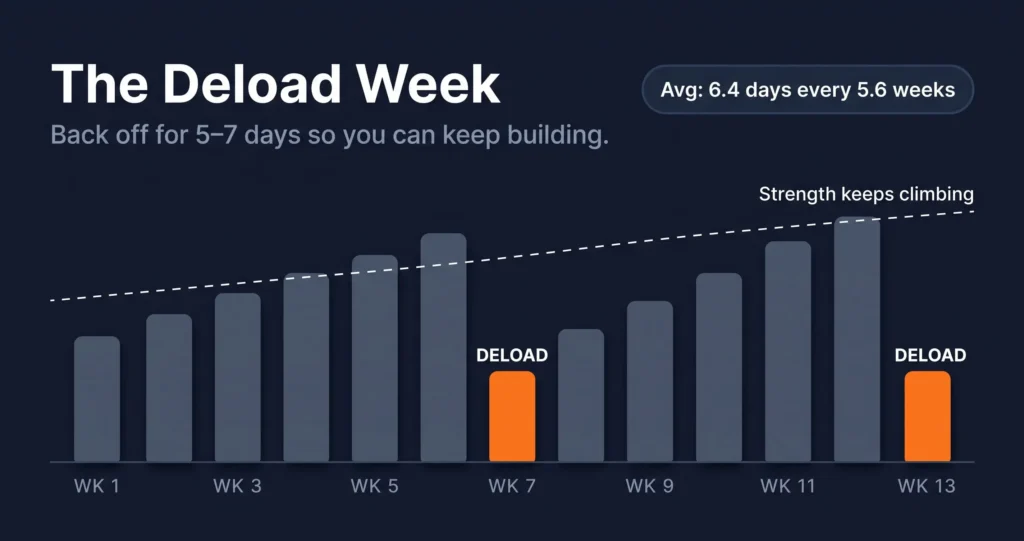
What is a Deload Week?
A deload week is a planned stretch of lighter training that lets accumulated fatigue clear before your next block. The field’s first agreed definition came from a 2023 Delphi consensus, in which expert strength and physique coaches worked through three rounds (34 started, 21 finished): “Deloading is a period of reduced training stress designed to mitigate physiological and psychological fatigue, promote recovery, and enhance preparedness for subsequent training.” (Bell et al., 2023)
Why Deloads Work
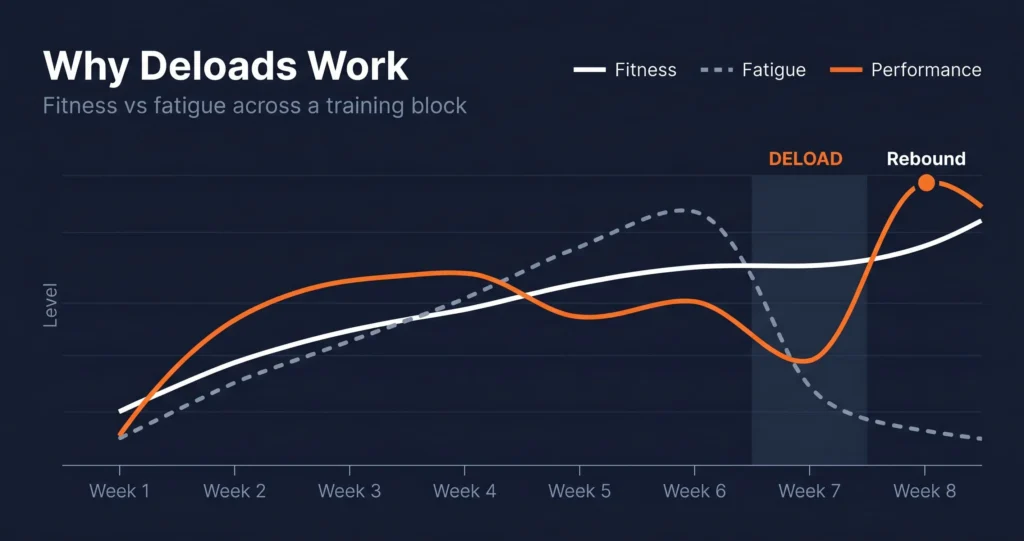
A deload week works because hard training builds fitness and fatigue together, and the two don’t fade at the same speed. Fatigue clears in days. Fitness, meaning the strength and muscle you’ve built, fades over weeks, so a short stretch of reduced work lets the fatigue drop while the strength stays put.
That gap is what keeps progressive overload going across months. You can’t add load every week indefinitely without letting your body catch up, and a lighter week every so often costs far less than a stalled block or a nagging elbow.
The consensus definition names psychological fatigue too. After five or six hard weeks, the urge to train often sags before the numbers do, and a lighter week usually brings it back.
Deload vs. Rest Week vs. Taper
A deload week keeps you training, only easier. A rest week stops training entirely, while a taper is a deload aimed at a test or meet, where volume drops but the bar stays heavy.
| Deload Week | Rest Week | Taper | |
| Do you still train? | Yes, easier sessions | No | Yes, easier sessions |
| What changes | Sets, load, or effort drop | Everything stops. | Volume drops; load usually stays heavy. |
| Typical length | 5–7 days | 5–7 days | 1–2 weeks |
| Purpose | Clear fatigue, then keep building. | Mental and physical break | Peak for a 1RM test or meet |
| Effect on strength | Maintained | Smaller gains in one RCT (Coleman 2024) | Raised for test day |
A deload is for continuing to train; a taper is for testing. Sources: Bell et al. 2023; Coleman et al. 2024.
The gap between a deload and a rest week showed up in the first controlled trial on the question. Coleman et al. (2024), a team that included Brad Schoenfeld, put 39 resistance-trained men and women through a 9-week high-volume program (Coleman et al., 2024). One group took a full week off at the midpoint; the other trained straight through. The group that stopped gained less lower-body strength, while muscle growth, local endurance, and power didn’t differ.
The authors concluded that “a 1-week deload period at the midpoint of a 9-week RT program appears to negatively influence measures of lower body muscle strength but has no effect on lower body hypertrophy, power, or local muscular endurance.” It’s one study, and its “deload” was complete rest rather than reduced training. For anyone chasing strength, the result still points one way. Train lighter instead of stopping.
When Should You Deload?
Most intermediate lifters take a deload week every 4–8 weeks on a schedule, and earlier whenever measurable signs of fatigue show up. Planned and reactive deloads work together: the competitive lifters surveyed by Rogerson et al. (2024) mostly pre-planned their deloads and often adjusted the timing to how training was going.
Planned Deloads: How Often
Planned deloads are the easiest to anchor in data. Rogerson et al. (2024) surveyed 246 competitive strength and physique athletes averaging 8 years of training, and the typical deload lasted 6.4 days every 5.6 weeks (Rogerson et al., 2024). The spread was wide (± 1.7 days and ± 2.3 weeks), so read the table as starting points built around that average rather than tested limits.
| Your Situation | Planned Deload Every | Why |
| Novice on linear progression | Not scheduled; reset 10% after 3 missed sessions | Fatigue clears between sessions at this stage. |
| Intermediate, normal life stress | 6–8 weeks | Close to the 5.6-week survey average |
| Advanced or high-volume program | 4–6 weeks | More fatigue per week of training |
| In a calorie deficit, poor sleep, or high work stress | 4–5 weeks | Recovery capacity is lower. |
| Lifters over 40 | 4–6 weeks | Most coaches shorten the cycle; adjust from there. |
Starting points based on the deloading survey of Rogerson et al. (2024), where athletes deloaded every 5.6 ± 2.3 weeks. Adjust after your first two cycles.
Novices on linear progression don’t need a scheduled deload week. Their version is the 10% reset after three missed sessions on a lift. The strength training guides cover the programs on either side of that stage.
Reactive Deloads: Signs You Need One Now
A scheduled deload week can arrive too late, so watch for signs you can measure. In the Rogerson survey, athletes deloaded reactively when performance stalled or when soreness and joint aches climbed.
- RPE drift: the same working sets (say 5 × 5 at 315 lb) have crept from RPE 7 to RPE 9 over two weeks
- Missed reps or a stalled top set in two consecutive sessions on the same lift
- Joint aches still present at the start of the next session, long after the last one ended
- Bar speed visibly slower on warm-up weights; you normally move fast
- Sleep or motivation to train dropping off for more than a few days
Two or more signs in the same week mean you deload now instead of waiting for the planned date.
Poor sleep is usually part of the picture, and the recovery guides cover how to fix it alongside the lighter week.
How to Deload: 4 Methods
You can run a deload week by cutting volume, intensity, effort, or a mix of them, and the mix is what most competitive lifters reported in Rogerson et al. (2024). Each method moves a different lever on the training volume vs intensity scale. For the effort method, the RPE calculator shows what load lands at RPE 6 for the reps you plan.
| Method | What Changes | Deload Prescription | Best For |
| Volume deload | Sets cut 40–60%; load stays | 2–3 × 5 @ 315 lb | Lifters peaking soon who want to stay used to heavy weight |
| Intensity deload | Load cut 10–20%; sets stay. | 5 × 5 @ 250–285 lb | Achy joints and connective tissue |
| Effort load | Reps per set cut, every set at RPE 6 or below | 5 × 3 @ 315 lb | Lifters who train by RPE/RIR |
| Combined deload | Sets ~40% fewer, load ~10% lighter, RPE 5–6 | 3 × 5 @ 285 lb | Most lifters, most of the time |
The combined method matches what most competitive lifters reported in Rogerson et al. (2024): fewer reps and sets, lighter loads, more reps in reserve, and the same training days. Calculate your own deload loads with the 1RM percentage calculator.
Which Deload Method to Choose
Default to the combined deload. It trims a little of everything, so no single change carries the whole reduction. Pick a volume deload when a test or meet is 2–4 weeks out and you want heavy weights to stay familiar. Pick an intensity deload when joints and tendons are the problem, since lighter loads take pressure off connective tissue while the sets keep the movement grooved. An effort deload suits lifters who already run RPE-based training.
Whichever method you pick, keep your normal training days. Rogerson et al. (2024) found athletes held training frequency steady during deloads, which keeps the habit intact and the practice on each lift going.
Swapping every exercise for a “fun” week is fine if you lift recreationally. With a strength goal, keep the main lifts in.
Sample Deload Week
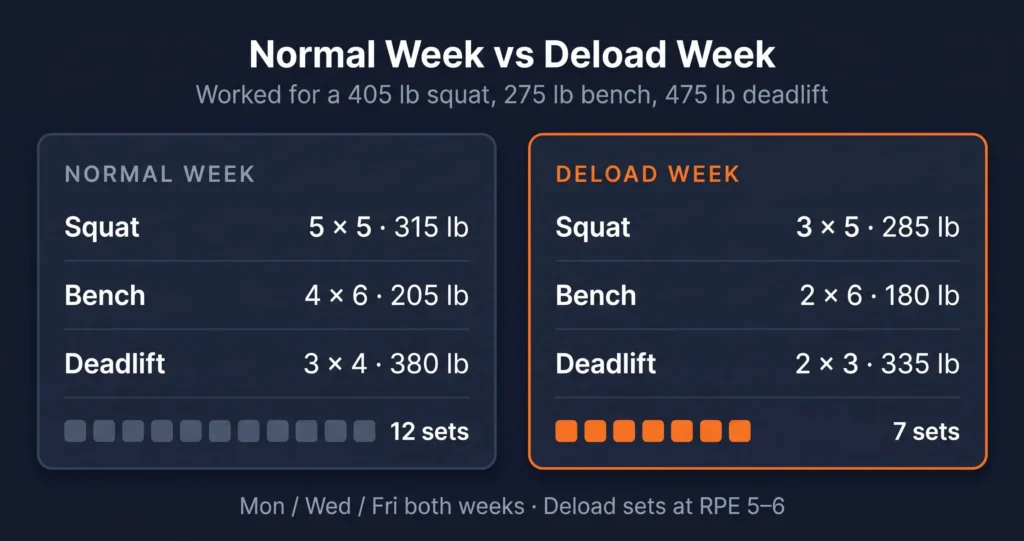
Here’s a combined deload week for a lifter with a 405 lb squat, 275 lb bench, and 475 lb deadlift who trains three days a week.
| Lift (1RM) | Normal Working Sets | Deload Working Sets | Change |
| Squat (405 lb) | 5 × 5 @ 77.5% (315 lb) | 3 × 5 @ 70% (285 lb) | 40% fewer sets, ~10% lighter |
| Bench press (275 lb) | 4 × 6 @ 75% (205 lb) | 2 × 6 @ 65% (180 lb) | 50% fewer sets, ~12% lighter |
| Deadlift (475 lb) | 3 × 4 @ 80% (380 lb) | 2 × 3 @ 70% (335 lb) | One set and one rep fewer, ~12% lighter |
| Accessories | 3–4 exercises × 3 sets | 1–2 exercises × 2 sets | Roughly half the accessory volume |
| Training days | Mon / Wed / Fri | Mon / Wed / Fri | No change |
Loads rounded to the nearest 5 lb. Every deload set should finish at RPE 5–6, with 4+ reps in reserve. Run your own numbers with the 1RM percentage calculator.
To plan your own deload week, work through these steps in order:
- Confirm your current 1RM for each main lift, or estimate it from a recent hard set with the one rep max calculator
- Keep your normal training days and exercises
- Cut working sets by 40–50% and accessories by about half
- Drop the load about 10% (to roughly 65–70% of 1RM) and stop every set at RPE 5–6
- Return to normal training the following week at your pre-deload loads, or 2.5–5% heavier if the last block ended strong
Common Deload Mistakes
Most deload weeks that don’t work fail for one of five reasons, and each one has a cost you can predict.
- Using a deload week to test a max. Grinding out a 1RM on “light week” puts back the fatigue you came to clear.
- Taking the whole week off by default. In Coleman et al. (2024), a full week off midway through a block led to smaller strength gains than training straight through.
- Deloading when there’s nothing to recover from. If your RPEs haven’t drifted and your lifts are still climbing, a scheduled deload can wait a week or two.
- Coming back too heavy. Jumping to a PR attempt in the first session back wipes out the benefit, so start at your pre-deload working weights.
- Cutting the load but still training to failure. A deload set at 70% taken to failure isn’t a deload, and every set should end with 4 or more reps in reserve.
How to Use the 1RM Percentage Calculator to Plan a Deload
Enter your current 1RM into the 1RM percentage calculator and read off 65–70% for an intensity or combined deload week. No recent max? Estimate one from a hard set with the one rep max calculator first. If you deload by effort, the RPE calculator takes a recent set and returns the load that should land at RPE 5–6 for your planned reps. Run the numbers before the week starts so every session is ready to load.