
How to Use RPE in Strength Programming
Your program says squat 5 @ RPE 8, and you’re at the rack unsure whether to load 300 or 330. Knowing how to use RPE settles that, and it tells you what to do with every set after it.
To use RPE in strength programming, rate each set by reps left in reserve: RPE 8 means two more reps were possible. Work up to a top set at the target RPE, base back-off sets on that load, and track the estimated 1RM it gives you. In one 8-week study, RPE-based loading matched or slightly beat fixed percentages.
What Is RPE in Strength Programming?
RPE in strength programming is a way of setting load by how hard a set actually is today, rated on a 1–10 scale, instead of by a percentage of a max that may be weeks old. It turns your daily readiness into the number that decides what goes on the bar.
The RIR-Based RPE Scale
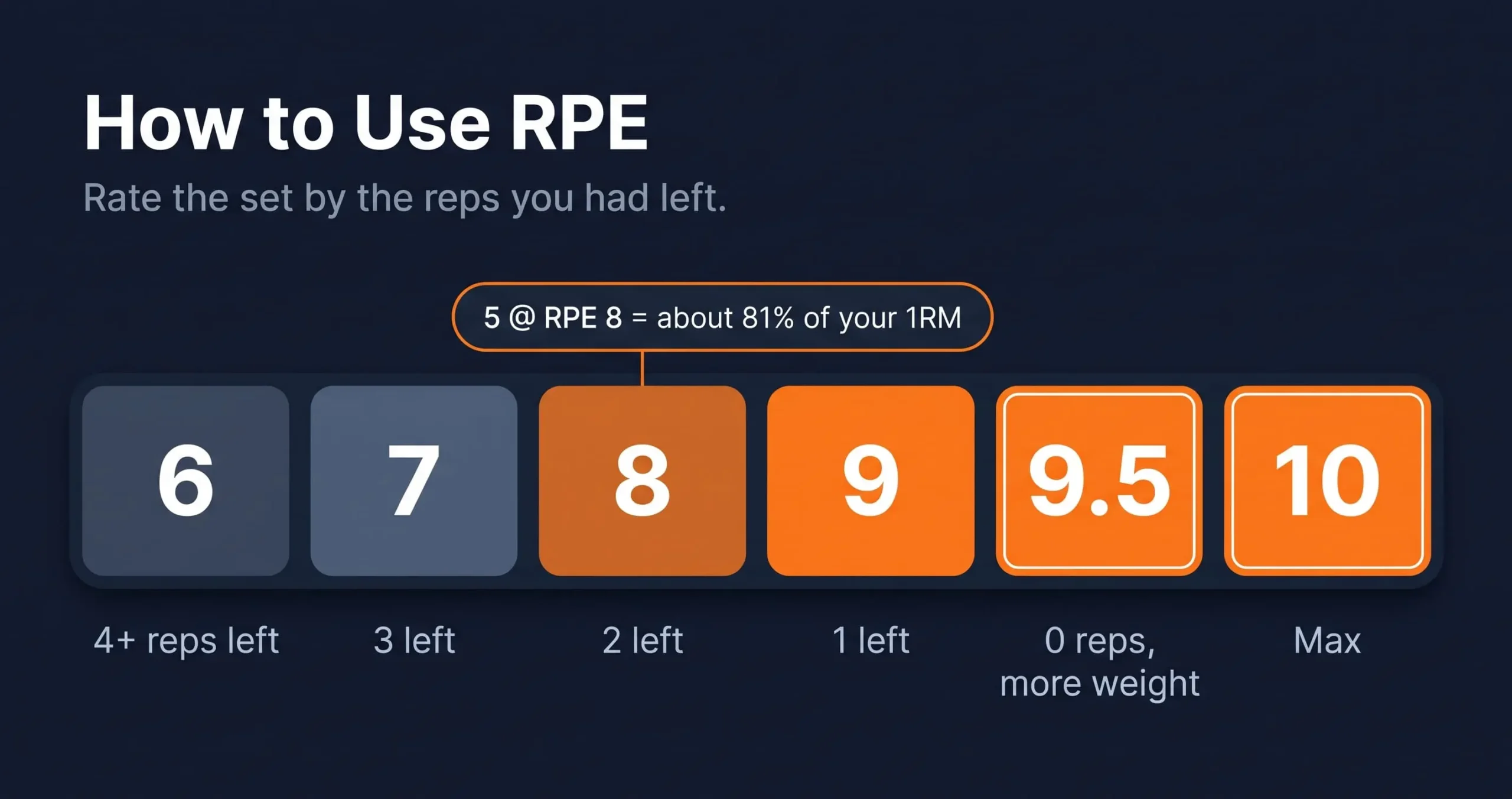
The RPE scale lifters use today started as Gunnar Borg’s measure of whole-body effort, and Mike Tuchscherer of Reactive Training Systems adapted it for powerlifting. The version in most programs ties each number to reps in reserve (RIR). Zourdos et al. (2016) validated it on the squat with 29 lifters, 15 experienced and 14 novices (Zourdos et al., 2016).
| RPE | Reps in Reserve | What the Set Felt Like |
| 10 | 0 | Maximal; no more reps or weight possible |
| 9.5 | 0 | No more reps, but slightly more weight was possible. |
| 9 | 1 | One more rep left. |
| 8.5 | 1–2 | Definitely one more, maybe two. |
| 8 | 2 | Two more reps left |
| 7 | 3 | Three more reps; bar speed is still good. |
| 5–6 | 4–6 | Warm-up or technique-practice effort |
RIR-based RPE scale as described by Zourdos et al. (2016) and Helms et al. (2016). Half-point ratings (8.5, 9.5) are common in powerlifting programs.
Bar velocity slowed as RPE climbed in that study, which is why bar speed is a useful rating cue. The authors concluded: “The RIR-based RPE scale is a practical method to regulate daily training load and provide feedback during a 1RM test.”
Why RPE Beats Fixed Percentages on Bad Days
RPE beats fixed percentages on bad days because a 1RM tested three weeks ago knows nothing about last night’s sleep or the fatigue you’ve stacked up since. An RPE target lets the load drop on a rough session and climb on a strong one, which is the whole case for learning how to use RPE.
Helms et al. (2018) tested both approaches head to head (Helms et al., 2018). Twenty-one resistance-trained men squatted and benched three times a week for 8 weeks with sets and reps matched, 11 loaded by %1RM and 10 by target RPE. Both groups gained strength and muscle, with no significant difference between them, though magnitude-based inferences gave a 79% chance of a small squat advantage for RPE.
The authors concluded, “Both loading types are effective. However, RPE-based loading may provide a small 1RM strength advantage in a majority of individuals.” With 21 trained men over 8 weeks, treat that edge as likely rather than settled.
How to Use RPE to Prescribe Training
An RPE prescription gives you reps and a target effort, such as “5 @ 8”, instead of a weight. You warm up to a top set that lands on that target, then use its load to set every back-off set for the day.
Top Sets and Back-Off Sets
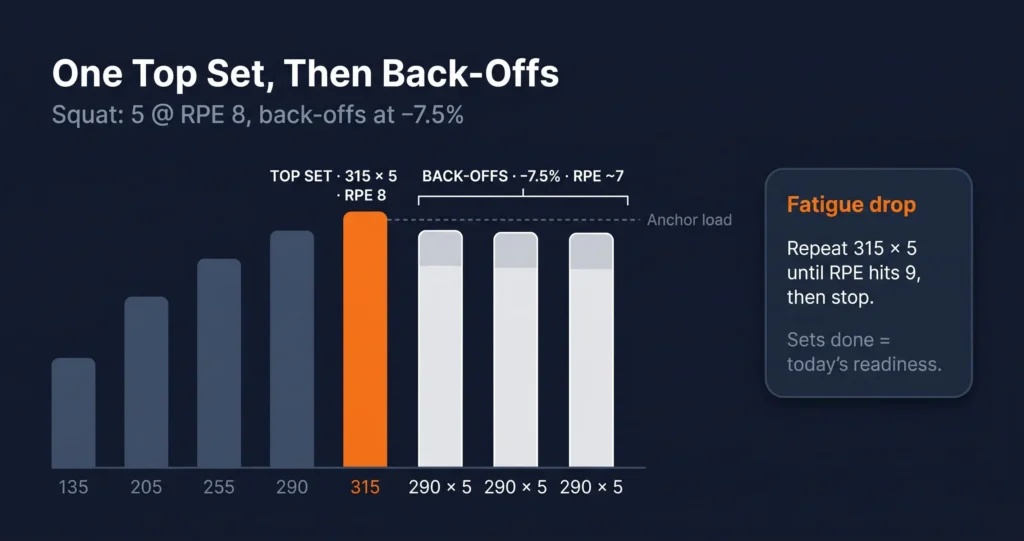
RPE sessions usually run one top set followed by back-off sets. Work up in warm-up jumps to a single top set at the target RPE; if you rated it an 8, that load is the anchor for the day. Back-offs come in two styles. Load drop is easier to run and better for most lifters; fatigue drop suits experienced raters who want the session to cap its own volume.
Load-Drop Back-Offs
A load-drop back-off takes a fixed percentage off the top set, typically 5–10%, for a set number of sets. A top set of 315 × 5 at RPE 8 becomes back-offs of 3 × 5 at 290 lb, a 7.5% drop. Those sets should land around RPE 6.5–7.5.
If the third back-off creeps up to RPE 9, the drop was too small.
Fatigue-Drop (Repeat-RPE) Back-Offs
A fatigue drop-back-off, popularized by RTS-style programs, repeats the top set’s weight (or slightly less) until the RPE climbs by a set amount, such as from 8 to 9. Then you stop. The set count becomes a readout of how recovered you are: five sets on a good day, two on a bad one. It only works with honest ratings, since one inflated number ends the session early.
RPE Targets by Training Goal
RPE targets change with what the session is for.
| Goal | Reps per Set | Target RPE | Example Prescription |
| Maximal strength | 1–5 | 7–9 | 3 × 3 @ RPE 8 |
| Strength + muscle | 5–8 | 7–8 | 4 × 6 @ RPE 7.5 |
| Muscle / volume | 8–12 | 6–8 | 3 × 10 @ RPE 7 |
| Technique / power | 1–3 | 6–7 | 6 × 2 @ RPE 6, moved fast |
| Peaking / test prep | 1–2 | 8.5–9.5 | 1 @ RPE 9 |
| Deload | 3–5 | 5–6 | 3 × 5 @ RPE 5 |
Coaching starting points, consistent with the RPE ranges used in RPE-based programs such as Helms et al. (2018). Adjust after two or three weeks of logged sessions.
Heavy, low-rep strength work sits at RPE 7–9. Volume work sits lower, at 6–8, because stacking more sets near failure piles up fatigue without a matching payoff, the trade-off behind training volume vs intensity. Peaking singles go to 9–9.5, and true RPE 10s are saved for tests.
Almost no programming week needs an RPE 10.
Converting RPE into a Load
Converting RPE into a load starts with reps to failure: reps done plus reps in reserve. Our calculator’s Epley formula then gives %1RM = 1 ÷ (1 + reps to failure ÷ 30), with a single at RPE 10 set at 100%. So 5 reps @ RPE 8 is about 81% of your 1RM.
| RPE | 1 rep | 3 reps | 5 reps | 8 reps |
| 10 | 100% | 90.9% | 85.7% | 78.9% |
| 9 | 93.8% | 88.2% | 83.3% | 76.9% |
| 8 | 90.9% | 85.7% | 81.1% | 75.0% |
| 7 | 88.2% | 83.3% | 78.9% | 73.2% |
| 6 | 85.7% | 81.1% | 76.9% | 71.4% |
Calculated by onerepmaxcalculators.com from the Epley formula (reps to failure = reps + RIR). Published charts vary by 1–2%. Get exact loads with the RPE calculator.
Use the chart for a starting weight, and let the RPE you rate decide the rest. The RPE calculator runs the conversion for any rep count, and the 1RM percentage calculator turns a percentage into bar weights. The rep max equivalency chart shows the same relationship for sets taken to failure.
Worked Example: Four Weeks of RPE-Based Squats
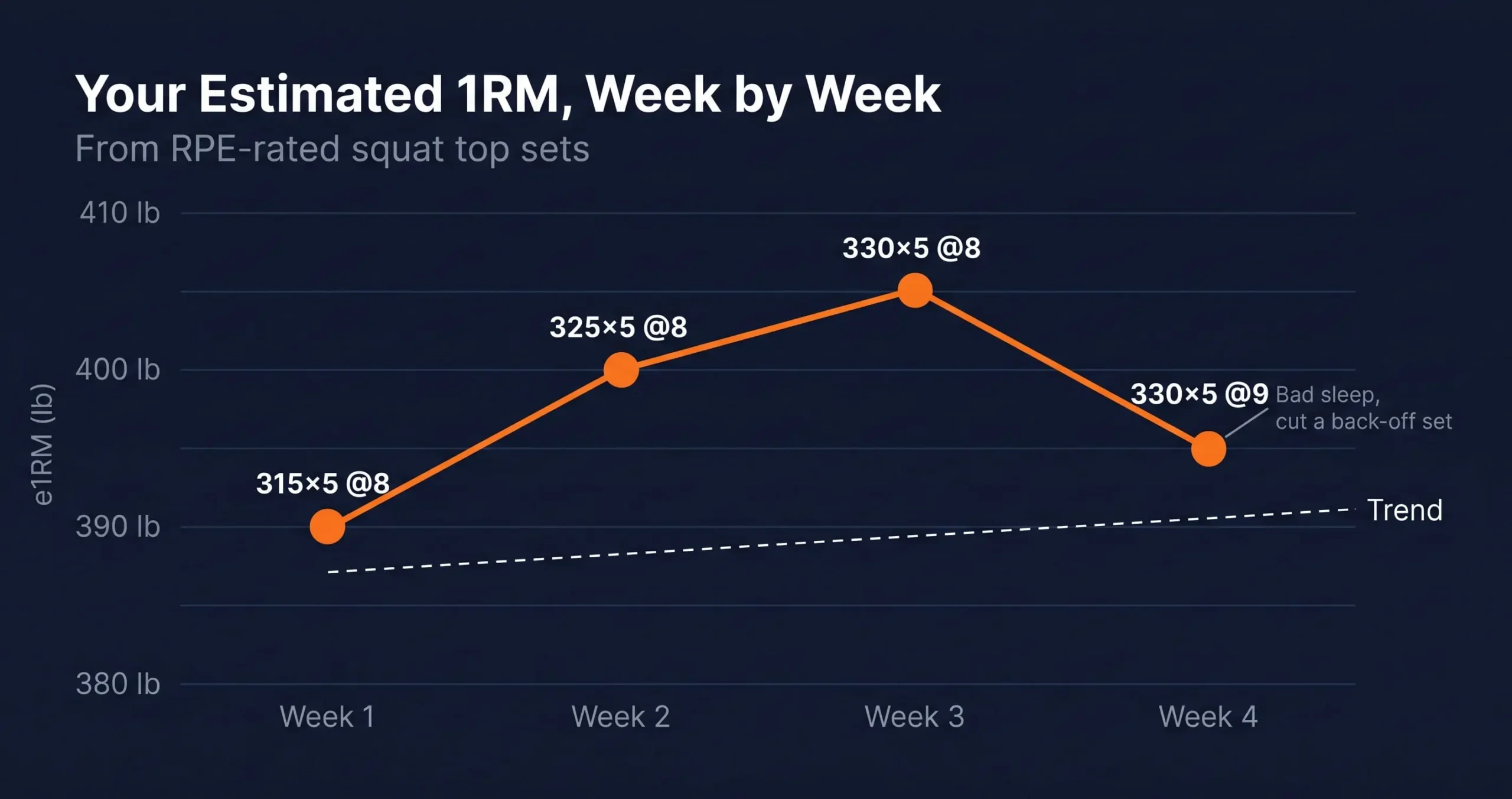
This RPE worked example follows one lifter whose squat is prescribed as 1 × 5 at RPE 8, then 3 × 5 back-offs 7.5% lighter, once a week for four weeks. It includes a bad night before week 4.
| Week | Top Set (Rated) | Estimated 1RM | Back-Off Sets | Note |
| 1 | 315 × 5 @ RPE 8 | ~390 lb | 3 × 5 @ 290 lb | Baseline |
| 2 | 325 × 5 @ RPE 8 | ~400 lb | 3 × 5 @ 300 lb | Felt strong; added 10 lb. |
| 3 | 330 × 5 @ RPE 8 | ~405 lb | 3 × 5 @ 305 lb | Steady progress |
| 4 | 330 × 5 @ RPE 9 | ~395 lb | 2 × 5 @ 295 lb | Bad sleep; cut a back-off set. |
e1RM = weight × (1 + (reps + RIR) ÷ 30), rounded to the nearest 5 lb. Back-offs are 7.5% below the top set (10% on the bad day). Calculate your own with the RPE calculator.
Finding Today’s Top Set
Finding a top set at a target RPE starts from a conservative guess. Warm-ups show you the bar speed, and the top set’s rating confirms the load.
- Estimate a starting weight from your e1RM and the RPE chart. For 5 @ RPE 8 with a 390 lb e1RM: 390 × 81.1% ≈ 315 lb
- Warm up in 3–5 jumps, watching bar speed on the last two
- Do the top set, then rate it within 10 seconds: how many more clean reps were there?
- If the rating was off by a full point, adjust the load 2–4% and run the back-off sets from there. Note the miss for next week
Estimating Your 1RM From an RPE Set
An RPE-rated top set gives you an estimated 1RM without maxing out. Add the reps you did to the reps you had left, then apply the Epley: 315 × 5 at RPE 8 means 7 reps to failure, and 315 × (1 + 7 ÷ 30) = 388.5, or about 390 lb. Log weight × (1 + (reps + RIR) ÷ 30) after every top set, and you build a strength trend from normal training. The RPE calculator handles that step, and the one rep max calculator compares the estimate across formulas.
Judge the e1RM trend over 3–4 weeks, never a single session.
One bad day isn’t a lost week.
Progressing Week to Week
Progressing on RPE comes down to one rule applied to the top set’s rating. A half point or more under target: add 5–10 lb next week. On target: add 5 lb or repeat. Over target: repeat or drop 5 lb.
In the worked example, weeks 1–3 climb from an e1RM of about 390 lb to 405. Week 2’s last warm-up moved unusually fast, so the lifter jumped 10 lb instead of 5, and the RPE 8 rating confirmed the call. After a bad night in week 4, 330 × 5 came in at RPE 9, the e1RM dipped to about 395, and the lifter cut a back-off set instead of grinding. That’s autoregulation doing its job.
RPE still needs the load to trend up across a block, or it’s training by feel with no progressive overload behind it.
How Accurate Is RPE?
Lifters rate RPE fairly accurately, though not perfectly. Halperin et al. (2022) pooled 12 studies and 414 participants and found lifters underpredicted reps to failure by 0.95 reps on average, with large variation between studies (Halperin et al., 2022). In practice, you’ll usually have about one more rep in you than you think. Ratings got sharper near failure and on sets of 12 reps or fewer, and training status made no meaningful difference.
The authors summed it up: “Prediction accuracies can be improved if they are provided closer to task failure, when using heavier loads, or in later sets. ” Zourdos et al. (2016) add one wrinkle: experienced squatters rated their 1RM attempts as harder than novices did, which suggests novices hadn’t yet learned what a true max feels like.
RPE is reliable enough to program with, especially on heavy sets of 1–6 reps, as long as you read any single rating as an estimate within about one rep.
How to Get Better at Rating RPE
Rating RPE well is a skill, and these habits close the roughly one-rep gap Halperin’s team found:
- Rate within 10 seconds of racking the bar, before the effort fades from memory
- Start by rating only heavy sets of 1–6 reps, where predictions are most accurate
- Film your top sets; a slowing last rep is the clearest RPE 8–9 cue
- Once a month, take one set to a true RPE 10 on a safe lift with safeties set, to recalibrate what “no reps left” feels like
- Log the rating next to weight and reps every session, so the pattern shows over weeks
Who Should (and Shouldn’t) Program with RPE
Programming with RPE pays off most for intermediates who’ve stalled on fixed loads and for lifters whose sleep or work stress makes recovery unpredictable. Powerlifters running undulating or peaking blocks use it heavily too.
Novices should run fixed-load linear progression and practice rating RPE alongside it, without letting the ratings set their loads yet. Their ratings are less calibrated, and they don’t need autoregulation yet. The strength training guides cover the programs that come before RPE-based training.
Common RPE Programming Mistakes
Most RPE programs that stall trace back to how the sets were rated.
- Rating ego instead of effort. Calling a grinder an RPE 8 because 8 was the target inflates your e1RM and next week’s loads.
- Learning RPE on high-rep sets. Accuracy drops above about 12 reps (Halperin 2022), so start on heavy triples and fives.
- Never going heavier on good days. Autoregulation works in both directions: if 315 × 5 moves at RPE 7, the program wants more weight.
- Rating every session an RPE 9. Living near the top of the scale means you’ve skipped the easier weeks that make the heavy ones work; that’s what a deload week is for.
- Ignoring the e1RM trend. The single-session number swings; the 3–4 week trend tells you whether the program is working.
How to Use the RPE Calculator in Your Program
The RPE calculator is the quickest way to use RPE in a program, and it works in both directions. Enter a set you’ve done along with its RPE to get an estimated 1RM, or enter your e1RM with a target like 5 @ RPE 8 to get today’s starting load. Use the 1RM percentage calculator to set back-off weights from the top set, and the one rep max calculator to compare your estimate across formulas.
Frequently Asked Questions
The fastest way to learn how to use RPE is to start logging it. Next session, rate every top set within 10 seconds of racking it and write it down as weight × reps @ RPE. After two weeks, run those sets through the RPE calculator and let the e1RM trend set your loads. If the trend is still flat after four weeks, film your next top set and check your ratings.