How to Prepare for Your First Powerlifting Meet
Every detail of a first powerlifting meet is learnable before you step on the platform. Lifters who struggle at their first meet almost always struggle over logistics, not strength: wrong weigh-in time, openers that were too heavy, and commands they didn’t know. This guide covers the complete preparation sequence: a 12-week timeline, attempt selection, equipment, the mock meet strategy, meet day nutrition, and what to do after the platform. If you’re still building your 1RM foundation, see 1RM for Beginners first.
At a glance: the first meet preparation checklist:
- ✅ Register for a meet at least 12 weeks out
- ✅ Confirm your weight class and commit to competing at your natural training weight
- ✅ Have all equipment approved before meet day: never use untested gear in competition
- ✅ Run a mock meet in training 3–4 weeks before the real one
- ✅ Choose conservative openers: weights you’ve done for a triple in training
- ✅ Bring food for a full day: meets run 6–10 hours
- ✅ Know the commands for all three lifts before you step on the platform
The 12-Week Preparation Timeline
Everything in this guide has a place in the calendar below. The first decision is the most important one: register early. A meet date on the calendar anchors the training block and forces every other preparation task to start on time. Search the OpenPowerlifting database to see results for your weight class at the local meets you’re considering, then register for the one that fits your 12-week window.
| Week | Phase | Key Milestone |
| 12 | Registration | Find and register for a meet. Check the federation’s rulebook. Order singlet and confirm equipment. |
| 10 | Foundation | Establish your training max using the Training Max Calculator. Confirm your weight class at natural bodyweight. |
| 8 | Build | Increase intensity. Accessory volume reduces. Begin practising lifts with commands and pause on bench. |
| 6 | Peak Start | True peaking begins. Intensity rises to 90–97% of training max on competition lifts. Volume drops significantly. |
| 4 | Mock Meet | Run a full mock meet (see section below). Finalise opening attempts from mock meet performance. |
| 3 | Equipment | Have all equipment inspected by a coach or experienced lifter. Confirm rack heights for squat and bench. |
| 2 | Deload | Significant volume reduction. Intensity stays moderate (75–85%). Goal: arrive fresh, not fitter. |
| 1 | Meet Week | Final session Monday or Tuesday: very light (5–6 reps at 70%). Weigh-in. Submit attempt card. |
| 0 | Meet Day | See the Meet Day section below. |
No weight cutting for a first meet. Register at your natural training bodyweight. That alone removes an entire category of risk.
Choosing Your Attempts: The Most Important Pre-Meet Decision
Attempt selection is the most consequential decision a first-time competitor makes. A well-chosen opener produces a clean total and a confident meet. A poorly chosen opener can produce a bomb-out before the bench press starts.
The Conservative Opener Rule: Non-Negotiable for a First Meet
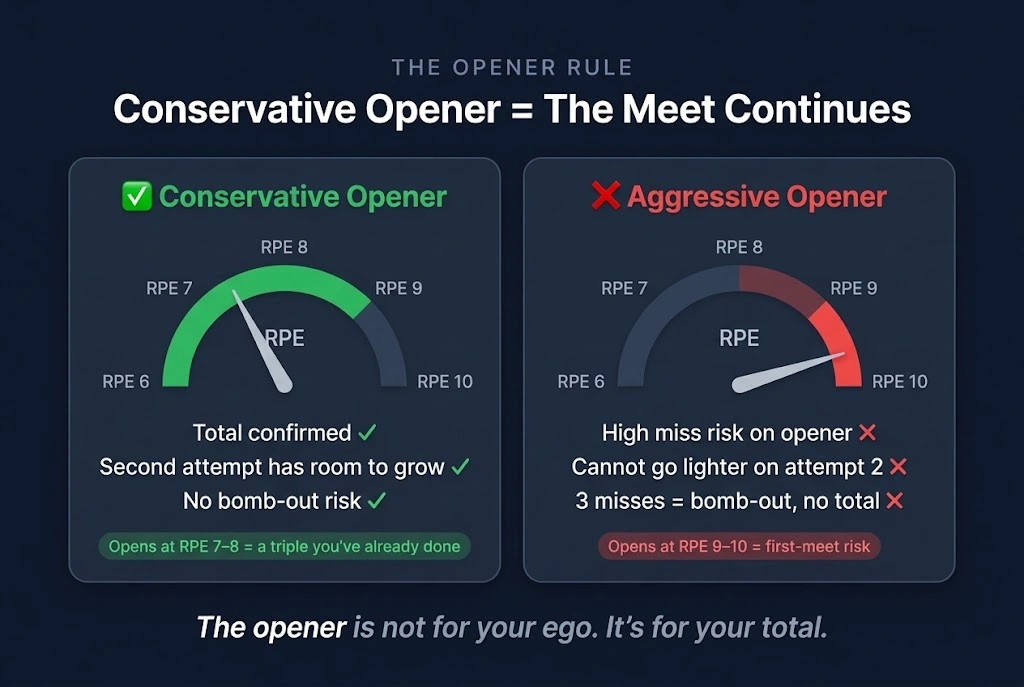
Your opener serves one purpose at a first meet: confirming that your total exists. The opener must be a weight you could make on your worst day: not your best training single, and not your estimated 1RM. Find a weight you have hit for a controlled triple in training with competition-standard execution. If you miss your opener, you cannot go lighter on attempt 2; you must repeat or increase. Three missed squats mean a bomb-out: no total, and the meet ends for you. The difference between a 90% opener and a 95% opener is irrelevant for placing at a first meet. The difference between making and missing your opener determines whether you finish at all.
Using RPE to Calibrate Your Opener in Training
The most reliable calibration method: your opener should feel like RPE 7–8 in training when performed with full competition-standard execution: below-parallel squat, paused bench press, and deadlift with full lockout. RPE 7–8 means 2–3 reps in reserve. The research validating RPE as a reliable measure of training intensity (Zourdos et al., 2016) confirmed that experienced lifters can accurately estimate reps in reserve, making RPE a more actionable calibration tool than fixed percentages. Use the RPE Calculator to convert your recent training sets into RPE ratings and identify your opener range. If you’re unsure whether your 1RM estimate is reliable, see How Accurate Are 1RM Calculators? and consider estimating from the one-rep max calculator before building your attempt plan.
Project Your Total Before the Meet
Before you submit your attempt card, run your projected openers, second attempts, and competition maxes through the Powerlifting Total Calculator. This shows your projected total if all attempts go to plan, your DOTS and Wilks score at that total, and what your total would be if only second attempts land. A conservative projection sets realistic expectations and prevents the emotional impact of expecting a number that was never going to happen on a first meet.
The Attempt Card: When You Submit and How
Most federations require opening attempts to be submitted during the weigh-in, before you arrive at the competition venue the following day. Your openers must be decided before you get there. Second and third attempts are declared after the previous attempt completes, within the federation’s time window (60 seconds in IPF). Pre-plan your second and third attempts, but remain flexible based on how the opener actually felt.
Equipment: What’s Required and What’s Legal
Equipment confusion is the most common source of anxiety before a first meet. The table below covers IPF Classic Raw requirements. Verify everything against your specific federation’s rulebook.
| Item | Required? | Specification | Common brands |
| Singlet | ✅ Yes | IPF-approved design; no extra padding | Titan, SBD, A7, Inzer |
| T-shirt (under singlet) | Optional | Must not cover elbows for bench press. | Any plain shirt |
| Belt | Optional but standard | Max 13 cm wide; worn outside singlet | Inzer, Pioneer, SBD |
| Knee sleeves | Optional | Max 30 cm long: NOT knee wraps in Classic Raw | SBD, Rehband, STrong |
| Wrist wraps | Optional | Max 100 cm long | SBD, Inzer, Stoic |
| Deadlift socks | ✅ Yes (most feds) | Must cover shins to prevent bar contact | Any knee-high sock |
| Shoes | Required | Flat-soled for deadlift; raised heel only for squat | Adidas, Nike, Converse |
| Chalk | Meet-provided | Personal chalk is usually permitted too. | : |
Always verify against your specific federation’s rulebook: other federations may differ from IPF. See the IPF technical rules for the official standards.
Equipment Inspection: What Happens
Before lifting, a meet official checks that your singlet is an approved model, your belt width is legal, your knee sleeves are the correct length, and your wrist wraps meet spec. Have all equipment in a bag and ready when you arrive. If an item fails inspection, you cannot use it in competition. The rule: never use new, untested gear on meet day applies to equipment legality as much as to comfort. Only use gear you’ve tested in training and confirmed is federation-legal.
The Weigh-In: What First-Timers Don’t Know
24-Hour vs. Same-Day Weigh-In
Most IPF-affiliated meets use a 24-hour weigh-in: you weigh in the evening before the competition, giving you approximately 16–24 hours to rehydrate and refuel before your first attempt. Some smaller and non-IPF meets use a same-day 2-hour weigh-in (typically 2 hours before your session). Confirm which format your meet uses when registering: the 24-hour format means you arrive the evening before the competition, which affects accommodation and travel planning.
No Weight Cutting for Your First Meet
The most common first-meet mistake: deliberate dehydration or caloric reduction to compete in a lower weight class. Weight cutting adds physiological impairment to an already demanding experience. At a first meet, the goal is to perform as close to training performance as possible. Competing at your natural training bodyweight eliminates the dehydration variable entirely. If you fall between weight classes, compete in the heavier class. The performance difference between classes at a local meet is negligible; the performance impact of arriving depleted is significant.
After Weigh-In: Rehydration and Refueling
After weighing in (24-hour format), immediately begin rehydrating and eating. This is your recovery window before competition. Target: 500–750 ml of water or an electrolyte drink in the first hour after weigh-in; a moderate carbohydrate meal: familiar food, not a feast that will sit heavy. Sleep well. Your food choices in this window directly affect how you feel under the bar the next morning.
Run a Mock Meet Before the Real One
A mock meet is a training session structured to replicate competition conditions and the most underused preparation strategy for first-time competitors.
What a Mock Meet Is and Why It Changes Everything
Schedule it 3–4 weeks before the real one. Use your planned opening attempts as the mock meet weights. Wear all competition equipment: singlet, belt, knee sleeves, and deadlift socks. Have a training partner give you the commands for every set and take full rest periods (90+ seconds between squat warm-ups, 3–5 minutes between working sets). Record the session to review your pause and lockout. Most first-meet anxiety comes from uncertainty about the experience, not about strength. A mock meet removes most of it.
The Commands You Must Practice
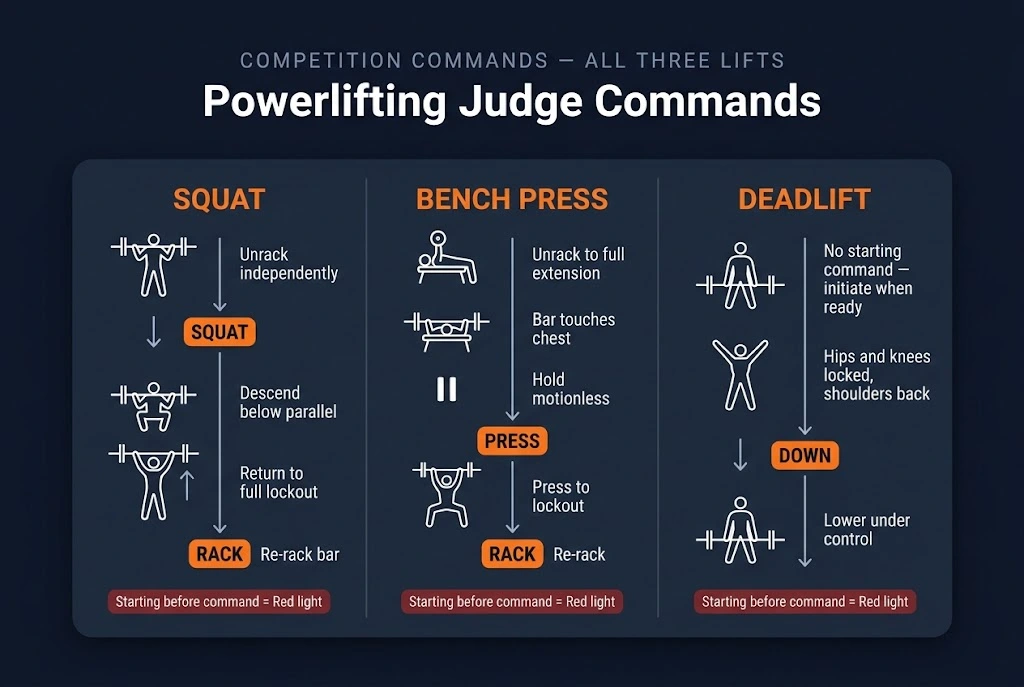
Starting a lift before a command, or missing the rack command, produces an automatic red light. These errors are entirely preventable with deliberate practice:
- Squat: Lifter unracks independently. Wait for “Squat” command when stationary. Descend and return to full lockout. Wait for “Rack” command before re-racking.
- Bench Press: Unrack to full extension. Lower bar to chest. Hold motionless until “Press” command. Press to full lockout. Wait for “Rack” command.
- Deadlift: No starting command: lifter initiates independently. Stand to full lockout (hips and knees extended, shoulders back). Wait for “Down” command. Lower bar under control.
Meet Day Logistics: Planning the Full Day
Meets run 6–10 hours. Bring everything you need for the full day.
| Category | What to bring |
| Competition gear | Singlet, belt, knee sleeves, wrist wraps, deadlift socks, squat shoes, flat shoes for deadlift |
| Backup clothing | Extra t-shirt, shorts or sweatpants to wear over singlet between flights, warm sweatshirt |
| Food and drink | Rice cakes, white rice, bananas, protein bars, electrolyte drinks, water: nothing new |
| Documents | Federation membership card, photo ID, attempt card (if required by federation) |
| Recovery items | Foam roller, resistance bands for activation warm-ups |
| Personal items | Headphones, phone charger, cash (food vendors at meets are common) |
| Handler essentials | If you have a coach: copy of attempt plan, rack heights written down, your session timing |
Timing Your Warm-Up
Meets typically allow 30–45 minutes of warm-up time before each lift begins in the competition session: which is less time than it sounds when accounting for equipment changes and bar availability in a busy warm-up room. The rule of thumb: your last warm-up set should finish approximately 5–8 minutes before you’re called to the platform for your first attempt. Work backward from your projected first lift time. Ask a more experienced lifter or handler to help you time warm-ups correctly on your first meet.
Having a Handler
A handler sits ringside and manages logistics: submitting your next attempt, timing your warm-ups, chalking your hands, and communicating what weight you’ve declared. For a first meet, a handler is strongly recommended. If you don’t have a coach, most powerlifting meets are friendly environments where experienced competitors will help. Ask in advance on your federation’s local Facebook or Discord group.
Nutrition and Hydration for a 6–10 Hour Competition
Pre-Meet Meal: 2–3 Hours Before Your First Lift
Eat a familiar meal 2–3 hours before your first squat attempt. First meet day is not a day to experiment with food. Practical guidelines:
- Eat 2–3 hours before your first lift, not immediately before
- Carbohydrate-forward: white rice, oats, banana, toast: easily digested and familiar
- Moderate protein (25–40g): eggs, chicken, yoghurt
- Low fat and low fibre before lifting: both slow digestion and can cause discomfort under a belt
- Only foods you’ve eaten before training before: no new foods on meet day
Between Flights: Fueling for the Long Day
Between the squat, bench, and deadlift sessions (typically 1–2 hours apart in a large meet), eat small, easily digested snacks: rice cakes, bananas, gummy sweets for quick glucose, electrolyte drinks. Stay hydrated consistently throughout. Arriving to the deadlift depleted is one of the most common performance issues at first meets. Many lifters report their deadlift felt worse than expected: this is usually nutrition, not strength.
The Mental Game: What Success Looks Like
Redefine What Winning Means for a First Meet
For a first meet, success has three components: and none of them is lifting a personal record. First, making all nine attempts. Second, experiencing every element of competition: the commands, the judging lights, the platform, the atmosphere: for the first time. Third, leaving with data: you now know your real openers, how your body responds to competition conditions, and what to improve. A first meet you finish is a successful one.
Using Nerves as a Tool
Pre-competition anxiety and excitement are physiologically identical: raised heart rate, heightened alertness, physical tension. The distinction is cognitive. Reframing the feeling as excitement rather than dread channels the same state productively. Deliberate breathing before each attempt (4-second inhale, 4-second hold, 4-second exhale) lowers the acute stress response while preserving the arousal needed to lift.
After the Meet: What to Do Next
Reviewing Your Performance Data
Your result will appear in the OpenPowerlifting database within a few days. Review it against your weight class to contextualize the performance. Then work through three questions: which of your attempts succeeded, and whether your openers felt appropriately conservative or too heavy; what your RPE ratings across the day told you about recovery and readiness; and what your final DOTS score from the Powerlifting Total Calculator establishes as your competitive baseline.
Planning the Next Training Block
A competition is a data collection event as much as a performance event. After your first meet: increase the training max by the standard progression increment for each lift; identify which lift has the most room to improve relative to your total distribution; set a realistic 6-month total target and run it through the Powerlifting Total Calculator to see the per-lift requirements. Then register for the next meet: 12–16 weeks out: before the post-meet motivation peaks and fades.
Frequently Asked Questions
A first powerlifting meet is learnable before you step on the platform. Prepare the logistics, choose conservative openers, run the mock meet, and go make your lifts. Everything builds from the baseline total that comes from a meet you finish. Start at the Powerlifting & Competition guide for the full competitive picture, run your attempt plan through the Powerlifting Total Calculator before submitting your attempt card, and see What Is Powerlifting? if you’re still getting familiar with the sport’s structure.