
Starting Strength Program: 1RM Progress Tracking
The Starting Strength program is Mark Rippetoe’s novice barbell plan: three sessions a week of squats and alternating press or bench press at 3×5, plus deadlifts, with weight added every session. To track your 1RM without testing it, run your heaviest completed set of five through the Epley formula: weight × 1.167.
You’ve added 5 lb to the bar every session for six weeks, and you still don’t know what your max is. The Starting Strength program already gives you one of the most reliable inputs for an estimate: a completed set of five, three times a week. Below are the official increments, a weekly tracking method, and a clear line for when a stall is real, so keep the one rep max calculator open as you read.
What Is the Starting Strength Program?
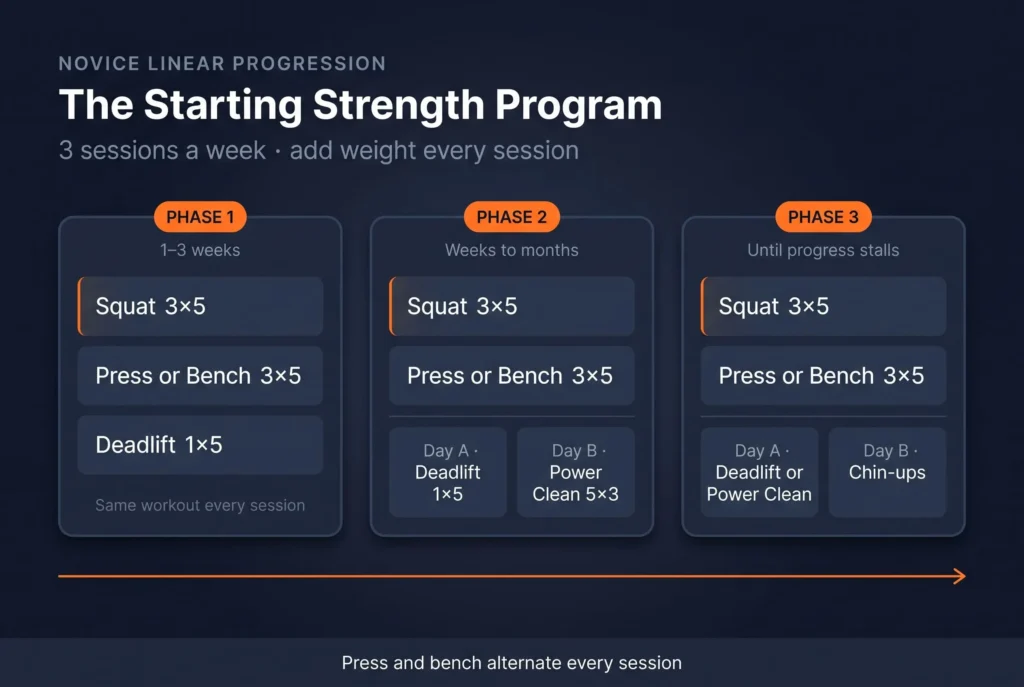
The Starting Strength program is a three-day-a-week novice barbell program in which you add weight to every lift, every session, for as long as recovery allows. Mark Rippetoe built it around the lifts in his book Starting Strength: Basic Barbell Training. The official Starting Strength program page splits it into three phases, trained on non-consecutive days such as Monday, Wednesday, and Friday.
Every lift uses “sets across”: after warm-ups, all three work sets go at the same weight. The press and bench press alternate from one session to the next. Pulling work is what changes, starting with one set of five deadlifts and later adding power cleans and chin-ups.
| Phase | Typical length | Day A | Day B |
| Phase 1 | 1–3 weeks | Squat 3×5 · Press/Bench 3×5 · Deadlift 1×5 | Same as Day A |
| Phase 2 | Several weeks to months | Squat 3×5 · Press/Bench 3×5 · Deadlift 1×5 | Squat 3×5 · Press/Bench 3×5 · Power Clean 5×3 |
| Phase 3 | Until progress stalls | Squat 3×5 · Press/Bench 3×5 · Deadlift 1×5 or Power Clean 5×3 | Squat 3×5 · Press/Bench 3×5 · Chin-ups |
Table 1: Starting strength phases, work sets only. Press and bench alternate every session. Source: startingstrength.com.
The squat is the only lift trained every session, so it’s the cleanest to track, and optimal workout frequency explains why three days suits novices.
How Much Weight Do You Add Each Session?
Starting Strength progression adds a fixed jump to each lift every time it’s trained: bigger jumps early, shrinking to 5 lb, then to 2.5 lb or less on the pressing lifts. Women and older lifters follow the same pattern with smaller increases.
| Lift | First sessions | Next stage | Later |
| Squat | ~10 lb for 2–3 sessions | 5 lb per workout | Smaller as progress slows |
| Deadlift | ~15–20 lb for the first couple | 10 lb for the next several | 5 lb per workout |
| Press | Possibly one 10 lb jump | 5 lb | 2.5 lb or smaller |
| Bench press | Possibly one 10 lb jump | 5 lb | 2.5 lb or smaller |
| Power clean | Possibly one 10 lb jump | 5 lb | 2.5 lb or smaller |
Table 2: Official Starting Strength program increments for healthy men aged about 18–40. Source: startingstrength.com.
A 5 lb jump on a 95 lb press adds 5.3% to the bar in one session, which is why the press usually stalls first. Most commercial gyms don’t stock 1.25 lb plates, so 2.5 lb jumps mean bringing fractional plates yourself. Buy them in your first month, while the press is still moving.
Are You on Track After Phase 1?
The official program page publishes expected gains for Phase 1, which usually lasts 1–3 weeks. Here are six sessions of official increments from illustrative starting loads (press and bench get three each).
| Lift | Session 1 | After 2 weeks | Gain | Official expected Phase 1 gain |
| Squat | 135 lb | 175 lb | +40 lb | +40–50 lb |
| Deadlift | 155 lb | 225 lb | +70 lb | +50–70 lb |
| Press | 65 lb | 80 lb | +15 lb | +15–20 lb |
| Bench press | 95 lb | 110 lb | +15 lb | +15–20 lb |
Table 3: Phase 1 benchmark, worked example. Expected gains from startingstrength.com (healthy males aged about 18–35/40).
Fall short on every lift at once, and food and sleep are the first places to look.
Can You Estimate Your 1RM from 3×5?
Yes. A completed set of five is one of the most reliable inputs for estimating a one-rep max, and Starting Strength gives you a new one every session. In a 2006 study on predicting 1RM from rep maxes, Reynolds, Gordon, and Robergs tested 70 adults aged 18–69. The 5RM predicted chest press 1RM with an R² of 0.993, ahead of the 10RM (0.976) and 20RM (0.955).
There’s a catch. Starting Strength work sets usually aren’t true 5RMs, especially early on, when loads are deliberately light. So treat your Starting Strength 1RM estimate as a floor.
The trend matters more than the number.
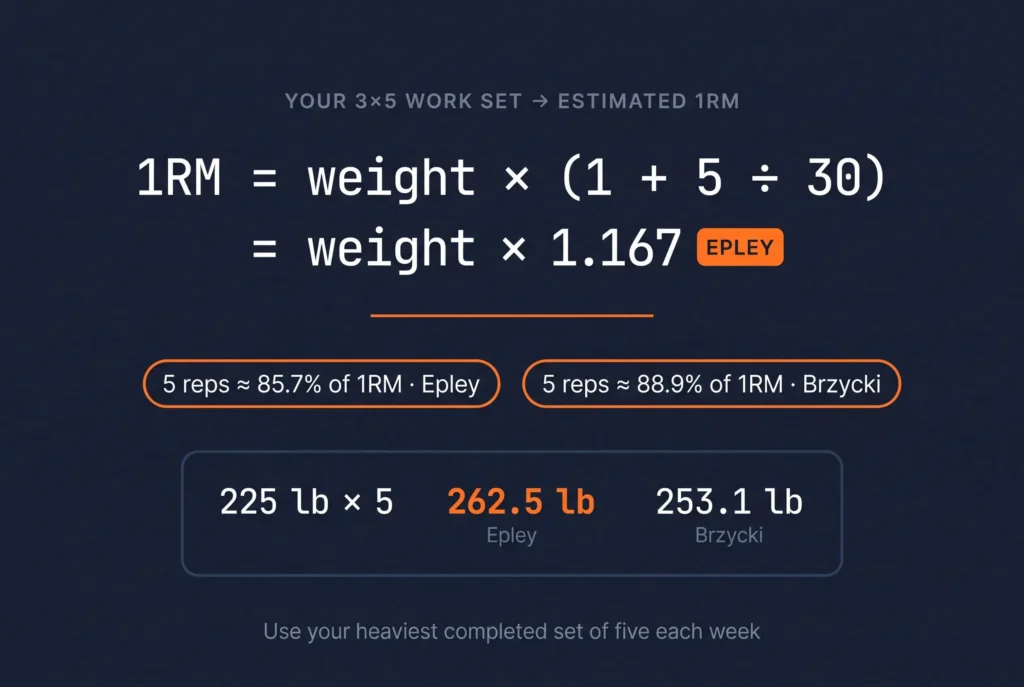
Epley (1985) turns a set of five into weight × 1.167, putting a 5RM at 85.7% of max. Brzycki (1993) puts it at 88.9%, so it estimates lower. Epley vs Brzycki formulas cover where each fits.
| 5-rep work set | Epley e1RM | Brzycki e1RM |
| 95 lb | 110.8 lb | 106.9 lb |
| 135 lb | 157.5 lb | 151.9 lb |
| 185 lb | 215.8 lb | 208.1 lb |
| 225 lb | 262.5 lb | 253.1 lb |
| 60 kg | 70.0 kg | 67.5 kg |
| 100 kg | 116.7 kg | 112.5 kg |
Table 4: 3×5 work weight as an estimated 1RM. Run your own numbers in the All Formulas 1RM Calculator.
How to Track Your 1RM Week by Week
Tracking your 1RM on Starting Strength means logging one estimated max per lift per week, taken from the heaviest set of five you completed with good form. Daily estimates bounce around with sleep, so one weekly number shows the trend better.
- Log every work set with weight and reps completed, for example, 225 × 5, 5, 5.
- At the end of the week, find the heaviest weight you completed for a full five.
- Multiply it by 1.167, or enter it in the one rep max calculator with the squat selected.
- Write one estimated 1RM per lift per week in a separate column.
- Compare week to week. A flat or falling e1RM for two weeks is your early stall warning.
| Week | Work set (3×5) | Epley e1RM | Brzycki e1RM |
| 1 | 155 lb | 180.8 lb | 174.4 lb |
| 2 | 175 lb | 204.2 lb | 196.9 lb |
| 3 | 190 lb | 221.7 lb | 213.8 lb |
| 4 | 205 lb | 239.2 lb | 230.6 lb |
| 5 | 220 lb | 256.7 lb | 247.5 lb |
| 6 | 235 lb | 274.2 lb | 264.4 lb |
Table 5: Six-week squat log (illustrative), official increments from a 135 lb start, every session successful.
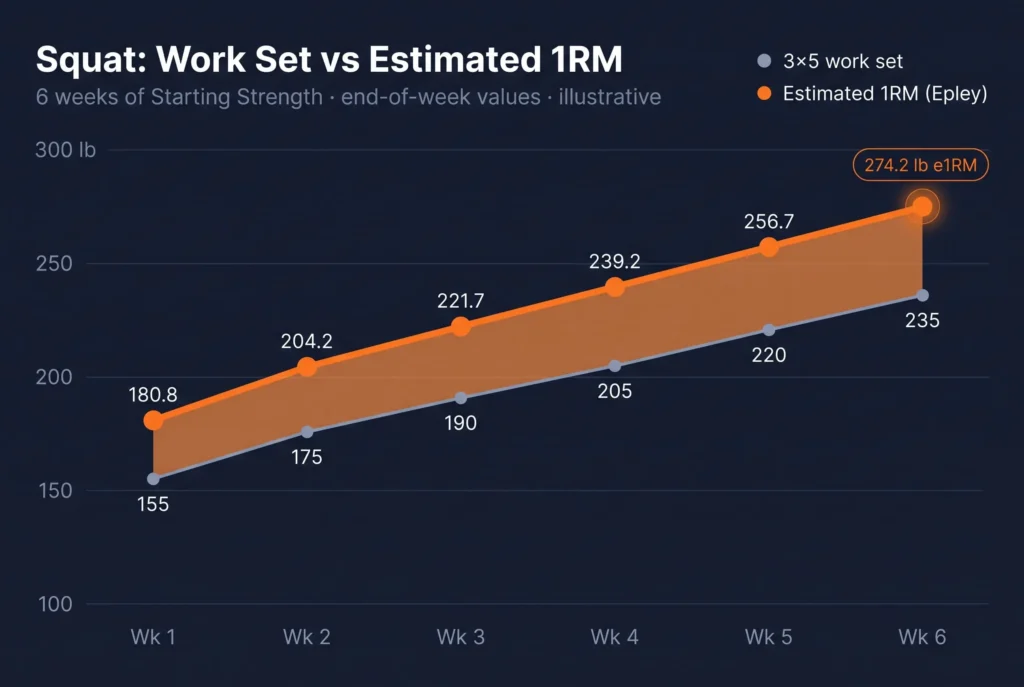
Real logs rarely look this clean, and the e1RM column is where a slowdown shows up first.
What If You Miss Reps?
Log the last set you finished, even if it fell short of five. A day of 225 × 5, 5, 3 estimates 247.5 lb (Epley) or 238.2 lb (Brzycki) from the 3-rep set. Logging 262.5 lb from the first set would hide the miss. Repeat 225 lb next session.
How Fast Should Your Lifts Go Up?
On the Starting Strength program, a squat that adds 5 lb three times a week climbs 15 lb a week, so a 100 lb gain takes 20 successful sessions, or just under 7 weeks.
ACSM’s position stand on progression in resistance training (2009) recommends a 2–10% load increase once a lifter can do 1–2 reps beyond the target. A 5 lb jump on a 135 lb squat is 3.7%, inside that range. Starting strength makes the jump every session instead of waiting for extra reps, because a novice recovers from one session’s overload before the next.
That pace is the program’s whole advantage: progressive overload at its fastest possible rate. Leaving the Starting Strength program for a “smarter” one while your lifts still climb throws away months of easy progress.
What Counts as a Stall on Starting Strength?
A Starting Strength stall is when you can’t complete 3×5 at a weight or repeat it next session, despite sleeping, eating, and recovering well. Two or three failed sessions on the same weight usually qualify. One doesn’t.
| What you see | Likely cause | What to do |
| One missed rep, one session | Bad day | Repeat the weight. |
| Misses on the same weight for 2–3 sessions running | Real stall or poor recovery | Check sleep and food, then reset that lift by ~10%. |
| Press stalls, squat still climbing. | Jumps too big for a small lift | Switch to 2.5 lb or smaller jumps. |
| Several lifts stall together after resets. | Novice gains are used up. | Move to intermediate programming. |
| e1RM flat for 2+ weeks while weights rise | Cutting depth or grinding | Film sets; check depth and bar path. |
Table 6: Stall decision table. The program page gives no fixed reset rule; ~10% is common coaching practice.
Before you reset any lift, check these:
- Sleep: the same hours you had when progress was steady.
- Bodyweight, which should still be trending up for most novices.
- Rest between work sets. Heavy squats need several minutes.
- Form on video, because heavier sets with worse form aren’t progress (training volume vs intensity explains why).
Should You Test a Real 1RM After Starting Strength?
Most lifters don’t need to test a true 1RM during the Starting Strength program; an estimated 1RM from recent sets of five is enough to set up the next program. A test makes sense when you’re moving to a percentage program or entering a meet.
Open the warm-up ramp and it’ll build the jumps to your attempt, and how to test your one rep max covers the full protocol. For a program built on a training max, the Training Max Calculator sets it from your estimated or tested max.
Common next steps after Starting Strength:
- Texas Method, with weekly volume, recovery, and intensity days.
- 5/3/1, using percentages of a 90% training max.
- A starting strength “advanced novice” setup, if only the press has stalled.
- Any percentage program. Get the weights from the % of 1RM calculator.
Common Starting Strength Tracking Mistakes
Ranked by how much damage they do to your log:
- Treating the e1RM as a real max. Early sets sit below your true 5RM, so the estimate runs low. Use it for the trend.
- Logging your best set instead of your last, which hides misses.
- Feeding the log sets past 10 reps. Reynolds et al. advise staying at 10 or fewer, so chin-ups and back-off sets stay out of the e1RM column.
- Testing a max mid-program, which costs a session’s recovery for a number you already know within a few percent.
- Keeping 5 lb jumps on the press too long. That’s 5% on a 100 lb press, against 1.7% on a 300 lb squat.
- Comparing your log to someone else’s. Starting weight decides how long a novice run lasts.
Switching between Epley and Brzycki mid-program also creates a fake 9 lb change at 225 lb, so pick one formula and stick with it. How accurate 1RM calculators are breaks down the error by formula.
How to Use the Calculator with Starting Strength
Each week, enter your heaviest completed set of five in the one rep max calculator with the right lift loaded: squat, deadlift, press, or the bench press one rep max calculator. Our calculator runs seven formulas: Epley, Brzycki, Lander, Lombardi, Mayhew, O’Conner and Wathan. Log the average or one formula, as long as it’s the same every week.
For 5×3 power cleans and missed-rep sets, use the Rep Range to 1RM Converter. New to barbells? Read 1RM for beginners first.
Starting Strength FAQs
Start a separate column in your log this week: one estimated 1RM per lift, taken from the last complete set of five. The week that column goes flat on the squat is the week the novice run starts ending. When it does, the Strength Training Programming guide maps what comes next, and Epley vs Brzycki formulas helps you choose the formula to carry forward.