Training Age and Its Effect on 1RM Progress
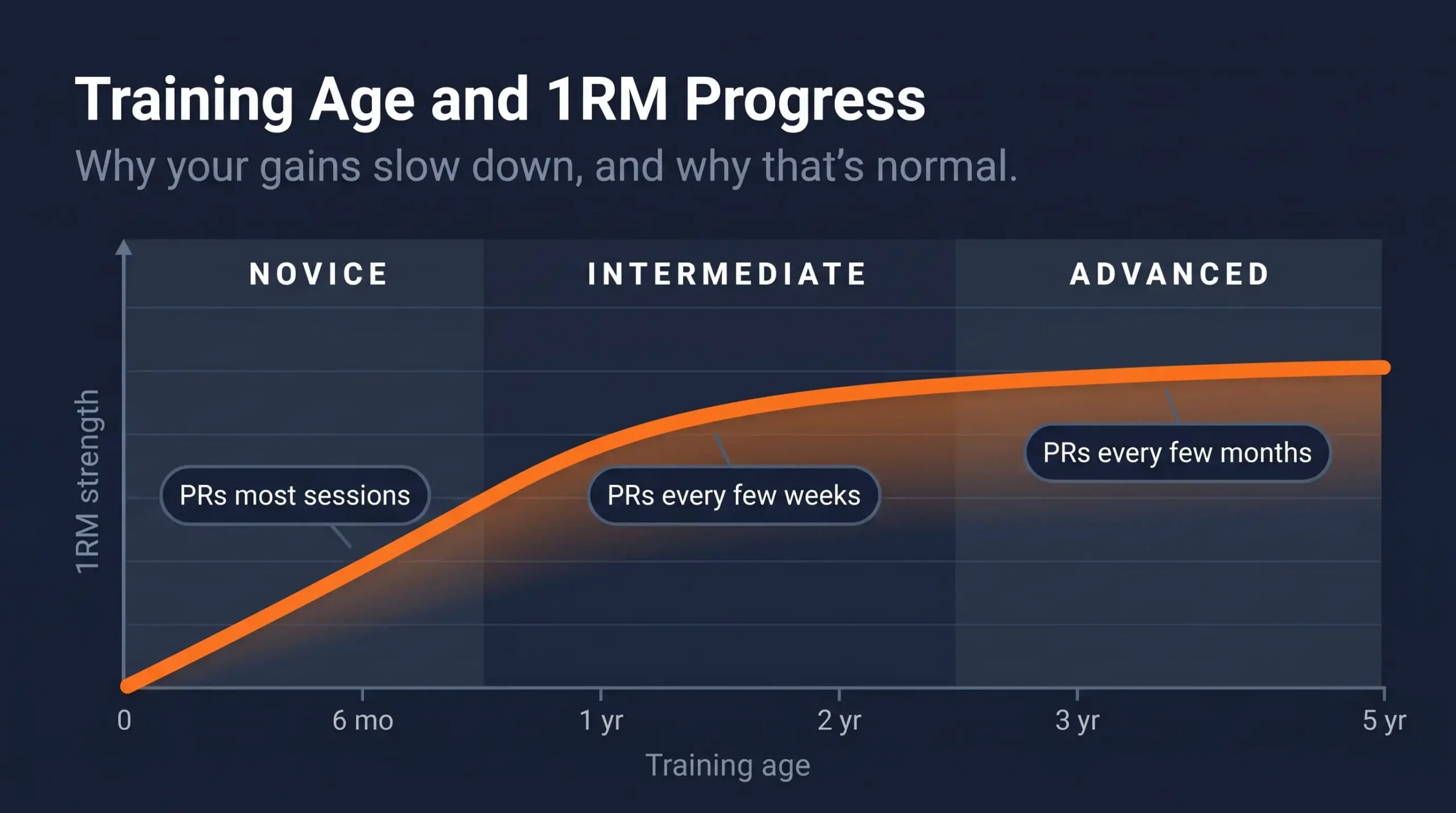
In your first year, your squat went up almost every week. Now a 10 lb PR takes two months, and you’re starting to wonder whether the program is broken. Your training age explains most of that slowdown, and it tells you what kind of progress is still realistic from here.
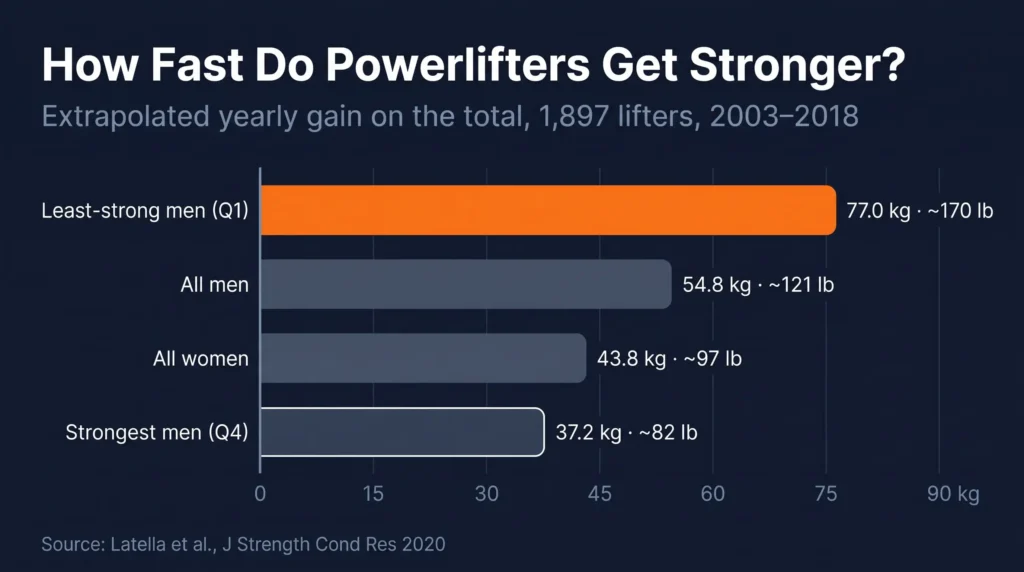
Training age is how long you’ve trained consistently with a structured program, and it’s the strongest predictor of how fast your 1RM can climb. In a 15-year analysis of 1,897 powerlifters, the least-strong men added about 77 kg to their total per year, while the strongest added about 37 kg.
What Is Training Age?
Training age is the time you’ve spent training consistently on a structured, progressive program, with long layoffs left out. It’s counted in months of real training, which can be far fewer than the years since your first gym membership. It matters because it predicts how much fast 1RM progress you still have available.
Training Age vs. Chronological Age
Training age and chronological age can point in opposite directions. A 45-year-old who started lifting last year has a low training age, so she can still make novice-speed progress. A 25-year-old with eight years of structured training is an advanced lifter, and his 1RM will climb slowly however young he is.
For the rate of 1RM progress, training age matters more than birthday age in most adults. Chronological age still shapes how quickly you recover between hard sessions and how high your eventual ceiling sits, which is why lifters over 40 are usually judged against master-lifter standards.
How to Calculate Your Training Age
Calculating your training age means counting only the months you actually trained on a plan:
- Count months where you trained the main lifts at least twice a week, on a program with planned progression
- Leave out random gym visits and any phase without progressive loading, such as cardio blocks or fitness classes
- Subtract layoffs longer than about three months, because some strength detrains during long breaks
- If you’re returning after several years off, you’ll usually regain strength faster than a true beginner builds it, but program as a novice at first; the ACSM’s novice definition includes people who haven’t trained for several years
Once you have the number, the strength standards calculator shows if your current lifts sit where that training age suggests.
How Training Age Changes 1RM Progress
The higher your training age, the slower your 1RM rises. Novices can add weight most sessions, intermediates set a PR every few weeks, and advanced lifters may wait months between them. That pattern sits underneath every set of strength standards and benchmarks, because a fair comparison has to account for how long you’ve trained.
| Stage | Training Age | Typical 1RM Progress Pace | Progression Unit | ACSM Training Frequency |
| Novice | 0 to about 6 months | Weight added to most sessions | Per session | 2–3 days/week |
| Intermediate | About 6 months to 2–3 years | A PR every few weeks | Per week or training cycle | 3–4 days/week |
| Advanced | Several years or more | A PR every few months | Per training block (8–16 weeks) | 4–5 days/week |
Stage definitions and training frequencies from the ACSM position stand (2009). Progress pace and progression units are coaching rules of thumb, not study measurements; individual rates vary widely. The 2–3 year upper bound for intermediates is coaching convention.
The Novice Phase
The novice phase covers roughly your first six months of consistent training, and it’s the fastest stretch of strength gain you’ll ever get. Most of that early jump comes from neural adaptation: your nervous system gets better at recruiting motor units and coordinating the lift before much muscle has been added. A novice on linear progression can usually add 5 lb to the squat most sessions for three to six months.
Don’t spend those months testing true maxes. Track an estimated max from your working sets instead; the guide to 1RM for beginners shows how.
The Intermediate Phase
The intermediate phase starts when session-to-session progress stops but weekly or cycle-to-cycle progress still works, usually after about six months of consistent training. A hard session now takes longer than 48–72 hours to recover from, so adding weight every workout outruns your recovery. Progressive overload still drives every gain, applied across weeks instead of across sessions.
Most lifters spend years in this phase.
That’s normal, and it doesn’t mean the program is broken.
The Advanced Phase
The advanced phase arrives after several years of training, when PRs come every few months and often only at planned test points such as a meet or a peaked gym max. Adding 5–10 lb to a lift across a whole training block is a good result at this stage. Long-term competition data shows the same pattern: the strongest lifters improve at about half the rate of the least strong.
An advanced lifter who still expects monthly PRs will keep switching programs and stall.
Why Progress Slows as Training Age Rises
Progress slows as training age rises for two reasons. The easy adaptations get used up first, and the stimulus needed to keep adapting gets bigger.
The Ceiling Effect
The ceiling effect is the slowdown that comes as you get closer to your genetic and practical potential, where each extra kilogram is harder to add than the last. In Latella et al. (2020), the strongest quartile of men gained 0.102 kg per day on their total, against 0.211 kg per day for the least strong (Latella et al., 2020). The authors’ explanation: “The strongest males improve more slowly, possibly due to a ceiling effect.”
Why Trained Lifters Need More Stimulus
Trained lifters need a bigger training stimulus than novices to keep getting stronger. Rhea et al. (2003) pooled 140 studies and found untrained lifters gained most at about 60% of 1RM, training each muscle group 3 days a week (Rhea et al., 2003). Trained lifters gained most at about 80% of 1RM, 2 days a week, and four sets per muscle group worked best for both groups.
What built a novice’s strength isn’t heavy enough to keep building an intermediate’s, which is the training volume vs intensity trade-off in practice. The trained/untrained split is broad, though, and the frequency findings are per muscle group rather than per lift.
What 15 Years of Powerlifting Data Shows
Fifteen years of competition data confirms that the rate of strength gain falls as lifters get stronger. Latella et al. (2020) tracked 1,897 Australian powerlifters (626 women and 1,271 men) who competed between 2003 and 2018, measuring strength gain per day on the total between competitions (Latella et al., 2020). Men averaged 0.15 kg a day and women 0.12 kg, a difference that wasn’t significant. Among men, the least-strong quartile gained about twice as fast as the strongest. Among women, the quartiles didn’t differ.
| Group | Strength Gain per Day | Extrapolated Gain per Year (Total) | Per Year in lb |
| All men (n = 1,271) | 0.15 kg | 54.8 kg | ~121 lb |
| All women (n = 626) | 0.12 kg | 43.8 kg | ~97 lb |
| Least-strong men (Q1) | 0.211 kg | 77.0 kg | ~170 lb |
| Strongest men (Q4) | 0.102 kg | 37.2 kg | ~82 lb |
Gains are on the powerlifting total (squat + bench press + deadlift). Yearly figures are the study’s own extrapolations from per-day rates and lb conversions by onerepmaxcalculators.com. Source: Latella et al., JSCR 2020.
What the Data Can and Can’t Tell You
The Latella data has limits worth knowing before you compare yourself to it. These lifters were already competing, so even the least-strong group isn’t made up of true novices. The yearly figures are extrapolated from an average of roughly 600 days of competing, and the study couldn’t account for how anyone trained. The authors say so directly: “It was not possible to report more detailed information regarding training practices (e.g., consistency, training program used, and frequency).”
Use the numbers as a benchmark range for trained lifters. They were never meant as a personal target.
How to Program for Your Training Age
Programming for your training age means planning progress over longer units as you advance, from single sessions to weeks to whole blocks. Frequency and intensity rise along the way, so each session still delivers enough stimulus to drive adaptation.
| Stage | Example Program Style | Typical Main-Lift Intensity | How Progress Is Added | Deload Need |
| Novice | Linear progression | Working sets around 75–85% of an estimated max | Small load jump most sessions | Reset only after repeated misses |
| Intermediate | Weekly progression (5/3/1, Texas Method) | Wider range, heavier top sets | Each week or 3–4 week cycle | Every 6–8 weeks |
| Advanced | Block or undulating periodization | Planned phases up to 90%+ | Across 8–16 week blocks toward a test | Every 4–6 weeks |
Coaching starting points that follow the ACSM progression model (2009) and Rhea et al. (2003). Adjust to your recovery and schedule.
Match your training frequency to your stage; the guide on how often to train covers the trade-offs. The program styles above are examples of a typical path: linear progression first, then weekly progression such as 5/3/1 or the Texas Method, then block or undulating periodization.
Most lifters move to a more complex program too early. If linear progression still adds weight to the bar, staying on it is the faster path, and the extra structure can wait until it stops working.
How to Measure Your Progress Rate?
Measuring your progress rate means logging an estimated 1RM for each main lift once a month, then dividing the change by the months elapsed. The result is a rate you can compare against the benchmarks for your training age.
- Once a month, enter a hard set from each main lift into the one rep max calculator and record the e1RM
- Add your three competition-lift e1RMs together to get an estimated total
- After six months, subtract the first total from the latest one
- Divide by 6 for a monthly rate, then multiply by 12 for a yearly rate
- Compare the yearly rate with the Latella figures and with your stage
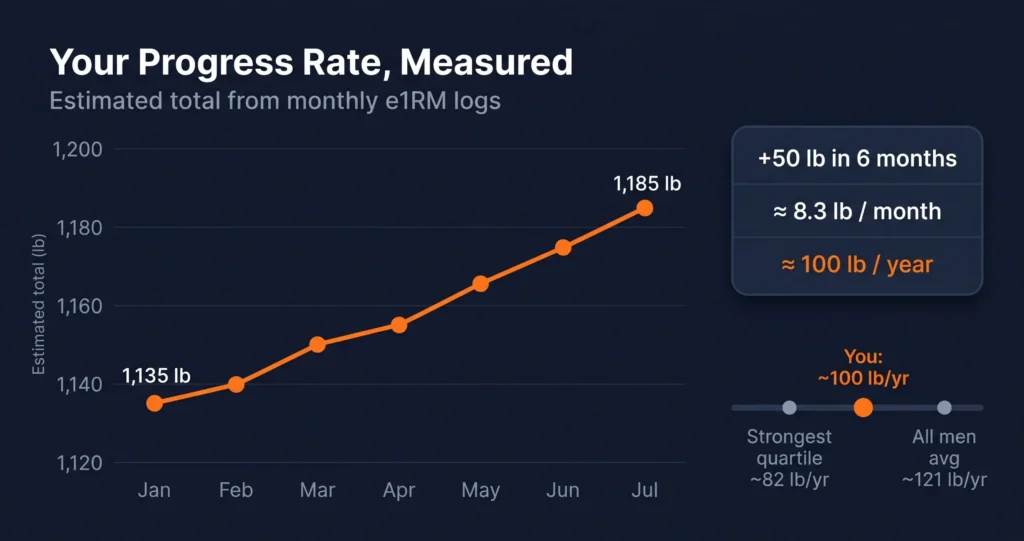
Here’s how it looks for one lifter. In January, their estimated total is 1,135 lb (405 squat, 275 bench, 455 deadlift), about 515 kg. By July it’s 1,185 lb. That’s 50 lb in six months, roughly 8.3 lb a month or 100 lb (about 45 kg) a year.
That rate sits between the Latella average for all men (~121 lb a year) and the strongest quartile (~82 lb a year), which is normal progress for an intermediate competitor. One caveat: e1RMs from training sets aren’t competition totals, so treat the comparison as a rough guide.
Common Mistakes in Judging Progress by Training Age
Judging progress by training age goes wrong in a few predictable ways, and each one costs you months.
- Counting gym membership years as training age. Three years of casual sessions can still leave you a novice, with fast gains waiting on a real program.
- Expecting novice speed in year three. Slower progress is the normal shape of the curve and says nothing bad about your program.
- Switching programs every time progress slows. Intermediate gains show up across weeks, and a new program every month never gives one time to work.
- Leaving linear progression too early. If you can still add weight session to session, you’re giving up the fastest gains of your lifting life.
- Comparing your rate with someone at a different training age. A one-year lifter’s monthly PRs say nothing about where a five-year lifter should be.
How to Use the Calculators to Benchmark Your Progress
Benchmarking your progress against your training age takes two tools. Once a month, the one rep max calculator turns a hard working set into an estimated 1RM, which feeds the progress-rate method. The strength standards calculator then shows if your lifts sit at the novice, intermediate or advanced level your training age suggests. If they sit lower, you likely have fast progress still available on a simpler program.
Frequently Asked Questions
Count your real training age today, leaving out the layoffs and the casual months. Log one e1RM per lift this week, then check your rate again in six months before deciding your program has stopped working. If the numbers do point to a change, the strength training guides cover what to run next.