Beginner Program Comparison: Starting Strength vs StrongLifts vs GZCLP
You’ve narrowed your first barbell program to three, and every forum thread picks a different winner. Starting Strength vs StrongLifts vs GZCLP is a closer race than those threads suggest, because all three run on the same engine. The real differences are how much work each asks for and what it does when you stall.
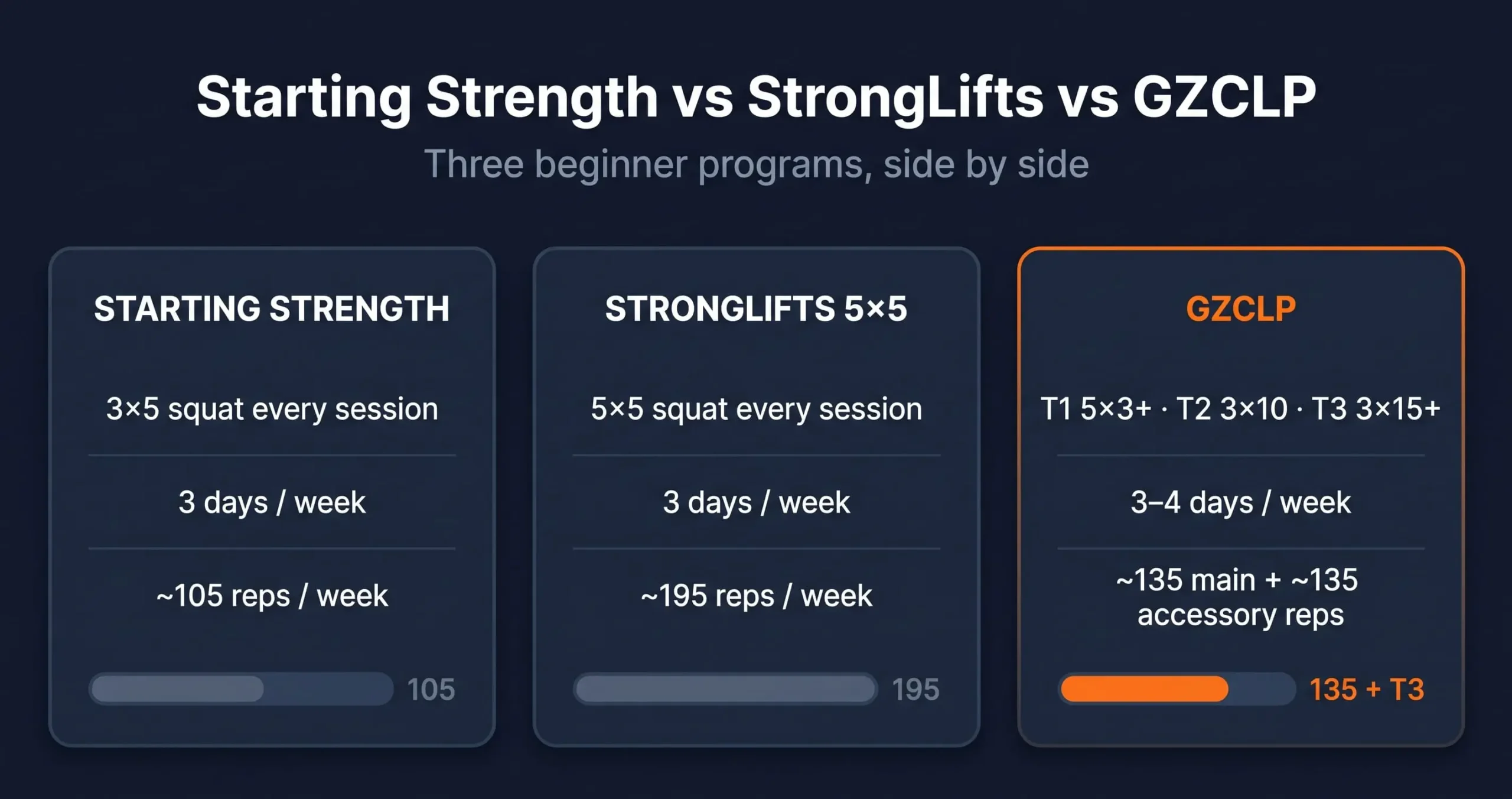
Starting Strength, StrongLifts 5×5, and GZCLP all add weight every successful session, but they differ in volume and structure. Starting Strength is the lowest volume (about 105 working reps a week), StrongLifts nearly doubles that, and GZCLP adds a tiered T1/T2/T3 structure with accessory work and a built-in plan for stalls.
Starting Strength vs StrongLifts vs GZCLP at a Glance
Starting Strength vs StrongLifts vs GZCLP comes down to how much weekly work each program asks for and how it handles a stall. Underneath, all three add weight every time you complete your reps.
| Feature | Starting Strength | StrongLifts 5×5 | GZCLP |
| Creator | Mark Rippetoe | Mehdi Hadim | Cody Lefever |
| Sessions per week | 3 (e.g., Mon/Wed/Fri) | 3 | 3 or 4 (rotating A1/B1/A2/B2) |
| Main set scheme | 3×5 (deadlift 1×5, power clean 5×3) | 5×5 (deadlift 1×5) | T1 5×3+, T2 3×10, T3 3×15+ |
| Squat frequency | Every session | Every session | T1 or T2 in alternating sessions |
| Unique lifts | Power clean, chin-ups (later phases) | Barbell row | Lifter-chosen T3 accessories (e.g. lat pulldown, DB row) |
| Failure plan | No fixed reset rule on the official programs page; jumps shrink as lifts slow | Miss reps, and you repeat the weight until you complete 5×5. | Built-in stage ladder: 5×3 → 6×2 → 10×1, then retest 5RM |
| Best fit | Pure strength, minimal time, coaching-style form focus | Simple structure, a bit more volume, and upper-back work | Lifters who want muscle and strength, accessories, and a long runway |
Program details from each creator’s published guide: startingstrength.com, stronglifts.com, and Cody Lefever’s Swole at Every Height blog.
What All Three Programs Share
All three beginner programs share one core: progressive overload in its simplest form, where the bar gets heavier every time you finish your reps.
- Weight goes up every session you complete your reps
- Full-body sessions built on the squat, bench press, overhead press, and deadlift
- Three training days a week as the default
- Upper-body lifts eventually need jumps of 2.5 lb or less, so a pair of small plates extends every one of them
The program you pick matters less than running it consistently for three to six months.
Weekly Volume Compared
Weekly volume is the biggest number separating these beginner programs: counted from each published template, Starting Strength and StrongLifts sit at 105 vs 195 weekly working reps.
| Lift | Starting Strength (Phase 1) | StrongLifts 5×5 | GZCLP (Stage 1, 3×/week) |
| Squat | 45 | 75 | ~34 (T1 + T2 combined) |
| Bench press | 22.5 | 37.5 | ~34 |
| Overhead press | 22.5 | 37.5 | ~34 |
| Deadlift | 15 | 7.5 | ~34 |
| Barbell row | – | 37.5 | – |
| Main lift total | 105 | 195 | ~135 + ~135 T3 accessory reps |
Weekly averages excluding warm-ups, calculated by onerepmaxcalculators.com from each program’s published starting template (A/B alternation over two weeks; GZCLP’s four-workout rotation over four weeks). GZCLP T1 counted at the 15-rep minimum.
Working reps count workload and ignore intensity, and GZCLP’s T2 sets are lighter than its T1 sets. StrongLifts puts the most squat volume on a novice, while GZCLP spreads its work across every main lift and stacks accessories on top.
More volume only helps a novice who recovers from it, and recovery is usually where 5×5 breaks first, the training volume vs intensity trade-off in action.
Starting Strength
Starting Strength is Mark Rippetoe’s novice linear progression, built around three sets of five on the squat every session, and the leanest of the three programs.
How Starting Strength Works
Starting Strength runs three days a week on non-consecutive days in three phases (Starting Strength). Phase 1 is the squat for 3×5, the press and bench press alternating for 3×5, and the deadlift for 1×5. Phase 2 swaps the power clean (5×3) in on alternate days, and Phase 3 adds chin-ups.
Increments start big: most healthy men aged 18 to 35 or 40 can add 10 lb to the squat for the first 2–3 sessions and 15–20 lb to the deadlift the first couple of times, then 5 lb per workout. Pressing lifts move to 2.5 lb or smaller jumps later. The stated goal: “The goal of this program is to add weight each and every time you lift, taking advantage of the Novice Effect that allows you to do so.”
The programs page sets no fixed stall or reset rule.
Who Starting Strength Suits (and Who It Doesn’t)
Starting Strength suits a lifter who wants a bigger squat and deadlift fast from three short sessions a week, and it comes with the deepest pool of coaching material on form.
The trade-offs are real. There’s very little upper-back or arm work, and the low volume can leave a lifter chasing muscle wanting more. The power clean is also hard to learn well without a coach.
Pick it if strength on the big lifts is the whole goal.
StrongLifts 5×5
StrongLifts 5×5 is Mehdi Hadim’s two-workout novice program, using five sets of five on most lifts and the barbell row in place of the power clean.
How StrongLifts 5×5 Works
StrongLifts 5×5 alternates two workouts three days a week (StrongLifts). Workout A is the squat, bench press, and barbell row, each for 5×5. Workout B is the squat and overhead press for 5×5, then the deadlift for 1×5. You rest about 3 minutes between work sets.
The quick-start guide adds 5–10 lb per session on the squat and deadlift and 2.5–5 lb on the upper-body lifts. It warns against the bigger squat jump: “10 lb increments on squats is not a good idea because you squat 3x/week.” When you miss reps, the rule is simple: don’t add weight next time, and repeat it until you complete all five sets of five.
Who StrongLifts Suits (and Who It Doesn’t)
StrongLifts suits a lifter who likes more training volume and recovers well. The fixed A/B structure is the simplest of the three, and the official app tracks every set. The barbell row also adds upper-back work that Starting Strength lacks.
The cost shows up as the weights climb: 75 squat reps a week gets hard to recover from, and five heavy sets of five stretch a session out. The deadlift also gets the least practice of the three, at 7.5 reps a week.
Older or busier novices often do better on Starting Strength.
GZCLP
GZCLP is Cody Lefever’s linear-progression version of his GZCL. Method: every workout pairs a heavy main lift (T1), a lighter main lift (T2), and an accessory (T3), with a built-in plan for stalls.
The Three GZCLP Tiers
GZCLP rotates four workouts (A1, B1, A2, B2) through a 3- or 4-day week, and the T1 and T2 lifts swap between them. A1 is squat T1 with bench T2, for example, while A2 is bench T1 with squat T2.
Tier 1 (T1): Heavy Main Lift
GZCLP’s T1 is 5 sets of 3 with the last set taken for as many reps as possible (5×3+), and the weight goes up each time the lift returns as a T1 (Lefever, 2016). Lefever recommends novices add no more than 5–10 lb (2.5–4.5 kg) per workout and cap AMRAP sets at 10 reps. That AMRAP count doubles as a test: put the weight and reps into the one rep max calculator and watch your estimated max.
Tier 2 (T2): Lighter Main Lift for Volume
GZCLP’s T2 is 3 sets of 10 at a lighter weight, adding load each time. When 3×10 fails, drop to 3×8, then 3×6. After that, restart at 3×10 slightly heavier, no more than 20 lb above the previous cycle’s starting weight.
Tier 3 (T3): Accessories
GZCLP’s T3 is 3 sets of 15 with the last set AMRAP, usually a back exercise such as a lat pulldown or dumbbell row. Add weight once that last set reaches 25 reps. That’s upper-back volume. Starting Strength mostly skips.
How GZCLP Handles a Stall
GZCLP handles a T1 stall by keeping the weight and cutting reps per set. When 5×3+ misses its 15-rep base, switch to 6×2+ (12-rep base). When that fails, move to 10×1+ (10-rep base). When that fails too, rest 2–3 days, test a new 5RM, and restart at 85% of it.
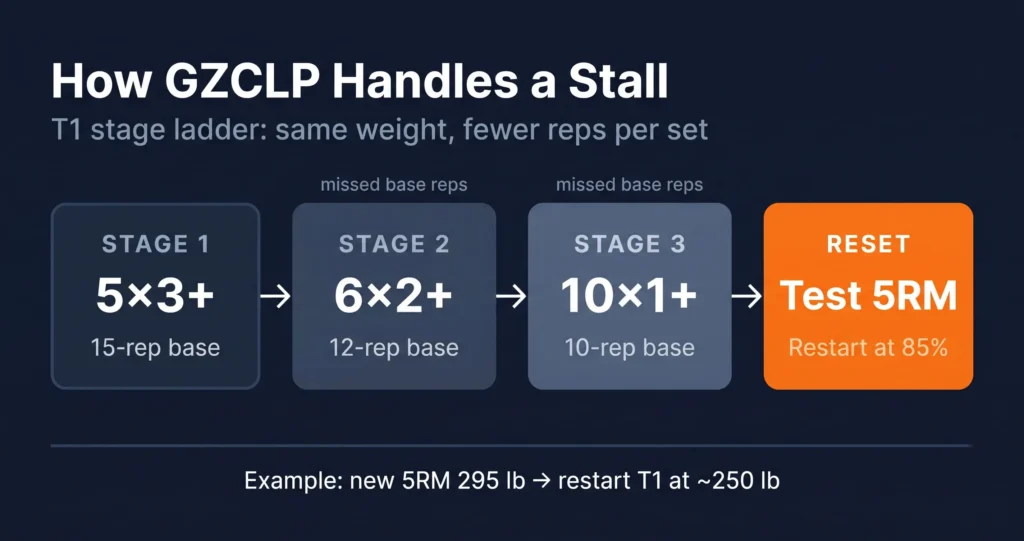
A 5RM retest of 295 lb means restarting T1 at about 250 lb (295 × 0.85 = 250.75); the 1RM percentage calculator runs that math for any number. That ladder is GZCLP’s biggest advantage, because one weight can carry a lifter several more weeks before a reset.
GZCLP T1 stage ladder 5×3 to 6×2 to 10×1 and reset When a T1 lift stalls, GZCLP keeps the weight and drops reps per set: 5×3+, then 6×2+, then 10×1+, then retest a 5RM and restart at 85%.

Who GZCLP Suits (and Who It Doesn’t)
GZCLP suits a lifter who wants muscle as well as strength and will log a little more. Its stall ladder and accessory volume are strengths, neither rival matches, and it leads straight into the full GZCL Method.
The cost is bookkeeping, since four workouts and three tiers really need an app or spreadsheet. Progress per lift also looks slower on paper, which Lefever admits: “This does have the negative aspect of slower progression (at least when reading, but in practice definitely not) than something like Starting Strength, where all movements are performed with each movement and weight is added each workout.”
Pick it if you want size along with strength, and you’ll actually track the tiers.
How Fast Each Program Progresses?
On paper, Starting Strength and StrongLifts add squat weight fastest because they squat every session. GZCLP looks slower per lift, but it trains the squat on two tracks, T1 heavy and T2 for volume.
| Program | Squat Sessions in 6 Weeks | Assumed Jump | Squat Weight After 6 Weeks |
| Starting Strength | 18 | 5 lb per session | 220 lb |
| StrongLifts 5×5 | 18 | 5 lb per session | 220 lb |
| GZCLP (T1 squat, 3×/week) | 5 as T1 | 10 lb per T1 session | 175 lb (T1 track) |
A theoretical best case calculated by onerepmaxcalculators.com, assuming no missed sessions or stalls and a first session at 135 lb. GZCLP also progresses squat separately as a T2 (3×10).
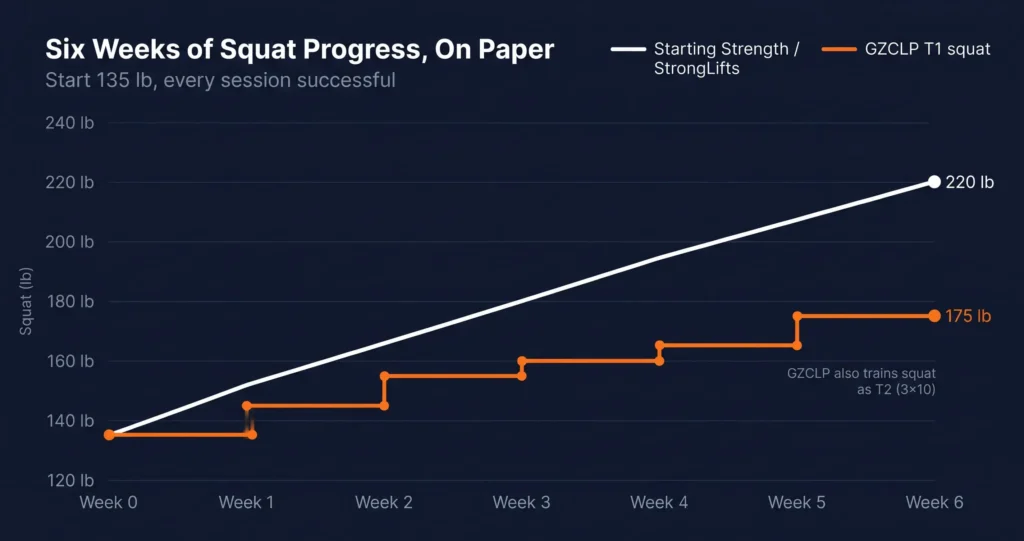
six-week squat progression on Starting Strength, StrongLifts and GZCLP On paper, squatting every session wins: 135 to 220 lb on SS and SL vs 175 lb on GZCLP’s T1 track. Real lifters stall before either line ends.

Real lifters rarely make every session, and once resets and stage changes kick in, the paper gap mostly closes by the end of the novice phase. Track the estimated max from your working sets instead; the guide to 1RM for beginners shows how.
Which Beginner Program Should You Choose?
The right beginner program matches your goal and schedule, and you’ll run it unchanged for at least three months:
- Pick Starting Strength if you want the fastest squat and deadlift gains and have about an hour three times a week
- StrongLifts suits you if you want the simplest A/B routine with an app that tracks everything, and you recover well from extra volume
- Choose GZCLP if you want muscle as well as strength and don’t mind tracking tiers and accessories
- Training at home without a coach, skip the power clean on Starting Strength, or pick StrongLifts or GZCLP instead
- Restarting after years off, run any of the three, and start lighter than you think you need to
| Your Priority | Best Pick | Why |
| Fastest strength on the big lifts | Starting Strength | Lowest volume, squats every session, smallest time cost |
| Simplicity and app support | StrongLifts 5×5 | Two fixed workouts, official app, clear increments |
| Muscle + strength | GZCLP | T2 and T3 volume plus heavy T1 work |
| Longest run before resets | GZCLP | Stage ladder stretches each weight across more sessions |
| Most upper-back work | StrongLifts or GZCLP | Barbell row (SL) or back-focused T3 (GZCLP) |
| Least to track | Starting Strength | One set scheme, one progression rule |
Starting points, not rules. Any of the three works if you run it consistently.
What the Research Says About Novice Programming
No study has compared Starting Strength, StrongLifts and GZCLP head to head.
Rhea et al. (2003) pooled 140 studies and found untrained lifters gained most when training each muscle group 3 days a week at about 60% of 1RM, with 4 sets per muscle group (Rhea et al., 2003). All three programs meet or exceed that training frequency.
Schoenfeld et al. (2017) compared heavy and light loads across 21 studies with sets taken to failure (Schoenfeld et al., 2017). They concluded that “maximal strength benefits are obtained from the use of heavy loads while muscle hypertrophy can be equally achieved across a spectrum of loading ranges.” That backs the heavy core of all three, and GZCLP’s lighter work for size.
The ACSM (2009) recommends 2–3 days a week for novices, with loads around an 8–12 rep maximum (ACSM, 2009). All three programs go heavier than that from day one. That’s reasonable for a strength-focused novice learning technique under supervision or from video, and an argument for GZCLP’s higher-rep T2 work if you’re less sure of your form.
What Comes After a Beginner Program?
Every beginner program ends when session-to-session jumps stop working even after resets. Starting Strength lifters often move to the Texas Method, StrongLifts points lifters to its own intermediate programs such as Madcow 5×5, and GZCLP lifters move into the full GZCL Method or 5/3/1.
Run your beginner program until it truly stops working, which is usually three to six months in. The first stall isn’t that point.
Common Beginner Program Mistakes
Most beginner programs fail for reasons unrelated to which one you picked.
- Program-hopping in the first month. All three work, and switching every few weeks resets the progression that makes them work.
- Starting too heavy. Every program tells you to start light, and a first-session weight that’s already a grind takes weeks of easy progress off the front.
- Stacking programs together. Bolting a bodybuilding split onto StrongLifts’ 195 weekly working reps is the quickest way to stall by week six.
- Skipping small plates. Without 1.25 lb plates, overhead press progress usually stops weeks before the squat does.
- Quitting at the first stall. Use the program’s reset or stage ladder first, then check your lifts against strength standards and benchmarks before you move on.
How to Track Your Beginner Program With the Calculators
Each week, enter your best set of each lift in the one rep max calculator and watch the estimated 1RM climb. On GZCLP, the 1RM percentage calculator handles the 85%-of-5RM restart after a full stall. Once resets stop working, the strength standards calculator shows if your lifts have moved past novice levels, your signal to change programs.
Frequently Asked Questions
Settle Starting Strength vs StrongLifts vs GZCLP by your goal, using the decision matrix, and ignore forum consensus. Buy a pair of 1.25 lb plates before your first session, because your press will need them within a couple of months. Then run the program unchanged for at least 12 weeks; when it stops working, the strength training guides cover what comes next.