
What Is a Compound Lift? The Main Barbell Lifts Explained
Nearly every beginner program opens with the same barbell movements before the small stuff. Those are compound lifts, and they’re the lifts your one-rep max gets measured on.
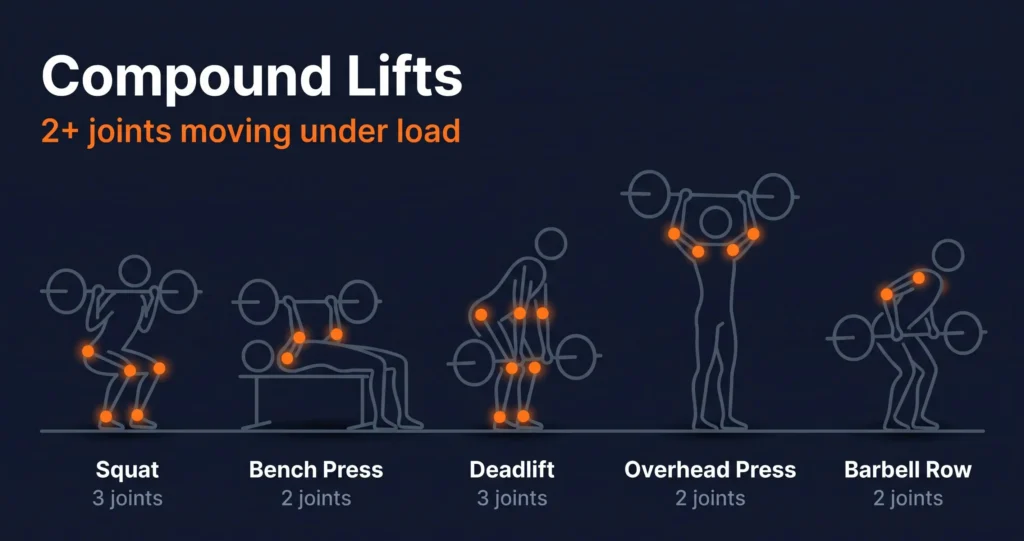
Compound lifts are exercises that move two or more primary joints under load, so several large muscle groups work together. The squat, bench press, deadlift, overhead press and barbell row are the main ones. In an 8-week study, equal-volume compound training raised squat 1RM 13.8%, against 8.3% for isolation work.
The per-lift overviews live in the lift-specific 1RM guides. This page covers what the term means and how to estimate a 1RM on every lift that qualifies.
What Is a Compound Lift?
A compound lift is a multi-joint exercise: two or more joints bend and straighten under load at the same time, so the prime movers and their helpers share the weight. That shared load is why you can squat several times what you can leg-extend.
Take the bench press. Your chest and front delts drive the bar while your triceps finish the lockout. Behind them, your upper back holds the shoulder blades still so the press has a base to push from. Coaches call the drivers prime movers and the helpers synergists, and a compound lift recruits both on every rep, along with the stabilizers holding you in position. An isolation exercise moves one joint and puts nearly all the work on one muscle, which suits a weak spot and suits big weights poorly.
Compound Lift Meaning: The Two-Joint Test
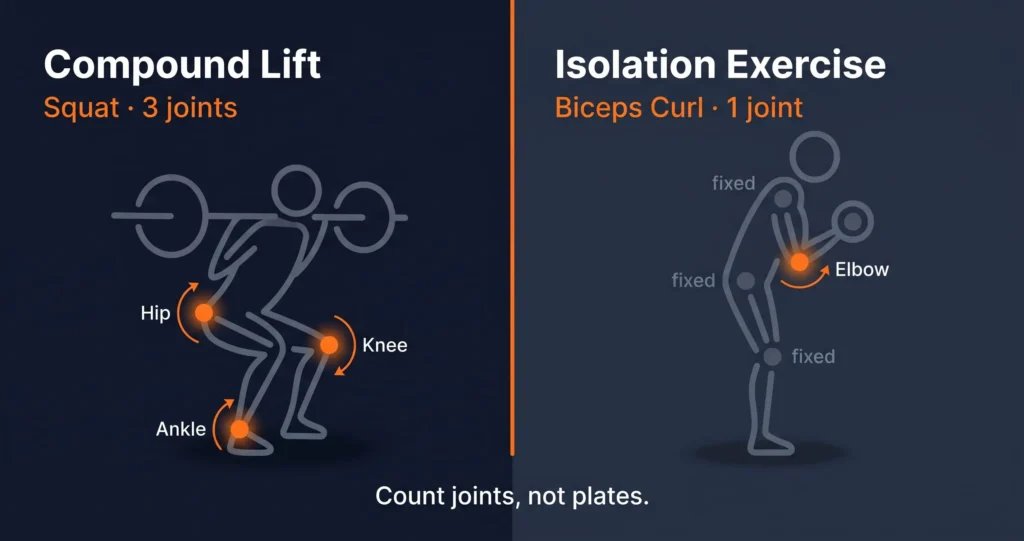
The compound lift test is quick: count the joints that bend and straighten while the weight moves. Two or more, it’s compound. One, it’s isolation.
A back squat moves your hips, knees, and ankles. A biceps curl moves the elbow and nothing else, even though your trunk works hard to keep you upright.
Textbooks use different words for the same split. The NSCA’s Essentials of Strength Training and Conditioning (4th edition, 2016) calls exercises that recruit one or more large muscle areas across two or more primary joints “core” exercises, and single-joint movements “assistance” exercises. A coach’s core lift and a gym regular’s compound lift are the same thing.
What “Compound” Doesn’t Mean
A compound lift isn’t defined by how heavy it is or by the equipment it uses. A bodyweight lunge is compound because the hip and knee both move, while a barbell curl with 135 lb on the bar is still isolation.
Compound vs Isolation Exercises
Compound lifts move several joints and load more muscle per rep, while isolation exercises move one joint and target one muscle. Both build strength, but compound lifts carry over better to your 1RM on the big barbell lifts, and programs put them first.
| Feature | Compound lift | Isolation exercise |
| Joints moving under load | 2 or more | 1 |
| Muscle groups trained | Several at once (prime movers + synergists) | Mostly one |
| Typical load | High; most lifters can handle far more weight | Low to moderate |
| Examples | Squat, bench press, deadlift, overhead press, row | Leg extension, biceps curl, lateral raise |
| Usual place in a session | First, when you’re fresh (ACSM 2009) | After compound work |
| Common 1RM use | Tested or estimated to set training loads | Rarely maxed; usually trained by reps |
Compound vs isolation exercises compared. Ordering rule from the ACSM 2009 position stands on progression models in resistance training.
What the Research Shows on Strength
The cleanest head-to-head trial on compound lifts for strength comes from Antonio Paoli’s group (Paoli et al., 2017). Thirty-six physically active men trained three times a week for 8 weeks with total load volume matched, one group on single-joint exercises only and the other on multi-joint exercises only. The multi-joint group gained more on every 1RM tested.
| 1RM test | Single-joint group | Multi-joint group |
| Bench press | +8.1% | +10.9% |
| Knee extension | +12.4% | +18.9% |
| Back squat | +8.3% | +13.8% |
Percent increase in 1RM after 8 weeks of equal-volume training (n = 36 physically active males). Source: Paoli A, Gentil P, Moro T, et al. Front Physiol. 2017;8:1105.
The surprise is the middle row: the compound group gained more on the knee extension, an isolation exercise it never trained. The authors concluded that “RT programs involving MJ exercises appear to be more efficient for improving muscle strength and maximal oxygen consumption than programs involving SJ exercises, but no differences were found for body composition.”
That’s 36 young, active men over 8 weeks. It says little about women or about lifters who are already strong.
When Isolation Exercises Still Earn a Spot
Isolation exercises still have a job. Paulo Gentil, James Fisher, and James Steele reviewed 23 studies and found that, for the upper limbs, adding single-joint work to a multi-joint program gave no extra size or strength (Gentil et al., 2017). Their summary: “SJ exercises may only be necessary to strengthen lumbar extensors and to correct muscular imbalances. ” Other researchers disputed parts of the review in a published comment, so read it as a strong lean, not a verdict.
Build the program on compound lifts and add isolation work only when you have a reason, such as
- A lagging muscle that keeps stalling a big lift, like triceps that quit at bench lockout.
- Lower-back extensor work, the one area the review flags.
- Training around an injury that blocks a compound lift, with a qualified professional’s guidance.
- Arm and shoulder size goals, where extra direct volume is easy to recover from.
The Main Compound Barbell Lifts
Six barbell lifts form the base of most strength programs, and you can estimate a 1RM for each one on this site. Between them they cover the squat and hinge patterns plus upper-body pushing and pulling. Full per-lift overviews sit in the lift-specific 1RM guides.
| Lift | Primary joints moving | Main muscles | Movement pattern |
| Back squat | Hip, knee, ankle | Quads, glutes, adductors | Squat |
| Front squat | Hip, knee, ankle | Quads, glutes, upper back | Squat |
| Deadlift | Hip, knee, ankle | Glutes, hamstrings, back extensors | Hip hinge |
| Bench press | Shoulder, elbow | Chest, front delts, triceps | Horizontal push |
| Overhead press | Shoulder, elbow | Delts, triceps, upper chest | Vertical push |
| Barbell row | Shoulder, elbow | Lats, upper back, biceps | Horizontal pull |
The six main compound barbell lifts by joints, muscles and movement pattern.
Compound Lift Examples Beyond the Big Five
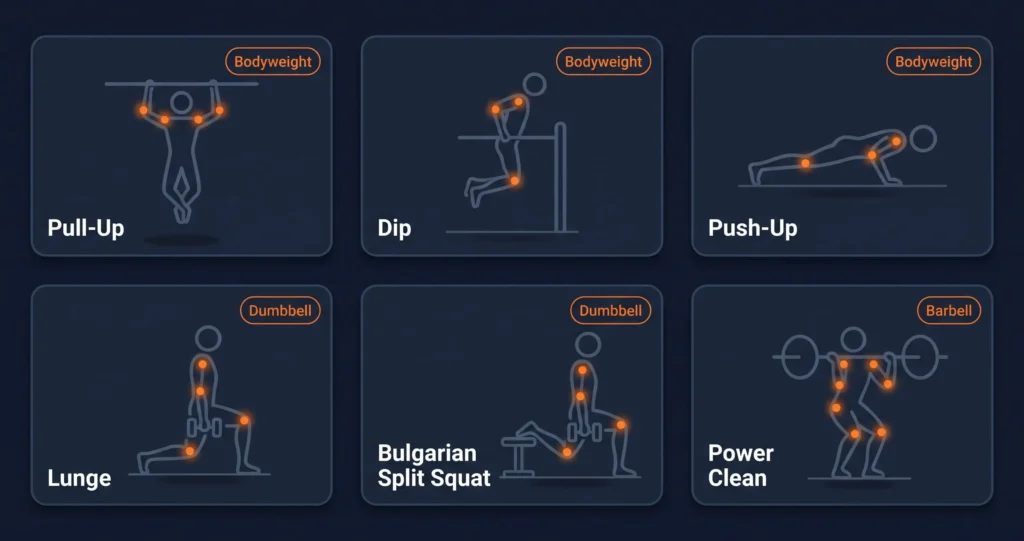
Plenty of compound lift examples never touch a barbell. Pull-ups, chin-ups, dips, and push-ups move the shoulder and elbow together; lunges and Bulgarian split squats move the hip and knee. The power clean is compound from floor to rack. The hip thrust is borderline: the knee bends slightly, but the hip does nearly all the work.
Compound Lift vs Power Lift vs Olympic Lift
A power lift is one of the lifts contested in powerlifting: the squat, bench press, and deadlift. Every power lift is a compound lift, but most compound lifts aren’t power lifts. The overhead press and barbell row never appear on a powerlifting platform, and the Olympic lifts belong to a separate sport.
| Term | What it means | Lifts included | Tested as |
| Compound lift | Any exercise moving 2+ primary joints | Squat, bench, deadlift, press, row, pull-up, lunge, and more | No set test |
| Power lift | A lift contested in powerlifting | Squat, bench press, deadlift | 1RM, three attempts each |
| Olympic lift | A lift contested in weightlifting | Snatch, clean & jerk | 1RM, three attempts each |
Every power lift and every Olympic lift is a compound lift. The reverse isn’t true.
Why Powerlifters Care About Compound 1RMs
Powerlifting is scored entirely on compound lift 1RMs. Your meet total is your best squat plus your best bench plus your best deadlift, so every block aims at those single-rep numbers. A 180 lb lifter who squats 225, benches 165 and deadlifts 275 for sets of 5 has an estimated total of 780 lb (265 + 195 + 320) without stepping on a platform.
Why Compound Lifts Are the Lifts You Max
The one-rep max is tested and estimated almost entirely on compound lifts. They load the most muscle and track whole-body strength better than any single-joint number. Programs from 5/3/1 to Starting Strength also write their working sets as percentages of compound lifts. Isolation 1RMs exist (Paoli’s team tested the knee extension), but nobody sets training loads from a max curl.
If you only track five numbers, make them your compound lifts.
How to Estimate Your 1RM on Each Compound Lift
To estimate a 1RM on each compound lift, take one hard set of 3–10 reps, put the weight and reps into a 1RM formula, and compare the results against bodyweight standards. The All Formulas 1RM Calculator runs seven published formulas at once and averages them, so you don’t have to pick one.
Worked Example: One Lifter, Five Compound Lifts
Picture a 180 lb man a few months into training who does one hard set of 5 on each main lift. The Epley formula (1985) turns each set into an estimate: 1RM = weight × (1 + reps ÷ 30), rounded to the nearest 5 lb because that’s the smallest jump most gyms can load.
| Lift | Set | Epley result | Estimated 1RM (rounded) |
| Back squat | 225 lb × 5 | 262.5 lb | 265 lb |
| Bench press | 165 lb × 5 | 192.5 lb | 195 lb |
| Deadlift | 275 lb × 5 | 320.8 lb | 320 lb |
| Overhead press | 105 lb × 5 | 122.5 lb | 125 lb |
| Barbell row | 145 lb × 5 | 169.2 lb | 170 lb |
Epley-formula estimates for one 180 lb lifter, rounded to the nearest 5 lb. Calculated by onerepmaxcalculators.com; run your own sets through the All Formulas 1RM Calculator.
The All Formulas tool will show slightly different numbers, because it averages seven formulas instead of using Epley alone. A small spread between formulas is normal, and every figure here is an estimate, not a tested max.
Where Your Compound Lifts Rank
Compound lift estimates only mean something next to a standard, so put them into the Strength Standards Calculator. It rates the same five lifts by bodyweight multiple, from Beginner to Elite.
| Lift | Est. 1RM | × Bodyweight | Level | Next level at |
| Back squat | 265 lb | 1.47× | Novice | Intermediate: 270 lb (1.50×) |
| Bench press | 195 lb | 1.08× | Novice | Intermediate: 225 lb (1.25×) |
| Deadlift | 320 lb | 1.78× | Intermediate | Advanced: 405 lb (2.25×) |
| Overhead press | 125 lb | 0.69× | Novice | Intermediate: 144 lb (0.80×) |
| Barbell row | 170 lb | 0.94× | Novice | Intermediate: 189 lb (1.05×) |
Levels from the site’s male bodyweight multipliers (Beginner to Elite), calculated with the Strength Standards Calculator.
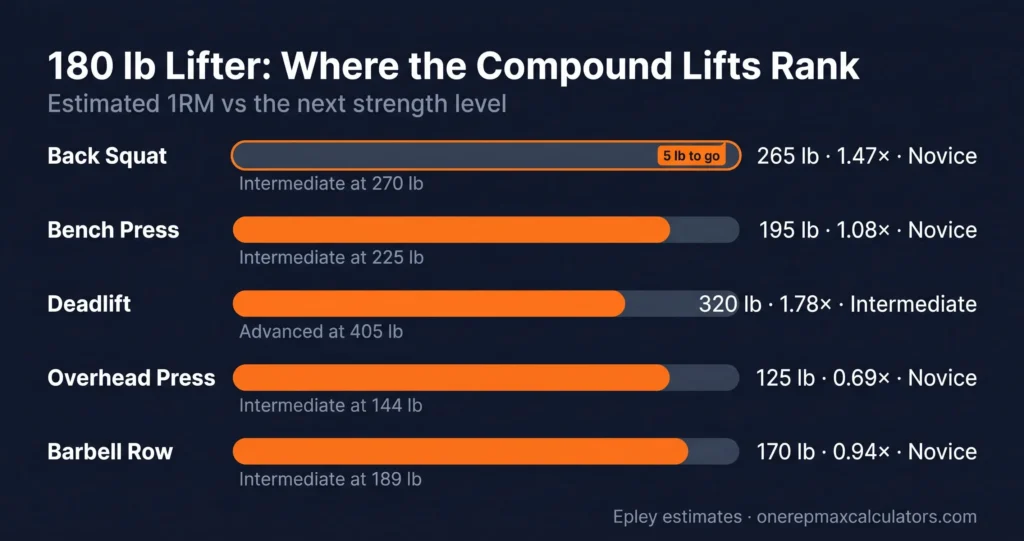
The squat is 5 lb from Intermediate. The bench press is 30 lb away, the furthest of the four Novice lifts from Intermediate, so that’s the lift this lifter should push hardest next.
Where Compound Lifts Go in a Workout
Compound lifts go first in the session, while you’re fresh, with isolation work after. The ACSM’s 2009 position stand recommends sequencing “multiple-joint exercises before single-joint exercises” so the heaviest lifts get your best effort. Curl before you row and the row suffers, because your biceps are already tired.
A Simple Compound Lift Routine Template
A beginner’s compound lift routine can be this short:
- Warm up, then do one main compound lift such as the squat for heavy sets of 3–6.
- Move to a second compound lift, usually the bench press or overhead press, for moderate sets.
- Add one or two assistance or isolation exercises for a weak point.
- Finish with optional core or conditioning work.
Run it two or three days a week, the range the ACSM gives for novices. The guides to progressive overload on compound lifts and how often to train each lift cover weight jumps and weekly frequency.
Common Mistakes with Compound Lifts
Most compound lift mistakes come from misreading the term or rushing the numbers:
- Calling every barbell exercise compound. A barbell curl is isolation no matter what’s on the bar.
- Maxing out in week one. A true single on an unpracticed lift is a form test you’ll probably fail; estimate from a set of 5 instead, as the 1RM guide for beginners explains.
- Dropping isolation work when one muscle keeps stalling a lift. Triceps that give out at lockout every week need a few sets of extensions more than another bench day.
- Saving the compound lifts for the end, after the muscles that stabilize them are tired.
- Chasing a number past good form. If a lift hurts, stop and get it checked by a qualified professional.
Frequently Asked Questions
Start on your next training day. Pick a weight you can move for a hard set of 5 on each main compound lift, write down the weight and reps, and enter them in the All Formulas 1RM Calculator. Those five estimates are your starting numbers for the compound lifts, and the Strength Standards Calculator will show which one needs the most work first.