
5/3/1 Program Guide: Using 1RM Percentages
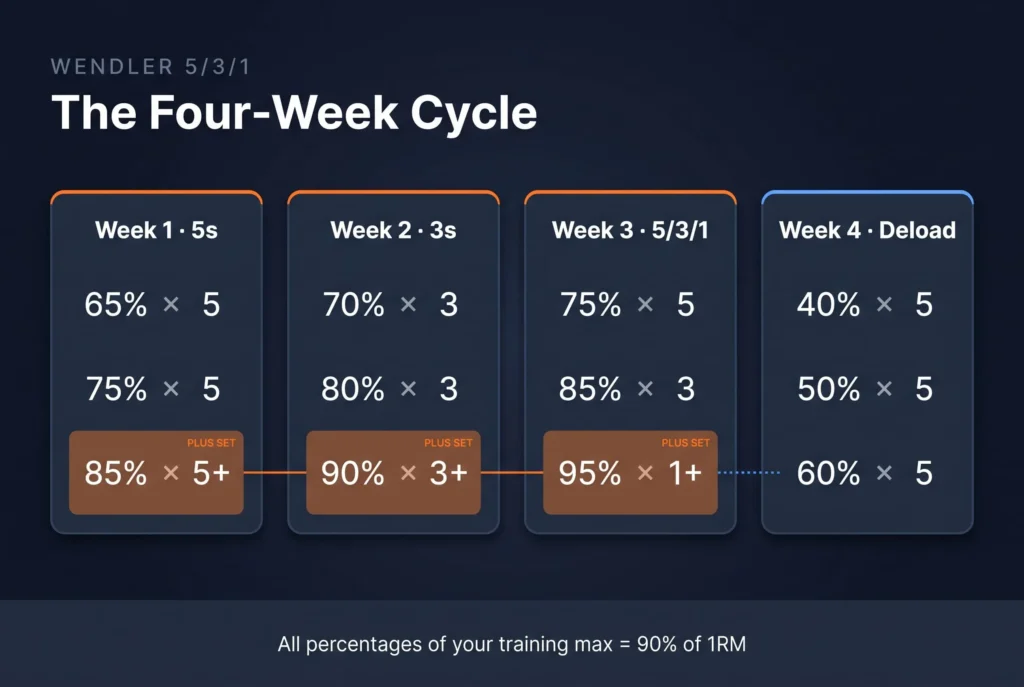
The 5/3/1 program is Jim Wendler’s four-week strength cycle, built on a training max of 90% of your one-rep max. Week 1 uses 65/75/85% for fives, week 2 70/80/90% for threes, week 3 75/85/95% for 5/3/1, and week 4 deloads. Each cycle adds 10 lb to lower-body and 5 lb to upper-body training maxes.
Every percentage in 5/3/1 comes from the training max, not your true one-rep max, and that’s the detail most lifters get wrong. This guide gives you the exact working weights in pounds and kilograms, how to log rep records, and how to progress cycle after cycle. The Training Max Calculator will build your numbers as you read.
What Is the 5/3/1 Program?
5/3/1 is a percentage-based strength program created by powerlifter and coach Jim Wendler, built around four main lifts and a four-week loading wave. The lifts are the back squat, bench press, deadlift, and overhead press. Each session trains one main lift, so most lifters run 3–4 sessions a week.
The program comes from Wendler’s books 5/3/1, Beyond 5/3/1, and 5/3/1 Forever, all listed on Jim Wendler’s official site. Later books added templates and options, but the four-week wave and the training max sit at the core of every version.
What Are the Core Principles of 5/3/1?
The 5/3/1 principles, paraphrased from Wendler’s books, explain why the program looks easy on paper:
- Start too light, with a 90% training max that deliberately leaves room to grow
- Progress slowly, with small fixed increases every four weeks
- Beat rep records, because the last set each week is a plus set, and more reps than last time count as progress
- Build the program on big multi-joint lifts: squat, bench press, deadlift, and overhead press
What Are the 5/3/1 Percentages?
5/3/1 percentages are fixed fractions of your training max, used for three working sets per session. They change each week of the four-week cycle.
| Week | Set 1 | Set 2 | Set 3 |
| Week 1 (5s) | 65% × 5 | 75% × 5 | 85% × 5+ |
| Week 2 (3s) | 70% × 3 | 80% × 3 | 90% × 3+ |
| Week 3 (5/3/1) | 75% × 5 | 85% × 3 | 95% × 1+ |
| Week 4 (deload) | 40% × 5 | 50% × 5 | 60% × 5 |
The 5/3/1 four-week wave, as percentages of training max. “+” marks a plus set: as many good reps as possible. Source: Jim Wendler, 5/3/1.
Is 5/3/1 Lighter Than It Looks?
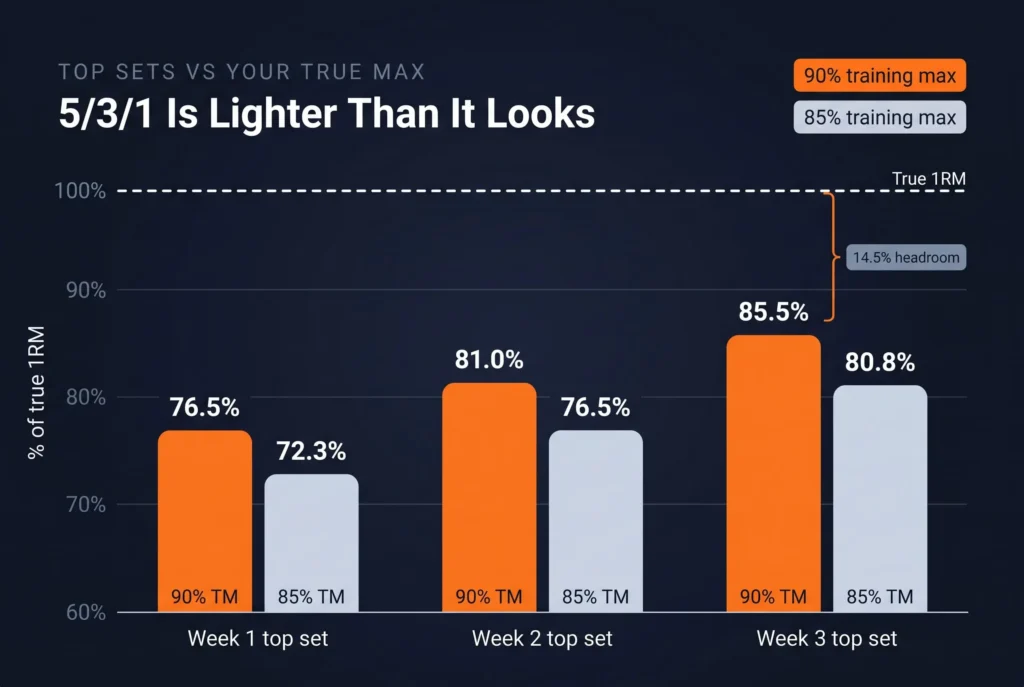
Yes. Because every 5/3/1 percentage comes from a training max rather than a true max, the heaviest top set in the program never goes above 85.5% of your real one-rep max.
| Week | % of training max | With a 90% training max | With an 85% training max |
| Week 1 top set | 85% | 76.5% of 1RM | 72.3% of 1RM |
| Week 2 top set | 90% | 81.0% of 1RM | 76.5% of 1RM |
| Week 3 top set | 95% | 85.5% of 1RM | 80.8% of 1RM |
5/3/1 top sets as a percentage of true one-rep max, calculated by onerepmaxcalculators.com.
That margin explains how plus sets reach double-digit reps and how the program runs for months without stalling. To convert any other percentage, see How to Calculate % of 1RM.
How Do You Set Your 5/3/1 Training Max?
A 5/3/1 training max is 90% of your current one-rep max, and it’s the base for every percentage in the program. Set one for each of the four lifts:
- Find your one-rep max for each lift. Test it, or estimate it from a recent 3–5 rep set with the one rep max calculator.
- Multiply by 0.90, or by 0.85 for a more conservative start.
- Round to your smallest plate jump.
- Multiply the training max by each week’s percentages and round again.
Should Your 5/3/1 Training Max Be 85% or 90%?
The 90% training max is Wendler’s original default and suits most intermediate lifters. An 85% training max suits beginners, lifters returning from a break, and anyone whose plus sets keep falling short.
The test is the week 1 plus set: if you can’t get at least 5 reps at 85% of your training max, the training max is too high. The Training Max Calculator lets you compare both settings side by side.
5/3/1 Worked Example: 300 lb Squat
A 300 lb squat gives a 270 lb training max at 90%. Here’s the full four-week cycle, rounded to the nearest 5 lb.
| Week | Set 1 | Set 2 | Set 3 |
| Week 1 | 175 lb × 5 | 205 lb × 5 | 230 lb × 5+ |
| Week 2 | 190 lb × 3 | 215 lb × 3 | 245 lb × 3+ |
| Week 3 | 205 lb × 5 | 230 lb × 3 | 255 lb × 1+ |
| Deload | 110 lb × 5 | 135 lb × 5 | 160 lb × 5 |
Full 5/3/1 cycle for a 300 lb squat and 270 lb training max, 5 lb rounding.
Watch the 75% sets. 75% of 270 lb is 202.5 lb, which rounds to 205 lb, not 200 lb as several popular examples show.
The same cycle in kilograms, for a 140 kg max and a 126 kg training max at 2.5 kg rounding, runs 82.5 / 95 / 107.5 kg in week 1, 87.5 / 100 / 112.5 kg in week 2, 95 / 107.5 / 120 kg in week 3, and 50 / 62.5 / 75 kg in the deload. The Percentage & Rep-Max Table generates the same grid for any max.
What Are 5/3/1 Plus Sets?
A 5/3/1 plus set is the last set of weeks 1–3, done for as many quality reps as possible, and it’s the program’s main measure of progress. The number in the plan (5+, 3+, 1+) is the minimum, not the target.
Stop each plus set 1–2 reps short of failure, with the bar speed and form still clean. Lifters are fairly accurate at judging reps left in the tank, according to research on reps-in-reserve ratings by Zourdos and colleagues in 2016. The RPE Calculator turns that judgement into a number.
How Do You Track Rep Records on 5/3/1?
Wendler estimates a rep record with weight × reps × 0.0333 + weight. That’s the Epley formula, because 0.0333 is 1 divided by 30, and it’s the same equation behind this site’s one rep max calculator.
| 5/3/1 plus set | Estimated 1RM (Epley) |
| 230 lb × 10 | 306.7 lb |
| 245 lb × 6 | 294.0 lb |
| 255 lb × 3 | 280.5 lb |
Plus sets from a 270 lb squat training max converted to an estimated one-rep max.
Compare each plus set with the same week of the previous cycle. A higher estimated max means progress, even when the rep count looks lower because the weight went up.
What Happens in the 5/3/1 Deload Week?
The 5/3/1 deload is week 4: three easy sets of five at 40%, 50%, and 60% of training max. For a 270 lb squat training max, that’s 110, 135, and 160 lb.
The deload lets fatigue clear before the next cycle starts heavier. Many 5/3/1 Forever templates swap the every-fourth-week deload for a “7th week” after two cycles, used for either a deload or a training max test. Pick one approach and use it consistently.
How Fast Does 5/3/1 Progress?
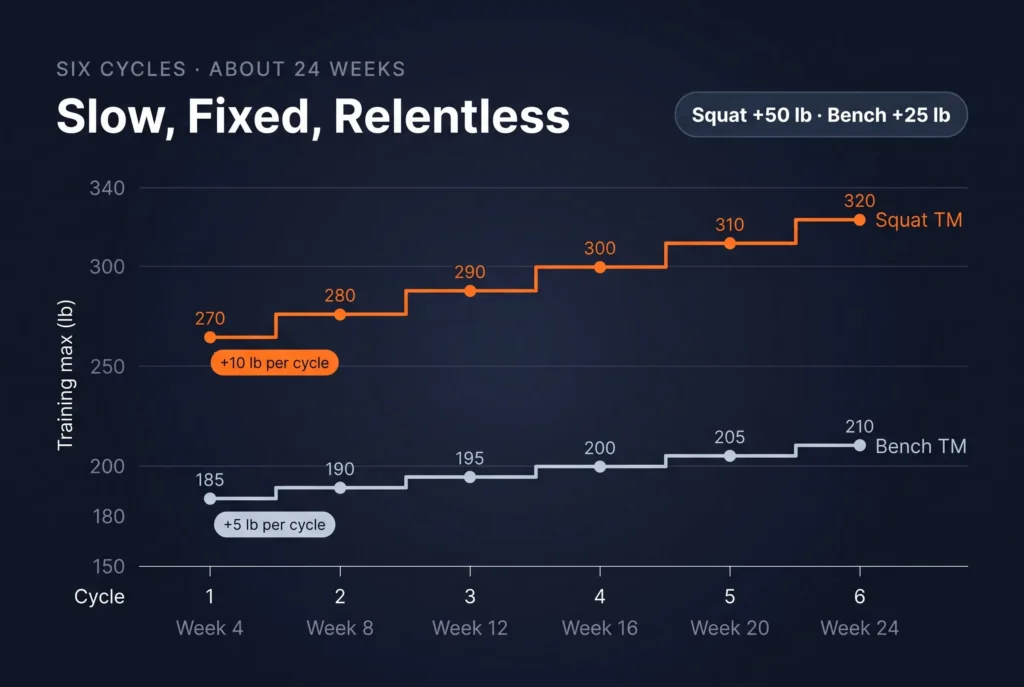
5/3/1 progresses by adding a fixed amount to each training max after every four-week cycle: 10 lb (5 kg) for squat and deadlift, and 5 lb (2.5 kg) for bench press and overhead press. ACSM’s position stands on progression in resistance training, recommending load increases of 2–10% once a lifter beats their target reps, and 5/3/1’s steps sit inside that range for most lifters.
| Cycle | Squat TM | Squat, week 3, single | Bench TM | Bench week 3 single |
| 1 | 270 | 255 | 185 | 175 |
| 2 | 280 | 265 | 190 | 180 |
| 3 | 290 | 275 | 195 | 185 |
| 4 | 300 | 285 | 200 | 190 |
| 5 | 310 | 295 | 205 | 195 |
| 6 | 320 | 305 | 210 | 200 |
Six 5/3/1 cycles from a 270 lb squat and 185 lb bench training max. Six cycles take about 24 weeks, roughly 5.5 months. All values in lb, 5 lb rounding.
What Should You Do If You Stall on 5/3/1?
A 5/3/1 stall means missing the minimum reps on a plus set, such as fewer than 5 reps in week 1. The fix is to reset that lift’s training max, commonly by about 10%, and build back up with the normal increments.
A reset feels like a step back, but it usually puts you above your old rep records within two or three cycles. Check the exact reset rule in the edition of Wendler’s book you follow, because it has changed over time.
Which 5/3/1 Assistance Template Should You Use?
A 5/3/1 assistance template is the extra work you do after the main sets. The four most common options are:
| Template | Extra work after main sets | Best for |
| Boring But Big (BBB) | 5 × 10 of the same lift at 50–60% of training max | Size and work capacity |
| First Set Last (FSL) | Repeat the first working set for 3–5 sets. | Extra practice with less fatigue |
| Triumvirate | Main lift plus 2 assistance exercises, 5 sets each | Simple, balanced sessions |
| Joker sets | Heavier singles or doubles above the top set on good days | Experienced lifters only |
Popular 5/3/1 assistance templates. Exact prescriptions vary between Wendler’s books.
Boring But Big is the most popular choice for lifters who want muscle as well as strength. The first set last is the gentler option when recovery is tight.
Is 5/3/1 Good for Beginners?
5/3/1 works for beginners who use an 85% training max and keep assistance simple. Beginners on 5/3/1 gain steadily but slowly, since training maxes rise only once every four weeks.
True novices often progress faster on a linear program first, adding weight every session for 3–6 months, then switch to 5/3/1 once those gains slow. If you’ve never estimated a max before, 1RM for Beginners covers how to get a safe starting number.
What Are the Most Common 5/3/1 Mistakes?
Most 5/3/1 problems come from setup, not effort:
- Using the true one-rep max instead of the training max, which makes every set about 10% too heavy
- Setting the training max from an old or inflated max instead of a recent set
- Grinding plus sets to failure every week instead of leaving 1–2 reps in reserve
- Adding weight faster than 10 lb and 5 lb per cycle
- Always rounding down, which turns a 202.5 lb set into 200 lb instead of 205 lb
- Skipping the deload, which lets fatigue build until plus sets stall
The first mistake causes the most trouble. A training max is the program’s safety margin, and dropping it removes the room that makes 5/3/1 work.
How Do You Use the Calculators for 5/3/1?
Four tools on this site cover every number in a 5/3/1 cycle:
- Estimate each one-rep max with the one rep max calculator.
- Set training maxes and generate every week’s weights with the Training Max Calculator.
- Check plus-set effort with the RPE Calculator.
- Look up any other percentage with the % of 1RM Calculator.
Frequently Asked Questions
5/3/1 works because it starts light, progresses slowly, and measures progress through rep records instead of max tests. Set the training max correctly and the rest is arithmetic. The Strength Training Programming guide shows where 5/3/1 fits among other programs, the Training Max Calculator builds your cycle, and lifters heading to competition can see first powerlifting meet preparation.