
Linear Periodization for Strength Beginners
You’re adding weight every session. The bar goes up, the body responds, and the cycle repeats. What you’re running is linear periodization, and understanding how it works tells you both how long it’ll last and how to get the most out of it.
Linear periodization is a training method that increases load by a fixed amount each session or week. Beginners use it because their neuromuscular system adapts rapidly enough to handle new stress every 48–72 hours. It’s the most efficient path to strength for a lifter with under six months of consistent barbell training.
What Is Linear Periodization?
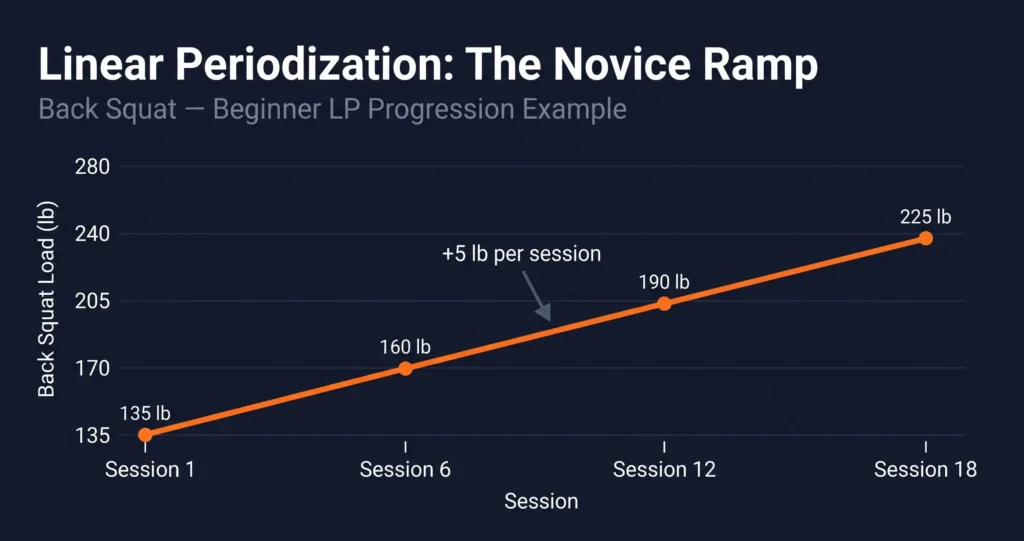
LP is the most direct mechanical expression of progressive overload: add weight each session, recover in the gap, and arrive slightly stronger. The load climbs in a straight line with no rotating intensities or periodized waves. Two variants suit different stages of development, and understanding which one applies determines how long you can run it.
The Stress–Recovery–Adaptation Mechanism
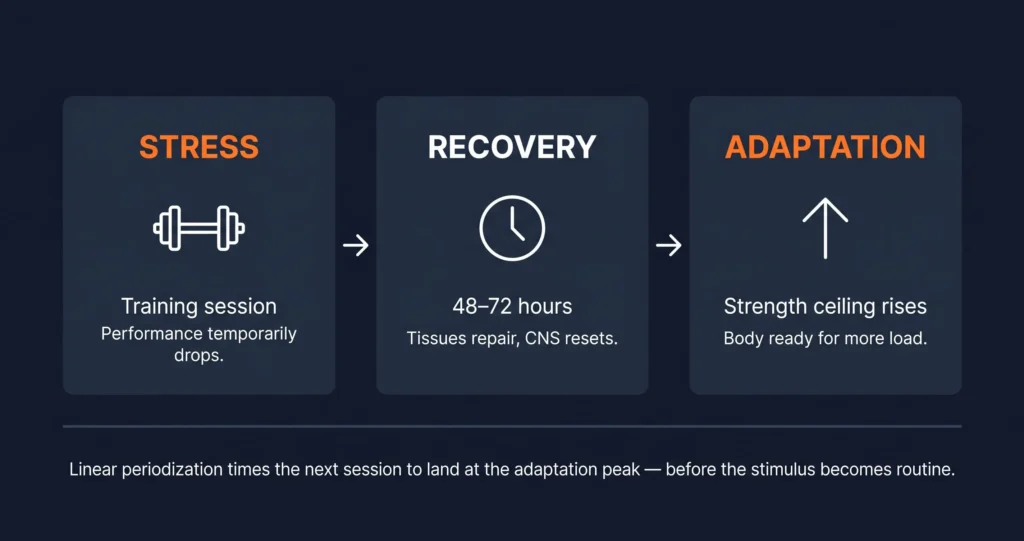
Hans Selye’s General Adaptation Syndrome sets the timing. A training session applies a stress stimulus; in the 48 to 72 hours that follow, the body repairs and adapts. Each recovery cycle raises the performance ceiling slightly above where it started. LP times the next session to land at that new ceiling before the body plateaus.
Beginners sustain session-to-session jumps because their primary adaptation is neural, not hypertrophic. Sale (1988) demonstrated that early strength gains in untrained individuals are driven by improvements in motor unit recruitment and firing rate (Sale, 1988). Those neural changes reset within 48 to 72 hours. The muscle doesn’t need to grow much yet; the nervous system simply gets better at using what’s already there.
For an intermediate, session-to-session increments fail within two to three weeks. Neural gains are largely spent; further progress requires muscle growth, which takes 10 to 14 days to consolidate.
Session-to-Session vs. Week-to-Week LP
LP comes in two variants.
| Feature | Session-to-Session LP | Week-to-Week LP |
| Who it suits | Novice (0–6 months consistent training) | Early intermediate (6–18 months) |
| Weight increase timing | Every training session | Every training week |
| Typical programs | Starting Strength, StrongLifts 5×5 | 5/3/1 (weekly training max increase) |
| Typical increment | 5 lb lower body / 2.5 lb upper | 5–10 lb per training cycle |
| Typical duration | 3–6 months | 6–18+ months |
Session-to-session LP demands full recovery between sessions. Only novice lifters adapt quickly enough to sustain that pace.
Mark Rippetoe’s Starting Strength and StrongLifts are the standard-bearers for session-to-session LP. Jim Wendler’s 5/3/1 applies the same logic week to week by increasing the training max 5–10 lb per cycle, a structure suited to a lifter whose neural gains are mostly spent and whose progress is now driven by hypertrophy.
How to Run a Novice Linear Progression?
Your starting weight and session increment determine how the first phase goes; the stall protocol handles everything after the first missed rep. All three are covered below.
How Much Weight to Add per Lift
The ACSM position stand on resistance training progression recommends load increases of 2–10% per microcycle (Ratamess et al., 2009). For a novice squatting 200 lb, that’s 4 to 20 lb per session. In practice, stay at the lower end; smaller increments extend the LP window by weeks.
| Lift | Session Increment | Why This Amount | Notes |
| Back Squat | 5 lb | Largest muscle mass; fastest novice neural adaptation | 2 × 2.5 lb plates per side |
| Deadlift | 5–10 lb | High neural demand; larger early jumps are sustainable. | Pull 1–2× per week |
| Bench Press | 2.5–5 lb | Smaller musculature; 5 lb stalls within 4–6 weeks | Switch to 2.5 lb at the first sign of struggle. |
| Overhead Press | 2.5 lb | Stalls before any other lift | 2 × 1.25 lb plates per side |
| Barbell Row | 5 lb | Technique-dependent; larger jumps mask form issues early. | Reduce to 2.5 lb once the form is consistent. |
If your gym doesn’t stock 1.25 lb plates, a pair costs under $15 and adds weeks to your LP on upper-body lifts.
The plate math:
- A 2.5 lb increase = one 1.25 lb plate per side
- A 5 lb increase = one 2.5 lb plate per side
- A 10 lb increase = one 5 lb plate per side
- No 1.25 lb plates at the gym: buy a pair; they cost less than a training session and extend LP by weeks on bench and OHP
Starting Weight, Frequency, and Logging
Three things need to be in place before you start:
- Consistent availability for three sessions per week; irregular attendance breaks the 48-hour adaptation window LP depends on
- Ability to perform the back squat, bench press, deadlift, and OHP with a consistent bar path and bracing; LP increases load every session, so form errors compound fast
- Access to 1.25 lb plates for upper-body increments; without them, bench and OHP stall within three to four weeks
Once those are confirmed:
- Estimate your starting weight: enter a recent set of 5 reps into the one rep max calculator and take 80–85% of the estimated 1RM as your Day 1 working weight per lift. Starting conservatively is intentional; the first two weeks calibrate bar path and bracing before the weight becomes demanding.
- Set your increment per lift: use the table above—5 lb for squat and deadlift, 2.5–5 lb for bench, 2.5 lb for OHP, and 5 lb for row.
- Schedule three sessions per week: Mon/Wed/Fri spacing keeps recovery gaps consistent. Squat every session, alternate bench and OHP, and pull deadlift once or twice per week.
- Log every session: write the date, lift, weight, sets, and reps completed. Don’t rely on memory.
The Stall Protocol
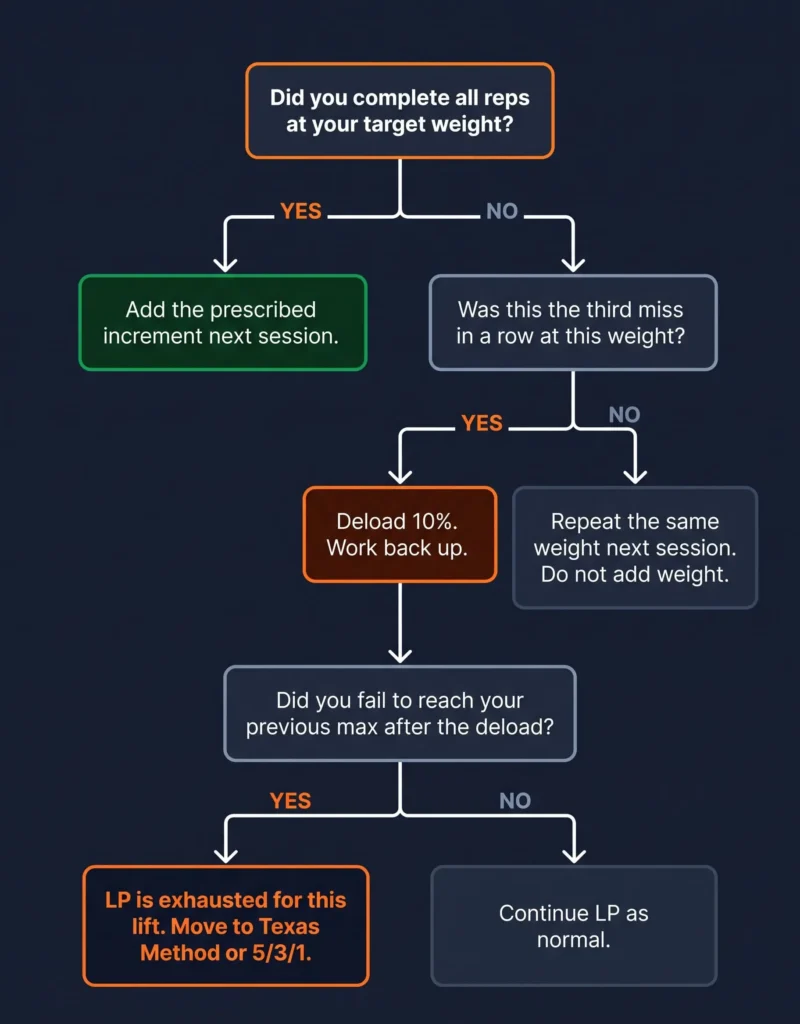
Three misses at the same weight trigger the same response every time.
- Apply the stall protocol: deload the lift by 10% and work back up at normal increments. Use the training max calculator to recalculate working weights after the deload.
Working back up doesn’t mean repeating the deload weight once and jumping back to the previous max. You climb at the same increments used on the way up. That climb is faster than the original; you’re re-expressing strength you already built.
One stall cycle is normal. LP has this built in. The deload-and-return is part of the method, not a sign it’s failing.
When LP Stops Working
A single stall cycle is handled by the protocol above. Linear periodization exhaustion is different: the method has genuinely run its course, and additional deload cycles won’t fix it.
Signs You’ve Outgrown the Novice Phase
Four specific, observable signals mean LP is done for a given lift:
- You’ve run the deload protocol on the same lift twice and failed to reach your previous maximum after the second return
- Your rate of gain has dropped below 5 lb per week (not per session, per week) on lower-body lifts
- Fatigue is accumulating week to week rather than resolving within 48 hours between sessions
- You’ve been training consistently for more than six months
OHP typically stalls first. Squat tends to last longest. Most lifters misread the first stall as program failure; running the deload protocol and trying again is almost always the right call before concluding LP is done.
What Comes After LP
The two most common next steps are the Texas Method and 5/3/1. The Texas Method separates high-volume work from maximal-intensity work across the training week. 5/3/1 applies LP at the training max level rather than session-to-session on the work set.
Both have their own guides, linked once live: Texas Method and Starting Strength 1RM Tracking. The strength training guides cover broader programming options once you’re past the novice phase.
Linear Periodization vs Daily Undulating Periodization
Rhea et al. (2002) compared LP and daily undulating periodization (DUP) over 12 weeks in trained men. DUP produced 28.8% bench press strength gains; LP produced 14.4% (Rhea et al., 2002). That difference is real. For beginners, it’s also largely irrelevant.
The study used trained subjects, not novices. Trained lifters have already exhausted most of their neural adaptation capacity, which is exactly where DUP’s variety across rep ranges provides an edge. A novice hasn’t exhausted anything. Their nervous system responds to almost any consistent compound barbell training with rapid strength gains in the early months.
DUP also requires managing three distinct rep ranges per week. For someone still grooving a consistent bar path on the squat, that complexity burns cognitive overhead the method doesn’t need. LP’s single variable makes it easy to see what’s working.
Run linear periodization until it stops. Switch to a method designed for a slower adaptation profile once it does.
Common Mistakes on Linear Periodization
These are the errors that end linear periodization before it’s actually run its course:
- Starting at 90% of tested max: leaves almost no room to add weight in the first two weeks; most lifters stall before the method has had a fair run
- Missing sessions and keeping the next increment: LP assumes 48-hour recovery windows; a five-day gap doesn’t bank extra recovery, it disrupts the adaptation cycle
- Adding weight on an incomplete set: LP increments only after completing the full rep target; adding weight after missing reps compounds fatigue rather than driving adaptation
- Running LP on isolation exercises: curls and lateral raises don’t follow the same neural adaptation curve as compound barbell lifts and don’t benefit from session-to-session loading
- Treating the first stall as program failure: one stall cycle is built into LP; two or three exhausted deload cycles is the real signal to move on
How to Track LP Progress with the Calculator?
Two points in the linear periodization cycle benefit from the calculator.
At the start, enter a recent set of 5 reps into the one rep max calculator to get your estimated 1RM, then take 80–85% of that figure as your Day 1 working weight. This gives you a principled starting point rather than guessing.
After any deload, use the training max calculator to recalculate working weights from the new baseline. It removes the math and keeps the weights you’re climbing back through correctly spaced.
Linear Periodizations FAQs
LP is designed to run out. When the last stall cycle confirms it’s done, the progression doesn’t stop; it changes form. The Texas Method restructures your week around volume and intensity days. 5/3/1 applies LP at the training max level. Both build directly on the foundation novice linear periodization established.