
Texas Method: Volume and Intensity Days Explained
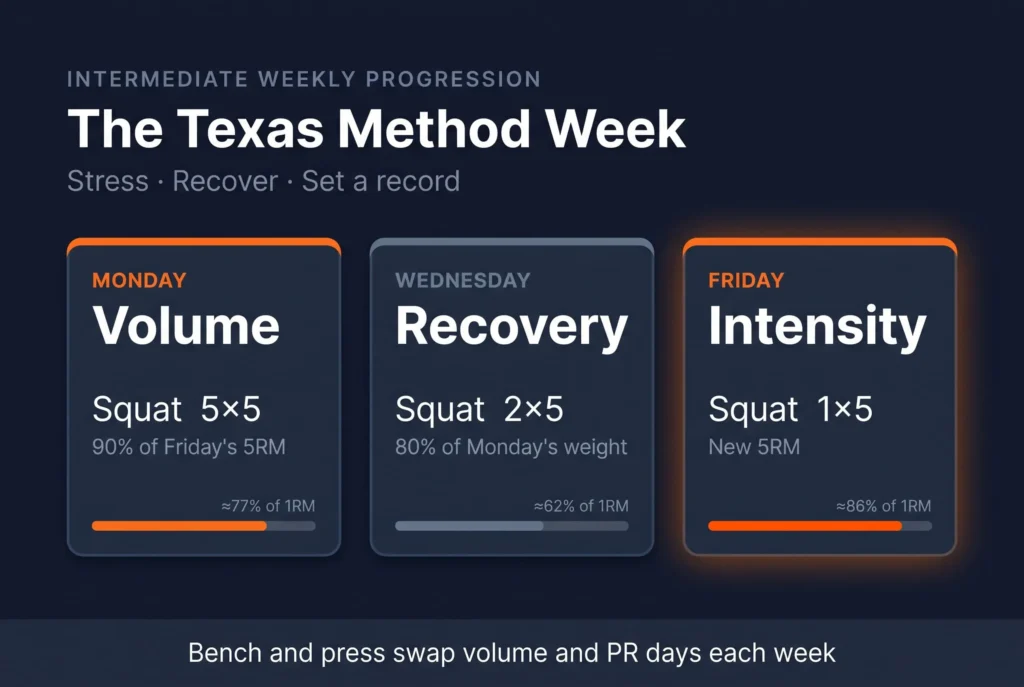
The Texas Method is a three-day intermediate strength program: Monday’s volume day is 5×5 at about 90% of your 5RM, Wednesday’s recovery day squats about 80% of Monday’s weight, and Friday’s intensity day sets a new 5RM. Each week adds roughly 5 lb to the squat, and each press moves every second week.
Your squat has stopped moving session to session, and the last few 3×5 workouts ground out even after a reset. That’s where the Texas Method takes over. Below are the percentages that link its three days, a six-week example in pounds, Andy Baker’s four-week switch from a novice program, and stall fixes with clear thresholds, so keep the one rep max calculator open.
What Is the Texas Method?
The Texas Method is a weekly-progression strength program in which one hard-volume day, one light day, and one heavy day combine so you can set a new personal record every Friday. It’s associated with weightlifting coach Glenn Pendlay and the lifters at the Wichita Falls Athletic Club, and Mark Rippetoe published it in Practical Programming for Strength Training.
It’s an intermediate program. A novice adds weight every session; an intermediate needs a full week of stress and recovery before the bar goes up. That’s still progressive overload, just on a seven-day clock instead of a two-day one.
| Day | Week A | Week B |
| Monday (Volume) | Squat 5×5 · Bench 5×5 · Deadlift 1×5 | Squat 5×5 · Press 5×5 · Deadlift 1×5 |
| Wednesday (Recovery) | Squat 2×5 light · Press 3×5 light · Chin-ups · Back extensions | Squat 2×5 light · Bench 3×5 light · Chin-ups · Back extensions |
| Friday (Intensity) | Squat 1×5 PR · Bench 1×5 PR · Power clean 5×3 | Squat 1×5 PR · Press 1×5 PR · Power clean 5×3 |
Table 1: Texas Method two-week template, work sets only. Bench and press swap roles each week. Common template; adjust the pulls to your goals.
What Happens on Volume Day?
Texas Method volume day is Monday’s 5×5 at about 90% of your current Friday 5RM, and it’s the session that drives the week’s adaptation. Andy Baker describes the volume load as roughly 10% below the intensity-day 5RM. That’s 25 work reps on the squat, the most work you’ll do all week.
Rest long enough between sets to finish every rep. Monday should feel hard and finish clean. A fifth set that grinds every single week means 90% is too high for you right now.
Why 90% of Your 5RM?
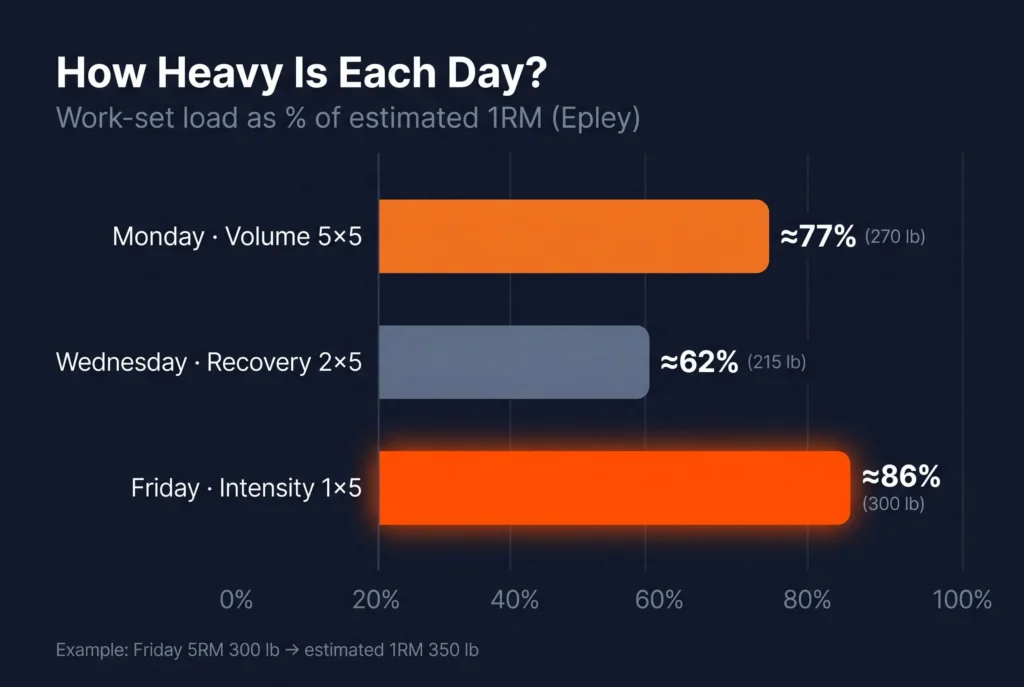
Ninety percent of a 5RM works out to about 77% of your estimated 1RM. By the Epley formula, 77% allows roughly 9 reps, so each set of five stops 3–4 reps short of failure. One set is easy. Twenty-five reps of it is what makes Friday possible.
What Happens on Recovery Day?
Texas Method recovery day is Wednesday’s light session: squats at about 80% of Monday’s weight, usually 2×5, plus light pressing and back work. Its job is to keep the squat pattern practiced without adding fatigue that Friday has to pay for. Chin-ups and back extensions are the usual extras.
The 80% figure comes from the common template. Andy Baker’s own transition example runs Wednesday closer to 90% of Monday, so treat 80% as the starting point and 90% as the ceiling.
The quickest way to ruin the program is chasing Wednesday’s weight. Wednesday’s load should follow Monday’s, never lead it. Training volume vs intensity explains why heavy and light days need each other.
What Happens on Intensity Day?
Texas Method intensity day is Friday’s attempt at a new five-rep max: one set of five, slightly heavier than last week’s. If Monday was too heavy, Friday usually tells you first.
Andy Baker’s guide to the Texas Method intensity day suggests adding about 5–10 lb a week early on. In practice that settles to about 5 lb a week on the squat. The bench press and press each get a Friday PR attempt every second week, so each moves about 5 lb per two weeks.
Weekly 5RMs don’t last forever. Baker puts the run at about 4–8 weeks, after which Friday moves to lower rep targets (covered under stalls).
How Do the Three Days Connect?
The three Texas Method days are tied together by percentages: Monday is set from Friday’s 5RM, and Wednesday is set from Monday. Change Friday’s number, and the week moves with it.
| Day | Rule | % of Friday 5RM | % of e1RM | Example load |
| Monday (Volume) | 90% of Friday’s 5RM, 5×5 | 90% | ≈77% | 270 lb |
| Wednesday (Recovery) | 80% of Monday’s weight, 2×5 | 72% | ≈62% | 215 lb |
| Friday (Intensity) | New 5RM, 1×5 | 100%+ | ≈86% | 300 lb |
Table 2: Texas Method percentages by day. Example uses a 300 lb Friday 5RM (e1RM 350 lb, Epley); loads rounded half-up to 5 lb. Check your own in the % of 1RM calculator.
Texas Method Worked Example: Six Weeks of Squats
This six-week squat block starts from a 300 lb Friday 5RM and adds 5 lb a week to every day.
| Week | Monday 5×5 | Wednesday 2×5 | Friday 1×5 (PR) | Friday e1RM (Epley) |
| 1 | 270 | 215 | 300 | 350.0 |
| 2 | 275 | 220 | 305 | 355.8 |
| 3 | 280 | 225 | 310 | 361.7 |
| 4 | 285 | 230 | 315 | 367.5 |
| 5 | 290 | 230 | 320 | 373.3 |
| 6 | 295 | 235 | 325 | 379.2 |
Table 3: Six-week Texas Method squat progression in lb. Monday = 90% of that week’s Friday target; Wednesday = 80% of Monday; rounded half-up to 5 lb.
The bench press follows the same rule on its own two-week clock. A 225 lb bench 5RM gives a 205 lb 5×5 on its volume Monday, with a 230 lb attempt two Fridays later.
Weekly squat work comes to 40 reps (25 + 10 + 5), against 45 on a novice 3×5 three times a week. The program doesn’t add reps; it concentrates them on Monday.
How to Switch from Starting Strength to the Texas Method
Switch to the Texas Method when you can no longer add weight to your squat every session, even after a reset, while sleeping and eating well. Andy Baker’s rule: base your first 5RM on the last 3×5 you actually completed, because a failed attempt overstates where you are.
- Find the last 3×5 squat weight you completed. In Baker’s example, it’s 305 lb.
- Set week 1’s Friday set of five about 10 lb below it (295 lb).
- Set Monday’s 5×5 at about 90% of that Friday weight (265 lb).
- Squat Wednesday light for 2×5.
- Add 5 lb a week to each day. Friday ties the old weight in week 3 and beats it in week 4.
| Week | Monday 5×5 | Wednesday 2×5 | Friday 1×5 |
| 1 | 265 | 240 | 295 |
| 2 | 270 | 245 | 300 |
| 3 | 275 | 250 | 305 (ties old 3×5) |
| 4 | 280 | 255 | 310 (new 5RM) |
Table 4: Andy Baker’s four-week transition example, squat loads in lb. Source: Baker (2017), Starting Strength. Baker’s Wednesday sits near 91% of Monday.
The lighter early weeks let Monday’s new volume settle before you push for records. Optimal workout frequency explains why three days a week stays the norm.
Who Should Run the Texas Method?
The Texas Method suits early intermediates who’ve used up novice progress. You’re probably ready if these fit:
- Session-to-session squat gains have stopped, even after one reset.
- You recover from one very hard session a week.
- Three sessions of 60–90 minutes fit your schedule.
- Your goal is strength or a powerlifting meet more than size or conditioning.
Age changes the picture. Baker suggests recreational lifters over 35–40 consider a heavy-light-medium or split routine instead, because Monday’s 25 heavy reps get harder to recover from. Not past novice gains yet? Read 1RM for beginners first.
Why Does Mixing Heavy and Light Days Work?
Varying load across the week lets you apply more stress than a novice program while recovering enough to show the result a few days later.
A 2002 study comparing linear and undulating programs by Rhea and colleagues ran 20 men through 12 weeks of equal-volume training, 3 days a week. The group that varied load day to day raised bench press strength 28.78%, against 14.37% for the linear group, and leg press 55.78% against 25.61%. Twenty men is a small sample, and it wasn’t a Texas Method study.
ACSM’s position stand on progression in resistance training (2009) also recommends varied, periodized loading once lifters move past the novice stage. The evidence backs varying load in general, and it says nothing about 90% and 80% specifically. Treat those numbers as starting points.
What to Do When You Stall on the Texas Method
A Texas Method stall is two or more Fridays in a row without a new 5RM, despite good sleep and food. Find which day is failing, then change one thing at a time.
| What you see | Day to change | What to do |
| Monday grinds, Friday misses | Volume | Drop to 80–85% of 5RM, or cut to 4×5 or 3×5. |
| Monday is fine; Friday misses. | Intensity | Rotate Friday to triples, then doubles, then singles. |
| Stale on 5×5 | Volume | Swap to 6×4 or 8×3 at a similar workload. |
| Friday rep rotation stalls too. | Intensity | Run 3-week waves of 3s, 2s, and 1s, later 5-3-1 or 6-4-2. |
| Everything stalls, life stress is high. | Whole program | Take 1–2 lighter weeks, then rebuild |
Table 5: Texas Method stall decision table. Fixes from Baker (2017) and Barbell Logic.
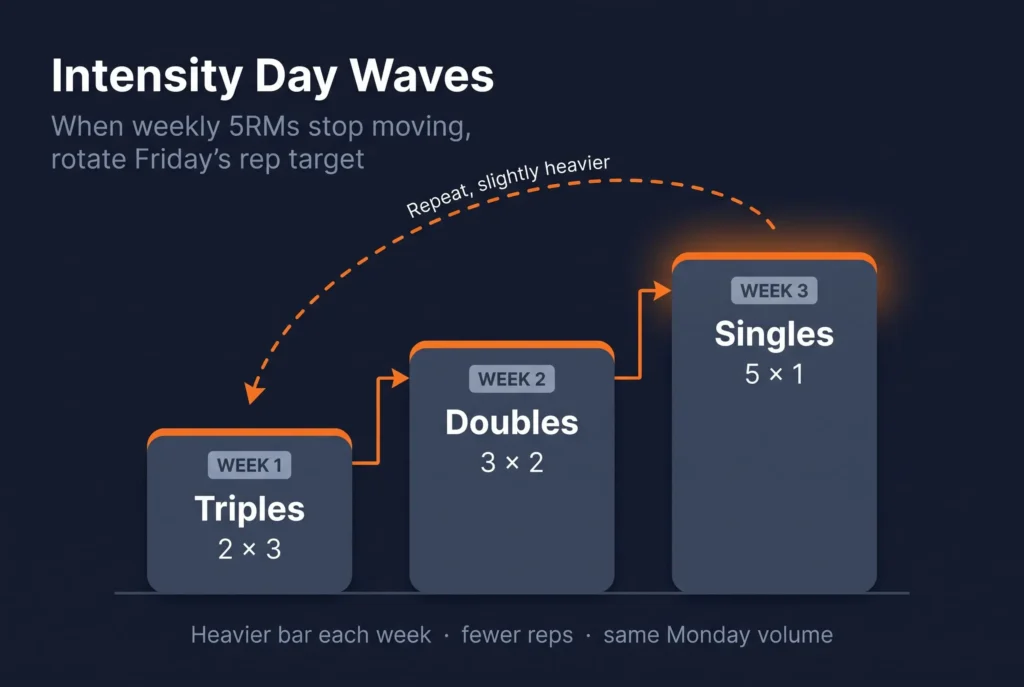
Baker’s usual Friday sets for a new intermediate are two triples, three doubles or five singles. Before changing anything, check these:
- Wednesday hasn’t crept heavier than Monday’s percentage allows.
- Monday’s rest periods are long enough to finish every rep.
- Bodyweight and sleep haven’t dropped.
- Friday warm-ups aren’t eating into the top set. The warm-up ramp builds lighter jumps for you.
How to Track Progress on the Texas Method?
Track Texas Method progress with one estimated 1RM per week from Friday’s top set, so progress still shows when the rep target changes.
| Friday top set | Epley e1RM |
| 300 × 5 | 350.0 lb |
| 315 × 3 | 346.5 lb |
| 330 × 2 | 352.0 lb |
| 340 × 1 | 351.3 lb |
Table 6: Comparing Friday rep schemes by e1RM, calculated with Epley. Compare your own weeks in the All Formulas 1RM Calculator.
All four sets land within about 6 lb of each other. Epley adds 3.3% to a single, so a 340 lb single “estimates” 351.3 lb even though it was your max that day. How accurate 1RM calculators are explains where that error comes from, and Epley vs Brzycki formulas helps you pick one formula to log every week.
Common Texas Method Mistakes
Ranked by how often they stall lifters:
- Making Wednesday a second hard day. Recovery day exists so Friday can be heavy.
- Setting Monday from an old max instead of this week’s Friday target.
- Jumping Friday 10 lb every week past the first few. Five pounds on a 300 lb 5RM is about 1.7% a week, which is plenty.
- Switching too early. Leaving a novice program while session-to-session gains still work gives up weeks of easy progress.
- Piling assistance work onto Monday, which steals recovery from Friday.
- Testing true 1RMs mid-program. Friday’s e1RM tells you enough, so save singles for a planned peak and follow how to test your one rep max when you do.
Most Texas Method stalls start on Monday or Wednesday. Fix the setup days before you blame the PR attempt.
How to Use the Calculators for the Texas Method?
Log a weekly e1RM by entering Friday’s top set in the one rep max calculator with the squat selected. For pressing weeks, use the bench press one rep max calculator or switch to the press.
The % of 1RM calculator works out Monday’s 90% and Wednesday’s 80% from any 5RM. Low-rep and missed-rep sets convert cleanly in the Rep Range to 1RM Converter. Moving on to 5/3/1 later? The Training Max Calculator sets your starting numbers from the e1RM you’ve been logging.
Texas Method FAQs
Monday sets the stress, Wednesday stays easy, and Friday tells you whether it worked. Keep the percentages linked to this week’s Friday target, log one Friday e1RM a week, and when that number stops climbing for two weeks, change one variable on the day that’s failing. The Strength Training Programming guide shows where this program sits among the programs you’ll run after it.