
Bench Press Calculator
Turn any set into your max bench, see where it ranks for your bodyweight, and get every working weight you need.
How strong is it?
Rep max chart
| Reps | Weight | % of max |
|---|
Percent of your max
| % of max | Weight | Typical reps |
|---|
Load the bar
Warm up to a max singleReady-to-load jumps with plates per side
| Set | Weight | Reps | Rest | Plates per side |
|---|
Bench with a spotter or safeties set just below chest height.
All 7 formulasEvery estimate, highest first
| Formula | Spread | Est. max |
|---|
★ Mayhew is the best fit for bench press. Compare every formula side by side in the all formulas 1RM calculator.
Nearby training weights
| Training weight | Reps needed |
|---|
Conversions are rule-of-thumb estimates. A barbell set of 3–8 reps beats any conversion.
Estimates come from 7 published 1RM formulas. A max bench changes with arch, grip, pause and bar path, so treat this as a planning number and test with a spotter.
Bench Press Calculator: How It Works and What Your Number Means
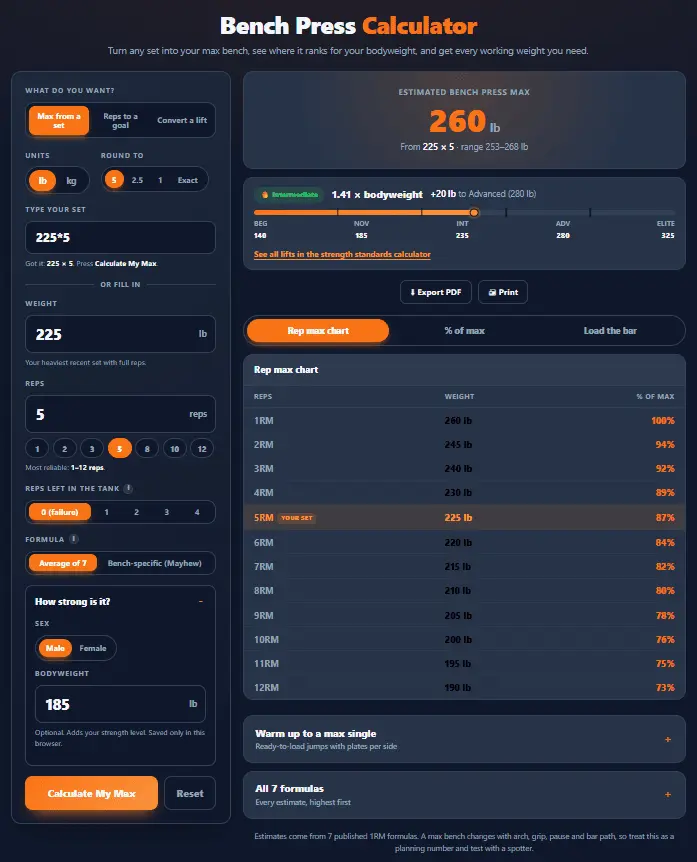
You hit 225 for five last week, and now you want to know what that set says about your max. The bench press calculator above turns any set into an estimated one-rep max. It then tells you how that number ranks for your bodyweight and what to load for every working set after it.
A bench press calculator estimates your one-rep max from a single set of 1–12 reps. Our tool averages seven published formulas and marks Mayhew as the best fit for the bench. For 225 × 5, that gives about 260 lb, with the formulas spread from 255 to 270 lb.
How to Use the Bench Press Calculator
The bench press calculator has three modes. Max from a set is the default and covers most visits. Reps to a goal and convert a lift answer the two questions people ask right after they see their number.
Max from a set
Max from a set turns a single hard set into an estimated one-rep max. Type the set the way you’d write it in a training log, such as 225×5, 185×8, or 275/3, and the calculator splits it into weight and reps for you. You can also fill in the two boxes separately.
- Pick lb or kg, and the plate jump you can actually load (5 lb or 2.5 kg for most gyms).
- Enter your set in quick entry, or type weight and reps.
- Set “reps left in the tank” if you stopped short of failure.
- Leave the formula on an average of 7, or switch to bench-specific (Mayhew).
- Add your sex and body weight once if you want a strength level. Your browser remembers both for next time.
The reps-left setting matters more than people expect. A set of five with two reps in reserve was really a seven-rep effort, so the calculator adds those reps before it runs the math. Entered honestly, 225 × 5 with two left in the tank moves the estimate from 260 to 275 lb. If you track effort on a 1–10 scale instead, the RPE calculator converts it for you.
Keep your test set between 3 and 8 reps. Above 12 reps the bench press calculator warns you, and above 20 it won’t estimate at all.
Reps to a goal
Reps to a goal work backwards. You enter the max you want and a weight you train with, and it tells you how many reps at that weight would predict the goal. It answers the classic gym question of how many reps of 135 you need to bench 225.
The answer is 20 reps, using the average of the seven formulas. That number surprises people, and it should make you suspicious. Twenty reps of 135 tests of endurance far more than it tests a 225 single, so the bench press calculator flags anything above 12 reps as a loose estimate. A more useful version of the same question is 185 for 8, which predicts about 230.
Convert a lift
Convert a lift estimates your barbell bench from a different pressing exercise. Every conversion uses a published ratio, and the result always comes with a likely range, because these ratios carry more error than a straight bench set.
| Convert from | Ratio used | Example input | Barbell bench estimate | Likely range |
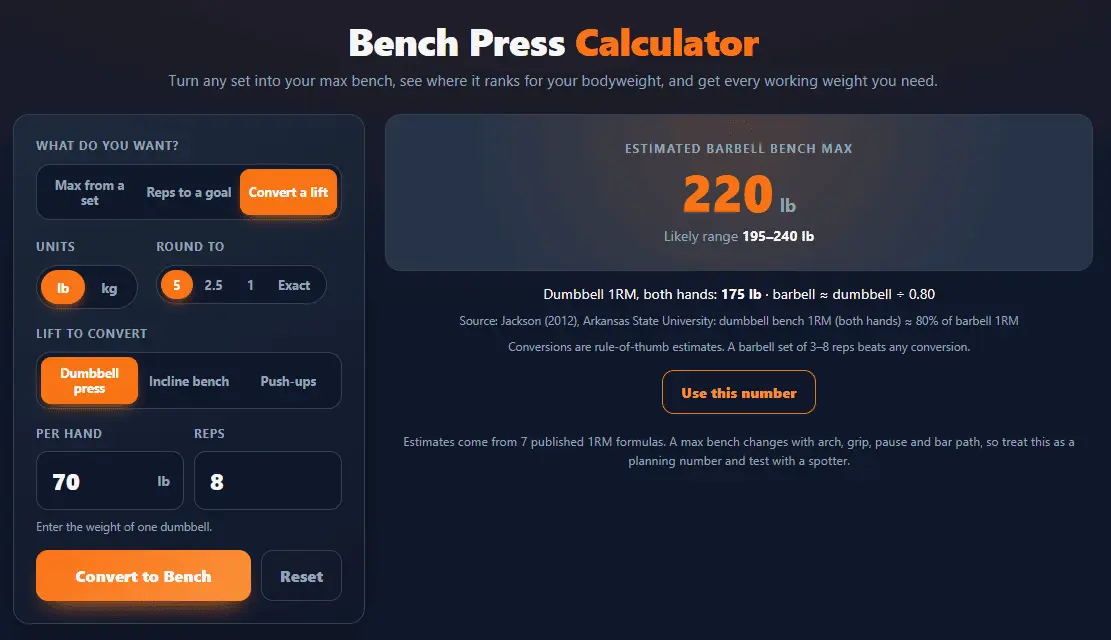
| Dumbbell press | Dumbbells (both hands) ≈ 80% of barbell 1RM | 70 lb dumbbells × 8 | 220 lb | 195–240 lb |
| Incline bench, 30° | Incline 1RM ≈ 77.8% of flat | 185 × 5 | 275 lb | 245–300 lb |
| Push-ups | Push-up load ≈ 72% of bodyweight | 25 reps at 185 lb | 245 lb | 210–280 lb |
Conversion ratios from Jackson (2012), Rodríguez-Ridao et al. (2020) and Suprak et al. (2011). Values computed by the bench press calculator, rounded to 5 lb.
Dumbbell press to bench
The dumbbell-to-bench conversion uses a 2012 Arkansas State thesis comparing the two lifts. Lifters “could bench press approximately 20% more weight with a barbell” than with dumbbells (Jackson, 2012). The bench press calculator treats 80% as both dumbbells combined, which is the reading that fits the study’s regression numbers, then divides your combined dumbbell max by 0.80. The same study’s regression showed an average prediction error of about 14 lb, which is why the range is wide.
Incline to a flat bench
The incline-to-flat conversion depends on bench angle. In a 2020 study, lifters’ flat-bench 1RM averaged 81.4 kg. At 30°, it dropped to 63.3 kg, about 78% of flat, and at 45° to 57.9 kg, about 71% (Rodríguez-Ridao et al., 2020). Pick the angle your bench actually sits at, and use the same notch every time you test.
Push-ups to bench
A standard push-up loads your arms with about 69% of your bodyweight at the top and about 75% at the bottom (Suprak et al., 2011). The calculator uses 72% as the working load and runs Epley on it. In the past 20 push-ups, you’re measuring muscular endurance more than pressing strength, and the estimate gets loose.
Worked Example: Benching 225 for 5
A 185 lb lifter who benches 225 for five clean, touch-and-go reps has an estimated max bench of about 260 lb on the average of seven formulas. The bench-specific Mayhew formula reads 270 lb, and the full spread runs from 255 to 270. That 15 lb gap is the honest error bar on any estimate from five reps.
| Reps | Weight (lb) | % of max |
| 1 | 260 | 100% |
| 2 | 245 | 94% |
| 3 | 240 | 92% |
| 5 | 225 | 87% |
| 8 | 210 | 80% |
| 10 | 200 | 76% |
| 12 | 190 | 73% |
Bench press max chart for 225 × 5, average of 7 formulas, rounded to 5 lb. Generated by the bench press calculator.
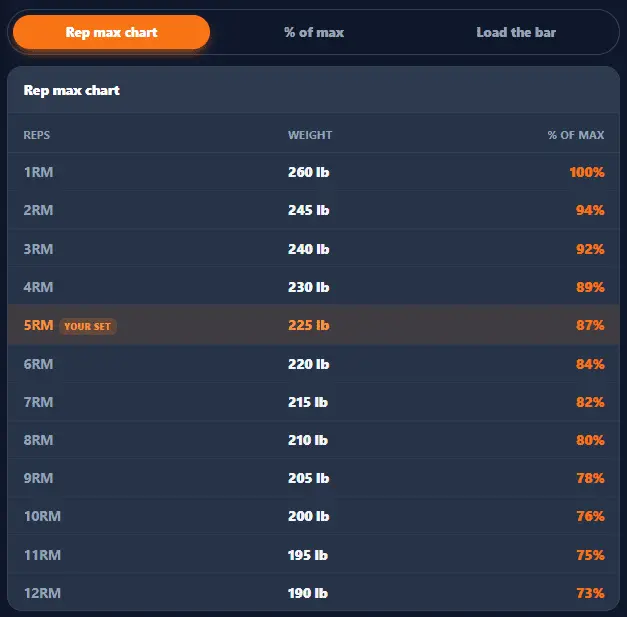
The 5-rep row lands back on 225, which is a quick check that the chart is consistent. Look at the 10-rep row too: 200 lb for ten is the same strength level as 225 for five. That helps when a program calls for a set of ten and you don’t want to guess. For the general version of this table across all lifts, the rep max equivalency chart covers the theory.
Turning 260 lb into training weights
The % of max tab turns your estimated max bench into working weights. For the 260 lb example, 80% is 210 lb for about eight reps, 85% is 220 lb, and 90% is 235 lb, which most lifters can move for about four reps. If your program prescribes other percentages, the 1RM percentage calculator builds the full table.
5/3/1 programs off 90% of your max instead of the max itself. For this lifter that’s a training max of 235 lb, and the training max calculator lays out all four weeks.
What Is My Max If I Bench 135 for 7?
Bench 135 for seven and your estimated max is about 165 lb, with the seven formulas ranging from 160 to 165. The table below answers the sets people search for most. The bench press calculator also accepts any set you type in shorthand.
| Your set | Estimated max | Formula range |
| 135 × 7 | 165 lb | 160–165 lb |
| 135 × 10 | 175 lb | 170–180 lb |
| 185 × 5 | 215 lb | 210–220 lb |
| 185 × 8 | 230 lb | 220–235 lb |
| 225 × 3 | 245 lb | 240–255 lb |
| 225 × 10 | 295 lb | 280–305 lb |
| 275 × 5 | 320 lb | 310–325 lb |
| 315 × 3 | 345 lb | 335–360 lb |
Estimated max bench from common sets, average of Epley, Brzycki, Lander, Lombardi, Mayhew, O’Conner, and Wathan, rounded to 5 lb.
Notice how the range widens as reps climb. At 225 × 3 the formulas sit 15 lb apart. At 225 × 10, they’re 25 lb apart. That’s the main reason to test bench with sets of 3 to 6 when you care about the number.
Is My Bench Press Good for My Bodyweight?
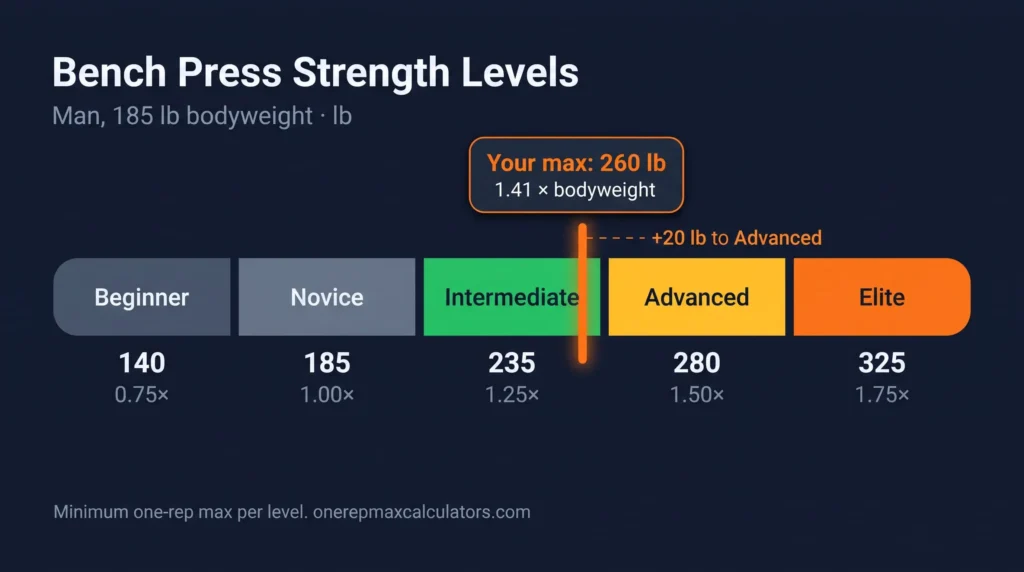
A good bench press depends on how much you weigh. Bench strength is usually judged as a multiple of bodyweight. For men, a 1.25× bodyweight bench marks Intermediate, 1.5× marks Advanced, and 1.75× marks Elite. Add your bodyweight and sex once, and the bench press calculator shows your level along with the weight you need for the one above it.
Bench press standards by bodyweight
| Lifter | Beginner | Novice | Intermediate | Advanced | Elite |
| Ratio, men | 0.75× | 1.00× | 1.25× | 1.50× | 1.75× |
| Man, 185 lb | 140 | 185 | 235 | 280 | 325 |
| Man, 200 lb | 150 | 200 | 250 | 300 | 350 |
| Ratio, women | 0.35× | 0.50× | 0.65× | 0.85× | 1.00× |
| Woman, 135 lb | 45 | 70 | 90 | 115 | 135 |
| Woman, 150 lb | 55 | 75 | 100 | 130 | 150 |
Minimum one-rep max bench (lb) for each level, from the same ratios the strength standards calculator uses. Rounded up to the next 5 lb, so lifting the weight shown always earns the level.
These ratios describe trained lifters. They don’t adjust for age, arm length, or a competition arch, so treat a level as a rough bracket, not a verdict.
Is 225 a good bench?
A 225 lb bench is a solid result for most men, and how good it is depends on your bodyweight. At 185 lb, a 225 single is a 1.22× ratio, in the upper half of Novice and about 6 lb short of Intermediate (235 on the bar). At 160 lb the same bench is 1.41×, firmly intermediate. Two plates a side is a real milestone, but it means more for a light lifter.
How much should a 200 lb man bench?
A 200 lb man reaches Intermediate at a 250 lb bench and Advanced at 300 lb. A 300 lb bench at that bodyweight is a strong result by any gym’s standard. A bench under 200 lb, below 1.0× bodyweight, sits in the Beginner range, which only means he’s early in his training.
Why the Calculator Uses Mayhew for Bench
Mayhew was built from bench press data, which is why the bench press calculator marks it as the best fit. Jerry Mayhew and colleagues published the equation in 1992. A 2008 follow-up tested several prediction equations on the bench press in women, before and after a training program. Before training, the Mayhew equation had the smallest mean error of the group, 0.2 kg or 1.2% (Mayhew et al., 2008). The sample was women only, so treat it as strong support rather than proof for every lifter.
The same study found that accuracy improved for most equations when sets stayed at 10 reps or fewer. Linear formulas such as Brzycki and Lander overestimated badly across wide rep ranges, then tightened up under 10 reps. We still default to the average of seven, because averaging cancels out the quirks of any single formula. Switch to Mayhew if you want the bench-specific read. The Mayhew formula guide covers the equation itself. To compare all seven side by side, open the all-formulas 1RM calculator.
Warm Up to a Max Single
The warm-up ramp in the bench press calculator builds the jumps from the empty bar to your estimated max bench, with plates per side for every set. For a 260 lb max with 5 lb jumps, it looks like this:
- Empty bar, 45 lb, for 5–8 reps.
- 130 lb for 5 reps: 35 + 5 + 2.5 per side. Rest 45–60 seconds.
- 170 lb for 4 reps: 45 + 10 + 5 + 2.5 per side. Rest 60–90 seconds.
- 210 lb for 2 reps: 45 + 35 + 2.5 per side. Rest 90 seconds to 2 minutes.
- 235 lb for 1 rep: 45 + 45 + 5 per side. Rest 2–3 minutes.
- 260 lb single: 45 + 45 + 10 + 5 + 2.5 per side.
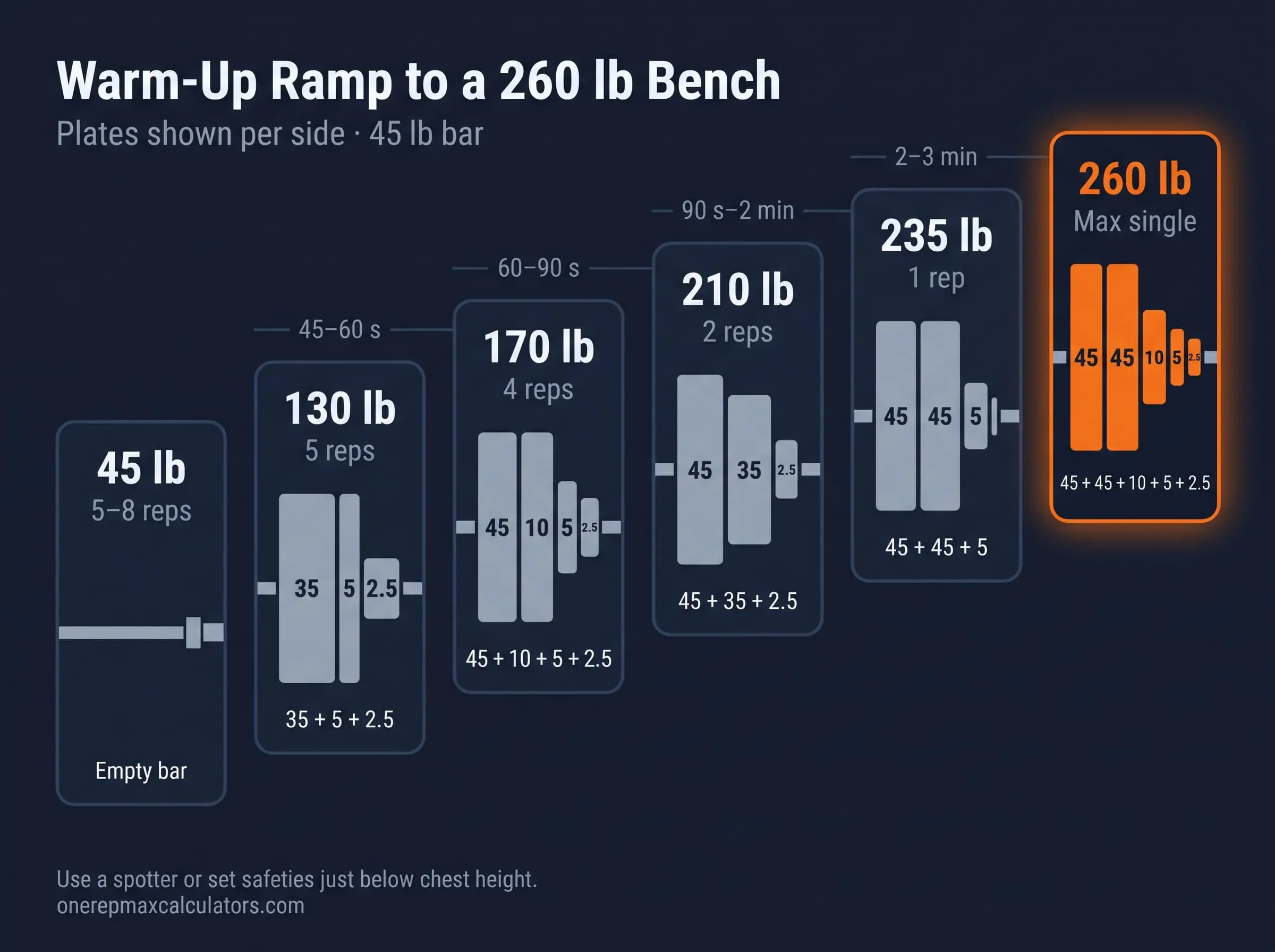
The ramp keeps the reps dropping as the weight climbs, so you arrive at the single without fatigue in your triceps. Set safeties just below chest height or get a spotter who knows the hand-off. A failed max bench without either is how people get hurt. Our guide to testing your one rep max covers attempt selection and when to stop.
You don’t need to test a true single to train well, though. Most lifters are better off retesting every 6–8 weeks with a hard set of 3 to 5 and letting the calculator do the rest.
Common Mistakes with Bench Press Estimates
Bench press estimates go wrong for a handful of predictable reasons, and most of them inflate the number. A max bench calculator can only be as honest as the set you give it.
- Counting reps with a bounce off the chest or a butt lift. Those reps wouldn’t pass in a meet, and every cheated rep pushes the estimate up by roughly 7 lb at 225.
- Testing with sets of 12 or more. The seven formulas drift apart fast past 10 reps, and you’re mostly testing endurance.
- Ignoring reps left in the tank. Logging a set of 5 as “to failure” when you had two more in you underestimates your max by about 15 lb at 225.
- Mixing paused and touch-and-go sets. A paused bench is weaker, so compare like with like from week to week.
- Treating the estimate as a weight to attempt cold. Plan your opener near 90% of the estimate and earn the next jump.
A bench press calculator is most accurate between 3 and 8 reps, on a set you’d be happy to film. Our breakdown of how accurate 1RM calculators are shows where the error comes from. The Epley vs Brzycki comparison explains why two formulas can disagree on the same set.
What to Do with Your Max Bench Next
Your max bench becomes more useful once it sits beside your other lifts. The bench press calculator saves your result in your browser, alongside any squat or deadlift you calculate elsewhere on the site. When all three are saved, it adds them into a Big 3 total. From there, the powerlifting total calculator can plan meet attempts, and Wilks and DOTS score the total against lifters of other bodyweights.
For other lifts and any rep range, the main one rep max calculator covers more than 30 exercises. The lift-specific 1RM guides go deeper on each one.
Frequently Asked Questions
Enter your last hard set of 3 to 8 reps, with reps left in the tank logged honestly. If your bench press calculator result is within 10 lb of the next strength level, run a 4-week block at 80–85% of that number. Then retest with the same rep count.